
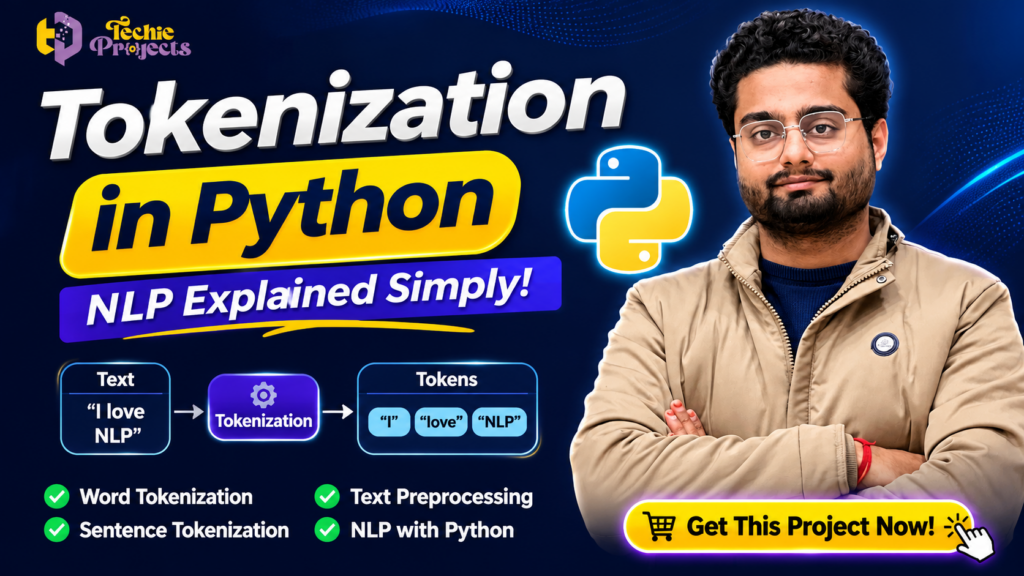
🚀 Looking for a practical NLP project in Python for your final-year engineering submission? Get your Tokenization in Python project from Techie Projects! Explore how Natural Language Processing (NLP) works, understand text preprocessing techniques, and learn how computers convert unstructured text into meaningful tokens.
Whether you are a B.Tech, BCA, MCA, M.Tech, or Computer Science student, this project provides an opportunity to explore an important NLP technique used in chatbots, artificial intelligence, text analytics, search engines, and machine learning applications.
Instead of spending hours searching for incomplete tutorials, confusing implementations, or incompatible Python libraries, connect with Techie Projects to enquire about the complete project package, source code availability, implementation details, and demonstration.
Learn NLP practically and strengthen your understanding of how machines process human language.
📞 Contact Techie Projects for Project Enquiries
Looking to purchase a Tokenization in Python project for your academic submission or practical learning? Contact our team to discuss project availability, pricing, source code, and implementation requirements.
- 📞 Contact / WhatsApp: +91 94600 60699
- 🌐 Website: www.techieprojects.com
- 📸 Instagram: @pythonprojects_
🎬 Watch the Tokenization in Python Project Demo
Explore the practical demonstration of tokenization and understand how text is converted into smaller meaningful units using Python.
The demonstration introduces the basic workflow of Natural Language Processing, including text input, word segmentation, sentence segmentation, and token generation.
🧠 What Is Tokenization in Python?
Tokenization in Python is an essential Natural Language Processing technique that divides a large piece of text into smaller meaningful units called tokens.
These tokens can represent individual words, sentences, characters, or subwords depending on the selected tokenization method.
For example, consider the following sentence:
Input Text:
“Python is an amazing programming language.”
Output Tokens:
- Python
- is
- an
- amazing
- programming
- language
After converting text into tokens, machine learning algorithms can process and analyze the individual elements more efficiently.
Tokenization is generally one of the initial steps in an NLP pipeline. It helps prepare textual information for additional operations such as stemming, lemmatization, stopword removal, text classification, sentiment analysis, and language modelling.
Why Is Tokenization Important?
Computers cannot directly understand human language in the same way people do. They require structured representations of textual information to perform computational operations.
Tokenization helps bridge this gap by converting sentences and paragraphs into smaller units that can be analyzed by NLP algorithms.
Important applications include:
- Text classification.
- Sentiment analysis.
- Chatbot development.
- Search engine optimization.
- Document analysis.
- Machine translation.
- Artificial intelligence applications.
🎯 Project Overview: Tokenization Using Python
The Tokenization in Python project demonstrates how textual information can be processed using Python programming and Natural Language Processing techniques.
The project focuses on converting input text into meaningful tokens and understanding how different tokenization methods work.
It provides an educational implementation of fundamental NLP operations that students can explore during practical sessions, project demonstrations, and academic presentations.
Main Project Objectives
The major objectives of this project include:
- Understanding Natural Language Processing fundamentals.
- Learning how text data is processed using Python.
- Implementing word tokenization.
- Implementing sentence tokenization.
- Exploring character-level tokenization.
- Understanding different tokenization techniques.
- Learning how NLP libraries simplify text processing.
- Preparing textual data for machine learning applications.
- Exploring real-world applications of tokenization.
This project is particularly useful for students interested in Artificial Intelligence, Data Science, Machine Learning, and Python development.
💻 Technologies Used in the Project
Tokenization applications can be developed using several Python libraries and programming technologies.
The following tools are commonly used to implement and understand NLP workflows.
1. Python Programming Language
Python is a popular programming language for Artificial Intelligence, Machine Learning, and Natural Language Processing.
Its simple syntax, extensive libraries, and developer community make it suitable for building text-processing applications.
2. NLTK
Natural Language Toolkit (NLTK) is a widely used Python library for working with human language data.
It provides several tools for:
- Word tokenization.
- Sentence tokenization.
- Text preprocessing.
- Stopword removal.
- Stemming.
- Linguistic analysis.
3. spaCy
spaCy is an NLP library designed for efficient and production-oriented natural language processing.
It supports tokenization, linguistic annotations, named entity recognition, and other NLP operations.
4. NumPy
NumPy supports numerical operations and array-based computations that can be useful in broader machine learning workflows.
5. Pandas
Pandas helps developers load, organize, clean, and analyze structured text datasets.
6. Jupyter Notebook
Jupyter Notebook provides an interactive environment for writing Python code, executing experiments, and understanding NLP results.
⚙️ Different Types of Tokenization in Python
There are several tokenization techniques depending on the type of text-processing requirement.
1. Word Tokenization
Word tokenization divides a sentence into individual words.
Example:
Input:
“Natural Language Processing is interesting.”
Output:
[“Natural”, “Language”, “Processing”, “is”, “interesting”, “.”]
Word tokenization is useful in sentiment analysis, document classification, and text analytics.
2. Sentence Tokenization
Sentence tokenization divides a paragraph into separate sentences.
Example:
Input:
“Python is easy to learn. NLP is an interesting technology.”
Output:
- Python is easy to learn.
- NLP is an interesting technology.
Sentence tokenization is useful for document analysis, summarization, and information extraction.
3. Character Tokenization
Character tokenization divides text into individual characters.
Example:
Input:
“Python”
Output:
[“P”, “y”, “t”, “h”, “o”, “n”]
This technique can be useful in character-level language modelling and certain text-processing applications.
4. Subword Tokenization
Subword tokenization divides words into smaller meaningful or frequently occurring units.
For example, a word may be divided into a root component and additional subword units.
Subword methods are widely used in modern transformer-based language models.
Popular approaches include:
- Byte Pair Encoding (BPE).
- WordPiece.
- SentencePiece.
🐍 How to Perform Tokenization in Python
Python provides several libraries that make tokenization straightforward.
Let’s understand the basic implementation using NLTK.
Step 1: Install Python
First, download and install Python from the official website.
Website: https://www.python.org/
After installation, verify the Python version using:
python --versionStep 2: Install NLTK
Open the terminal, command prompt, or VS Code terminal and execute:
pip install nltkStep 3: Import the Required Library
Import NLTK into your Python program.
import nltkStep 4: Download Required NLTK Resources
Download the required tokenizer resources.
nltk.download('punkt')
nltk.download('punkt_tab')
Resource requirements may vary depending on your NLTK version.
Step 5: Implement Word Tokenization
Create a simple Python program:
import nltk
from nltk.tokenize import word_tokenize

text = "Python is an amazing language for NLP."

tokens = word_tokenize(text)

print("Original Text:")
print(text)

print("\nWord Tokens:")
print(tokens)
Expected Output
Original Text:
Python is an amazing language for NLP.

Word Tokens:
['Python', 'is', 'an', 'amazing',
 'language', 'for', 'NLP', '.']
Step 6: Implement Sentence Tokenization
Sentence tokenization separates multiple sentences from a paragraph.
from nltk.tokenize import sent_tokenize

text = """
Python is a popular programming language.
Natural Language Processing is an AI technology.
Tokenization is an important NLP technique.
"""

sentences = sent_tokenize(text)

for sentence in sentences:
    print(sentence)
Expected Output
Python is a popular programming language.
Natural Language Processing is an AI technology.
Tokenization is an important NLP technique.
Step 7: Display Tokenization Results
After performing tokenization, developers can display the results and analyze how the original text has been divided.
This helps students understand the relationship between raw textual information and processed tokens.
🔄 Working Process of the Tokenization Project
The general workflow of a tokenization application can be divided into several stages.
Step 1: Input Text Collection
The application receives textual information from a user, document, dataset, or text file.
Step 2: Text Preprocessing
The input text can be cleaned depending on the application requirements.
Common preprocessing operations include:
- Removing unnecessary spaces.
- Handling special characters.
- Converting text into lowercase.
- Removing unwanted symbols.
- Preparing the text for tokenization.
Step 3: Tokenization
The selected tokenizer processes the cleaned text and generates individual tokens.
Step 4: Token Analysis
The generated tokens can be examined to understand their structure, frequency, and distribution.
Step 5: Display Results
The application displays the processed output so users can understand how the original text has been transformed.
This workflow demonstrates the foundation of many Natural Language Processing applications.
📊 Applications of Tokenization in Real-World Projects
Tokenization is not limited to academic experiments. It is an important component of modern AI-powered applications.
1. Chatbot Development
Chatbots use NLP techniques to understand user messages and generate appropriate responses.
Tokenization helps divide incoming messages into manageable units.
2. Sentiment Analysis
Businesses analyze customer feedback, product reviews, and social media comments to understand customer opinions.
Tokenization prepares textual information for sentiment classification models.
3. Search Engines
Search engines process search queries and documents to identify relevant information.
Tokenization helps break queries into individual terms for further analysis.
4. Text Classification
Tokenization is used to prepare textual datasets for classification tasks such as spam detection, news categorization, and document classification.
5. Machine Translation
Language translation systems process text using different NLP techniques. Tokenization is one of the important stages in preparing language data.
6. AI and Language Models
Modern language models use tokenization to convert text into numerical token representations that can be processed by neural networks.
🎓 Why Choose This NLP Project for Your Final-Year Submission?
If you are pursuing B.Tech, BCA, MCA, M.Tech, or Computer Science, this project can help you understand the practical implementation of NLP concepts.
Some important learning benefits include:
1. Practical Python Experience
Understand how Python libraries can be used to process real textual information.
2. NLP Fundamentals
Learn the basic concepts behind natural language processing and text analysis.
3. Library Integration
Explore how libraries such as NLTK and spaCy simplify complex language-processing tasks.
4. Understanding AI Applications
Develop foundational knowledge that can be applied to chatbots, text classification, and other AI applications.
5. Academic Demonstration
Use the project as a learning reference when explaining tokenization concepts, Python implementation, and NLP workflows during academic presentations.
🏢 Who Can Purchase This Python NLP Project?
Techie Projects provides project-related solutions for students and learners interested in practical software development.
This project may be relevant to:
- B.Tech Computer Science students.
- BCA students.
- MCA students.
- M.Tech students.
- Artificial Intelligence students.
- Machine Learning students.
- Data Science students.
- Python programming learners.
- NLP beginners.
Whether you need a practical learning reference or an academic project implementation, contact our team to discuss your requirements.
⭐ Why Purchase Your Project from Techie Projects?
Choosing the right project provider can make your academic project development process easier.
At Techie Projects, we focus on developing practical technology projects across multiple domains.
What Makes Techie Projects Different?
- 💻 Python and programming-based project solutions.
- 🤖 Artificial Intelligence and Machine Learning projects.
- 🧠 Natural Language Processing applications.
- 📊 Data Science and Data Analytics projects.
- 🎬 Practical project demonstrations.
- 📁 Source code availability based on the selected project package.
- 🛠️ Implementation-related guidance.
- 🎓 Project solutions for engineering and postgraduate students.
Our objective is to help students explore modern technologies through practical project development.
🚀 Purchase Tokenization in Python Project from Techie Projects
Are you ready to explore Natural Language Processing through a practical Python project?
Get your Tokenization in Python project from Techie Projects!
Instead of searching for multiple incomplete implementations, connect with our team to enquire about the available project package.
What Can You Enquire About?
When contacting our team, you can discuss:
- Complete project package availability.
- Python source code availability.
- Project implementation details.
- Software and library requirements.
- Project demonstration.
- Documentation availability.
- Installation and execution guidance.
- Pricing and delivery options.
The exact package contents and support options can be confirmed before purchase.
🔥 GET THIS PROJECT NOW!
Build your NLP learning journey with Techie Projects.
📞 Contact / WhatsApp: +91 94600 60699
🌐 Website: www.techieprojects.com
📸 Instagram: @pythonprojects_
👉 Click the WhatsApp link to enquire about project pricing, source code availability, and complete project details.
💡 Recommended Projects from Techie Projects
Interested in exploring more Artificial Intelligence, Python, and Natural Language Processing projects?
Check out these related project ideas:
- Fake News Detection Using Machine Learning – Identify potentially misleading news articles using machine learning and NLP.
- Sentiment Analysis Using Python – Analyze customer reviews and classify positive, negative, and neutral opinions.
- Text Summarization Using NLP – Generate meaningful summaries from lengthy documents.
- Chatbot Using Python – Develop an interactive chatbot that processes user queries.
Explore more Python and AI projects at www.techieprojects.com.
❓ Frequently Asked Questions (FAQs)
1. What is Tokenization in Python?
It is the process of dividing text into smaller units called tokens using Python libraries and NLP techniques.
2. Which Python library is used for tokenization?
Popular libraries include NLTK, spaCy, and Hugging Face Tokenizers.
3. What are the different types of tokenization?
Common types include word tokenization, sentence tokenization, character tokenization, and subword tokenization.
4. Is tokenization important in NLP?
Yes. It is a fundamental operation used to prepare textual information for several natural language processing tasks.
5. Can beginners learn tokenization using Python?
Yes. Beginners can start with basic Python programming and gradually explore word and sentence tokenization.
6. What is the difference between word and sentence tokenization?
Word tokenization divides sentences into individual words, whereas sentence tokenization separates paragraphs into individual sentences.
7. Is NLTK suitable for tokenization?
Yes. NLTK provides useful tokenization tools and is widely used for educational NLP applications.
8. Can tokenization be used in chatbot development?
Yes. It helps process incoming text messages before further NLP operations are performed.
9. Can I purchase the Tokenization in Python project?
Yes. You can contact Techie Projects to enquire about project availability, pricing, source code, and implementation details.
10. How can I contact Techie Projects?
You can contact us through WhatsApp at +91 94600 60699 or visit www.techieprojects.com.
🎯 Conclusion
Tokenization is one of the fundamental concepts in Natural Language Processing and plays an important role in preparing textual information for Artificial Intelligence applications.
Through this Python-based implementation, students can explore word tokenization, sentence tokenization, character processing, and practical NLP workflows.
If you are looking for a practical NLP project for your academic learning or final-year engineering work, Techie Projects can help you explore available project solutions.
Get in touch with our team to discuss the Tokenization in Python project, package availability, pricing, and implementation details.
Techie Projects – Your Partner in Engineering Projects and Innovative Technology Solutions.

