
Introduction
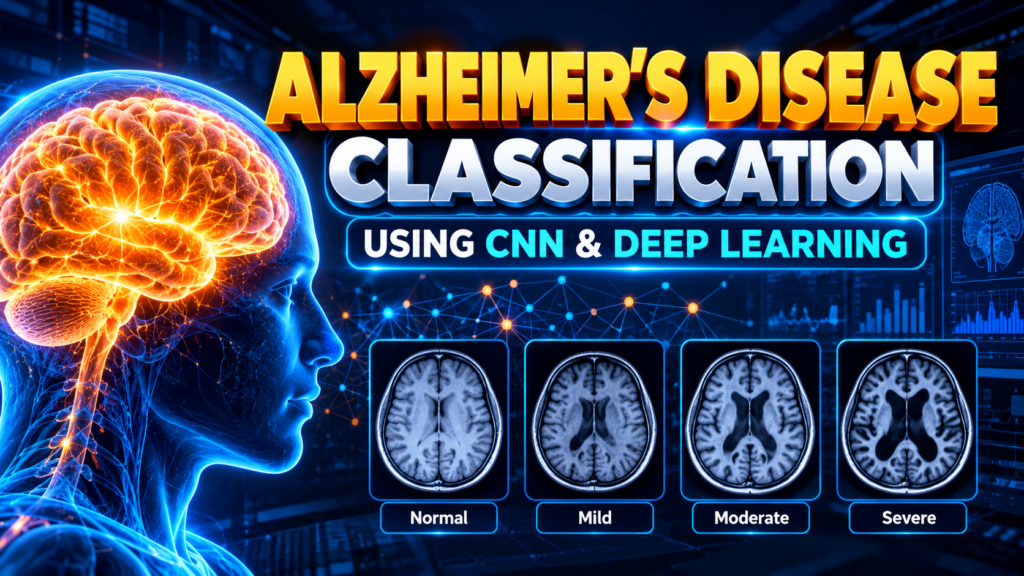
Alzheimer’s disease classification using CNN is an educational deep learning project that explores how convolutional neural networks can classify brain MRI images into predefined categories. This project helps computer science engineering students understand medical image processing, image classification, model training, and deep learning workflows using Python. It is suitable for students interested in artificial intelligence, machine learning, and healthcare-related research prototypes.
🎬 Project Demo
Watch the project demonstration to understand its interface, image classification workflow, and implemented features. The demo can help you evaluate whether this project is suitable for your final-year engineering requirements.
🎯 Objectives of Alzheimer’s Disease Classification Using CNN
The primary objective of this project is to demonstrate how deep learning can be applied to brain MRI image classification in an educational setting.
Key objectives include:
- Understanding convolutional neural networks (CNNs).
- Exploring preprocessing techniques for MRI images.
- Learning how image datasets can be organized into classification categories.
- Understanding model training, validation, and prediction.
- Presenting classification results through a project interface, if included.
🧠 What Is Alzheimer’s Disease Classification?
Alzheimer’s disease is a progressive neurological condition that affects memory and cognitive function. Researchers investigate various approaches to studying brain images and identifying patterns associated with neurological conditions.
An Alzheimer’s disease classification project uses image-processing and machine-learning concepts to classify input images according to the categories defined by its dataset and trained model.
Important: This project is an educational prototype, not a clinically validated diagnostic system. Its predictions must not be used to diagnose Alzheimer’s disease or make medical decisions.
Understanding the CNN Model
The Alzheimer’s disease classification using CNN project demonstrates how convolutional neural networks learn image features from a labeled MRI dataset. The model processes prepared images and predicts a category defined by its training data.
Dataset Preparation and Evaluation
In Alzheimer’s disease classification using CNN, dataset preparation is an important step. Images should be organized into the correct categories, preprocessed consistently, and separated appropriately for training and evaluation. Performance should be assessed using suitable metrics rather than accuracy alone.
Project Learning Outcomes
By exploring Alzheimer’s disease classification using CNN, students can learn about image preprocessing, neural-network training, model evaluation, and prediction interfaces. These skills provide a foundation for further experiments in educational medical-image analysis.
⚙️ How Does the CNN Project Work?
The typical workflow for Alzheimer’s disease classification using CNN includes the following steps.
1. MRI Image Dataset
The project uses a dataset of brain images organized into predefined classes. The available categories depend on the dataset supplied with the implementation.
2. Image Preprocessing
Images may be resized, normalized, and converted into a format suitable for model training. Consistent preprocessing helps prepare the dataset for the neural network.
3. CNN Model Development
A convolutional neural network learns visual features from training images. Convolution and pooling operations help the model learn patterns that can support image classification.
4. Model Training and Validation
The dataset is divided into training and evaluation subsets according to the configured workflow. Model performance should be assessed using appropriate metrics and data separation practices.
5. Image Classification
A supported input image is passed through the trained model, which produces a prediction among the configured classes. The output depends on the training data, model quality, and input image.
6. Result Display
The application may display the predicted category through a graphical interface or another output method, depending on the supplied implementation.
💻 Technologies Used
The exact technology stack depends on the project package. A typical implementation may use:
- Python: Main programming language.
- TensorFlow or Keras: Deep learning model development, if included.
- CNN: Image classification architecture.
- OpenCV or Pillow: Image loading and preprocessing, if included.
- NumPy: Numerical operations.
- Tkinter or another GUI framework: User interface, if included.
Check the supplied source code for the actual libraries and versions.
🖥️ Software and Hardware Requirements
Software Requirements
- Windows or another compatible operating system.
- Python version supported by the project dependencies.
- Required deep learning and image-processing libraries.
- Visual Studio Code, PyCharm, or another compatible editor.
Hardware Requirements
- Laptop or desktop computer.
- Sufficient RAM and storage for the dataset and model.
- A compatible GPU may accelerate training when supported, but is not necessarily required for every implementation.
Actual requirements depend on the model architecture, dataset size, and configured environment.
✨ Key Features
Depending on the included implementation, the project may demonstrate:
- Brain MRI image input.
- Image preprocessing.
- CNN-based image classification.
- Prediction display for predefined categories.
- A graphical interface for interacting with the model.
- Model evaluation and experimentation.
Confirm the included features before purchasing, as not every possible feature is necessarily implemented in every version.
📊 Advantages of the Project
- Provides practical exposure to deep learning and CNNs.
- Demonstrates image classification using Python.
- Helps students understand dataset preparation and model evaluation.
- Offers a foundation for experimenting with medical image analysis.
- Can support academic presentations and project demonstrations.
⚠️ Limitations and Responsible Use
Model performance depends on the quality, diversity, and labeling of the dataset. Differences in scanners, image quality, and patient populations can affect generalization. Data leakage and unbalanced datasets can also lead to misleading evaluation results.
The system should be treated as an academic research prototype. It is not a substitute for clinical examination, professional medical advice, or diagnosis by qualified healthcare professionals.
🚀 Future Scope
Possible research extensions include:
- Evaluating different CNN architectures.
- Improving dataset quality and class balance.
- Comparing precision, recall, F1-score, and confusion matrices.
- Exploring explainability techniques to visualize model attention.
- Testing generalization on appropriately separated datasets.
- Improving the user interface and experiment reporting.
These are potential extensions and should not be interpreted as features already included in the project.
🎓 Why Choose This Project for Your Final Year?
Alzheimer’s disease classification using CNN combines Python programming, image processing, and deep learning in a focused academic project. It can help students explore how neural networks learn from image data and how classification systems are developed and evaluated.
Before choosing the project, review the included source code, dataset, documentation, installation instructions, and actual model capabilities to ensure they meet your college requirements.
📲 Purchase the Project from Techie Projects
Looking for a deep learning project for your final-year engineering submission? Contact Techie Projects to ask about availability, pricing, source code, documentation, installation instructions, and the features included with the Alzheimer’s disease classification project.
📲 Call/WhatsApp: +91-9460060699
🌎 Website: www.techieprojects.com
📺 Instagram: @pythonprojects_
🎓 Recommended Projects
Explore related project topics on Techie Projects. Link each title to its corresponding published article.
- Dental Caries Detection Using Deep Learning — Explore image classification techniques for dental image analysis.
- Lung Cancer Detection Using Machine Learning — Study a machine-learning approach to medical image analysis.
- Skin Cancer Detection Using Machine Learning — Learn about image classification for skin lesion research.
- Brain Tumor Detection Using Deep Learning — Explore CNN-based brain image classification.
- Brain Stroke Detection using Machine Learning — Understand image preprocessing and classification workflows.
These are related educational topics; link only to articles that are available on your website.
❓ Frequently Asked Questions
1. What is Alzheimer’s disease classification using CNN?
It is a deep learning approach that uses a convolutional neural network to classify brain MRI images into predefined dataset categories.
2. Which programming language is used?
Python is commonly used for this type of project. The specific libraries depend on the implementation.
3. Is the project suitable for final-year students?
It can be suitable for students studying computer science, artificial intelligence, machine learning, or deep learning, subject to their college’s project requirements.
4. Does the project provide an accurate medical diagnosis?
No. An educational classification model is not a clinically validated diagnostic tool and must not be used to make medical decisions.
5. Can the project be customized?
Customization depends on the available source code and requirements. Contact Techie Projects to discuss requested modifications and confirm feasibility.
6. How can I purchase the project?
Contact Techie Projects using the WhatsApp link above to request current pricing, source code details, documentation, and installation requirements.
Conclusion
Alzheimer’s disease classification using CNN provides an educational way to explore deep learning, medical image processing, and neural-network classification with Python. By studying the workflow, dataset preparation, model evaluation, and limitations, students can build a stronger understanding of image-based machine learning.
Contact Techie Projects to confirm project availability and obtain purchasing details.