
Introduction
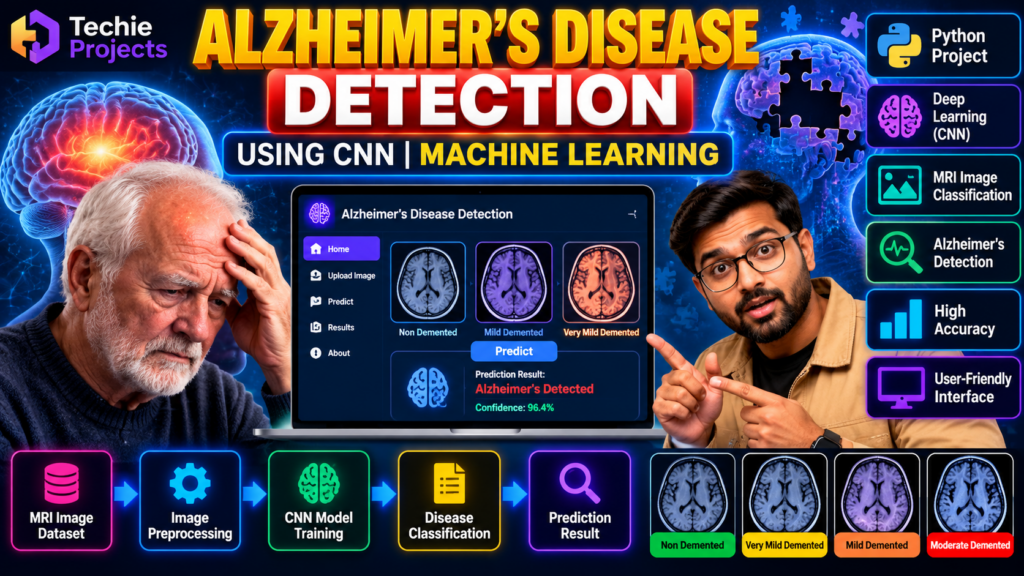
Alzheimer’s Disease Detection Using CNN is an educational machine learning project that demonstrates how deep learning and medical image classification techniques can be used to analyze brain MRI images for research and learning purposes. This project is suitable for B.Tech, B.E., computer science, artificial intelligence, machine learning, and final-year engineering students who want to explore an AI-based healthcare application using Python.
The project demonstrates how a Convolutional Neural Network (CNN) can learn patterns from labeled MRI image datasets and classify images into the categories supported by the trained model. It helps students understand image preprocessing, model training, prediction, and the development of a user-friendly application.
🎬 Project Demo – Alzheimer’s Disease Detection Using CNN
Watch the project demonstration to understand its interface, image classification workflow, and how the trained model produces prediction results.
The demo showcases the project workflow, from selecting an MRI image to viewing the model’s output. Actual features and classification categories depend on the implemented version of the project.
What Is Alzheimer’s Disease Detection Using CNN?
Alzheimer’s disease is a progressive neurological condition that affects memory and cognitive abilities. Researchers study medical imaging and computational methods to better understand patterns associated with neurological conditions.
In this educational project, a CNN model processes labeled brain MRI images to learn visual features and generate a classification result. The system illustrates how deep learning can be applied to medical image analysis.
Important: This project is intended for academic demonstration and research learning only. It is not a clinically validated diagnostic system and must not be used to diagnose Alzheimer’s disease or make medical decisions.
🎯 Objectives of the Project
The main objectives of this project are to:
- Understand deep learning concepts through a practical healthcare application.
- Learn how CNN models process image data.
- Preprocess and organize labeled MRI images for model training.
- Train and evaluate an image classification model.
- Build a workflow for uploading images and displaying predictions, if supported by the implementation.
- Explore the limitations and responsible use of AI in healthcare research.
⭐ Key Features
Depending on the supplied implementation, the project may include the following features:
- MRI Image Input: Select an image from the supported dataset.
- Image Preprocessing: Resize and normalize images as required by the model.
- CNN-Based Classification: Use a trained neural network to classify input images.
- Prediction Results: Display the predicted class through the application interface.
- User-Friendly Interface: Provide a convenient way to test the trained model.
- Model Evaluation: Assess performance using appropriate metrics and a separate test dataset.
Confirm which features are included in the actual project before presenting them as implemented capabilities.
⚙️ How the Project Works
1. Dataset Collection
Collect a suitable, properly licensed brain MRI dataset with reliable class labels. Review the dataset documentation and ensure that the images are appropriate for educational model development.
2. Image Preprocessing
Prepare the images for the CNN model. Typical preprocessing steps include resizing, normalization, checking image quality, and splitting the dataset into training, validation, and test sets.
3. CNN Model Development
Build or load a Convolutional Neural Network. CNN layers learn spatial patterns and visual features from training images.
4. Model Training
Train the model using the training dataset and use validation data to monitor performance. Avoid data leakage by ensuring that related images from the same subject do not improperly appear across training and test sets.
5. Model Evaluation
Evaluate the model on previously unseen test data. Useful metrics include accuracy, precision, recall, F1-score, and a confusion matrix. Accuracy alone does not establish clinical usefulness.
6. Image Classification
Provide a supported MRI image to the application. The trained model processes the image and returns a predicted category based on its learned patterns.
7. Result Display
Display the model output through the interface. Results should be described as experimental predictions rather than confirmed medical findings.
How CNN Supports Alzheimer’s Disease Detection
Alzheimer’s disease detection using CNN demonstrates how deep learning models can analyze labeled brain MRI images for educational image-classification tasks. The model learns visual patterns from training data and uses them to predict a category for a new image.
Project Implementation Using Python
This Alzheimer’s disease detection using CNN project combines Python programming, image preprocessing, and neural network training. Students can explore the complete workflow, from preparing the dataset to evaluating the model and displaying prediction results.
Learning Outcomes
By developing Alzheimer’s disease detection using CNN, students can gain practical experience with CNN architectures, image classification, model evaluation, and responsible AI development. The project is intended for academic learning and is not a clinically validated diagnostic tool.
🛠️ Technologies Used
The exact technology stack depends on the supplied source code. A typical implementation may use:
- Programming Language: Python
- Deep Learning: TensorFlow/Keras or PyTorch
- Image Processing: OpenCV or Pillow
- Data Handling: NumPy and Pandas
- Visualization: Matplotlib
- Interface: Streamlit, Flask, Tkinter, or another supported framework
💻 Software and Hardware Requirements
Software Requirements
- Python environment compatible with the project dependencies
- Required deep learning framework
- Image processing and numerical computing libraries
- Code editor such as Visual Studio Code or PyCharm
- Dataset files and trained model weights, where provided
Hardware Requirements
- A computer capable of running the required Python environment
- Sufficient RAM and storage for the dataset and model
- A compatible GPU may help accelerate training, but a GPU is not always necessary for basic inference
Check the actual project package for its tested versions and minimum requirements.
🎓 Applications of the Project
This project can be used for:
- Final-year engineering demonstrations
- Learning CNN architectures and image classification
- Academic research prototypes involving MRI images
- Understanding AI workflows in medical imaging
- Demonstrating dataset preprocessing and model evaluation
- Developing skills in Python-based deep learning applications
It should not be represented as a replacement for clinical assessment or professional medical advice.
✅ Advantages
- Provides hands-on experience with deep learning.
- Combines Python programming with image classification.
- Helps students understand the complete model development workflow.
- Can be extended for experiments with different CNN architectures.
- Offers opportunities to learn evaluation, visualization, and application development.
🔮 Future Scope
Students can extend the project by exploring:
- Transfer learning with suitable pretrained architectures
- More rigorous validation and testing
- Explainability techniques to visualize model attention
- Improved dataset documentation and class balance
- A more accessible interface for educational demonstrations
- Privacy-conscious data handling and reproducible experiments
Any improvement in model performance should be verified experimentally rather than assumed.
🎓 Why Choose This Project for Your Final Year?
The Alzheimer’s Disease Detection Using CNN project combines Python, deep learning, computer vision, and healthcare-related research into one academic topic. It can help students demonstrate their understanding of data preparation, model development, classification, and evaluation.
Techie Projects can help students explore project availability and the implementation details relevant to their academic requirements. Before purchasing, ask about the included source code, dataset, trained model, setup instructions, documentation, and demonstration support so you can confirm what is supplied.
📩 Get the Project Details and Pricing
Looking for the Alzheimer’s Disease Detection Using CNN project for your final-year submission or learning portfolio?
Contact Techie Projects to ask about availability, source code, implementation details, requirements, and pricing.
- 📲 Call/WhatsApp: +91-9460060699
- 🌎 Website: www.techieprojects.com
- 📺 Instagram: @pythonprojects_
Please confirm the included deliverables and support before placing your order.
🔗 Explore Related Projects
Explore more project ideas from Techie Projects:
- Deep Learning Projects
- Machine Learning Projects
- OpenCV Projects
- Python Projects
- Computer Vision Projects
❓ Frequently Asked Questions
1. What is Alzheimer’s Disease Detection Using CNN?
It is an educational deep learning project that demonstrates how a CNN can classify labeled brain MRI images into categories supported by a trained model.
2. Which programming language is used?
Python is commonly used for this type of project. The specific libraries depend on the supplied implementation.
3. Is the project suitable for final-year engineering students?
Yes. It can be suitable for students studying computer science, artificial intelligence, machine learning, and related fields, subject to their institution’s project requirements.
4. Does the model provide a confirmed medical diagnosis?
No. An academic prototype is not a clinically validated diagnostic tool. Its predictions must not be treated as medical diagnoses.
5. Can I get the source code?
Contact Techie Projects to confirm current availability, the included source code, setup instructions, dataset details, and pricing.
6. How can I purchase the project?
Use the WhatsApp link above to request the latest project details and confirm the deliverables before ordering.
Conclusion
The Alzheimer’s Disease Detection Using CNN project offers a practical way to explore Python, deep learning, CNN architectures, and medical image classification in an educational setting. It introduces students to the stages of dataset preparation, model training, evaluation, and prediction.
If you are planning a final-year engineering project, contact Techie Projects to discuss the available implementation, source code, documentation, and pricing. Use the project to strengthen your technical understanding while keeping its experimental results separate from clinical diagnosis.