
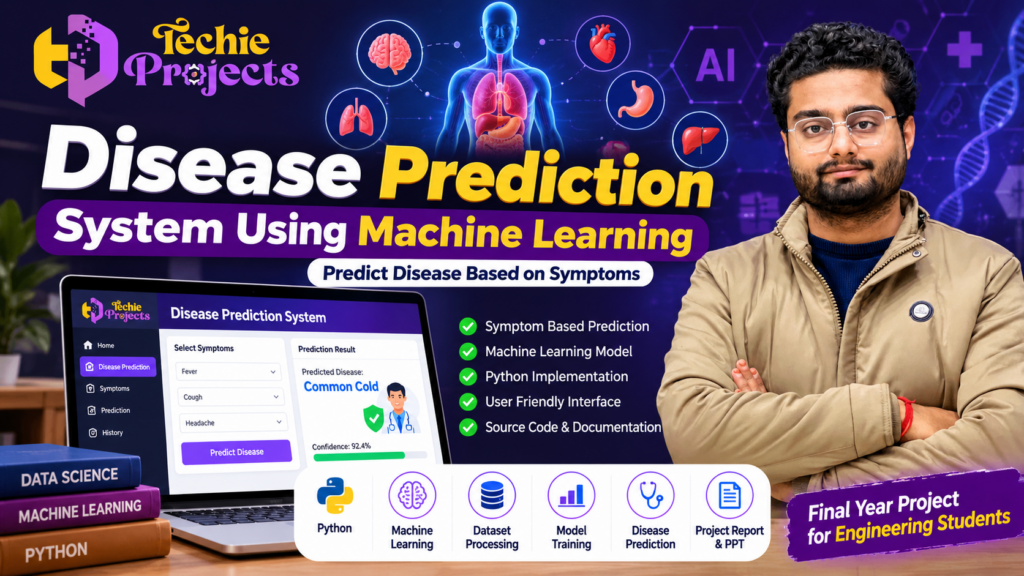
Introduction to the Disease Prediction System Using Machine Learning
Artificial Intelligence (AI) and Machine Learning (ML) are transforming how data is analysed across different industries, including healthcare research. A Disease Prediction System Using Machine Learning is an educational software project that demonstrates how machine learning algorithms can analyse patterns in a dataset and predict a possible disease category based on selected symptoms.
This project is suitable for B.Tech, B.E., BCA, MCA, M.Tech, and computer science students who want practical experience with Python programming, data preprocessing, classification algorithms, and application development.
Techie Projects helps students explore engineering project ideas and learn about available implementation options, source code, installation instructions, project documentation, and technical support. Students can review the project requirements and select an option that suits their academic objectives.
🎬 Project Demo
Explore the Disease Prediction System Using Machine Learning demonstration to understand its interface, symptom selection process, and prediction workflow. Watching the demo can help you understand how the application works before exploring its technical implementation.
Embed your project demonstration video below this paragraph to show the interface, input process, and sample prediction output.
Important: This is an educational demonstration. Its predictions are not medical diagnoses and should not be used to make treatment decisions.
What Is a Disease Prediction System?
A disease prediction system is a software application that processes selected input features using a trained machine learning model. Depending on the dataset and implementation, the application may classify an input into one of several predefined categories.
For example, an educational prototype might accept symptoms such as fever, cough, fatigue, or headache and generate a predicted label from its training dataset. The model learns statistical patterns from the examples provided during training.
The output depends on the quality of the dataset, the features selected, the algorithm used, and the evaluation process. A prediction from a student project does not confirm that a person has a particular medical condition.
🎯 Objectives of the Project
The main objective is to demonstrate the practical application of machine learning in a healthcare-related classification problem.
Key objectives include:
- Understand supervised machine learning and classification.
- Prepare and process a structured dataset.
- Train a model using Python libraries.
- Develop an interface for entering selected symptoms.
- Display the model’s prediction output.
- Evaluate the model using suitable performance metrics.
- Understand the limitations of machine learning in healthcare.
- Practise explaining the implementation during an academic presentation.
These objectives help students connect machine learning theory with a working software prototype.
⚙️ Technologies Used in the Project
The technology stack can be adapted according to the selected implementation, dataset, and academic requirements.
1. Python Programming
Python is commonly used for machine learning because of its readable syntax and extensive library ecosystem. It can support data preprocessing, model training, evaluation, and application development.
2. Pandas and NumPy
Pandas helps load, inspect, organise, and clean datasets. NumPy supports numerical calculations and array-based operations required during data preparation and model development.
3. Scikit-learn
Scikit-learn provides tools for building machine learning workflows, including preprocessing, classification, model evaluation, and dataset splitting.
Possible algorithms include:
- Decision Tree
- Random Forest
- Logistic Regression
- Support Vector Machine (SVM)
- Naive Bayes
- K-Nearest Neighbors (KNN)
The best algorithm should be selected through appropriate testing rather than assuming that one method will always provide the highest accuracy.
4. Streamlit or Flask
Streamlit can be used to develop a simple interactive application. Flask is another option for building a customised web interface that connects user input with a trained model.
5. Dataset and Model Evaluation
The dataset provides examples used to train and evaluate the model. It should be checked for missing values, inconsistent labels, duplicates, class imbalance, and possible data leakage.
Evaluation metrics may include accuracy, precision, recall, F1-score, and a confusion matrix, depending on the classification task.
Benefits of a Disease Prediction System Using Machine Learning
A Disease Prediction System Using Machine Learning helps engineering students understand how data preprocessing, classification algorithms, and model evaluation work together in a practical application. The project provides experience with Python, dataset analysis, and developing a user-friendly prediction interface.
How to Develop a Disease Prediction System Using Machine Learning
To develop a Disease Prediction System Using Machine Learning, begin by selecting a suitable dataset and preparing its input features. Train a classification algorithm, evaluate its performance on separate test data, and connect the model to an application interface. Document the results, limitations, and installation steps clearly.
Why Choose This Machine Learning Project?
This Disease Prediction System Using Machine Learning project can help students practise programming, understand classification methods, and prepare a technical demonstration. Contact Techie Projects to confirm the available source code, documentation, implementation details, and support options before ordering.
🔄 How the Disease Prediction System Works
A typical implementation follows these steps.
Step 1: Dataset Collection
The process begins with a suitable dataset containing input features and corresponding labels. Students should verify the dataset’s source, licence, limitations, and suitability for an educational project.
Step 2: Data Preprocessing
The dataset is inspected and prepared for training. This may involve handling missing values, encoding categorical variables, checking class distributions, and ensuring that input features use a consistent format.
Step 3: Training the Machine Learning Model
The prepared training data is used to train a selected classification algorithm. A separate test dataset helps estimate how the model performs on examples that were not used during training.
Step 4: User Input
The application provides an interface where users can select symptoms supported by the dataset. The selected values are converted into the feature format expected by the model.
Step 5: Prediction
The trained model processes the input and returns a predicted category. If the implementation displays probabilities, these must be interpreted carefully and should not be presented as medically reliable diagnostic confidence.
Step 6: Displaying the Result
The application displays the output in an understandable format. The result should include an appropriate educational disclaimer and should not recommend treatment based solely on the model prediction.
🚀 Key Features of the Disease Prediction Project
The exact features depend on the selected version of the project. A typical implementation may include:
- Symptom selection: Choose from the symptoms supported by the dataset.
- Machine learning classification: Generate a predicted category using a trained model.
- Data preprocessing: Prepare input features for model training and prediction.
- Interactive interface: Provide a simple way to submit inputs and view results.
- Model evaluation: Display relevant performance metrics.
- Input validation: Handle missing, invalid, or unsupported selections.
- Modular code: Separate data preparation, model training, and interface logic.
- Documentation: Explain the setup, workflow, technologies, and limitations.
Before selecting a project package, confirm which features and deliverables are included.
📚 Project Modules
Dividing the application into modules makes it easier to understand, test, and maintain.
| Module | Description |
|---|---|
| Dataset Management | Loads and inspects the dataset |
| Data Preprocessing | Cleans data and prepares model inputs |
| Model Training | Trains the selected classification algorithm |
| Model Evaluation | Measures performance on test data |
| Prediction Interface | Accepts symptoms and displays model output |
| Documentation | Explains the methodology, setup, and results |
The actual architecture may vary depending on the chosen algorithm, dataset, and interface.
💻 Software and Hardware Requirements
Software Requirements
A typical Python-based implementation may use:
- Python 3.x with compatible library versions.
- Pandas and NumPy.
- Scikit-learn.
- Streamlit or Flask, if a web interface is included.
- Visual Studio Code, PyCharm, or another Python-compatible editor.
A virtual environment is recommended to keep project dependencies organised.
Hardware Requirements
For a basic educational prototype, the following is generally sufficient:
- Laptop or desktop computer.
- Adequate RAM and storage for Python packages and the dataset.
- Internet access for installing dependencies, if needed.
A small classification project typically does not require a dedicated GPU. Actual requirements depend on the dataset size and implementation.
📈 Benefits for Engineering Students
Practical Machine Learning Experience
Students can practise data loading, feature preparation, model training, testing, and prediction. These activities provide a structured introduction to machine learning development.
Better Understanding of Python Libraries
The project demonstrates how Python libraries work together to create a complete data-driven application.
Academic Project Demonstration
A working prototype can help students explain their design, workflow, algorithm selection, evaluation metrics, and limitations during a presentation or viva.
Scope for Customisation
Students may extend the project by comparing multiple algorithms, improving the user interface, adding charts, or building an API. Any modification should be tested and documented properly.
Portfolio Development
A well-documented implementation can demonstrate practical programming and data science skills when presented accurately in a portfolio. Students should describe their own contributions and understanding honestly.
🏥 Applications of Machine Learning in Healthcare Research
Machine learning supports a range of research activities involving health-related data. Depending on the available dataset and validation, possible educational application areas include:
- Medical image classification.
- Analysis of structured health datasets.
- Risk prediction research using public datasets.
- Medical text processing and information extraction.
- Health data visualisation.
- Pattern analysis for research purposes.
A model developed for coursework should not be assumed to work reliably in clinical settings. Real-world healthcare applications require appropriate validation, privacy safeguards, domain expertise, and regulatory consideration.
🔬 Possible Future Enhancements
Students can explore several extensions to improve the technical depth of the project.
Compare Different Algorithms
Train multiple classifiers using a consistent evaluation process and compare their results using appropriate metrics.
Improve Visualisation
Add charts showing class distribution, model performance, or confusion matrix results.
Improve Input Validation
Prevent incomplete or incorrectly formatted input from being passed to the prediction model.
Add an API
Create an API endpoint that accepts structured input and returns the model output, if this is appropriate for the project scope.
Improve Documentation
Record the dataset source, preprocessing steps, train-test split, model parameters, evaluation results, and known limitations.
Explore Responsible AI Practices
Consider privacy, dataset bias, reproducibility, explainability, and the risks of incorrect predictions.
📦 What Should the Project Package Include?
Before ordering a Disease Prediction System Using Machine Learning project, confirm the deliverables and support options.
Depending on the selected package, these may include:
- Python source code.
- Installation and execution instructions.
- Dataset information and preprocessing details.
- Explanation of the selected algorithm.
- Model evaluation results.
- Project report or documentation.
- Presentation slides.
- Demonstration video or implementation walkthrough.
- Technical support, if included in the agreed package.
The availability of each item, customisation options, pricing, and support duration should be confirmed with Techie Projects before payment.
🎓 Explore Related Projects
Interested in other AI and software project ideas? Explore related categories to compare technologies and identify a topic that matches your interests.
- Python Projects
- Artificial Intelligence Projects
- Machine Learning Projects
- Data Science Projects
- Data Analytics Projects
- Deep Learning Projects
- Computer Vision Projects
- Image Processing Projects
- Healthcare AI Projects
Visit Techie Projects to explore more engineering project topics.
❓ Frequently Asked Questions
1. What is a Disease Prediction System Using Machine Learning?
It is an educational application that uses a trained machine learning model to predict a category from selected input features, such as symptoms included in a predefined dataset.
2. Which programming language is used?
Python is a common choice because it supports data preprocessing, model training, evaluation, and application development.
3. Is this project suitable for final-year engineering students?
It can be suitable for computer science and related courses when the implementation, scope, documentation, and evaluation meet the institution’s requirements.
4. Can I customise the project?
Possible changes include modifying the interface, comparing classification algorithms, adding evaluation charts, or using another suitable dataset. Confirm the available customisation options before ordering.
5. Does this project provide a medical diagnosis?
No. An educational prototype is not a substitute for professional medical evaluation. Its output should not be used to decide treatment or medication.
6. Can beginners understand this project?
Students with basic Python knowledge can use it to learn about datasets, classification, and model evaluation. Beginners may need additional time to understand preprocessing and the selected algorithm.
7. What should I understand before my project presentation?
Be prepared to explain the dataset, features, preprocessing, selected algorithm, train-test split, evaluation metrics, limitations, and the role of each software module.
📞 Get Project Details from Techie Projects
Looking for source code, installation guidance, documentation, or technical details for a Disease Prediction System Using Machine Learning?
Contact Techie Projects to discuss your course, deadline, required technologies, available deliverables, pricing, and support options before ordering.
- Website: https://techieprojects.com/
- WhatsApp: Chat with Techie Projects
- Instagram: Follow Techie Projects
Share your academic requirements and preferred technologies so the team can help you explore a suitable project option.
Choose a project you can understand, demonstrate, and explain independently. Use project resources responsibly and follow your institution’s academic integrity rules.