
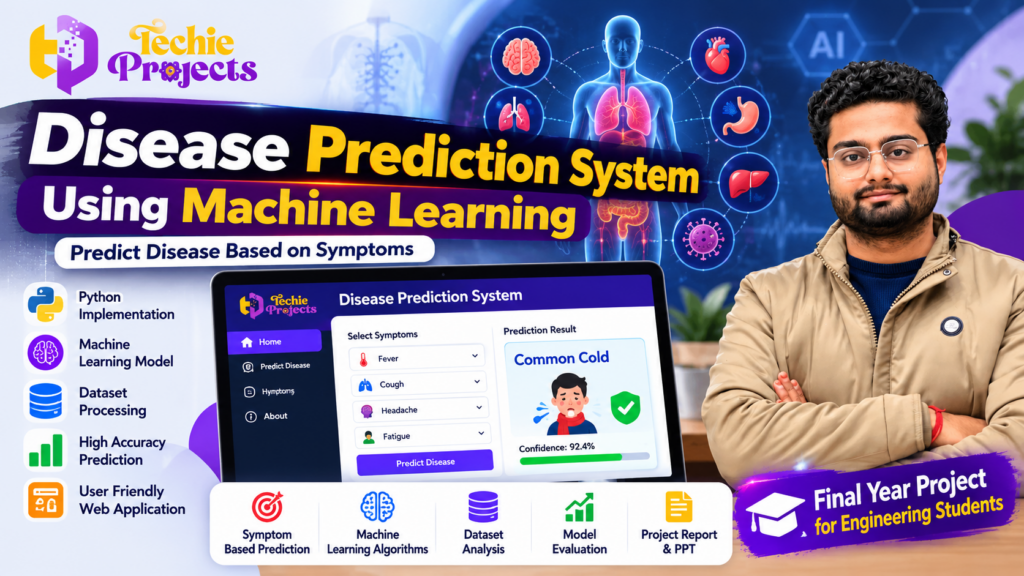
Are you looking for a practical healthcare-based machine learning project for your final-year engineering submission? The Disease Prediction System Using Machine Learning is an interesting Python project that demonstrates how machine learning algorithms can analyze symptom-related data and predict a possible disease category based on a trained model.
Healthcare and artificial intelligence are increasingly important areas of computer science. By developing a disease prediction application, students can explore data preprocessing, classification algorithms, model evaluation, and application development in one practical project.
🎓 Techie Projects helps engineering students explore Python, artificial intelligence, and machine learning projects for academic learning and technical demonstrations. If you are interested in this project, contact us to discuss the available implementation, source code, documentation, and project support options.
🎬 Project Demo: Disease Prediction System Using Machine Learning
Explore the Disease Prediction System Using Machine Learning and understand how symptom-based input can be processed through a machine learning model to generate a predicted disease category.
The project demonstrates the connection between a user-friendly interface, a prepared dataset, and a trained prediction model. It is suitable for students who want to understand the workflow of a healthcare-related machine learning application.
Watch the project demonstration video embedded on this page to explore its interface, features, and overall working process.
Important: This project is intended for educational and demonstration purposes. Its predictions are not a substitute for professional medical diagnosis or treatment.
What Is a Disease Prediction System Using Machine Learning?
A Disease Prediction System Using Machine Learning is a software application that uses a trained classification model to analyze selected symptoms or other relevant input features and predict a disease category represented in its training data.
Traditional diagnosis requires professional medical assessment, clinical history, and appropriate investigations. A student-developed machine learning application offers a simplified way to study how data-driven prediction works. It can help demonstrate the fundamental concepts behind healthcare analytics without replacing medical professionals.
Depending on the implementation, the application may include a symptom selection interface, a prediction module, dataset processing, and a results page. The available functionality depends on the dataset, algorithm, and software package used.
Objectives of the Disease Prediction Project
The primary objective of this project is to demonstrate how machine learning techniques can be applied to a healthcare-related classification problem.
The main learning objectives include:
- Understanding the fundamentals of machine learning and classification.
- Preparing and processing a symptom-related dataset.
- Selecting suitable input features for model training.
- Training a classification algorithm using prepared data.
- Evaluating model performance using appropriate metrics.
- Developing a simple interface for entering symptoms.
- Displaying the model’s predicted category in an understandable format.
- Documenting the system architecture, limitations, and results.
These objectives make the project useful for students who want practical exposure to Python programming and machine learning concepts.
Key Features of the Disease Prediction System
The exact features depend on the implementation and package selected. A typical educational version may include the following modules.
1. Symptom-Based Input
The application can provide an interface where users select symptoms from the options supported by the dataset. The selected values are converted into the format expected by the trained model.
2. Machine Learning Prediction
A trained classification model processes the input features and produces a predicted category. The prediction depends on the model, training data, and quality of the selected input.
3. Dataset Processing
The dataset is prepared before training. This may include checking missing values, encoding categorical information, selecting features, and separating training and testing data.
4. User-Friendly Interface
Depending on the implementation, the project may use a simple web interface to make symptom selection and result display easier to understand.
5. Model Evaluation
The project can demonstrate evaluation metrics such as accuracy, precision, recall, and F1-score. These metrics help students understand model performance beyond a single accuracy value.
6. Educational Results Display
The application displays the prediction generated by the model. Students can use the result to explain the workflow during a project presentation or technical demonstration.
Confirm the exact features included in the available project package before purchasing.
Technologies Used in the Project
A Disease Prediction System Using Machine Learning can be developed using several Python-based technologies.
| Technology | Purpose |
|---|---|
| Python | Main programming language |
| Pandas | Dataset loading and manipulation |
| NumPy | Numerical operations |
| Scikit-learn | Machine learning model development and evaluation |
| Matplotlib or Seaborn | Data visualization, if included |
| Streamlit or Flask | Application interface, depending on implementation |
| CSV dataset | Storage of structured training data, if used |
The actual technology stack may vary according to the selected implementation. Students should confirm the required Python version, package dependencies, dataset, and execution environment before installation.
How Does the Disease Prediction System Work?
The project follows a typical machine learning workflow.
Step 1: Collect the Dataset
A suitable dataset containing symptom-related features and corresponding labels is selected. The quality, source, representativeness, and limitations of the dataset affect the usefulness of the model.
Step 2: Preprocess the Data
The dataset is inspected and prepared for training. Depending on its structure, preprocessing may involve handling missing values, encoding features, and checking data consistency.
Step 3: Train the Machine Learning Model
A suitable classification algorithm is trained using the prepared dataset. The model learns patterns in the training examples to associate input features with the labels represented in the data.
Step 4: Evaluate the Model
The trained model is evaluated using appropriate test data and metrics. A reliable evaluation should avoid data leakage and should not rely solely on training accuracy.
Step 5: Enter Symptoms
The user selects symptoms through the available application interface. The application converts the input into the format required by the model.
Step 6: Generate a Prediction
The trained model processes the input and returns a predicted category. The output reflects patterns learned from the dataset and may be incorrect or unsuitable for real-world medical decisions.
Step 7: Display the Result
The application presents the prediction to the user. The system can then be demonstrated as part of a machine learning project presentation.
Applications of a Disease Prediction Machine Learning Project
This educational project can support learning and demonstrations in several areas.
- Machine learning education: Understand classification and model evaluation.
- Healthcare analytics demonstrations: Explore how structured health-related data can be analyzed.
- Python programming practice: Apply data processing and model development skills.
- Academic presentations: Explain a complete machine learning workflow.
- Research prototypes: Experiment with alternative algorithms and datasets under appropriate supervision.
A student prototype should not be presented as a clinically validated diagnostic tool. Real healthcare deployment requires appropriate clinical validation, privacy safeguards, regulatory review, and professional oversight.
Advantages of This Final-Year Project
A Disease Prediction System Using Machine Learning offers several educational benefits.
Practical machine learning experience: Students can connect theory with dataset preparation, model training, testing, and prediction.
Clear project workflow: The project can be divided into manageable modules, making it easier to explain the software architecture.
Scope for improvement: Students can investigate feature selection, alternative classification algorithms, class imbalance, and evaluation methods.
Presentation opportunities: The interface and prediction workflow can help demonstrate the system during a viva or project review.
Cross-disciplinary learning: The project combines programming, data analysis, machine learning, and a healthcare-related use case.
The quality of the final project depends on the implementation, documentation, testing, and the student’s understanding of the underlying concepts.
Project Modules and Documentation
A well-organized implementation may include modules such as:
- Dataset loading and preprocessing.
- Feature preparation and model training.
- Model evaluation and performance reporting.
- Symptom input and prediction interface.
- Result display and application testing.
For academic preparation, students should understand how each module works and how the model generates its output.
Before ordering, ask Techie Projects to confirm which deliverables are available. These may include source code, installation instructions, project documentation, a presentation, a dataset, or implementation guidance, depending on the selected package.
Why Choose Techie Projects?
Choosing a suitable engineering project involves more than selecting an interesting title. Students should consider the technology stack, installation requirements, project scope, documentation, and their ability to explain the implementation.
Techie Projects helps students explore technical project ideas across Python, machine learning, artificial intelligence, data analytics, computer vision, and other engineering domains.
If you are considering the Disease Prediction System Using Machine Learning, contact us to discuss the available version, included deliverables, pricing, and support before placing an order.
What to Confirm Before Purchasing
- Which source code and project files are included?
- Is the dataset included, and what is its source?
- Which machine learning algorithm is implemented?
- What are the Python version and installation requirements?
- Is a project report or presentation included?
- What installation or technical support is available?
- Can the project be demonstrated on your system?
Confirm these details in advance so you can select a package that matches your academic requirements and budget.
Frequently Asked Questions (FAQs)
1. What is a Disease Prediction System Using Machine Learning?
It is an educational software application that uses a trained machine learning model to predict a disease category from supported input features, such as selected symptoms.
2. Which programming language is used for this project?
Python is commonly used because it supports data processing, machine learning, evaluation, and application development through its extensive libraries.
3. Is this project suitable for final-year engineering students?
It can be suitable for computer science and related engineering students, depending on their syllabus, project requirements, implementation complexity, and evaluation criteria.
4. Which algorithms can be used?
Depending on the dataset and implementation, classification algorithms such as Decision Tree, Random Forest, Support Vector Machine, or Naive Bayes may be explored. The best choice should be determined through appropriate evaluation rather than assumed in advance.
5. Can this project diagnose real diseases?
No. An academic prototype should not be used to diagnose or treat a person. Its output may be inaccurate and is not a replacement for qualified medical advice.
6. Can I purchase this project from Techie Projects?
You can contact Techie Projects to ask about the available implementation, pricing, source code, documentation, and support. Confirm the deliverables and terms before ordering.
7. Can I modify the project for learning?
Modifications may be possible depending on the implementation and its license or purchase terms. Discuss your requirements before purchasing and make sure you understand the code before presenting it academically.
🎓 Explore Related Python and Machine Learning Projects
Interested in more engineering project ideas? Explore related topics on Techie Projects:
- Machine Learning Projects
- Artificial Intelligence Projects
- Python Projects for Engineering Students
- Healthcare Data Analytics Projects
- Deep Learning Projects
- Data Science Projects
- Natural Language Processing Projects
- Computer Vision Projects
Browse the website to discover project ideas that align with your academic interests and technical skills.
🚀 Interested in the Disease Prediction System Using Machine Learning?
Take the next step toward exploring this Python-based machine learning project. Contact Techie Projects to discuss the available project package, source code, documentation, installation requirements, pricing, and technical support options.
📲 Call/WhatsApp: +91-9460060699
🌎 Website: www.techieprojects.com
📺 Instagram: @pythonprojects_
Send us a message with the project name and your requirements so we can discuss the available options before you order.
Educational disclaimer: This project is intended for learning, research demonstrations, and academic purposes. Predictions generated by an unvalidated student model should not be used for clinical decisions, diagnosis, or treatment.