
🎓 Introduction
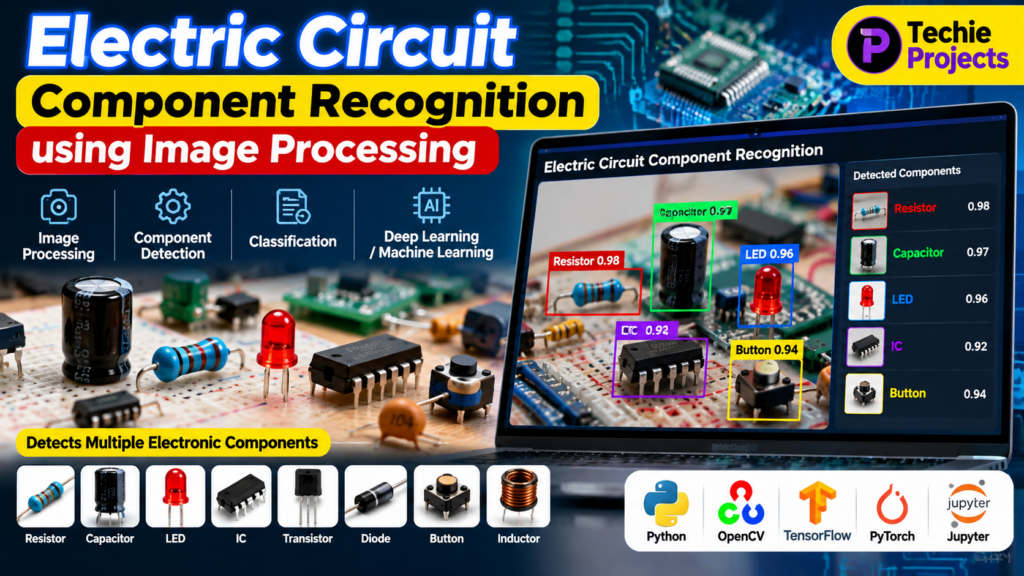
Electric Circuit Component Recognition Using Image Processing is a practical computer vision project designed to identify and recognize electronic components from images. The project can analyze an image containing circuit components and determine the type of component present using image processing and machine learning techniques.
Electronic circuits contain components such as resistors, capacitors, LEDs, transistors, diodes, integrated circuits, buttons, and inductors. Identifying these components manually can be time-consuming, especially when working with a large number of circuit images.
This project demonstrates how Python and image processing can be used to automate component recognition. It is suitable for B.Tech, BCA, MCA, Computer Science, Electronics, IT, and final-year engineering students interested in Python, computer vision, machine learning, and image processing projects.
🎥 Watch the Electric Circuit Component Recognition Working Demo
Before purchasing or selecting the project, students can watch the Electric Circuit Component Recognition Using Image Processing Working Demo to understand the actual interface, component detection process, image processing workflow, and overall project functionality.
The working demonstration provides a practical view of how the system can identify electronic components such as resistors, capacitors, LEDs, diodes, transistors, and other circuit components from images.
Watching the demo can help students understand the project’s user interface, recognition results, image processing techniques, and possible real-world applications before selecting the project.
🔍 What Is Electric Circuit Component Recognition?
Electric circuit component recognition is the process of identifying electronic components from an image automatically.
The system takes an image as input, processes the image, extracts useful visual information, and identifies the component based on its appearance.
Depending on the implementation, the system can recognize components such as:
- Resistors
- Capacitors
- LEDs
- Diodes
- Transistors
- Integrated Circuits
- Push buttons
- Inductors
- Other electronic components
The project can be developed using traditional image processing techniques or extended with machine learning and deep learning models for more advanced recognition.
This electric circuit component recognition using image processing project can be extended with real-time camera detection.
🎯 Objectives of the Project
The main objectives of the Electric Circuit Component Recognition Using Image Processing project are:
- To automatically identify electronic components from images.
- To process circuit images using Python.
- To apply image processing techniques for component analysis.
- To classify different types of electronic components.
- To reduce manual component identification.
- To demonstrate the practical application of computer vision.
- To provide a foundation for developing automated electronics inspection systems.
⚙️ How the System Works
The basic workflow of the project can be divided into several stages.
Step 1: Input Image
The system first receives an image containing one or more electronic components.
The image can be captured using a camera or selected from an existing image dataset.
Step 2: Image Preprocessing
The input image is processed to improve its quality and make component detection easier.
Common preprocessing operations may include:
- Image resizing
- Noise removal
- Grayscale conversion
- Image normalization
- Contrast enhancement
- Thresholding
Step 3: Component Detection
The system identifies the regions containing electronic components.
Depending on the implementation, techniques such as contour detection, segmentation, edge detection, object detection, or feature extraction can be used.
Step 4: Feature Extraction
Important visual characteristics are extracted from the detected component.
These characteristics can include:
- Shape
- Size
- Color
- Texture
- Edges
- Contours
- Geometric properties
Step 5: Component Classification
The extracted information is then used to determine the type of electronic component.
A machine learning or deep learning model can be trained using images of different components.
Step 6: Display the Result
Finally, the system displays the detected component and its predicted class.
For an advanced implementation, the output can include the component name and confidence score.
🧠 Technologies Used
The project can be developed using the following technologies:
- Python
- OpenCV
- NumPy
- Machine Learning
- Deep Learning
- Computer Vision
- Jupyter Notebook
- TensorFlow or PyTorch, if a deep learning model is used
OpenCV can be used for image processing and computer vision operations, while machine learning or deep learning frameworks can be used for classification.
🛠️ Image Processing Techniques
Several image processing techniques can be used in this project.
Grayscale Conversion
Converting an image into grayscale can simplify image processing by reducing the number of color channels.
Noise Removal
Noise reduction improves the quality of the image and can make component boundaries easier to detect.
Edge Detection
Edge detection can help identify the boundaries and shapes of electronic components.
Thresholding
Thresholding separates objects from the background and can be useful for component segmentation.
Contour Detection
Contours can be used to detect the shape and boundaries of components.
Image Segmentation
Segmentation divides an image into meaningful regions so that individual components can be analyzed separately.
🤖 Machine Learning Approach
For a machine-learning-based implementation, a dataset containing images of different electronic components can be created.
For example, the dataset can contain classes such as:
- Resistor
- Capacitor
- LED
- Diode
- Transistor
- IC
- Button
- Inductor
The dataset can then be divided into training and testing sets.
The general workflow is:
Dataset → Preprocessing → Feature Extraction → Model Training → Testing → Prediction
A suitable classification algorithm can be selected depending on the size and complexity of the dataset.
🧠 Deep Learning Approach
The project can also be extended using a Convolutional Neural Network (CNN).
CNN-based models are particularly useful for image classification because they can automatically learn important visual features from images.
The deep learning workflow can be:
Input Image → Preprocessing → CNN Model → Feature Extraction → Classification → Component Name
Transfer learning can also be considered when the available dataset is relatively small.
📊 Example Output
A sample system can produce an output such as:
Detected Component: Resistor
Confidence: 98%
Another image might produce:
Detected Component: Capacitor
Confidence: 97%
For multiple components, the system can display bounding boxes around individual components and label each detected component.
💻 Software Requirements
The basic software requirements may include:
- Python 3.x
- OpenCV
- NumPy
- Jupyter Notebook or VS Code
- Windows/Linux operating system
- TensorFlow or PyTorch for deep learning implementation
The exact libraries may vary depending on the selected implementation.
🖥️ Hardware Requirements
Recommended hardware requirements include:
- Processor: Intel Core i3 or higher
- RAM: 4 GB minimum
- Storage: 500 GB or higher
- Keyboard and mouse
- Camera, if real-time image capture is required
For deep learning models, a GPU can significantly improve training speed.
📁 Dataset for Component Recognition
The quality of the dataset has a major impact on recognition performance.
The dataset should contain multiple images for every component class. Images should ideally contain variations in:
- Background
- Lighting
- Orientation
- Component size
- Component position
- Image quality
A balanced dataset can help the model learn different component classes more effectively.
🚀 Key Features
The Electric Circuit Component Recognition project can include the following features:
- Image-based component recognition
- Automatic component classification
- Image preprocessing
- Component detection
- Multiple component support
- Machine learning classification
- Deep learning integration
- Confidence score
- Real-time camera support
- Detection result visualization
- User-friendly interface
- Dataset-based model training
🌐 Applications
Electric circuit component recognition can have several practical applications.
Electronics Education
Students can use the system to learn about electronic components and computer vision.
Automated Inspection
The technology can potentially assist in automated inspection processes where electronic components need to be identified.
Electronics Laboratories
Educational institutions can use such systems as demonstration projects for electronics and computer science students.
Inventory Management
Component recognition can potentially assist with organizing and identifying electronic components.
PCB and Circuit Analysis
With further development, computer vision techniques can be integrated into systems designed for automated circuit and PCB analysis.
Quality Control
Advanced versions can be explored for identifying incorrectly placed or missing components during electronics manufacturing.
🔮 Future Scope
The project can be further improved by adding advanced features such as:
- Real-time component detection using a camera
- YOLO-based component detection
- CNN-based classification
- Mobile application integration
- Web-based recognition system
- Component value recognition
- OCR-based component marking detection
- PCB component recognition
- Automated component counting
- Cloud-based image processing
- Component database integration
- Voice-based recognition results
A more advanced version could detect several components simultaneously and display their names, locations, and confidence scores.
📈 Advantages
The major advantages of this project include:
- Reduces manual identification effort
- Demonstrates practical computer vision
- Can recognize multiple component categories
- Can be extended with machine learning
- Suitable for academic projects
- Can be upgraded to real-time detection
- Provides practical experience with Python and OpenCV
⚠️ Limitations
The accuracy of the system depends on several factors.
Poor lighting, blurry images, unusual component orientations, similar-looking components, and insufficient training data can reduce recognition accuracy.
A model trained using a limited dataset may also have difficulty recognizing components that are significantly different from the training images.
Therefore, collecting a diverse and high-quality dataset is important for improving performance.
🎓 Why Is This a Good Final-Year Project?
Electric Circuit Component Recognition Using Image Processing is a useful final-year project because it combines multiple areas of computer science and electronics.
Students can gain practical experience with:
- Python programming
- Image processing
- OpenCV
- Computer vision
- Machine learning
- Deep learning
- Dataset preparation
- Model evaluation
- Application development
The project can also be customized according to the student’s academic requirements and project scope.
❓ Frequently Asked Questions
What is Electric Circuit Component Recognition?
It is a computer vision application that identifies electronic components from images using image processing, machine learning, or deep learning techniques.
Which programming language can be used?
Python is a suitable programming language because it provides libraries such as OpenCV, NumPy, TensorFlow, and PyTorch for image processing and machine learning.
Can this project recognize multiple components?
Yes. A properly trained system can be designed to recognize multiple component classes in the same image.
Can the project work in real time?
Yes. A camera can be integrated with the system to detect components from live video.
Can machine learning be added?
Yes. Machine learning and deep learning models can be used to improve automated component classification.
Is this suitable for B.Tech final-year students?
Yes. The project can be developed as a practical Python, image processing, computer vision, or machine learning final-year project.
🔗 Explore Related Engineering Projects
Students looking for similar project ideas can also explore:
- Computer Vision Projects
- Image Processing Projects
- Machine Learning Projects
- Python Projects
- Deep Learning Projects
🎓 Need Help With Your Final-Year Project?
Looking for a Python, AI, Machine Learning, Computer Vision, or final-year engineering project?
Techie Projects can help you discuss your project idea, required features, source-code requirements, documentation, and project scope before development.
📲 Call/WhatsApp: +91-9460060699
🌎 Website: www.techieprojects.com
📺 Instagram: @pythonprojects_
Discuss your project requirements before making a decision.
Conclusion
Electric Circuit Component Recognition Using Image Processing is a practical project that demonstrates how computer vision and Python can be applied to recognize electronic components from images.
The project starts with image acquisition and preprocessing and can be extended with feature extraction, machine learning, or deep learning for automated classification.
For students, this project provides practical exposure to Python, OpenCV, image processing, computer vision, and machine learning. With additional development, it can also be converted into a real-time application capable of recognizing multiple electronic components automatically.