
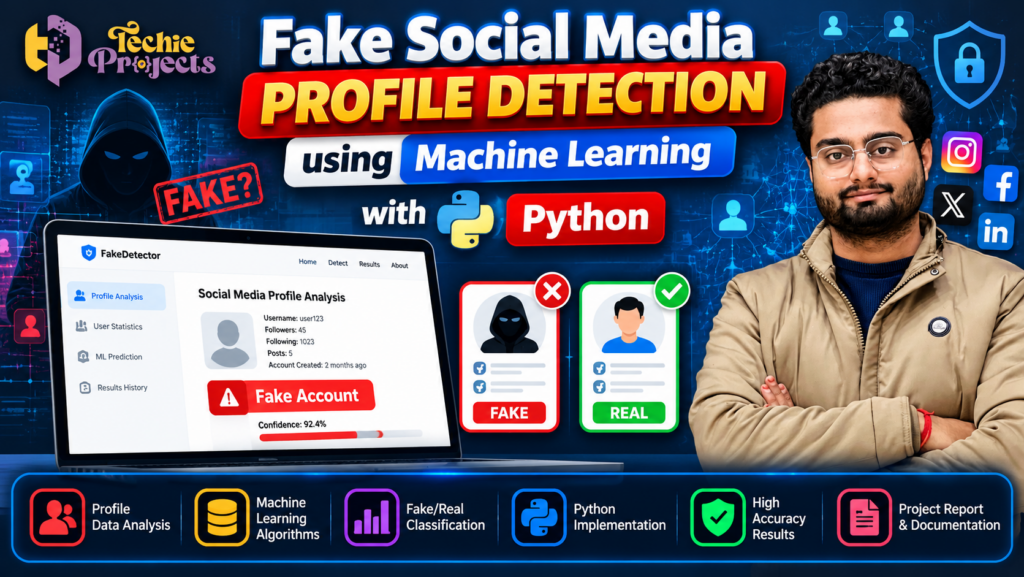
Are you looking for a practical final-year engineering project in Artificial Intelligence, Machine Learning, or Cyber Security? Fake Social Media Profile Detection is an excellent project topic for students who want to explore how machine learning algorithms can help classify social media accounts using profile-related data. Instead of spending weeks searching for a suitable project idea, you can contact Techie Projects to enquire about the available project implementation and choose an option that matches your course requirements, technical interests, and submission deadline.
This project explores how Python and machine learning can be used to analyze account attributes, identify patterns in profile data, and predict whether an account may be fake or genuine. It is suitable for students interested in practical machine learning, data analysis, classification algorithms, and online safety.
🎓 Want to purchase this project for your college submission? Visit Techie Projects or contact us directly through WhatsApp to discuss availability, pricing, and package deliverables before ordering.
🎬 Fake Social Media Profile Detection Project Demo
Explore the project demonstration to understand its interface, prediction workflow, and the way the implemented machine learning models present their results. A demonstration can help students evaluate whether the project is relevant to their academic requirements and technical interests.
The available implementation may include a user interface for entering or reviewing account-related information and displaying classification results. Actual functionality, supported algorithms, input fields, and output screens depend on the version offered.
📱 What Is Fake Social Media Profile Detection?
Fake Social Media Profile Detection is a machine learning application that attempts to classify social media accounts using selected profile characteristics and historical or labeled data.
Social networking platforms are widely used for communication, entertainment, education, marketing, and business. However, some accounts may be created for spam, impersonation, fraudulent promotion, misleading engagement, or other harmful activities. Identifying suspicious accounts can be challenging when thousands of profiles are created and updated regularly.
Machine learning offers one possible approach to this challenge. A classification model learns patterns from examples labeled as fake or genuine and uses those patterns to predict the category of new records.
For example, a dataset might contain attributes such as follower count, following count, number of posts, account age, profile completeness, or other available account statistics. The precise attributes depend on the dataset and implementation.
The model processes these attributes and generates a prediction based on the patterns learned during training.
Important: A model prediction is not proof that a real person or account is fraudulent. Results depend on the quality of the dataset, the features selected, and the model’s performance. Real-world systems require additional verification and careful evaluation.
🎯 Objectives of the Project
The main objective of this project is to demonstrate how machine learning can be applied to account classification and suspicious-profile analysis.
The major objectives include:
- Understand how classification algorithms work with labeled data.
- Explore how account-related attributes can be used as model inputs.
- Prepare and preprocess data for machine learning.
- Train a classification model to distinguish between labeled categories.
- Evaluate model performance using suitable metrics.
- Display predictions through an interface if supported by the implementation.
- Understand the limitations of automated account classification.
- Develop practical knowledge of Python, data analysis, and machine learning.
These objectives make the project relevant to undergraduate students studying Computer Science, Information Technology, Artificial Intelligence, Data Science, and related disciplines.
🔍 Advantages of Fake Social Media Profile Detection
Fake Social Media Profile Detection demonstrates how machine learning can help analyze account-related data and identify patterns associated with different profile categories. For engineering students, this project provides practical exposure to data preprocessing, classification algorithms, model testing, and result interpretation.
The system can help students understand how selected profile attributes influence predictions. Its effectiveness depends on the quality of the dataset, the chosen features, and the evaluation method.
⚙️ How Fake Social Media Profile Detection Using Machine Learning Works
The workflow generally follows several stages. The exact process depends on the dataset and the selected implementation.
1. Dataset Collection
The first stage involves obtaining a dataset containing account-related features and appropriate labels. The labels identify the categories the model is expected to learn, such as fake and genuine.
Students should use datasets that can legally be accessed and used for their intended academic purpose. If the project uses a prepared dataset, verify its source, structure, and licensing conditions.
2. Data Preprocessing
Raw data may contain missing values, duplicate records, inconsistent formats, or irrelevant fields. Preprocessing prepares the data for model training.
Common preprocessing tasks include handling missing values, removing duplicate entries where appropriate, encoding categorical variables, and scaling numerical features when required by the selected algorithm.
The preprocessing approach should be suitable for the actual dataset rather than applied automatically without analysis.
3. Feature Selection
Feature selection identifies which available attributes may help the model distinguish between account categories.
Possible attributes include follower counts, following counts, post counts, account age, and profile-related indicators. These are examples only; the features available in the purchased implementation may differ.
A feature should not be considered reliable merely because it appears correlated with a label in one dataset. Students should examine the data and evaluate how well the selected attributes generalize.
4. Model Training
The prepared dataset is used to train a classification algorithm. During training, the algorithm learns relationships between input features and the provided labels.
Depending on the implementation, the project may explore algorithms such as Logistic Regression, Decision Tree, Random Forest, or other classification methods.
The actual algorithms included must be confirmed before purchase. Students can learn how model choice affects training, interpretation, and prediction performance.
5. Model Testing and Evaluation
After training, the model should be evaluated on data that was not used to train it. This helps measure its ability to classify previously unseen examples.
Useful evaluation metrics include accuracy, precision, recall, F1-score, and a confusion matrix. For datasets with unequal numbers of fake and genuine examples, accuracy alone may provide an incomplete picture.
Students can use these metrics to understand where the model performs well and where it produces incorrect classifications.
6. Prediction and Results
The final stage uses the trained model to produce a classification for a new input record. If the implementation includes a graphical interface, the result may be displayed through a web page or desktop application.
The interface and prediction workflow vary by project version. Contact Techie Projects to confirm the actual interface and functions available in the package.
🛠️ Future Scope of Fake Social Media Profile Detection
The future scope of Fake Social Media Profile Detection includes exploring additional account attributes, comparing classification algorithms, and improving the quality of training data. Students can also investigate model explainability and evaluate how well a trained model performs on new data.
Further development could include a more user-friendly interface, visual reports, or additional evaluation metrics, provided these features are implemented and tested.
🧠 Machine Learning Algorithms Used
Different algorithms can be explored for fake-profile classification. The appropriate choice depends on the dataset, feature types, model requirements, and evaluation results.
Logistic Regression
Logistic Regression is a classification algorithm commonly used as a baseline for binary prediction tasks. It can help students understand how input features relate to the predicted probability of a class.
Decision Tree
A Decision Tree makes predictions through a series of feature-based decisions. Its structure can help students understand how a model separates records into categories.
Random Forest
Random Forest combines predictions from multiple decision trees. It is frequently used for structured data and can provide a useful comparison against simpler classification models.
Support Vector Machine
A Support Vector Machine can classify data by learning a decision boundary between categories. Its suitability depends on the dataset, feature representation, and parameter selection.
Note: The algorithms above are common options for this type of project, not a guarantee that every algorithm is included in the available package. Confirm the implementation details before purchasing.
💻 Technologies Used in the Project
The technologies depend on the specific version supplied. A typical Python-based implementation may use the following tools.
- Python: Main programming language for data processing and model development.
- Pandas: Useful for reading, organizing, and analyzing structured datasets.
- NumPy: Supports numerical operations and data manipulation.
- Scikit-learn: Provides machine learning algorithms and model evaluation tools.
- Matplotlib or Seaborn: Can be used to visualize data and model results when included.
- Flask, Streamlit, or Tkinter: Possible options for building an interface, depending on the implementation.
Confirm the actual libraries, framework, Python version, and installation requirements before ordering. Not every technology listed here is necessarily part of the available project.
✨ Key Features to Explore
The following are common features that may be relevant to this project. Check the available version to determine which functions are implemented.
- Profile attribute analysis: Examines selected account-related features.
- Machine learning classification: Predicts a category based on patterns learned from labeled data.
- Multiple model comparison: May allow different algorithms to be evaluated if supported.
- Prediction display: Presents the model’s output through the available interface.
- Performance evaluation: Can include classification metrics and test results.
- Python-based development: Offers an opportunity to study a widely used programming language.
- Academic learning value: Connects data preprocessing, classification, testing, and result interpretation.
The actual features, model outputs, and interface should be verified before purchase. A classification result should be treated as a model prediction rather than a definitive judgment about a person’s identity or intentions.
📊 Evaluation of Fake Social Media Profile Detection
Evaluating Fake Social Media Profile Detection is an important step in understanding the reliability of its predictions. Students can use precision, recall, F1-score, and a confusion matrix to examine correct and incorrect classifications.
Testing on data that was not used during training helps provide a more realistic assessment of performance. Accuracy figures should only be reported when supported by actual test results.
🎓 Why Choose This Fake Social Media Profile Detection Project?
This Fake Social Media Profile Detection project combines Python programming, machine learning, and an online safety use case. It can help students understand how a classification workflow moves from dataset preparation to model evaluation.
Before choosing the project, confirm that its implementation, software requirements, and available documentation meet your college’s expectations.
🎓 Benefits for Engineering Students
Fake Social Media Profile Detection can be a useful academic project because it connects theoretical concepts with a practical classification problem.
Learn Practical Machine Learning
Students can explore the complete machine learning workflow, from preparing data to evaluating predictions. This helps build a foundation for further study in Artificial Intelligence and Data Science.
Understand Data Preprocessing
Real datasets often require cleaning and preparation. Working with account-related data provides an opportunity to learn how missing values, inconsistent records, and feature selection affect model development.
Improve Project Presentation Skills
A well-documented project gives students material to explain the problem statement, objectives, methodology, algorithm selection, evaluation metrics, and limitations during a project presentation or viva.
Explore Cyber Security Concepts
The project introduces the broader topic of online account safety and suspicious activity detection. It can lead to further research into spam detection, phishing awareness, bot detection, and digital fraud prevention.
Build a Foundation for Further Development
Students may investigate new features, compare algorithms, improve dataset quality, or explore additional evaluation techniques as future enhancements.
The learning outcomes depend on the implementation and the work performed by the student. Students should understand the project and follow their institution’s rules for project use and submission.
🌐 Real-World Applications and Limitations
Machine learning-based profile classification can be studied in the context of several online safety challenges.
Online Safety Research
Researchers can examine patterns associated with suspicious accounts and investigate how data-driven classification might support further analysis.
Spam and Bot Detection
Some account attributes may be useful when studying automated or spam-related activity. However, fake accounts, bots, and genuine accounts are not identical categories, and each requires an appropriate definition and dataset.
Social Media Analytics
Analysts can study account patterns, engagement indicators, and data quality as part of broader social media research.
Cyber Security Education
The project can help students understand how classification systems are designed, tested, and evaluated for potential security-related applications.
Limitations to Understand
A model trained on one dataset may not perform equally well on another platform or a different group of users. Account features can change over time, and legitimate users may have characteristics that resemble those in the training data.
Automated predictions can also produce false positives and false negatives. For that reason, a model should not be used as the sole basis for account suspension, accusations, or other consequential decisions.
A reliable system requires suitable data, testing, monitoring, and appropriate human review.
🛒 Purchase Fake Social Media Profile Detection Project
Interested in purchasing Fake Social Media Profile Detection for your engineering project? Contact Techie Projects to ask about the available implementation, pricing, source code, dataset, documentation, and installation requirements.
Before placing an order, confirm the package contents rather than assuming every project includes the same materials.
Ask about:
- Source code and its compatibility with your computer.
- Dataset availability and usage conditions.
- Model files and supported classification algorithms.
- Installation instructions and software requirements.
- Project documentation and report availability.
- Demonstration interface and included functionality.
- Technical assistance, if offered with the selected package.
- Price, delivery method, and expected delivery timeline.
These details should be confirmed directly because package contents and services may vary.
Contact Techie Projects
📲 Call/WhatsApp: +91-9460060699
🌎 Website: www.techieprojects.com
📺 Instagram: @pythonprojects_
When contacting us, mention your course, college requirements, preferred technologies, and submission deadline. This makes it easier to discuss whether the available project is suitable for your needs.
🔗 Explore Related Python Projects
If you are exploring more topics in Artificial Intelligence, Machine Learning, and Cyber Security, consider researching these related project ideas:
- Fake News Detection Using Machine Learning
- Spam Message Classification Using Python
- Phishing Website Detection
- Email Spam Detection Using Machine Learning
- Intrusion Detection System Using Machine Learning
- Sentiment Analysis Using Natural Language Processing
- Network Traffic Classification
- Fraud Detection Using Machine Learning
These are related learning topics, not a statement that every project is available for purchase. Visit Techie Projects to explore the current project catalogue.
❓ Frequently Asked Questions
1. What is Fake Social Media Profile Detection?
It is a machine learning task that classifies social media account records into categories such as fake and genuine using selected profile attributes and labeled data.
2. Which programming language is used?
Python is commonly used for this type of project because it provides libraries for data preprocessing, model development, classification, and evaluation. Confirm the programming language used in the particular package.
3. Which algorithms can be used?
Possible algorithms include Logistic Regression, Decision Tree, Random Forest, and Support Vector Machine. The algorithms actually included depend on the project implementation.
4. Is this project suitable for final-year engineering students?
It can be suitable for students interested in Computer Science, Information Technology, Artificial Intelligence, Data Science, or Cyber Security. Suitability depends on the institution’s requirements and the project’s actual scope.
5. Can the system identify every fake account correctly?
No. Machine learning models can make incorrect predictions. Their performance depends on dataset quality, feature selection, testing methods, and changes in account behavior.
6. Can I purchase this project from Techie Projects?
You can contact Techie Projects to enquire about availability, pricing, and package details. Confirm the source code, dataset, documentation, installation requirements, and any included assistance before making a purchase.
7. How do I contact Techie Projects?
Visit techieprojects.com or send an enquiry through WhatsApp. You can also visit Instagram.
🚀 Start Your Machine Learning Project Journey
Fake Social Media Profile Detection provides an opportunity to explore how Python and machine learning can be applied to account classification and online safety research. By understanding the dataset, preprocessing workflow, classification algorithms, and evaluation metrics, students can develop a stronger foundation in practical machine learning.
If you want to explore this project for your college requirements, contact Techie Projects to discuss the available implementation, verify the deliverables, and select a suitable option.
Enquire today: Visit Techie Projects | Contact us on WhatsApp
Build your understanding of machine learning by studying the implementation, evaluating its results, and learning how classification systems work in practice.