
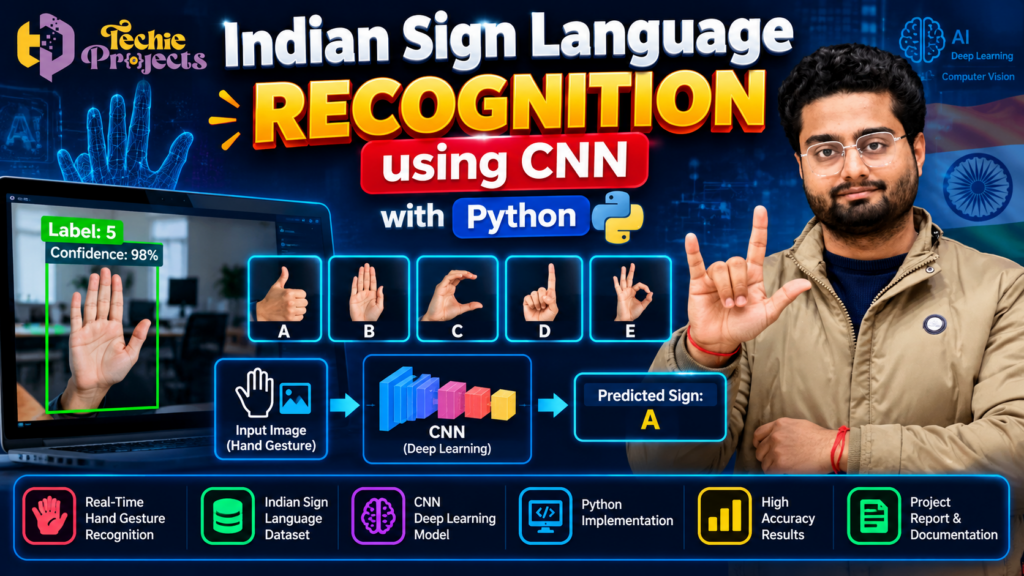
Are you looking for an impressive final-year engineering project that combines artificial intelligence, deep learning, Python, and computer vision? Indian Sign Language Recognition Using CNN is a practical project concept for students who want to explore how computers can recognize hand gestures and help make communication more accessible. Instead of spending weeks building an entire project from scratch, you can enquire about the available project package from Techie Projects and focus on understanding the implementation, preparing your presentation, and developing your technical knowledge.
At Techie Projects, we help engineering students explore practical software and AI project ideas for academic learning. This project introduces image-based gesture recognition using a Convolutional Neural Network (CNN), a popular deep learning architecture for processing visual information. If you are searching for a Python machine learning project for your B.Tech, BCA, MCA, or computer science course, this topic offers an opportunity to study a meaningful application of artificial intelligence.
Explore the project overview below, understand its workflow and technologies, and contact us to confirm the available source code, documentation, installation assistance, and other deliverables before purchasing.
🎬 Indian Sign Language Recognition Using CNN Project Demo
Explore the project demonstration on this page to understand its visual concept and how a hand gesture recognition application may operate. A demonstration can help you observe the interface, the input process, and the type of output produced by the particular implementation.
When evaluating the project, pay attention to how gesture images are captured or supplied, how the trained model processes the input, and how the predicted class is displayed. These details can help you prepare questions before purchasing and understand what you will need to explain during your project presentation.
The actual gestures supported, prediction speed, interface, and recognition performance depend on the implementation and training dataset. Contact Techie Projects to verify the available features and deliverables for the version you intend to purchase.
🤟 What Is Indian Sign Language Recognition Using CNN?
Indian Sign Language Recognition Using CNN is a computer vision and deep learning project designed to classify hand gestures from images. The system uses image data as input and a trained neural network to predict the corresponding class from the categories included in its dataset.
A Convolutional Neural Network is particularly useful for image classification because it learns visual patterns such as edges, shapes, textures, and combinations of features. During training, the network learns relationships between the images and their assigned labels. Once trained, it can make predictions on suitable input images.
For example, a dataset may contain images representing selected hand signs. The model learns to distinguish these categories and predicts a label when it receives a new image. The quality of the output depends on factors such as the dataset, image preprocessing, training procedure, and similarity between training images and real-world inputs.
It is important to understand that recognizing selected static gestures is not the same as translating complete sign language conversations. Full sign language interpretation can require motion analysis, facial expressions, context, and language-specific rules. The scope of this project should therefore be verified against the actual implementation.
🎓 Why Choose This Deep Learning Project?
Choosing a project involves more than selecting an attractive title. You need a topic that allows you to understand the underlying concepts, demonstrate a working workflow, and answer technical questions during evaluation.
This project brings together several useful areas of computer science:
- Deep learning: Understand how a CNN learns patterns from labeled image data.
- Python programming: Explore how Python can be used to build machine learning workflows.
- Computer vision: Learn how digital images are processed before prediction.
- Image classification: Study how a model assigns an input image to a learned category.
- Human-computer interaction: Explore ways to present predicted results to users.
- Social impact: Consider how gesture recognition research may contribute to accessible technology.
For students exploring artificial intelligence and machine learning, this topic provides a clear way to connect theoretical concepts with a visual application.
If you want to purchase the project rather than develop every component independently, contact Techie Projects first to discuss the implementation, technical requirements, and package inclusions. This helps you choose a version that suits your academic objectives and available time.
⚙️ How Does the Recognition System Work?
The general workflow of a CNN-based hand gesture classifier can be divided into several stages. The exact workflow may vary depending on the software design and dataset used in the project.
1. Image Collection
The first stage involves collecting or preparing images representing the gesture classes that the system should recognize. Each image must be associated with an appropriate label so the model can learn the relationship between the visual input and its category.
A balanced and representative dataset can help the model learn different examples of each class. Images that vary in lighting, background, hand position, and distance can also help reveal how well the model generalizes.
2. Image Preprocessing
Before training, images are commonly resized to a consistent dimension and converted into a suitable numerical format. Depending on the implementation, preprocessing may include normalization, color conversion, or other transformations.
Consistent preprocessing helps the model receive data in the format it expects. During testing, the same essential preprocessing steps should be applied to input images.
3. Dataset Splitting
A dataset is commonly divided into training, validation, and testing sets. The training set teaches the model, the validation set helps with model selection, and the test set provides an evaluation on examples not used during training.
A proper split helps reduce the risk of reporting overly optimistic performance. If nearly identical images appear across multiple sets, the reported results may not reflect how well the model handles genuinely new examples.
4. CNN Model Training
The CNN learns visual features from the training images. Convolutional layers detect patterns, while other layers combine those patterns into information useful for classification. The final output layer predicts a class from the categories supported by the dataset.
Training involves adjusting the model’s parameters to reduce prediction errors. The architecture, number of epochs, optimizer, and other settings depend on the dataset and implementation.
5. Gesture Prediction
After training, an input image is processed and passed to the model. The network produces a prediction for one of its learned classes. A software interface may display the predicted label to the user.
The prediction should not automatically be treated as correct in every situation. Poor lighting, unusual hand positions, occlusion, or unfamiliar backgrounds can affect recognition quality.
6. Output Display and Testing
The final stage presents the result and allows the application to be tested with different inputs. Students can examine successful predictions, incorrect classifications, and examples that the model struggles to recognize.
This evaluation is important for understanding both the capabilities and limitations of the system.
🤟 Key Advantages of Indian Sign Language Recognition Using CNN
Indian Sign Language Recognition Using CNN offers students an opportunity to understand how deep learning can be applied to hand gesture image classification. By combining Python, image preprocessing, and a Convolutional Neural Network, this project demonstrates an important computer vision workflow.
Some key learning benefits include:
- CNN model development: Understand how a neural network learns visual patterns from labeled hand gesture images.
- Python implementation: Explore the programming workflow used to prepare images and generate predictions.
- Image classification: Learn how the model assigns an input image to one of its trained gesture categories.
- Model evaluation: Examine prediction results and identify examples that require better training data.
- Project presentation: Explain the dataset, preprocessing steps, model architecture, testing process, and limitations.
For students looking for an AI-based final-year project, Indian Sign Language Recognition Using CNN offers a practical starting point for learning deep learning concepts. Actual recognition performance depends on the quality of the dataset and the implementation.
🧠 Technologies Used in the Project
The precise software stack should be confirmed before purchasing. A typical implementation of this type of project may use the following technologies.
Python
Python is widely used for machine learning because its ecosystem includes libraries for data processing, model development, image manipulation, and application building. Its readable syntax can also make it suitable for students learning AI concepts.
Convolutional Neural Network (CNN)
The CNN is the core image classification technique. It learns patterns from labeled gesture images and uses those patterns to predict the class of an input.
TensorFlow or Keras
Depending on the implementation, TensorFlow or Keras may be used to define, train, evaluate, and save the neural network. Confirm which framework and version the available project requires.
OpenCV
OpenCV is commonly used for image processing and computer vision tasks. If included, it may help load images, prepare visual inputs, or support camera-based functionality.
NumPy
NumPy provides numerical arrays and mathematical operations that are frequently used to represent and manipulate image data.
Matplotlib
Matplotlib can be used to plot training history, visualize class distributions, or display evaluation results when those features are included in the implementation.
These are common technology choices, not a guarantee that every library is included in the specific package offered by Techie Projects. Ask for the confirmed requirements before installation.
⚙️ How Indian Sign Language Recognition Using CNN Predicts Hand Gestures
The Indian Sign Language Recognition Using CNN workflow begins with a hand gesture image. The image is prepared in the required format and passed to a trained CNN model. The model then predicts the most likely class among the gesture categories it has learned.
During training, the CNN learns patterns from labeled images. During testing, new images help evaluate whether the model can recognize gestures it has not previously seen. Consistent preprocessing and a suitable test dataset are important for obtaining meaningful results.
Students can study the prediction process, compare correct and incorrect classifications, and investigate how lighting, background, hand position, and image quality affect performance. This makes the project useful for exploring both the capabilities and limitations of image-based deep learning.
✨ Important Project Features to Evaluate
Before purchasing Indian Sign Language Recognition Using CNN, check which of the following features are present in the actual version:
- Gesture image classification: Predicts a label for images belonging to the supported classes.
- Image preprocessing: Converts input images into the format required by the model.
- CNN-based learning: Uses a trained convolutional neural network for classification.
- Prediction display: Presents the model’s output through a suitable interface or script.
- Model evaluation: May include accuracy or other evaluation metrics, depending on the implementation.
- Visual demonstration: Shows the input and prediction process.
- Extensibility: May allow experimentation with additional classes after the dataset and training pipeline are updated.
Do not assume that live camera recognition, speech output, complete sentence translation, or a large gesture vocabulary is included unless the seller confirms it. These features may require additional development beyond a basic image classification system.
📊 Benefits for Engineering Students
A well-understood project can help you learn more than how to execute a Python script. It can provide a foundation for discussing data preparation, model architecture, testing, and responsible use of AI.
Practical Understanding of CNNs
You can study how convolutional layers learn visual patterns and how the final classification layer produces a prediction. This creates a connection between classroom theory and a working machine learning workflow.
Experience with Image Data
Working with images introduces practical challenges such as inconsistent dimensions, varying backgrounds, and differences in lighting. Understanding these factors helps build a more realistic view of computer vision.
Project Presentation Preparation
The workflow can be divided into understandable sections: problem statement, objectives, dataset, preprocessing, model design, implementation, testing, limitations, and future scope. These sections can help you prepare for a project review or viva.
A Foundation for Further Experiments
After understanding the original implementation, students may explore improvements such as collecting additional samples, testing different CNN architectures, comparing evaluation metrics, or developing a more accessible interface.
Any extension should be tested carefully. Adding more classes, for example, requires appropriate training data and a model capable of distinguishing the new categories.
🏥 Applications and Real-World Relevance
Gesture recognition has potential applications in research, assistive technology, educational demonstrations, and human-computer interaction. A classroom project can demonstrate some of the technical ideas behind these applications, but a prototype should not be presented as a complete or validated communication solution.
Possible areas of exploration include:
- Assistive technology research: Investigating ways to make digital interfaces more accessible.
- Educational tools: Demonstrating selected hand gestures as part of a learning application.
- Human-computer interaction: Exploring gesture-based input for suitable software interfaces.
- AI and computer vision research: Comparing image classification methods and evaluating their limitations.
- Academic experimentation: Studying how dataset quality affects model performance.
Real-world sign language communication is complex. Any application intended to support users should be developed and evaluated with relevant sign language users and experts, rather than relying only on a model’s classification score.
💻 Software and Hardware Requirements
Requirements depend on the selected implementation, Python version, model size, and whether inference uses saved images or a live camera.
A typical Python-based prototype may require:
- A computer running a compatible version of Windows, Linux, or another supported operating system.
- Python and the specific machine learning libraries required by the project.
- Sufficient RAM and storage for the dataset, dependencies, and trained model.
- A compatible processor for development and inference.
- A webcam only if the implementation supports camera input.
- A suitable development environment, such as VS Code or another compatible editor.
A dedicated GPU may help accelerate some training workloads, but it is not automatically required for every small CNN project. Before purchasing, request the tested Python version, installation instructions, dependency list, and minimum hardware requirements.
🎓 Why Choose Indian Sign Language Recognition Using CNN for Your Final-Year Project?
Indian Sign Language Recognition Using CNN is a valuable choice for students interested in artificial intelligence, deep learning, and computer vision. The project demonstrates how image data can be processed and classified using a trained Convolutional Neural Network (CNN).
Students can explore image preprocessing, dataset preparation, model training, prediction, and performance evaluation. These concepts help connect theoretical machine learning knowledge with a practical Python implementation.
🔬 Applications of Indian Sign Language Recognition Using CNN
The concepts demonstrated by Indian Sign Language Recognition Using CNN can support learning and experimentation in several areas:
- Educational demonstrations: Show how computer vision models classify hand gesture images.
- Gesture recognition research: Explore image-based recognition methods and model evaluation.
- Assistive technology prototypes: Investigate how gesture classification could contribute to communication-support tools.
- Deep learning practice: Understand how labeled image datasets are used to train classification models.
- Student research: Experiment with image quality, dataset diversity, and model performance.
This project is an educational prototype, not a replacement for a complete sign-language translation system. Real-world communication requires broader vocabulary, context, and careful evaluation.
🛒 Purchase the Indian Sign Language Recognition Using CNN Project from Techie Projects
Looking for Indian Sign Language Recognition Using CNN for your college project? Contact Techie Projects to discuss the available implementation and confirm whether it meets your academic requirements.
Before purchasing, ask about the source code, dataset, trained model, installation instructions, documentation, supported gesture classes, and available assistance. Deliverables may vary by package, so confirm the details before placing your order.
We encourage students to understand their project rather than simply run the program. Before placing an order, ask about the specific deliverables you need, such as:
- Python source code and the trained model, if included.
- Dataset details and supported gesture classes.
- Installation instructions and required dependencies.
- Project report or documentation availability.
- Explanation of the code and model workflow.
- Demonstration details and any available setup assistance.
- Price, delivery method, and applicable support terms.
These items must be confirmed for the specific package; do not assume every item is automatically included.
📲 Contact Techie Projects
Discuss your requirements and confirm package details through the official channels:
- 📲 Call/WhatsApp: +91-9460060699
- 🌎 Website: www.techieprojects.com
- 📺 Instagram: @pythonprojects_
When contacting us, mention the project title, your course, your deadline, and the deliverables you require. This helps clarify whether the available version fits your needs.
🚀 Future Scope of the Project
The basic image classification workflow can serve as a starting point for further research. Possible improvements depend on the quality of the existing code, the dataset, and the intended application.
Expand the Dataset
Additional representative samples may help the model learn more variation within each supported class. Any new images should be labeled carefully and divided appropriately between training and evaluation sets.
Experiment with Model Architectures
Students can compare different CNN configurations or other image classification approaches. A meaningful comparison should use consistent evaluation data and clearly documented settings.
Explore Live Camera Input
A camera-based version may capture frames and send them to the trained model. This requires additional implementation and testing and should not be assumed to exist in a basic image classification package.
Improve Accessibility and Usability
A future interface could make predictions easier to understand and provide clearer feedback when the model is uncertain. Such changes should be tested with users and should communicate the system’s limitations honestly.
Investigate More Complex Sign Recognition
Recognizing dynamic signs or sequences may require temporal information, additional data, and a more advanced modeling approach. Translating full sign language requires considerably more than classifying a few static hand gestures.
⚠️ Limitations You Should Understand
No image classification system is guaranteed to recognize every gesture correctly. Results may vary with the dataset, hand orientation, background, lighting, camera quality, and differences between training and testing conditions.
A model trained on a limited collection of gestures can only be expected to classify the categories it has learned. High test accuracy on a narrow dataset does not prove that the model understands a complete sign language.
For academic evaluation, describe the supported classes, dataset size, testing method, measured results, and known limitations. Report only metrics that have actually been measured in the implementation.
Understanding these limitations will help you answer technical questions and suggest realistic improvements during your presentation.
🎓 Explore Related Python Projects
If you are interested in more AI and software development topics, explore related project categories on Techie Projects. Depending on your interests, you could investigate:
- Computer vision and image processing projects.
- Deep learning and neural network applications.
- Machine learning classification projects.
- Object detection and tracking systems.
- Natural language processing applications.
- AI-powered accessibility and interaction tools.
Choose a project based on your learning objectives, available time, technical requirements, and the amount of experimentation you want to undertake.
❓ Frequently Asked Questions
1. What is Indian Sign Language Recognition Using CNN?
It is a computer vision project that uses a trained Convolutional Neural Network to classify hand gesture images into predefined categories. Its capabilities depend on the dataset and implementation.
2. Which programming language is used?
Python is a common choice for this type of project. The specific libraries and supported versions should be checked against the package being offered.
3. Is this project suitable for final-year engineering students?
It can be a suitable academic topic for students interested in AI, machine learning, and computer vision. Confirm that the project scope matches your course requirements and that you can explain the implementation.
4. Does the system translate complete sign language conversations?
Not necessarily. A basic CNN image classifier recognizes selected image categories. Complete sign language interpretation may require motion, facial expressions, context, and additional language-processing capabilities.
5. Can I use a webcam?
Only if the particular implementation includes camera input and the required processing pipeline. Ask Techie Projects to confirm whether this functionality is included.
6. What should I check before purchasing?
Confirm the available code, dataset, model, supported gestures, software requirements, documentation, installation instructions, price, and support terms. Request clarification on any feature that is essential for your submission.
7. How can I purchase the project?
Visit Techie Projects or contact us through WhatsApp. Share your course, deadline, and requirements so you can confirm the available package before ordering.
🎯 Final Thoughts
Indian Sign Language Recognition Using CNN is a useful topic for exploring how deep learning can classify visual hand gestures. It brings together Python, image preprocessing, CNN architecture, model evaluation, and the wider discussion of accessible technology.
For engineering students, the real value lies in understanding how the system works, evaluating its performance honestly, and explaining its limitations and future possibilities. If you want to use this topic for your academic project, contact Techie Projects to confirm the available package, technical requirements, and deliverables before purchasing.
Ready to discuss your project requirements? Visit TechieProjects.com or message us on WhatsApp to enquire about Indian Sign Language Recognition Using CNN.