
Dataset Link:- https://www.kaggle.com/datasets/aryashah2k/indian-medicinal-leaves-dataset
Medicinal Plant Identification Using Machine Learning: Python Project for Final Year Students
Looking for a practical machine learning project that combines Python, artificial intelligence, image classification, and real-world applications? Medicinal Plant Identification Using Machine Learning is an excellent project topic for B.Tech, BCA, MCA, and other computer science students who want to explore how intelligent systems can recognize plants from images.
If you need a project for your final-year submission, mini-project, or technical demonstration, Techie Projects can help you explore a suitable implementation. Instead of spending all your time building the entire system from scratch, you can enquire about the available project package, check its features, and choose an option that matches your academic requirements.
Visit Techie Projects or contact us directly on WhatsApp to enquire about availability, pricing, and deliverables.
🎬 Watch the Medicinal Plant Identification Project Demo
Explore the project demonstration to understand its interface, image input process, and plant classification workflow. The actual output depends on the model, dataset, and implementation used in the project.
Watch the demonstration to see how image-based plant recognition can be presented as a practical machine learning application.
🌿 What Is Medicinal Plant Identification Using Machine Learning?
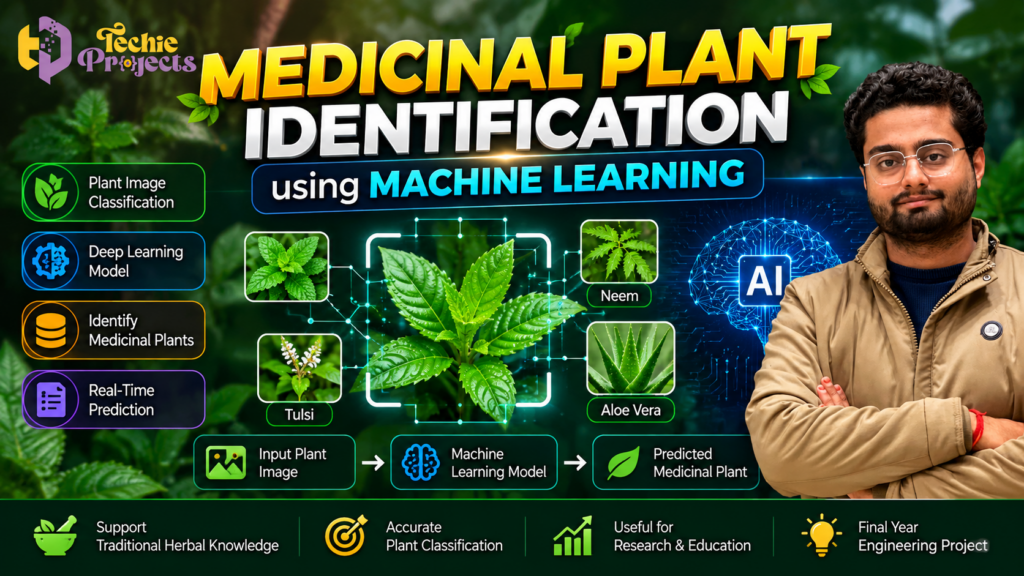
Medicinal Plant Identification Using Machine Learning is a computer science project that explores how algorithms can identify medicinal plants from images. The system processes an input image and uses patterns learned from a labelled dataset to predict the plant category.
Plants such as Tulsi, Neem, and Aloe Vera are familiar examples of medicinal plants. Their leaves and other visual characteristics can provide useful information for an image classification model. However, identifying a plant correctly from an image can be challenging because different species may have similar shapes, colours, and textures.
Machine learning makes it possible to train a model to recognize visual patterns from example images. After training, the model can predict the likely class of an image supplied by a user.
This type of project is useful for learning about image processing, dataset preparation, model training, prediction, and application development. It is an educational prototype, not a substitute for expert botanical identification or medical advice.
🎯 Objectives of the Project
The primary objective of this project is to demonstrate how machine learning can be applied to plant image classification.
The main objectives may include:
- Developing an image-based plant classification application.
- Understanding how to collect and organize labelled plant images.
- Preparing images for machine learning.
- Training or using a suitable classification model.
- Predicting a plant category from an input image.
- Displaying the predicted result through a user interface.
- Evaluating the model using suitable performance metrics.
- Understanding the limitations of image-based identification.
The precise objectives and features depend on the version of the project selected.
⚙️ How the Project Works
A typical medicinal plant recognition application follows a sequence of steps from image input to prediction.
1. Collecting the Plant Image Dataset
The first step is to prepare a labelled dataset containing images of the plant categories the model should recognize. Images should represent useful variations in lighting, background, orientation, and leaf appearance.
Dataset quality is important because a model can only learn patterns represented adequately in its training examples.
2. Image Preprocessing
Images may have different sizes, dimensions, and lighting conditions. Preprocessing helps prepare them for the selected model.
Common operations include resizing, normalization, and converting images into the required numerical format. Some implementations may also use data augmentation to increase training diversity.
3. Feature Learning and Model Training
A machine learning model learns patterns associated with the labelled plant categories. A traditional approach may use extracted image features with a classifier, while a deep learning approach may use a convolutional neural network (CNN).
The model learns from training images and can then be evaluated using separate validation or test data.
4. Uploading an Image
In an application with an image-upload interface, a user selects a plant image from a supported file location. The application prepares the image according to the model’s expected input format.
5. Predicting the Plant Category
The trained model processes the image and generates a prediction. Depending on the implementation, the application may display the predicted class and a confidence score.
A prediction should not automatically be treated as proof of a plant’s identity. Similar-looking species, poor image quality, and classes missing from the dataset can affect reliability.
6. Displaying the Result
The application displays the prediction in a user-friendly format. A graphical interface can make the project easier to demonstrate during an academic presentation or viva.
🧠 Technologies Used in the Project
The technology stack depends on the selected implementation. The following tools are commonly suitable for this type of project.
Python
Python is widely used in machine learning and image processing because it provides a readable programming language and an extensive ecosystem of libraries.
Machine Learning and Deep Learning
A classification model learns to distinguish between image categories. Depending on the implementation, the project may use a traditional machine learning classifier or a deep learning architecture.
TensorFlow or PyTorch
These frameworks can be used to build, train, or run neural network models. They are examples of possible tools rather than a guarantee that every project version includes both.
OpenCV and Pillow
Image processing libraries such as OpenCV and Pillow can help load, resize, convert, and prepare images for classification.
NumPy
NumPy supports numerical operations and array manipulation, which are common in image processing and model workflows.
User Interface
A project may use a graphical interface or a web application framework to accept an image and display the prediction. The exact interface should be confirmed before purchasing.
🔬 How Medicinal Plant Identification Using Machine Learning Supports Research
Medicinal Plant Identification Using Machine Learning can provide a foundation for educational experiments involving plant images. Students can compare how different datasets, image preprocessing methods, and classification models affect prediction results.
For example, a project may classify selected images of Tulsi, Neem, and Aloe Vera when these categories are included in the training dataset. Students can then test new images and examine incorrect predictions to understand the limitations of their model.
The project can also be extended with a clearer interface, additional supported plant categories, or improved evaluation methods. Each extension should be tested carefully rather than assuming that a larger dataset or a more complex model will automatically improve accuracy.
✨ Key Features of the Medicinal Plant Classification Project
Medicinal Plant Identification Using Machine Learning can demonstrate several useful features for academic learning.
Image-Based Plant Classification
The central function is to classify an input image into one of the categories supported by the trained model.
User-Friendly Image Input
An image upload or selection feature can simplify the process of testing the model with sample plant images.
Automated Prediction
Once the image has been processed, the model generates a prediction without requiring the user to manually compare every visual characteristic.
Result Display
The interface can present the predicted plant category and, where implemented, additional output such as confidence values.
Modular Project Workflow
The workflow can be divided into dataset preparation, preprocessing, model development, prediction, and interface development. This structure helps students understand how separate components work together.
Model Evaluation
A well-designed academic implementation can include evaluation measures such as accuracy, precision, recall, and a confusion matrix. The actual results should be calculated from the project’s test data rather than assumed in advance.
Important: Confirm which features are included in the available Techie Projects version before purchasing.
🎓 Why Choose This Project for Your Final Year?
Students often need projects that demonstrate programming ability, technical understanding, and a clear application of computer science concepts. This topic combines several areas in one implementation.
Practical Python experience: Students can explore data handling, functions, image processing, and application logic.
Introduction to artificial intelligence: The project demonstrates how a trained model can learn from labelled examples and make predictions on new inputs.
Image processing concepts: Students can understand how digital images are represented and prepared for a model.
Scope for experimentation: Different datasets, preprocessing methods, or classification models can be compared to study their effect on performance.
Presentation potential: A visual application is often easier to demonstrate than a project that produces only command-line output.
The project’s academic value comes from understanding the implementation and explaining its limitations, not simply from presenting a working interface.
🌿 Benefits of Medicinal Plant Identification Using Machine Learning
Medicinal Plant Identification Using Machine Learning combines image classification with Python programming to create a practical learning experience for computer science students.
The key benefits include:
- Automated image classification: Explore how a trained model predicts plant categories from images.
- Python development: Practise image handling, data preprocessing, and application development.
- Machine learning experience: Understand dataset preparation, model training, and prediction evaluation.
- Research opportunities: Experiment with different plant images, classification methods, and evaluation metrics.
- Academic presentation: Demonstrate the workflow and explain the model’s strengths and limitations.
These benefits make the topic relevant to students interested in artificial intelligence, deep learning, computer vision, and image processing.
📊 Dataset Preparation and Model Evaluation
Dataset preparation is one of the most important parts of a plant classification project. A dataset should contain representative examples of each supported class, and its labels should be checked carefully.
Training and testing images should be separated appropriately. If nearly identical images appear in both sets, the reported evaluation may be misleading. A reliable evaluation should test how the model performs on images it has not already seen during training.
Useful evaluation measures include:
- Accuracy: The proportion of predictions that are correct.
- Precision: How often predictions for a particular class are correct.
- Recall: How many examples of a class are identified correctly.
- F1-score: A combined measure of precision and recall.
- Confusion matrix: A summary of correct and incorrect predictions across classes.
A model’s performance depends on dataset quality, class balance, image conditions, and the selected architecture. No specific accuracy figure should be claimed without testing the actual implementation.
🌱 Applications of Medicinal Plant Recognition
Image-based plant classification has potential educational and research applications.
Botanical Learning
Students can use a classification prototype to explore visual differences between selected plant categories and understand the challenges of automated recognition.
Agricultural Research
Researchers may investigate image classification as one component of plant monitoring or plant information systems. Such use requires suitable datasets and validation for the intended environment.
Digital Plant Information Systems
A plant recognition application could be integrated into a larger system that provides educational information about identified species. Any information displayed should come from reliable sources and should clearly distinguish a model prediction from a verified identification.
Academic Research and Demonstrations
The project provides a foundation for experiments involving image preprocessing, model comparison, dataset quality, and prediction evaluation.
Nature Education
An appropriately validated application may support learning about plant diversity. It should not be presented as a definitive identification tool without adequate expert validation.
⚠️ Limitations and Challenges
Understanding limitations is essential for a credible machine learning project.
Similar-looking plants: Different species may have similar leaves, making visual classification difficult.
Image quality: Blurry, poorly lit, or partially obscured images can reduce prediction reliability.
Limited dataset: A model trained on only a few plant categories may not recognize species outside those categories.
Environmental variation: Lighting, background, plant age, and leaf condition can change an image’s appearance.
Prediction uncertainty: A model may return a category even when the input image does not belong to any supported class, unless the application has an appropriate rejection or uncertainty mechanism.
Medicinal safety: Plant identification from an image should never be used alone to decide whether a plant is safe to consume or suitable for treating a medical condition.
Discussing these limitations shows that you understand both the capabilities and the boundaries of machine learning.
💻 Software and Hardware Requirements
The requirements depend on the implementation and model size. A typical Python image classification project may require:
- A Windows, Linux, or compatible development environment.
- A supported Python version.
- Required machine learning and image processing libraries.
- Sufficient RAM and disk space for the dataset and model.
- A CPU for many basic experiments; a compatible GPU may help with larger training workloads.
- A code editor or IDE for development and debugging.
Before purchasing, confirm the Python version, dependency list, installation process, and hardware requirements of the specific project package.
🛒 Buy the Medicinal Plant Identification Using Machine Learning Project
Looking for a Python-based machine learning project for your academic submission? Contact Techie Projects to enquire about the availability of the Medicinal Plant Identification Using Machine Learning project.
Before ordering, confirm the current price, source-code availability, dataset, model architecture, installation instructions, documentation, and other included deliverables.
Contact Techie Projects:
- 📲 Call/WhatsApp: +91-9460060699
- 🌎 Website: www.techieprojects.com
- 📺 Instagram: @pythonprojects_
When contacting us, mention your course, preferred technology, submission deadline, and any college requirements. This helps you check whether the available project matches your needs.
Use the project as a learning resource: run the application, understand the code, test different images, evaluate its results, and prepare to explain the workflow independently.
🎓 Recommended Projects to Explore
If you are interested in related topics, you can also explore these project areas on Techie Projects:
- Plant Leaf Disease Detection
- Crop Yield Prediction using Machine Learning
- Flower Classification using Machine Learning
- Fruit Ripeness Detection Using Machine Learning
- Image Classification Using Deep Learning
- Agricultural Marketing Android Project
- Object Detection Using Python
Explore related project options at Techie Projects and compare the technologies, scope, and deliverables before making a decision.
❓ Frequently Asked Questions
1. What is Medicinal Plant Identification Using Machine Learning?
It is a computer science project that uses a trained model to predict the category of a medicinal plant from an image, within the classes supported by the dataset.
2. Which programming language is used?
Python is a common choice because of its machine learning, numerical computing, and image processing libraries. The exact dependencies depend on the implementation.
3. Is this project suitable for final-year students?
It can be suitable for B.Tech, BCA, MCA, and related students, subject to their syllabus, project requirements, and the scope of the selected implementation.
4. Does the project use deep learning?
Some implementations use convolutional neural networks or other deep learning methods. Confirm the model architecture included in the version you intend to purchase.
5. Can the model identify every medicinal plant?
No. The model is generally limited to the classes represented in its training data and may make incorrect predictions on unfamiliar or visually similar plants.
6. What should I confirm before purchasing?
Ask about the source code, supported plant categories, dataset, model architecture, software requirements, documentation, installation instructions, price, and any support included.
7. How can I enquire about this project?
Visit Techie Projects or message Techie Projects on WhatsApp to ask about availability, pricing, and package details.
🚀 Conclusion
Medicinal Plant Identification Using Machine Learning is a useful educational project for exploring Python, image processing, dataset preparation, and automated classification. It offers opportunities to experiment with models, evaluate predictions, and understand how AI systems work with real-world images.
For students looking for a project to study and demonstrate, the next step is to review the available implementation and confirm that it matches their academic requirements.
Enquire today through Techie Projects or WhatsApp to check project availability and purchase details.