
Introduction
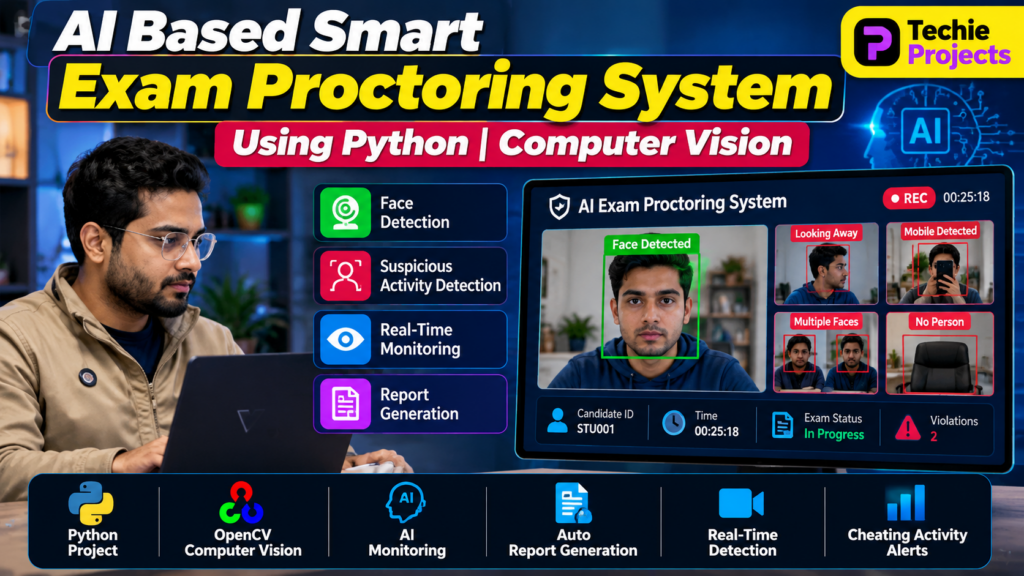
An AI Based Smart Exam Proctoring System using Python is a computer vision project designed to assist with online examination monitoring. As online education and remote assessments become more common, maintaining examination integrity and identifying suspicious activities have become important challenges.
This project demonstrates how Artificial Intelligence (AI), Machine Learning, and Computer Vision can be used to monitor a candidate through a webcam during an online examination. Depending on the implementation, the system can detect faces, monitor candidate presence, identify multiple faces, and flag potentially suspicious behavior for review.
Python provides useful libraries such as OpenCV and other machine learning frameworks for developing this type of application. The project is suitable for computer science engineering students interested in AI, computer vision, and intelligent monitoring systems.
🎬 Project Working Demo
Watch the project demonstration to understand the interface, monitoring process, and main features of the AI-based exam proctoring system.
The demonstration can show webcam access, face detection, candidate monitoring, suspicious activity alerts, and report generation if these features are implemented in your project.
What Is an AI Based Smart Exam Proctoring System?
An AI-based smart exam proctoring system is software that supports the supervision of online examinations using computer vision and automated monitoring techniques.
The system processes webcam images or video frames to identify predefined events. For example, it may detect whether a face is visible, whether multiple faces appear in the camera frame, or whether a candidate repeatedly looks away from the screen.
The system can display alerts when configured conditions are detected. These alerts should be treated as indicators for human review rather than definitive proof of cheating.
🎯 Objectives of the Project
The main objectives of the AI-based exam proctoring project are:
- Develop a Python-based application for online examination monitoring.
- Detect and locate faces in webcam frames.
- Monitor candidate presence during an examination.
- Identify configured events, such as multiple faces or prolonged absence.
- Generate alerts when predefined conditions are met.
- Maintain examination event records for review.
- Explore practical applications of AI and computer vision.
⭐ Key Features of the Smart Exam Proctoring System
1. Face Detection
The system identifies faces in webcam images using a suitable computer vision or machine learning model. Face detection can help determine whether a candidate is visible during the examination.
2. Real-Time Webcam Monitoring
The application processes video frames captured from the candidate’s webcam and displays the monitoring interface in real time, depending on the hardware and implementation.
3. Multiple Face Detection
If more than one face is detected in the camera frame, the system can generate an alert for review. This feature may help identify situations that require additional examination supervision.
4. Candidate Absence Detection
The application can detect when no face is visible in the webcam frame for a configured period. Temporary absences and camera problems should be considered before interpreting an alert.
5. Suspicious Activity Alerts
The system may flag events such as prolonged looking away from the screen or the appearance of another person. These events are not conclusive evidence of misconduct and should be reviewed by an authorized examiner.
6. Monitoring Dashboard
A dashboard can display the webcam feed, candidate status, monitoring duration, event counts, and generated alerts.
7. Report Generation
If included in the implementation, the system can save a summary of detected events, timestamps, and candidate session information for authorized review.
⚙️ Technologies Used
The technologies depend on the specific implementation of the project.
- Python: Main programming language.
- OpenCV: Webcam access, video processing, and image operations.
- NumPy: Numerical operations and image-array processing.
- Machine Learning or Deep Learning: Optional models for face detection and other supported tasks.
- Flask, Streamlit, or Tkinter: Optional tools for building the user interface.
- SQLite or MySQL: Optional databases for storing candidate details and examination records.
Choose only the libraries and frameworks actually used in your implementation.
How Does the AI Exam Proctoring System Work?
The general workflow of the project includes the following steps.
Step 1: Candidate Registration
The application records the required candidate and examination information, depending on the system design.
Step 2: Start the Examination Session
The candidate opens the application and grants webcam access. The system initializes the monitoring session.
Step 3: Capture Webcam Frames
The application captures video frames and prepares them for processing.
Step 4: Detect Faces
The selected computer vision model analyzes the frames to locate visible faces.
Step 5: Identify Configured Events
The system evaluates detection results against predefined conditions, such as no face detected for a specified duration or multiple faces appearing in the frame.
Step 6: Display Alerts
When a configured condition is met, the application displays an alert and records the event if logging is enabled.
Step 7: Generate a Session Summary
At the end of the examination, the system can produce a summary of monitoring events for an authorized examiner.
Software Requirements
The typical software requirements may include:
- Python 3
- OpenCV
- NumPy
- A compatible face detection model or library
- An IDE such as Visual Studio Code or PyCharm
- Windows, Linux, or another supported operating system
- Optional database and interface libraries
Install the exact package versions required by your project implementation.
Hardware Requirements
The project can generally be developed using:
- A computer or laptop
- A compatible webcam
- A keyboard and mouse
- Sufficient RAM for the selected models
- Adequate processing power for real-time video analysis
More computationally demanding deep learning models may benefit from a suitable GPU.
Advantages of the Project
The AI-based smart exam proctoring system offers several potential benefits:
- Supports remote examination supervision.
- Demonstrates practical applications of computer vision.
- Automates the identification of predefined monitoring events.
- Provides a useful learning experience in Python and AI.
- Can maintain structured event records when logging is implemented.
- Can be extended with additional monitoring and reporting features.
Limitations and Ethical Considerations
Although AI-based monitoring can support online examinations, it has important limitations.
- False alerts: Normal movements or environmental changes may trigger alerts.
- Lighting conditions: Poor lighting can affect face detection.
- Camera quality: Low-resolution webcams can reduce detection accuracy.
- Privacy: Webcam processing and stored records must be handled responsibly.
- Bias and accessibility: Detection performance can vary across people and environments.
- Human review: Automated alerts should not independently determine whether a candidate has cheated.
The project should use informed consent, appropriate access controls, secure storage, and a clear data-retention policy. It should also avoid collecting more personal information than necessary.
Future Scope
The project can be extended in several ways:
- Improve face detection under different lighting conditions.
- Add configurable monitoring thresholds.
- Create an examiner dashboard.
- Generate downloadable examination reports.
- Integrate secure candidate authentication.
- Add role-based access for administrators and examiners.
- Improve performance through model optimization.
- Evaluate detection accuracy using representative test data.
Any additional feature should be implemented and tested before it is described as a working capability.
🎓 Why Is This a Good Final-Year Engineering Project?
An AI-based smart exam proctoring system is a useful final-year engineering project because it combines Python programming, computer vision, software development, and responsible AI design.
Students can demonstrate webcam processing, face detection, event logging, and dashboard development in a practical application. The project can also be customized according to academic requirements, available hardware, and the complexity of the selected algorithms.
Frequently Asked Questions
1. What is an AI-based smart exam proctoring system?
It is an application that uses AI and computer vision techniques to support online examination monitoring and flag predefined events for review.
2. Which programming language is used for this project?
Python is commonly used because it supports libraries such as OpenCV, NumPy, and various machine learning frameworks.
3. Is OpenCV required for the project?
OpenCV is a common choice for webcam access and image processing, although the exact technology depends on the implementation.
4. Can the system detect multiple faces?
Yes, if the selected face detection model and application logic support detecting and counting multiple faces in a frame.
5. Does the system automatically prove that a student is cheating?
No. Automated detection can produce false alerts. Examination decisions should involve human review and appropriate institutional procedures.
6. Can this project be used for a final-year submission?
Yes. It can serve as a final-year engineering project, provided the implementation, testing, documentation, and academic requirements are completed appropriately.
🔗 Explore Related AI and Computer Vision Projects
Explore other project topics on Techie Projects:
- Artificial Intelligence Projects
- Deep Learning Projects Using Python
- Face Recognition Attendance System
- Object Detection Using Python
- Machine Learning Projects for Final-Year Students
Add internal links to the corresponding project pages on your website.
🚀 Need Help With Your Final-Year Project?
Looking for project ideas, implementation guidance, documentation, or source-code information?
Techie Projects helps students explore Python, Artificial Intelligence, Machine Learning, and Computer Vision projects.
- 📲 Call/WhatsApp: +91-9460060699
- 🌎 Website: www.techieprojects.com
- 📺 Instagram: @pythonprojects_
Conclusion
The AI Based Smart Exam Proctoring System using Python demonstrates how computer vision and artificial intelligence can support online examination monitoring. Features such as face detection, candidate presence monitoring, event alerts, and reporting provide opportunities to explore practical AI development.
By implementing, testing, and documenting the system carefully, students can build a meaningful final-year engineering project while learning about real-time image processing, software design, and responsible AI applications.