
Introduction
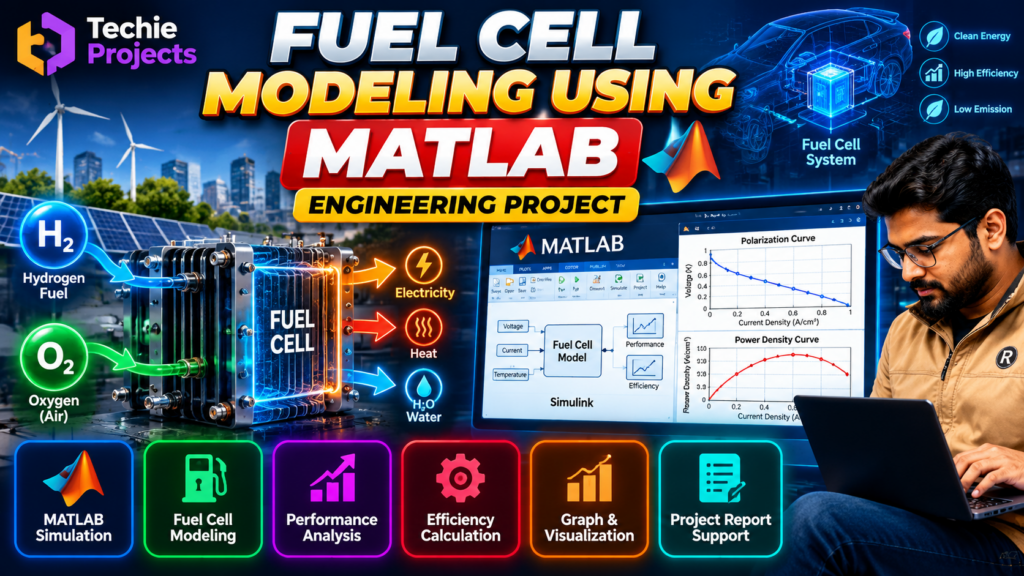
Fuel cell modeling using MATLAB is an engineering project that explores how fuel cells can be represented, simulated, and analyzed using MATLAB. Fuel cells are important in clean energy research because they can convert chemical energy into electrical energy through electrochemical reactions. This project helps students understand fuel cell operating principles, mathematical modeling, simulation, and performance analysis in a practical engineering environment.
If you are looking for a fuel cell modeling using MATLAB project for your final-year engineering submission, this project offers an opportunity to study renewable energy technologies, numerical modeling, and simulation-based problem-solving. It is relevant to students in electrical engineering, mechanical engineering, electronics, energy engineering, and related research areas.
At Techie Projects, we help engineering students explore technical projects and discuss suitable project implementations based on their academic requirements. You can contact us to enquire about project availability, source code, customization options, and technical support.
🎬 Fuel Cell Modeling Using MATLAB – Project Demo Video
Watch the project demonstration to understand the intended simulation concept and how MATLAB can be used to study fuel cell behavior. A project demonstration can help you understand the expected workflow, important parameters, and possible ways to present simulation results during a project review.
The implementation and available features may vary depending on the selected project version. Contact Techie Projects to confirm the exact functionality, files, and deliverables available before purchasing.
What Is Fuel Cell Modeling Using MATLAB?
Fuel cell modeling using MATLAB involves developing a mathematical representation of a fuel cell and using simulation techniques to examine its behavior under different operating conditions. MATLAB provides a suitable environment for calculations, numerical analysis, data visualization, and engineering simulations.
A fuel cell typically generates electricity through an electrochemical reaction involving a fuel and an oxidizing agent. Hydrogen fuel cells, for example, can combine hydrogen and oxygen to produce electrical energy, heat, and water. Their performance depends on several factors, including temperature, pressure, reactant supply, current density, and internal losses.
A mathematical model helps engineers understand the relationships between these parameters without conducting every experiment physically. By changing model inputs and analyzing outputs, students can investigate how operating conditions may affect voltage, current, power, and overall system behavior.
The exact equations depend on the selected fuel cell technology and the model’s scope. A project may use simplified equations for educational purposes or a more detailed model for advanced analysis.
Objectives of the Project
The main objective of this fuel cell modeling using MATLAB project is to demonstrate how mathematical modeling and simulation can support fuel cell performance analysis.
Key objectives include:
- Understanding the basic working principles of fuel cells.
- Studying the mathematical relationships governing fuel cell behavior.
- Implementing model equations in MATLAB.
- Analyzing the effect of selected operating parameters.
- Generating graphs to visualize simulation results.
- Comparing the behavior of the model under different input conditions.
- Developing practical knowledge of simulation-based engineering analysis.
- Understanding how fuel cell technology contributes to clean energy research.
These objectives can be adapted to your academic syllabus and project requirements. Students should confirm the precise scope of the available implementation before finalizing their project topic.
How Does the Project Work?
The general workflow of fuel cell modeling using MATLAB can be divided into several stages.
1. Understand the Fuel Cell System
The first step is to identify the type of fuel cell being studied and understand its operating principles. Different fuel cell technologies have different characteristics, equations, and operating requirements.
For an educational project, a proton exchange membrane fuel cell (PEMFC) may be selected as the model system. However, the actual fuel cell type should match the implementation supplied with the project.
2. Identify the Model Parameters
The next step is to identify the parameters required by the mathematical model. Depending on the selected model, these may include temperature, pressure, current density, cell area, reactant conditions, and model-specific constants.
Students should use documented parameter values and explain their assumptions clearly. Reliable parameter selection is important because unrealistic inputs can produce misleading simulation results.
3. Develop the Mathematical Model
Fuel cell performance can be represented using equations that describe the relationship between operating conditions and electrical output.
For example, a simplified voltage model may express the actual cell voltage as the reversible voltage minus different voltage losses:
Cell voltage = Reversible voltage − Activation losses − Ohmic losses − Concentration losses
This equation illustrates the general concept; the exact mathematical formulation depends on the fuel cell technology and model assumptions.
The model equations can then be translated into MATLAB calculations or functions.
4. Implement the Model in MATLAB
MATLAB can be used to organize model parameters, perform numerical calculations, execute simulations, and store the resulting data.
Depending on the implementation, students may use MATLAB scripts, functions, plots, or Simulink models. The tools required will depend on the project’s design and the installed software licenses.
5. Run Simulations
After implementing the equations, the model can be evaluated using selected input values. Students can vary one parameter at a time or compare multiple operating scenarios.
For example, a simulation may examine how predicted voltage changes with current density. Another scenario may investigate how a selected operating condition affects the model’s output.
6. Analyze the Results
The final stage involves examining the output values and graphs, interpreting trends, and documenting the findings. Students should distinguish simulated results from experimentally measured results and explain any assumptions or limitations.
This process helps connect theoretical knowledge with practical engineering analysis.
Key Features of the Project
The following features are relevant to a fuel cell modeling using MATLAB implementation. Confirm which features are included in the version you intend to purchase.
Mathematical Modeling
The project can demonstrate how fuel cell equations are represented computationally. This helps students understand how theoretical engineering concepts are translated into a numerical model.
MATLAB-Based Simulation
MATLAB provides tools for calculations, parameter variation, numerical analysis, and plotting. A MATLAB implementation can make the model easier to modify and analyze.
Parameter-Based Analysis
The model may allow users to change selected operating parameters and observe their effects on simulated output. This supports scenario-based learning and engineering experimentation.
Graphical Result Visualization
Plots can help illustrate relationships between parameters such as current density, cell voltage, and power. The exact graphs depend on the equations and outputs supported by the implementation.
Academic Project Documentation
A well-prepared academic submission should explain the problem statement, objectives, methodology, equations, software requirements, results, limitations, and conclusion.
Documentation and report availability should be confirmed before purchase rather than assumed.
Software and Hardware Requirements
Software Requirements
The typical software environment may include:
- Programming and simulation: MATLAB.
- Optional modeling environment: Simulink, if the implementation uses it.
- Operating system: A compatible Windows, Linux, or macOS environment, depending on the MATLAB version.
- Additional toolboxes: Only those required by the supplied model.
Check the compatibility of your MATLAB release and installed toolboxes before running the project.
Hardware Requirements
A standard computer capable of running the required MATLAB release is generally sufficient for a basic numerical simulation.
Typical requirements include:
- A compatible desktop or laptop.
- Adequate RAM and available storage.
- A supported processor.
- A licensed or otherwise authorized MATLAB installation.
The exact hardware requirements depend on the model’s complexity and software version.
Applications of Fuel Cell Modeling
Fuel cell modeling has applications across several engineering and clean energy research areas.
Renewable and Clean Energy Research
Fuel cells are studied as part of broader efforts to develop alternative energy technologies. Simulation can help researchers investigate performance characteristics before conducting physical tests.
Electric Mobility
Fuel cell systems are explored for selected transportation applications, including some vehicles that use hydrogen-based power systems. Modeling can help investigate component behavior and operating conditions.
Stationary Power Generation
Fuel cells can be used in certain stationary power applications. Mathematical models can support the study of electrical output and operating behavior.
Engineering Education
For students, fuel cell modeling provides a way to combine electrochemistry, electrical engineering, numerical methods, and programming.
Energy System Analysis
Fuel cell models can form part of larger simulations involving energy conversion, storage, and power management. Such integration requires an appropriately designed model and suitable system assumptions.
Advantages of the Project
A MATLAB-based fuel cell project offers several educational benefits.
- Better conceptual understanding: Connects fuel cell theory with computational calculations.
- Simulation-based learning: Allows students to investigate different model inputs.
- Visual interpretation: Graphs make it easier to examine predicted relationships.
- Flexible experimentation: Parameters can be modified without rebuilding a physical prototype.
- Interdisciplinary learning: Combines energy systems, mathematical modeling, and programming.
- Research preparation: Introduces methods used in more advanced engineering simulations.
These benefits depend on the quality of the implementation and the student’s understanding of the model.
Limitations and Future Scope
A mathematical model is only as reliable as its assumptions, equations, and input parameters. A simplified model may not represent every physical effect in a real fuel cell. Simulation results should therefore not be treated as experimental validation unless they have been compared with appropriate experimental or reference data.
Possible future improvements include:
- Comparing different fuel cell technologies.
- Studying the influence of temperature and pressure.
- Extending the model to examine dynamic operating conditions.
- Comparing simulated outputs with published experimental data.
- Integrating the fuel cell model into a hybrid energy system.
- Exploring energy management strategies for selected applications.
- Improving parameter estimation and model validation.
These are potential extensions, not guaranteed features of the current project package.
Why Choose Techie Projects for Your Engineering Project?
Choosing a final-year project involves more than selecting an interesting title. Students also need to understand the implementation, software requirements, expected outputs, and how to explain the work during evaluation.
Techie Projects provides an option for students who want to enquire about technical project implementations and customized development.
Before purchasing this fuel cell modeling using MATLAB project, you can discuss:
- Whether the project matches your branch and syllabus.
- Which MATLAB version and toolboxes are required.
- Whether source code is included.
- Which simulation outputs and graphs are available.
- Whether documentation or a project report is provided.
- Whether customization or technical assistance is available.
- The current price, delivery format, and support terms.
Confirm these details before placing an order so that the deliverables match your expectations.
How to Purchase the Fuel Cell Modeling Using MATLAB Project
Interested in using this project for your engineering coursework or research demonstration? Follow these steps to enquire.
Step 1: Contact Techie Projects using WhatsApp.
Step 2: Share the project title, your engineering branch, academic requirements, and preferred MATLAB version.
Step 3: Ask for the current project availability, price, included files, and customization options.
Step 4: Review the confirmed deliverables and compatibility details before making payment.
Step 5: After purchase, use the project to study the implementation and prepare your own explanation of the methodology and results.
Contact Techie Projects:
- WhatsApp: https://wa.me/919460060699
- Website: https://techieprojects.com/
- Instagram: https://www.instagram.com/pythonprojects_/
Contact us to discuss whether this project is suitable for your requirements. Pricing, source code availability, documentation, and support should be confirmed directly.
🎓 Explore Related Projects
If you are interested in MATLAB, energy systems, or engineering simulations, you may also explore these related project topics:
- Web Development Projects
- Mobile App Development
- Machine Learning Projects
- Deep Learning Projects
- Artificial Intelligence Projects
These are related project ideas; availability and individual project pages should be checked with Techie Projects.
Frequently Asked Questions (FAQs)
1. What is fuel cell modeling using MATLAB?
Fuel cell modeling using MATLAB is a simulation-based engineering approach that uses mathematical equations and MATLAB tools to study fuel cell behavior under selected operating conditions.
2. Who can choose this project?
It may be suitable for students in electrical, mechanical, electronics, energy, and related engineering disciplines, subject to their syllabus and project requirements.
3. Is MATLAB required for this project?
MATLAB is the primary environment described for this project. The required release and any additional toolboxes depend on the implementation.
4. Does the project include source code?
Source code availability depends on the package offered. Contact Techie Projects to confirm whether MATLAB scripts, functions, Simulink files, or other materials are included.
5. Can I customize the project?
Customization may be possible depending on the requested changes, technical scope, and project availability. Discuss your requirements before purchasing.
6. Can this project be used for a final-year submission?
It may be suitable if it meets your department’s requirements. Confirm the scope with your supervisor and ensure you understand the methodology, assumptions, and results before submitting your work.
7. Does the simulation prove real-world fuel cell performance?
No. Simulation results represent the behavior of the selected mathematical model. Real-world performance requires appropriate validation and consideration of physical operating conditions.
8. How can I get the project price?
Contact Techie Projects through WhatsApp at https://wa.me/919460060699 to enquire about current pricing, available deliverables, and customization options.
Conclusion
Fuel cell modeling using MATLAB is a useful engineering project topic for learning about electrochemical energy conversion, mathematical modeling, and simulation-based performance analysis. It connects theoretical concepts with computational methods and provides opportunities to investigate how selected operating parameters influence predicted fuel cell behavior.
For students seeking a MATLAB-based engineering project, the next step is to confirm the implementation details, compatibility requirements, included deliverables, and suitability for their academic objectives.
Want to enquire about this project? Contact Techie Projects through WhatsApp or visit Techie Projects to discuss availability, pricing, and customization options.
📲 Call/WhatsApp: +91-9460060699
🌎 Website: www.techieprojects.com
📺 Instagram: @pythonprojects_