
Introduction 🫁
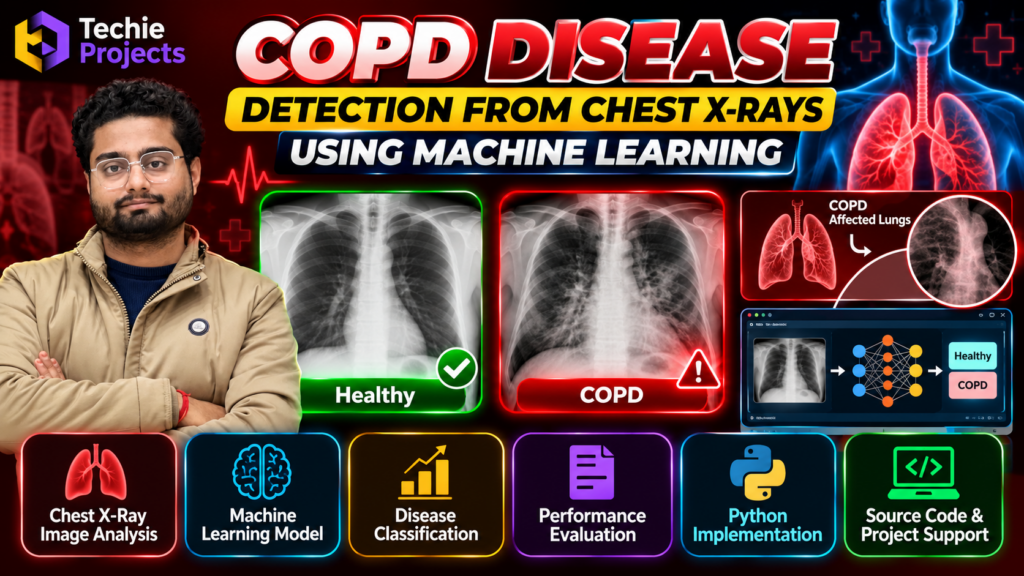
COPD disease detection using machine learning is an artificial intelligence project that explores how computer-based models can analyze chest X-ray images to support the study of Chronic Obstructive Pulmonary Disease (COPD). This project combines Python programming, machine learning, image processing, and medical image analysis to demonstrate how AI can be applied to healthcare-related research.
The COPD disease detection using machine learning project demonstrates how Python-based AI techniques can be explored for chest X-ray image classification and medical image analysis in an academic environment.
Chronic Obstructive Pulmonary Disease (COPD) is a long-term lung condition that can cause breathing difficulties, persistent coughing, and reduced airflow. Medical professionals assess COPD using clinical history, physical examinations, and lung function tests such as spirometry. Chest X-rays may help evaluate lung abnormalities and other conditions, but they cannot independently confirm COPD.
The COPD Disease Detection from Chest X-Rays Using Machine Learning project is designed for students who want to explore medical image classification and artificial intelligence through a practical implementation. It can be considered for B.Tech, B.E., M.Tech, computer science, artificial intelligence, machine learning, and final-year engineering project work.
At Techie Projects, students can enquire about this project for educational purposes, explore its implementation, and discuss project requirements or customization options.
🎬 COPD Disease Detection Using Machine Learning – Project Demo Video
Watch the project demonstration to understand the concept of analyzing chest X-ray images with machine learning. The demo introduces the project’s interface, image-processing workflow, and classification concept.
The demonstration can help students understand how a medical image analysis application is organized and how Python-based AI techniques can be applied in an academic project.
🎯 Project Overview
The COPD disease detection project demonstrates a machine learning workflow for processing chest X-ray images and generating model predictions based on the categories represented in the training dataset.
The system may include image uploading, preprocessing, model inference, result display, and a graphical user interface, depending on the implemented version.
Key project details
- 🎓 Project type: Final-year engineering and academic project
- 🫁 Application area: Healthcare research and medical image analysis
- 🧠 Core technology: Machine learning
- 🐍 Programming language: Python
- 🖼️ Input: Chest X-ray images
- 📊 Output: A model-generated classification or prediction
- 💻 Interface: A graphical interface or web interface, depending on implementation
- 🔬 Primary purpose: Educational demonstration of AI-based image analysis
The exact classification categories, model architecture, dataset, and performance metrics depend on the implementation supplied with the project.
💡 What Is COPD Disease Detection Using Machine Learning?
COPD disease detection using machine learning refers to the study of computational models that learn patterns from medical data and use those patterns to make predictions about new inputs.
In a typical image-classification workflow, a dataset is prepared, images are standardized, and a model is trained or loaded to classify images according to defined labels. The trained model can then process an image and return a prediction.
For this project, chest X-ray images are used to demonstrate the medical image processing pipeline. The model’s output must be interpreted carefully because a chest X-ray does not provide all the information needed to diagnose COPD.
This makes the project useful for learning about machine learning workflows, image preprocessing, model evaluation, and the limitations of AI in healthcare.
🚀 Objectives of the Project
The main objectives of the COPD disease detection project are:
- 🫁 To explore machine learning applications in respiratory health research.
- 🖼️ To process chest X-ray images using Python-based image processing techniques.
- 🧠 To demonstrate how a trained model generates image-classification predictions.
- 📊 To understand dataset preparation, training, testing, and model evaluation.
- 💻 To develop an application that presents the model output through a user-friendly interface.
- 🎓 To help engineering students understand the practical implementation of an AI-based healthcare project.
- 🔍 To study the challenges of applying machine learning to medical images.
These objectives can be adapted to the project requirements, academic syllabus, and implementation scope.
⚙️ How the COPD Disease Detection Project Works
The COPD disease detection using machine learning workflow can be divided into several stages.
A COPD disease detection using machine learning system typically involves image preprocessing, model inference, and prediction display, with performance depending on the training data and the model’s validation.
1. 📂 Dataset Collection
The first stage involves obtaining a suitable chest X-ray dataset with reliable labels and documented usage permissions. The dataset should be appropriate for the intended educational experiment.
Students should verify the source, label definitions, image quality, and any limitations in the dataset before using it.
2. 🖼️ Image Preprocessing
Medical images may have different dimensions, resolutions, and intensity distributions. Preprocessing helps prepare the images for the model.
Depending on the implementation, this stage may include:
- Resizing images to the required dimensions.
- Converting images into the expected color or grayscale format.
- Normalizing pixel values.
- Checking image files for errors.
- Preparing data in the format required by the model.
Consistent preprocessing is important because the input format used during inference should match the format expected by the trained model.
3. 🧠 Model Training or Loading
The next stage involves training a machine learning model or loading an already trained model.
A suitable implementation may use a convolutional neural network (CNN) or another image-classification architecture. The selected approach depends on the available dataset, project scope, and model requirements.
The model learns statistical patterns from training data. These patterns do not necessarily correspond to medically meaningful COPD indicators, so the results require careful evaluation.
4. 🔎 Image Prediction
After the model has been trained and evaluated, a new chest X-ray can be supplied to the application.
The system preprocesses the image and passes it to the model. The model then produces a prediction according to its learned parameters and the classes used during training.
The prediction is a computational output, not a confirmed medical diagnosis.
5. 📊 Result Display
The application may display the uploaded image and its predicted class through a graphical or web-based interface.
Depending on the implementation, the interface may also display a confidence score or other model output. Such scores should not be interpreted as a patient’s probability of having COPD unless that interpretation has been rigorously validated.
6. 🧪 Model Evaluation
Evaluation helps determine how the model performs on data that was not used for training.
Relevant metrics may include accuracy, precision, recall, F1-score, and a confusion matrix. These metrics should be calculated using a suitable evaluation dataset and reported honestly.
A high score on one dataset does not guarantee reliable performance on images from other hospitals, scanners, or patient populations.
✨ Important Features of the Project
The following features are possible components of a COPD disease detection application. The final feature set depends on the version supplied.
- 🖼️ Chest X-ray input: Allows users to select an image for processing.
- ⚙️ Image preprocessing: Prepares images for model inference.
- 🧠 Machine learning integration: Connects the application to a trained classification model.
- 📊 Prediction display: Presents the model’s output in a readable format.
- 💻 User interface: Makes the workflow easier to demonstrate.
- 🧪 Evaluation support: Helps students understand model performance metrics.
- 📁 Modular Python code: Can make the application easier to study and maintain.
- 🎓 Academic demonstration: Supports project presentations and technical discussions.
Before purchasing, ask which of these features are included in the available version.
🛠️ Technologies Used
A typical implementation may use the following technologies:
Programming language 🐍
Python is widely used for machine learning, image processing, and scientific computing.
Image processing 🖼️
OpenCV or Pillow may be used for loading, resizing, and preparing image files.
Machine learning 🧠
Depending on the model, the project may use TensorFlow, Keras, PyTorch, or scikit-learn.
Data handling 📊
NumPy and pandas may support numerical operations and dataset management.
User interface 💻
Tkinter, Flask, Streamlit, or another framework may be used to build the interface, depending on the implementation.
Note: These are possible technology choices, not a guarantee that every library is included in the supplied project. Confirm the actual requirements before purchasing.
💻 Software and Hardware Requirements
Software requirements
- Operating system: Windows or another compatible operating system.
- Python: A version compatible with the project’s dependencies.
- Required Python libraries and frameworks.
- Model file and configuration, if applicable.
- Dataset or sample images permitted for demonstration.
- Code editor such as Visual Studio Code or PyCharm.
Hardware requirements
- A computer or laptop.
- Adequate RAM and storage for the dataset and dependencies.
- A compatible CPU for basic inference.
- A supported GPU may be helpful for model training, but it is not necessarily required for every implementation.
The precise hardware requirements depend on the model size, image resolution, and whether training or only inference is required.
🎓 Who Can Choose This Project?
The COPD disease detection using machine learning project may be suitable for:
Students exploring COPD disease detection using machine learning can use this project to study Python programming, image classification, model evaluation, and healthcare AI limitations.
- B.Tech and B.E. Computer Science students.
- Artificial Intelligence and Machine Learning students.
- Information Technology students.
- Data Science students.
- M.Tech students exploring medical image analysis.
- Students interested in Python, computer vision, and healthcare AI.
It can be a useful starting point for understanding how an AI application is structured. Students should also study the underlying methods and be prepared to explain the dataset, algorithm, evaluation process, and limitations during their project presentation.
📈 Advantages of the Project
1. Practical machine learning experience
Students can explore the complete workflow, from image preprocessing to model inference.
2. Exposure to healthcare AI
The project introduces the challenges of using machine learning with medical images.
3. Python programming practice
Students can study data handling, model integration, error handling, and application development.
4. Understanding model evaluation
The project offers an opportunity to learn why accuracy alone is insufficient for evaluating a classification model.
5. Scope for further development
The implementation can be extended with additional evaluation tools, documentation, or interface improvements, subject to dataset availability and technical feasibility.
⚠️ Limitations and Important Considerations
Medical AI projects require more careful interpretation than many ordinary image-classification applications.
- A chest X-ray alone cannot reliably establish or exclude COPD.
- Model predictions may be affected by image quality, dataset bias, and differences between data sources.
- Performance measured on a small or unrepresentative dataset may not generalize to real clinical settings.
- A model may learn irrelevant image patterns instead of clinically meaningful features.
- Reported performance should be supported by reproducible testing.
- Patient data must be handled according to applicable privacy, consent, and data-use requirements.
This project is intended for education and research demonstration only. It is not a clinically validated diagnostic system and must not be used to diagnose, treat, or make healthcare decisions for patients. Medical assessment should be performed by qualified healthcare professionals.
🔮 Future Scope
Students can explore several possible extensions to the basic implementation.
Improved model evaluation
Use independent test data, class-specific precision and recall, confusion matrices, and appropriate validation methods.
Explainable AI
Investigate methods such as Grad-CAM to visualize image regions influencing a model’s output. These visualizations are exploratory and do not independently establish medical validity.
User interface improvements
Add clearer input validation, error messages, prediction summaries, and model information.
Dataset generalization
Evaluate how performance changes across different datasets, image sources, and patient groups.
Research extensions
With suitable datasets and clinical collaboration, future research could investigate additional respiratory conditions or combine imaging with other relevant clinical information.
These extensions require appropriate technical validation and, for clinical research, relevant ethical and regulatory oversight.
💰 Get the COPD Disease Detection Project from Techie Projects
Looking for a machine learning project for your final-year engineering work? Techie Projects provides a way to enquire about Python and AI-based project implementations and discuss your specific requirements.
When contacting us about the COPD disease detection project, share your course, project deadline, preferred interface, and any college-specific requirements. This helps us clarify whether the available implementation fits your needs.
📦 What should you confirm before purchasing?
Ask about the following items before placing an order:
- ✅ Available source code and project files.
- ✅ Confirmed software and library requirements.
- ✅ Installation and execution instructions.
- ✅ Dataset and model availability, including usage permissions.
- ✅ Documentation and report availability.
- ✅ Demonstration and customization options.
- ✅ Delivery timeline, price, and support terms.
The exact deliverables depend on the package agreed upon with Techie Projects. Please confirm these details before making payment.
📲 Contact Techie Projects
Interested in the COPD Disease Detection Using Machine Learning project?
- 📲 Call/WhatsApp: +91-9460060699
- 🌎 Website: www.techieprojects.com
- 📺 Instagram: @pythonprojects_
Send a message with your course, deadline, and required features to discuss availability and customization.
🎓 Explore Related Projects
If you are interested in medical image analysis, deep learning, and healthcare applications, explore these related project areas:
- 🧠 Brain Tumor Detection Using Machine Learning
- 🩺 Brain Stroke Detection Using Machine Learning
- 🎗️ Breast Cancer Prediction Using Deep Learning
- 🖼️ Medical Image Classification Using Deep Learning
- 🐍 Machine Learning Projects Using Python
- 🔬 Deep Learning Projects for Final-Year Students
Explore related project collections on the Techie Projects website and enquire about the availability of specific implementations. Individual project pages and deliverables should be verified before linking or purchasing.
❓ Frequently Asked Questions (FAQs)
1. What is the COPD disease detection using machine learning project?
It is an educational AI project that demonstrates how machine learning techniques can process chest X-ray images and generate model predictions. It is not a substitute for medical diagnosis.
2. Which programming language is used?
Python is a common choice for this type of project. The exact programming language and libraries should be confirmed for the version being offered.
3. Is this project suitable for final-year engineering students?
It may be suitable for students studying Computer Science, Information Technology, AI, Machine Learning, or Data Science, depending on their syllabus and project requirements.
4. Does the system accurately diagnose COPD?
The project should not be described as a clinically accurate diagnostic system without appropriate clinical validation. COPD assessment typically involves clinical evaluation and lung function testing, including spirometry.
5. Can I customize the project?
Customization may be possible depending on the available source code, dataset, model, and requested features. Contact Techie Projects to discuss feasibility, cost, and delivery time.
6. Can I run the project on a normal laptop?
A laptop may be sufficient for a lightweight implementation or model inference. Training a larger model can require more memory and computing resources. Check the actual requirements before purchasing.
7. What should I check before buying the project?
Confirm the source code, dependencies, model files, dataset permissions, installation instructions, documentation, and support terms. Also ask for a demonstration of the actual implementation.
8. How can I enquire about the project?
Contact Techie Projects through WhatsApp. Share your course, deadline, and required deliverables so that availability and pricing can be discussed.
🏁 Conclusion
The COPD disease detection using machine learning project introduces students to Python programming, medical image processing, image classification, and AI-based application development. It provides an opportunity to study how machine learning models are integrated into an application and how their outputs should be evaluated and interpreted.
For students planning a final-year engineering project, the implementation can serve as an educational starting point for exploring healthcare AI, provided its limitations are clearly understood and its results are not treated as medical advice.
📲 Want to explore this project for your academic work? Contact Techie Projects on WhatsApp to ask about project availability, source code, requirements, and customization options.
Educational disclaimer: This project is intended for academic demonstration and research learning. It is not a clinically validated COPD diagnostic tool. Do not use its predictions to make medical decisions.