
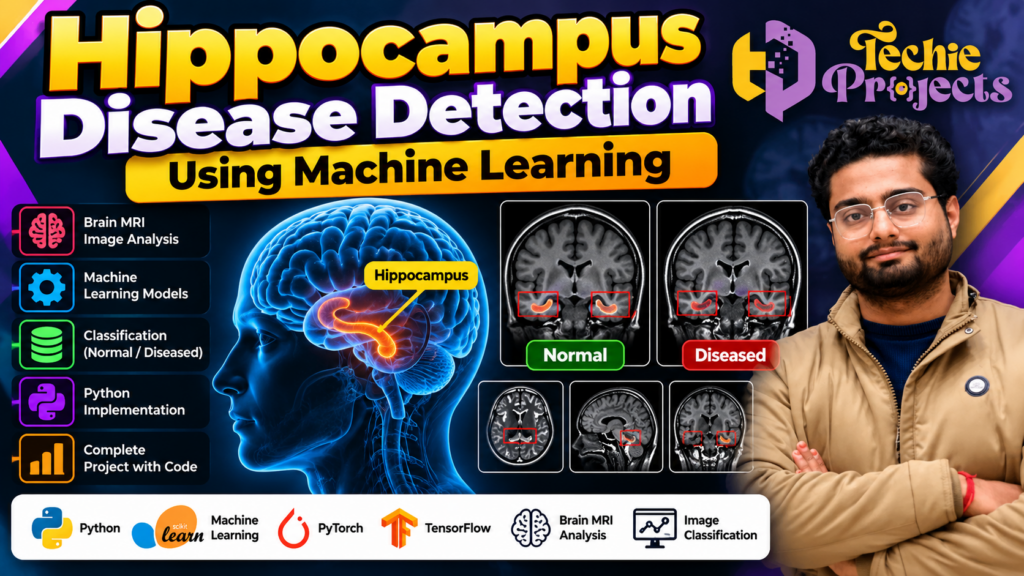
Looking for an impressive Hippocampus Disease Detection Using Machine Learning project for your final-year engineering submission? Explore this medical image analysis project from Techie Projects and learn how Python and machine learning techniques can be applied to brain MRI image classification. It is a relevant project topic for students interested in Artificial Intelligence, Machine Learning, Deep Learning, medical image processing, and healthcare technology.
If you want to save time researching project ideas and building an implementation from scratch, contact Techie Projects to enquire about the project package, available source code, installation requirements, demonstration, and documentation. Confirm the exact deliverables and compatibility with your academic requirements before purchasing.
This project offers an opportunity to explore how machine learning can support the analysis of hippocampus-related MRI images in a research or educational setting. It also provides a practical way to understand image preprocessing, feature learning, model training, and classification workflows.
🎬 Watch the Hippocampus Disease Detection Project Demo
Explore the Hippocampus Disease Detection Using Machine Learning project demonstration to understand its interface, example inputs, and displayed outputs. The demonstration can help you evaluate whether the project matches your interests and academic requirements.
🧠 What Is Hippocampus Disease Detection Using Machine Learning?
The hippocampus is a brain structure associated with learning, memory, and spatial navigation. Researchers study hippocampal structure and changes in medical imaging to investigate several neurological conditions.
Hippocampus Disease Detection Using Machine Learning is an educational project concept that explores the use of computational techniques to analyse brain MRI images and classify image samples according to predefined categories.
Depending on the dataset, model, and implementation, the project may involve image classification, preprocessing, model evaluation, or analysis of hippocampus-related regions. The actual functions depend on the specific implementation and should be verified before purchase.
Machine learning models learn patterns from training data and use those patterns to predict labels for new inputs. In medical image research, this approach can help demonstrate how computational methods are applied to complex image datasets.
It is important to understand that an academic prototype is not a clinically validated diagnostic system. Its predictions should not be used to diagnose a patient or replace qualified medical professionals.
🎯 Why Choose This Machine Learning Project for Your Final Year?
Engineering students often need a project that demonstrates technical understanding, has a clear application area, and can be explained during a project presentation. This topic combines several relevant concepts from computer science and healthcare technology.
1. Practical application of artificial intelligence
The project introduces a real-world research area where machine learning and medical imaging intersect. Students can explore how computational models process image data and generate predictions.
2. Python programming experience
Python is widely used in machine learning and image analysis. Working with a Python-based project can help students understand data handling, model execution, image processing, and software dependencies.
3. Understanding medical image analysis
Brain MRI images provide an opportunity to study image formats, preprocessing techniques, dataset preparation, and classification workflows.
4. Relevant for academic presentations
The topic can support discussions about dataset selection, model architecture, training procedures, evaluation metrics, limitations, and ethical considerations.
5. Scope for further learning
Students can investigate additional techniques such as transfer learning, image augmentation, model comparison, and explainable AI if they are supported by the project and permitted by the available dataset.
⚙️ How Does the Project Work?
A typical machine learning workflow for medical image classification includes several stages. The precise workflow depends on the model and source code used in the implementation.
Step 1: Collect and prepare MRI images
The process begins with an appropriate, legally usable dataset of brain MRI images. Students should review the dataset source, labels, image quality, and permitted use.
Step 2: Preprocess the images
Image preprocessing can include resizing, normalisation, format conversion, and other transformations required by the selected model. Consistent preprocessing helps ensure that images are presented to the model in the expected format.
Step 3: Prepare training and testing data
The dataset is divided into suitable subsets for training, validation, and testing. Careful separation is important to reduce data leakage and obtain a more realistic estimate of model performance.
Step 4: Train or load the machine learning model
Depending on the implementation, a model may be trained using labelled data or loaded from an existing trained checkpoint. A convolutional neural network (CNN) is one possible approach for image classification, but the actual model should be confirmed from the project files.
Step 5: Generate predictions
The model processes an input image and returns a predicted class or score according to its training and configuration. These outputs must be interpreted in the context of the dataset and evaluation results.
Step 6: Evaluate performance
Suitable evaluation methods may include accuracy, precision, recall, F1-score, a confusion matrix, and validation results. In medical research, class imbalance and the consequences of false predictions also need careful consideration.
💻 Technologies Used in the Project
The following technologies are commonly relevant to a Python-based medical image classification project. Verify the actual packages and versions in the implementation before installation.
- Python: Programming language for data processing and model execution.
- Machine Learning: Methods for learning patterns from labelled data.
- Deep Learning: Neural network techniques that may be used for image classification.
- Medical Image Processing: Techniques for preparing and analysing MRI images.
- NumPy and Pandas: Libraries that may support numerical operations and dataset management.
- OpenCV or Pillow: Image-processing libraries that may be used for loading and transforming images.
- TensorFlow or PyTorch: Potential deep learning frameworks, depending on the implementation.
- Matplotlib: A library that may be used to display images, charts, or training results.
The final technology stack should be based on the actual source code rather than assuming that every listed library is included.
📊 Important Features to Evaluate
Before purchasing the project, check which of the following features are actually available:
- MRI image input and preprocessing.
- Model-based image classification.
- A user interface for submitting images, if implemented.
- Prediction labels or confidence scores, if supported.
- Model evaluation results and performance metrics.
- Training scripts, model files, and dataset instructions, where included.
- Installation instructions and a project demonstration.
- Documentation and explanations of the implementation, where offered.
These are evaluation points, not a guarantee that every feature is included in the available package. Ask Techie Projects to confirm the exact scope before placing an order.
🎓 What Can Students Learn?
The project can provide a structured learning opportunity for students working in Artificial Intelligence, Machine Learning, Data Science, and Computer Vision.
Students may explore how image datasets are organised, how preprocessing affects model inputs, and how classification algorithms learn from examples. They can also learn to distinguish training performance from performance on unseen data.
Another important learning outcome is understanding the limitations of machine learning. A model may perform well on one dataset but fail on images collected from another source. Differences in scanners, image quality, patient populations, and labelling practices can affect performance.
For an academic presentation, students should be prepared to explain the dataset, preprocessing steps, model selection, evaluation method, observed results, and limitations. Understanding these elements is more valuable than simply demonstrating a prediction screen.
🏥 Potential Applications and Research Areas
Hippocampus-related MRI analysis is relevant to several areas of medical imaging research. Depending on the dataset and research objective, related work may investigate:
- Brain MRI image classification.
- Research into structural changes in the hippocampus.
- Medical image segmentation and region analysis.
- Evaluation of deep learning methods on neurological imaging datasets.
- Educational demonstrations of AI-assisted medical image analysis.
- Comparative studies of machine learning models.
These are broader research applications rather than guaranteed capabilities of this specific project. Any claim about detecting a particular disease must be supported by the actual dataset, model validation, and appropriate clinical evidence.
⚠️ Limitations and Responsible Use
Medical machine learning projects require careful interpretation. A prediction is not proof that a person has a disease, and an educational model should not be used to make healthcare decisions.
Performance depends on the quality and representativeness of the dataset, the correctness of its labels, the model architecture, and the evaluation process. Results from a small or limited dataset may not generalise to other populations or clinical environments.
Students should also respect dataset licensing, patient privacy, and institutional requirements. If the project is intended for academic assessment, review your institution’s rules on project assistance, reuse of code, citations, and original work.
🧠 Benefits of Hippocampus Disease Detection Using Machine Learning
Hippocampus Disease Detection Using Machine Learning is a useful academic topic for students interested in Python, medical image processing, and artificial intelligence. It demonstrates how machine learning techniques can be explored to analyse brain MRI images and classify image samples.
Key learning benefits include:
- Python implementation: Understand how Python supports image processing and machine learning workflows.
- MRI image analysis: Explore image preparation, resizing, normalisation, and dataset organisation.
- Machine learning classification: Learn how models identify patterns in labelled image datasets.
- Model evaluation: Study accuracy, precision, recall, F1-score, and confusion matrices where applicable.
- Healthcare AI research: Understand potential applications and limitations of computational methods in medical imaging.
The actual features and results depend on the dataset, model, and implementation used in the project.
⚙️ How Hippocampus Disease Detection Using Machine Learning Works
A typical Hippocampus Disease Detection Using Machine Learning workflow starts with collecting an appropriate brain MRI dataset. Images are prepared using suitable preprocessing techniques before being passed to a trained classification model.
The model processes image inputs and produces predictions based on patterns learned from the training data. Researchers can then evaluate its performance using a separate test dataset and appropriate classification metrics.
This workflow helps students understand the relationship between image quality, dataset preparation, model training, and prediction performance. It also highlights why reliable testing and careful interpretation are essential in medical image analysis.
🎓 Why Choose Hippocampus Disease Detection Using Machine Learning for Your Final-Year Project?
Hippocampus Disease Detection Using Machine Learning combines programming, image processing, and AI concepts in one healthcare-related project topic. It can be relevant for Computer Science, Artificial Intelligence, Data Science, and Machine Learning students.
Students can use the topic to explore data preparation, classification algorithms, model evaluation, and responsible AI development. Before selecting the project, confirm that its implementation, complexity, and available deliverables match your college’s requirements.
🛒 Enquire About the Hippocampus Disease Detection Using Machine Learning Project
Interested in purchasing the Hippocampus Disease Detection Using Machine Learning project for academic learning? Contact Techie Projects to confirm the current price, source-code availability, installation requirements, documentation, and included deliverables.
Visit Techie Projects or send your enquiry through WhatsApp. Please confirm the package details before purchasing.
📲 Call/WhatsApp: +91-9460060699
🌎 Website: www.techieprojects.com
📺 Instagram: @pythonprojects_
When enquiring, mention the project title and ask for the current deliverables, supported software versions, and any requirements you need to complete your academic work.
🔗 Explore Related Python Projects
If you are interested in similar topics, explore related project areas on Techie Projects:
- Machine Learning Projects
- Deep Learning Projects
- Python Projects
- Computer Vision Projects
- Artificial Intelligence Projects
- Data Science Projects
- Image Processing Projects
These categories can help you compare different project topics and select one that suits your course, interests, and technical skill level.
❓ Frequently Asked Questions
1. What is Hippocampus Disease Detection Using Machine Learning?
It is an educational project concept that applies machine learning techniques to brain MRI image analysis and classification. Its exact purpose and output depend on the dataset and implementation.
2. Which programming language is used?
Python is commonly used for this type of project. Check the actual project package for its programming language, libraries, and supported versions.
3. Is this project suitable for final-year engineering students?
It may be suitable for students studying Computer Science, Artificial Intelligence, Machine Learning, or Data Science, subject to their syllabus and institutional requirements.
4. Does the project provide a medically accurate diagnosis?
An academic prototype should not be considered a clinically validated diagnostic tool. Medical diagnosis requires appropriate clinical evaluation by qualified professionals.
5. Can I purchase the project from Techie Projects?
You can contact Techie Projects through the website or WhatsApp to ask about availability, pricing, source code, documentation, installation requirements, and other deliverables.
6. What should I check before purchasing?
Confirm the included files, supported software versions, dataset permissions, installation instructions, model details, documentation, and any support or delivery terms.
✅ Conclusion
Hippocampus Disease Detection Using Machine Learning is a valuable topic for exploring the intersection of artificial intelligence, Python programming, and medical image analysis. It introduces students to image preprocessing, model-based classification, performance evaluation, and the challenges of applying machine learning to healthcare-related data.
If you are considering this topic for your final-year project, contact Techie Projects to confirm the current package details and determine whether the implementation matches your academic requirements. Review the available demonstration, technical requirements, and deliverables before purchasing.
Visit Techie Projects or enquire directly through WhatsApp to discuss the project and available options.