
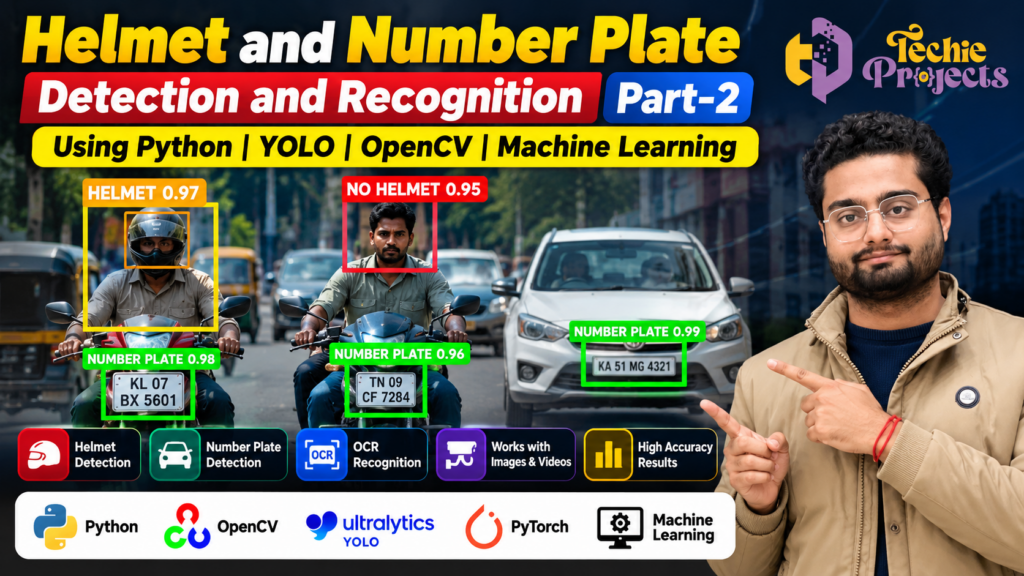
Helmet and Number Plate Detection Using Python, YOLO and OpenCV – Part 2
Looking for a practical Helmet and Number Plate Detection project for your final-year engineering submission? Choose a computer vision project that brings together helmet recognition, vehicle number plate detection, and machine learning in one application. Techie Projects helps engineering students explore practical Python-based project options for Computer Science, Information Technology, Artificial Intelligence, and Data Science.
If you want to demonstrate how AI can identify helmet-related classes and locate vehicle number plates in images or videos, this project is worth exploring. Instead of beginning with an unfamiliar implementation, enquire about the available project package, review the demonstration, and confirm the included code, installation requirements, and documentation before purchasing.
Get started with Techie Projects: Visit https://techieprojects.com/ or contact us on WhatsApp to check current availability, pricing, and project deliverables.
🎬 Watch the Helmet and Number Plate Detection Project Demo
Explore the Helmet and Number Plate Detection project demonstration to understand how the application processes visual input and displays detection results.
The demonstration can help you see how helmet-related classes and vehicle number plates may be identified using a computer vision workflow. Actual output depends on the model, training data, input quality, and implementation included in the project.
🚗 What Is Helmet and Number Plate Detection?
Helmet and Number Plate Detection is a computer vision application that combines two visual recognition tasks. The first involves detecting helmets or identifying supported helmet-related classes. The second involves locating vehicle number plates in images or video frames.
Python provides the programming environment, while YOLO-based object detection can locate relevant objects. OpenCV can support image and video processing, and an optical character recognition (OCR) component may be used to extract text from a detected number plate if that functionality is included in the implementation.
Combining these tasks creates an interesting project for students who want to explore object detection, image processing, and machine learning through a practical use case.
The exact recognition capabilities depend on the model and its trained classes. Detecting a number plate is different from accurately reading its characters, so the detection and OCR stages should be evaluated separately.
🎯 Why Choose This Python Computer Vision Project?
A strong engineering project should offer more than a title. It should give students an opportunity to understand the technology, demonstrate its output, and explain the practical problem it addresses.
1. Explore two computer vision tasks
This project combines helmet-related detection with vehicle number plate localization. Students can examine how different object classes are detected and how the application presents the results.
2. Understand YOLO object detection
YOLO models are designed to locate objects and predict their classes. Working with a YOLO-based application can help students understand bounding boxes, confidence scores, model inference, and detection errors.
3. Learn Python and OpenCV
Python is widely used for AI development, and OpenCV provides tools for image and video processing. This project can help students understand how these technologies contribute to a computer vision pipeline.
4. Demonstrate a practical application
Vehicle monitoring and road-safety research provide understandable contexts for discussing visual recognition. Students can use the project to explain the relationship between a real-world problem and an AI-based approach.
5. Support an academic presentation
A computer vision demonstration can form part of a project review, technical presentation, or viva, subject to the requirements of your institution. Understanding the code and limitations is essential before presenting the work.
🚗 Benefits of Helmet and Number Plate Detection for Students
Helmet and Number Plate Detection is a useful topic for students exploring artificial intelligence, Python programming, and computer vision. It combines object detection with the possibility of number plate text recognition, helping students understand how multiple image-processing tasks can work together.
Students can investigate model predictions, compare detection results, test different input images, and study how lighting and image quality affect accuracy. These activities can also provide useful material for a project presentation and technical viva.
⚙️ How the Helmet and Number Plate Detection System Works
The workflow may vary depending on the selected implementation, but a typical system follows these stages.
Step 1: Input image or video
The application receives an image, recorded video, or supported camera stream. The input must be compatible with the project’s processing pipeline.
Step 2: Frame processing
For video input, the application reads frames for analysis. OpenCV may be used to read video, resize images, convert colour formats, and display the processed output.
Step 3: Helmet detection
A trained object detection model examines the image and predicts supported helmet-related classes. Depending on its training, the model may distinguish between helmet and no-helmet categories.
Step 4: Number plate localization
A detection model locates vehicle number plate regions and marks them with bounding boxes. Detection quality can vary with distance, motion blur, lighting, camera angle, and plate visibility.
Step 5: Character recognition
If OCR is included, the detected number plate region can be processed to recognize its characters. OCR output may contain errors, particularly when the plate is blurry, obstructed, tilted, or poorly illuminated.
Step 6: Display and review results
The application displays the available predictions, such as bounding boxes, class labels, confidence scores, or recognized text. Users should review the output rather than assuming every prediction is correct.
🧰 Technologies Used in Helmet and Number Plate Detection
The following technologies are commonly used for projects in this category. The exact software stack depends on the implementation available for purchase.
- Python: Core programming language.
- YOLO: Object detection for locating supported objects.
- OpenCV: Image and video processing.
- OCR: A possible component for reading characters from detected number plates.
- PyTorch: A deep learning framework used by many YOLO implementations.
- Ultralytics: A framework used with supported YOLO models.
- Machine Learning: Techniques used to train and evaluate visual recognition models.
Confirm the actual libraries, model versions, and installation requirements with Techie Projects before purchasing.
🚀 Key Features of the Project
Depending on the selected implementation, the project may demonstrate capabilities such as:
- Helmet-related object detection.
- Vehicle number plate localization.
- Bounding boxes and class labels.
- Confidence scores for model predictions.
- Processing of supported images or videos.
- Visual presentation of detection results.
- OCR-based number plate text recognition, if included.
- An opportunity to study multiple computer vision tasks in one application.
Do not assume that features such as live camera monitoring, automatic challan generation, database integration, report generation, or cloud deployment are included unless they are confirmed in the package.
🏍️ Real-World Applications
Road-safety research
Helmet detection can be studied as a visual method for identifying helmet-related classes in road footage. Real-world safety decisions require appropriate validation and human oversight.
Vehicle monitoring
Number plate localization can support research into vehicle identification workflows. Reading the plate accurately requires a suitable recognition component and appropriate input quality.
Smart surveillance prototypes
Students can explore how object detection fits into a broader surveillance prototype and investigate the technical challenges of processing real-world footage.
Academic and research projects
The project provides opportunities to compare model predictions, test sample images, investigate recognition errors, and discuss the limitations of automated visual systems.
These applications describe possible uses of the technology; they do not imply that an educational project is a certified traffic enforcement or surveillance system.
⚙️ Challenges in Helmet and Number Plate Detection
Developing a reliable Helmet and Number Plate Detection application involves several technical challenges. Small or distant objects, poor lighting, motion blur, and partially hidden number plates can affect detection quality. OCR may also misread characters when the plate image is unclear.
Understanding these limitations helps students explain why model testing and evaluation are important. The output should be checked carefully rather than treated as completely accurate.
🎓 Learning Outcomes for Engineering Students
By studying this project, students can explore:
- Python programming and computer vision libraries.
- Object detection and bounding-box interpretation.
- Image and video frame processing.
- The difference between object localization and text recognition.
- Model confidence scores and prediction errors.
- The effect of lighting, angle, and image quality on results.
- Software installation, testing, and debugging.
- Technical documentation and project presentation.
For a strong viva, students should be able to explain the workflow, identify the model’s classes, describe how the output is generated, and discuss the system’s limitations.
💻 Software and Hardware Requirements
Requirements depend on the YOLO model, Python version, and installed dependencies.
Software requirements
A typical setup may use:
- Windows or Linux.
- A compatible Python environment.
- OpenCV.
- The required YOLO framework and model weights.
- PyTorch or the framework required by the selected model.
- An OCR library, if text recognition is part of the implementation.
- Visual Studio Code or another suitable code editor.
Hardware requirements
A modern computer with sufficient RAM and storage is generally useful. Some models can run on a CPU, while a compatible GPU may accelerate inference. Actual performance depends on the model size and software configuration.
Always check the project’s specific system requirements before purchasing.
🛒 Purchase the Helmet and Number Plate Detection Project
Interested in exploring Helmet and Number Plate Detection for your engineering project? Contact Techie Projects to enquire about the available implementation, pricing, software requirements, and package contents.
Before ordering, confirm whether the package includes source code, model weights, installation instructions, project documentation, a demonstration, and technical support. These items can vary by package, so choose an option that matches your academic requirements and computer configuration.
Contact Techie Projects today:
- 📲 Call/WhatsApp: +91-9460060699
- 🌎 Website: www.techieprojects.com
- 📺 Instagram: @pythonprojects_
Send an enquiry to discuss your requirements and confirm the available package before purchasing.
🎓 Recommended Computer Vision Projects
Explore these related project ideas if you are interested in Python, machine learning, and image processing:
- Helmet Detection on Construction Sites – Identify supported helmet-related classes in construction footage.
- Car Number Plate Detection Using Python – Locate number plates in vehicle images.
- Vehicle Detection and Counting System – Detect vehicles and count them in supported video footage.
- Pothole Detection System – Explore visual road-defect detection.
- Garbage Detection Using YOLO – Detect supported waste categories.
- Fire and Smoke Detection – Explore visual identification of fire and smoke.
- Real-Time Object Detection Using Python – Demonstrate object localization and classification.
Project features and availability should be checked individually.
❓ Frequently Asked Questions
What is Helmet and Number Plate Detection using Python?
It is a computer vision application that can detect helmet-related classes and locate vehicle number plates using suitable trained models. OCR may be used to read plate characters if it is included in the implementation.
Which technologies are used?
Python, YOLO, and OpenCV are common technologies for this type of project. PyTorch and OCR libraries may also be used, depending on the implementation.
Can the project process video?
Video processing is possible in implementations that support video input. Confirm whether the available package supports recorded video, live camera input, or both.
Is number plate detection the same as number plate recognition?
No. Detection locates the plate in an image. Recognition attempts to read the characters from that plate. Recognition may require an OCR component.
Is this project suitable for final-year engineering students?
It may be appropriate for computer science, IT, AI, or data science coursework, depending on institutional requirements. Confirm the project scope with your faculty guide.
How can I purchase the project?
Visit Techie Projects or contact WhatsApp to enquire about availability, pricing, and package contents.
✅ Conclusion
The Helmet and Number Plate Detection project using Python, YOLO, and OpenCV offers an opportunity to explore two practical computer vision tasks within one application. From locating helmets and number plates to understanding model predictions and potential OCR output, the project connects programming concepts with real-world visual recognition challenges.
If you are looking for a computer vision project for your engineering submission, contact Techie Projects to check the current package and its deliverables. Confirm the software requirements and included materials before purchasing, and make sure you understand the implementation well enough to demonstrate and explain it.
Explore your project options: Visit Techie Projects | Enquire on WhatsApp