
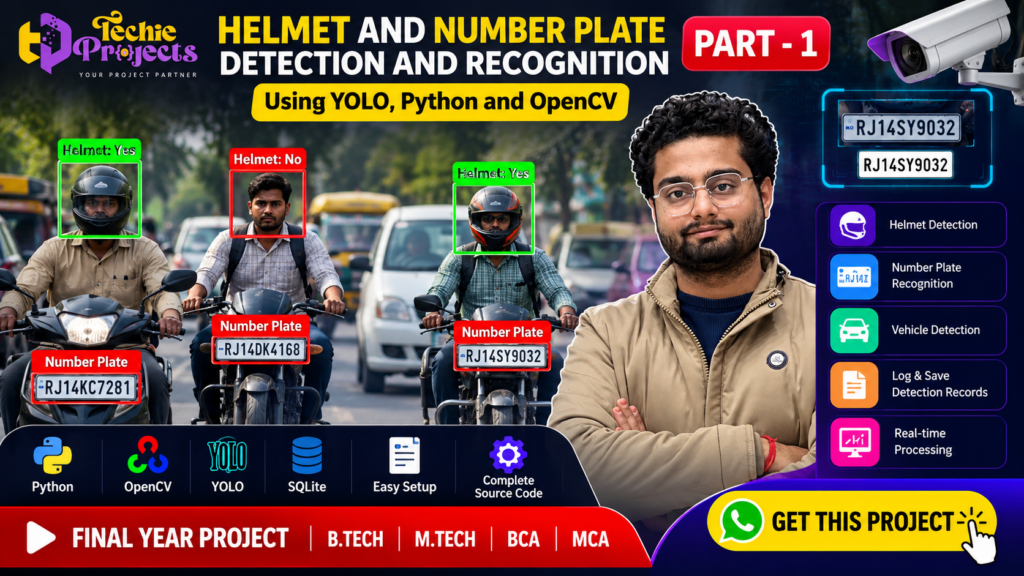
Looking for a practical final-year engineering project that combines Artificial Intelligence, Python, and real-time computer vision? The Helmet and Number Plate Detection Using YOLO project is an excellent topic to explore if you want to understand object detection, vehicle monitoring, helmet compliance detection, and number plate recognition in a single application.
At Techie Projects, we help students explore practical software and AI project solutions for academic learning. If you want to purchase this project, you can contact our team to discuss the available implementation, source code, installation requirements, documentation, and technical support. Instead of spending weeks assembling unrelated code examples, you can enquire about a project package that matches your requirements and use it as a foundation for understanding computer vision.
Whether you are pursuing B.Tech, M.Tech, BCA, MCA, or another technical course, this project can help you study how machine learning models detect objects in images or video and how number plate recognition can be integrated into a software workflow.
Want to get started? Contact Techie Projects on WhatsApp to ask about project availability, pricing, deliverables, and customization options.
📲 Request project details and pricing:
- 📲 Call/WhatsApp: +91-9460060699
- 🌎 Website: www.techieprojects.com
- 📺 Instagram: @pythonprojects_
🎬 Helmet and Number Plate Detection Using YOLO – Project Demo
Watch the project demonstration to understand how the application processes vehicle images or video, detects helmet-related classes, identifies number plates, and displays detection results.
The demonstration should reflect the actual project implementation and its supported features. Review the output and system requirements before deciding whether the project meets your academic needs.
🎯 What Is Helmet and Number Plate Detection Using YOLO?
Helmet and number plate detection is a computer vision application designed to analyze images or video frames of vehicles and identify selected visual objects. Depending on the trained model and implementation, these may include motorcycles, riders wearing helmets, riders without helmets, and vehicle number plates.
YOLO, which stands for You Only Look Once, is a family of object detection models used to locate and classify objects in images. It predicts object locations and classes, allowing software to process frames and display detection results.
In this project, Python provides the application logic, while computer vision and recognition components handle image processing and detection. OpenCV can be used for reading video streams, displaying frames, drawing bounding boxes, and presenting the results.
Number plate recognition may use an additional optical character recognition (OCR) component to extract text from a detected plate. The exact recognition method depends on the implementation.
The goal is to demonstrate how multiple computer vision tasks can work together in a practical vehicle-monitoring application.
🚀 Key Features of the Project
The features below describe common capabilities for this type of system. Confirm which features are included in the specific package before purchasing.
1. 🪖 Helmet Detection
The detection model can classify riders according to the helmet-related classes it was trained to recognize. For example, a model may distinguish between helmet-wearing and non-helmet-wearing riders.
The result can be displayed using labeled bounding boxes and confidence scores. Detection quality depends on the training data, camera angle, lighting, image quality, and model performance.
2. 🚘 Number Plate Detection
The application can identify a vehicle’s number plate region in a frame. The system may highlight the plate with a bounding box so that the region can be processed further.
A reliable implementation should account for variations in plate size, vehicle movement, image resolution, and environmental conditions.
3. 🔤 Number Plate Text Recognition
After detecting a plate, an OCR component may extract its visible characters. This allows the system to associate detected vehicles with recognized plate text.
Recognition can fail when plates are blurred, partially hidden, poorly illuminated, or captured at an unusual angle. Results should be validated rather than treated as automatically correct.
4. 🎥 Video-Based Detection
With a compatible video input, the system can process frames and show the detection results. Depending on the implementation, input may come from a recorded video or a supported camera.
Performance depends on the model, processing hardware, video resolution, and frame rate.
5. 📋 Detection Records
Some implementations can store selected detection information in a database or file. Records may include timestamps, recognized text, or paths to captured images, depending on the design.
If your required package includes database functionality, confirm which fields are saved and how the records can be viewed or exported.
6. 📊 Visual Results
Bounding boxes, class labels, and confidence scores help users interpret what the model has detected. A results interface can make demonstrations easier to understand and can support project evaluation.
7. 📧 Optional Notification Workflow
A notification or email workflow can be added when supported by the implementation. For example, a system may send a record for review after a detection event.
Automatic challan generation or issuing a legal traffic penalty is a separate process involving authorization, verification, and integration with official systems. Do not assume that detection alone creates a legally valid challan; confirm the actual functionality included in the project.
🎯 Benefits of Helmet and Number Plate Detection Using YOLO
The Helmet and Number Plate Detection Using YOLO project helps students explore practical applications of Python, Artificial Intelligence, and computer vision. It combines object detection with a number plate recognition workflow, making it useful for learning how multiple software components work together.
Students can study image processing, model inference, bounding box visualization, and optional optical character recognition (OCR). The project can also provide a foundation for experimenting with different detection models and evaluating their performance under varied lighting and traffic conditions.
⚙️ Technologies Used
Python
Python is the primary programming language for implementing the application logic and connecting computer vision components. Its libraries make it suitable for image processing, model inference, data storage, and application development.
YOLO Object Detection
YOLO is used to detect and classify objects in images or video frames. The specific model version should be confirmed from the project files because different versions have different dependencies and hardware requirements.
OpenCV
OpenCV supports image and video processing. It can read frames, resize images, draw detection boxes, display results, and support camera input.
OCR for Number Plate Recognition
An OCR library or recognition model can convert the detected number plate image into text. The chosen tool depends on the implementation and should be identified in the installation documentation.
Database and Storage
A database such as SQLite may be used to store detection records if included. Alternatively, the application may save results to files or use another storage method.
Development Environment
The project may require Python, a code editor, compatible libraries, model weights, and sample videos. Confirm the actual dependency list and versions before installation.
🖥️ Software and Hardware Requirements
The precise requirements depend on the YOLO model, image resolution, OCR component, and implementation.
Typical software requirements may include:
- Python in a version compatible with the project dependencies
- OpenCV for image and video processing
- A compatible YOLO implementation and its required packages
- OCR dependencies, if number plate text recognition is included
- A code editor such as Visual Studio Code
- Model weights and suitable test images or videos
- Database software or libraries, if record storage is included
A modern laptop may be sufficient for basic testing, although inference speed can vary significantly. A compatible NVIDIA GPU can improve performance for some configurations, but a GPU is not automatically required for every implementation.
Before purchasing, ask Techie Projects for the tested Python version, installation steps, model requirements, sample inputs, and recommended hardware.
🔄 How the System Works
The following workflow explains the typical operation of a helmet and number plate recognition application.
Step 1: Capture an Image or Video
The application receives an image, recorded video, or supported camera stream. The input is prepared for processing.
Step 2: Preprocess the Frame
The frame may be resized or converted into the format expected by the detection model. Preprocessing helps make the input compatible with the model.
Step 3: Detect Objects Using YOLO
The detection model processes the frame and predicts the locations and classes of objects it recognizes. Depending on its training, these may include motorcycles, people, helmets, or number plates.
Step 4: Identify Helmet-Related Classes
The system examines the detected classes to determine whether the expected helmet-related conditions are present. The classification depends on the model’s training and the quality of the video.
Step 5: Locate the Number Plate
A plate detector identifies the number plate region. The system may crop this region and prepare it for text recognition.
Step 6: Recognize the Plate Text
If OCR is implemented, the cropped plate is passed to the recognition component. The resulting text may need formatting or validation.
Step 7: Display or Store Results
The application displays annotated frames and may store selected records. Optional notification features can be configured if supported by the implementation.
This workflow illustrates the underlying concept; the exact sequence and supported functions should be verified against the project you purchase.
🧪 Applications of Helmet and Number Plate Detection Using YOLO
A helmet and number plate detection system can be explored in vehicle monitoring, road safety research, and intelligent transportation prototypes. Depending on the implementation, the application may identify helmet-related classes, detect number plates, and extract visible plate text.
The Helmet and Number Plate Detection Using YOLO project is also useful for demonstrating computer vision concepts in academic presentations. Detection results should be verified because poor lighting, motion blur, occlusion, and incorrect model predictions can affect reliability.
🎓 Why Is This a Good Final-Year Engineering Project?
This project combines several technical concepts in one application, making it useful for students who want to study computer vision and AI-based software development.
Computer Science and Engineering students can explore object detection, Python programming, model inference, databases, and application integration.
Artificial Intelligence and Machine Learning students can examine training data, object detection classes, model evaluation, confidence thresholds, and recognition limitations.
Electronics and related engineering students may explore camera inputs, edge computing, and the integration of software with compatible monitoring hardware.
The project’s scope can be adjusted according to academic requirements. A basic implementation might focus on image-based detection, while an advanced version could investigate video processing, recognition accuracy, data storage, or deployment.
For a strong academic submission, document your own testing, explain the model’s limitations, and follow your institution’s rules regarding purchased code and external assistance.
🛒 Get Helmet and Number Plate Detection Using YOLO from Techie Projects
Looking for a practical Python computer vision project for your academic work? Techie Projects can help you explore available project packages and discuss source code, installation instructions, documentation, and technical assistance.
Contact us to confirm the features, package inclusions, pricing, and customization options for the Helmet and Number Plate Detection Using YOLO project before purchasing.
Instagram: Techie Projects
Website: Techie Projects
WhatsApp: +91 94600 60699
Email: techieprojectshelp@gmail.com
What Should You Confirm Before Ordering?
Ask about the following items:
- Source code: Confirm the files and components included.
- Installation guide: Check whether setup instructions and dependency versions are provided.
- Project report: Confirm whether academic documentation is included and what format it follows.
- Demonstration: Ask whether a video or sample output is available.
- Model files: Verify whether trained weights and required datasets are supplied.
- Technical explanation: Ask whether code walkthroughs or installation assistance are available.
- Customization: Discuss additional features and costs before confirming your order.
- Delivery and support: Confirm the expected timeline and applicable support terms.
These checks help you understand exactly what you are purchasing and avoid assuming that every feature is part of the package.
Who Can Enquire About This Project?
Students pursuing B.Tech, M.Tech, BCA, MCA, and related technical courses can enquire about the project. It may also be relevant to learners interested in YOLO, Python, OpenCV, object detection, and OCR.
The suitability of a package depends on your academic requirements, project scope, and the features you need.
Share your course, project title, preferred features, submission deadline, and documentation requirements so the available options can be discussed clearly.
🎯 Features of Helmet and Number Plate Detection Using YOLO
The Helmet and Number Plate Detection Using YOLO project combines object detection and computer vision techniques to analyze vehicle images or video. Depending on the implementation, it can identify helmet-related classes, locate number plates, and display detection results using bounding boxes and labels.
Students can explore how Python, YOLO, OpenCV, and optional OCR components work together in a practical computer vision application.
⚙️ Software Requirements for Helmet and Number Plate Detection Using YOLO
To run the project, you may need a compatible Python environment, the required YOLO implementation, OpenCV, model weights, and sample images or videos. An OCR library may also be required if number plate text recognition is included.
Confirm the tested software versions, hardware requirements, installation instructions, and included files before purchasing the project package.
🛒 Purchase Helmet and Number Plate Detection Using YOLO from Techie Projects
Looking for a practical computer vision project for your academic work? Contact Techie Projects to discuss the available Helmet and Number Plate Detection Using YOLO package, source code, documentation, installation guidance, and pricing.
Visit Techie Projects or contact us on WhatsApp to confirm project availability, deliverables, and customization options before placing your order.
🌐 Website: www.techieprojects.com
💬 WhatsApp: +91 94600 60699
📧 Email: techieprojectshelp@gmail.com
📸 Instagram: @pythonprojects_
🎓 Recommended Projects
If you are exploring related computer vision and AI topics, consider these project ideas:
- Vehicle Detection and Counting Using Python: Detect vehicles in video frames and count objects according to the implemented tracking approach.
- Real-Time Object Detection Using YOLO: Identify supported object classes in images or video.
- Face Recognition Attendance System: Explore face detection, recognition, and attendance record management.
- AI-Based Examination Proctoring System: Study selected computer vision methods for monitoring examination sessions.
- Smart Traffic Monitoring System: Investigate vehicle detection, traffic flow analysis, and monitoring dashboards.
- Intrusion Detection System Using Machine Learning: Analyze network or system data for suspicious activity.
- Smart Surveillance System: Explore video processing, event detection, and alert workflows.
These are related topic suggestions; confirm availability and deliverables separately for each project.
❓ Frequently Asked Questions
1. What is the Helmet and Number Plate Detection Using YOLO project?
It is a computer vision application that can detect helmet-related classes and vehicle number plates using a trained object detection model. OCR may be used to recognize the text on detected plates.
2. Which programming language is used?
Python is commonly used for this type of implementation, alongside compatible computer vision and model libraries. Confirm the exact technology stack of the available package.
3. Is YOLO used for helmet detection?
Yes, a suitably trained YOLO model can detect helmet-related classes. The quality of the results depends on training data, model configuration, and the conditions in which images or videos are captured.
4. Does the project automatically issue traffic challans?
Not necessarily. Detecting a possible helmet violation is different from issuing a legally valid penalty. Official challan issuance requires appropriate verification, authorization, and integration. Confirm whether any notification or record-generation feature is included in the package.
5. Can the project recognize number plate text?
It can if the implementation includes a suitable number plate detector and OCR component. Accuracy depends on image quality, lighting, plate visibility, and the recognition method.
6. Is a GPU required?
Not in every configuration. Some models can run on a CPU, although processing speed may be lower. Check the project’s model, expected performance, and hardware recommendations.
7. Can I purchase the source code and documentation?
Contact Techie Projects to confirm the source code, report, installation instructions, model files, and other deliverables available with the specific package.
8. How can I enquire about the price?
Use WhatsApp to share your requirements and ask about pricing, availability, delivery, and customization.
🚀 Get Started with Your Computer Vision Project
The Helmet and Number Plate Detection Using YOLO project offers an opportunity to explore object detection, image processing, and number plate recognition in a practical application. It can serve as a learning resource for students who want to understand how computer vision components work together.
Before choosing a package, review the available features, verify the system requirements, and confirm the deliverables. Once you have the project, test the implementation, understand the code, document your results, and ensure that your academic use follows your institution’s rules.
Contact Techie Projects to discuss your project requirements and purchasing options.
🌐 Website: www.techieprojects.com
💬 WhatsApp: +91 94600 60699
📧 Email: techieprojectshelp@gmail.com
📸 Instagram: @pythonprojects_
Project availability, features, pricing, documentation, and technical support should be confirmed with Techie Projects before purchase. Use project resources responsibly and comply with your institution’s academic integrity requirements.