
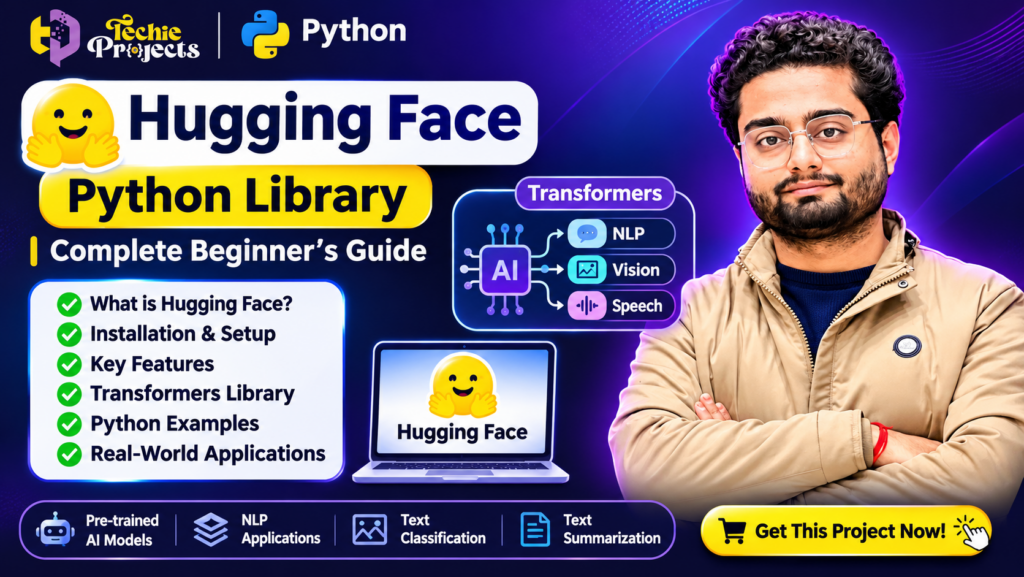
🚀 Get Your Hugging Face Python Project Developed by Techie Projects!
Looking to build an advanced Artificial Intelligence, Machine Learning, or Natural Language Processing project using modern Transformer models? Get your Hugging Face Python Library project developed by Techie Projects! We provide customized Python-based AI project development solutions for engineering students, final-year students, researchers, and developers who want practical experience with modern AI technologies.
Whether you need an NLP application, text classification system, sentiment analysis tool, chatbot, text summarization system, or a custom AI-powered solution, our team can help you develop a project according to your requirements.
🎓 Get professional project development assistance, Python implementation, source code, documentation, and technical guidance.
Why choose Techie Projects?
- Customized AI and Machine Learning project development.
- Python-based implementation.
- Practical applications using Transformer models.
- Source code and project documentation.
- Technical guidance and implementation support.
- Solutions suitable for different academic and development requirements.
Don’t spend weeks struggling with complex AI implementation. Contact Techie Projects and discuss your requirements today!
📞 Contact Techie Projects for Project Enquiries
Ready to develop your own AI or NLP application? Get in touch with our team for project development and customization.
📞 Contact / WhatsApp: +91 94600 60699
🌐 Website: www.techieprojects.com
📸 Instagram: Techie Projects
📖 Introduction to Hugging Face Python Library
Artificial Intelligence has transformed the way applications understand text, images, audio, and human language. Modern AI systems can generate content, translate languages, summarize documents, answer questions, recognize objects, and perform several complex tasks.
One of the most popular ecosystems supporting these technologies is Hugging Face.
The Hugging Face Python Library provides developers with access to thousands of pretrained machine learning models and tools that simplify the development of AI applications. Its ecosystem includes Transformers, Datasets, Tokenizers, Accelerate, and other useful libraries.
Instead of building every AI model from scratch, developers can use existing pretrained models and fine-tune them according to their application requirements.
For students working on final-year engineering projects, developers exploring Artificial Intelligence, and researchers experimenting with NLP, this ecosystem provides an excellent starting point.
In this guide, we will explore its features, installation, working process, practical examples, applications, and project development opportunities.
🤖 What Is Hugging Face?
Hugging Face is an open-source AI platform and ecosystem that provides tools, pretrained models, datasets, and libraries for developing machine learning applications.
It is particularly popular in Natural Language Processing because of its Transformer-based architecture and extensive model collection.
Developers can use the platform to:
- Perform sentiment analysis.
- Build text classification applications.
- Develop conversational AI systems.
- Generate and summarize text.
- Translate languages.
- Perform question answering.
- Work with image classification models.
- Build speech recognition applications.
- Fine-tune pretrained machine learning models.
The Hugging Face Python Library makes these capabilities accessible through Python programming interfaces.
Its model ecosystem supports several architectures, including BERT, GPT-style models, T5, RoBERTa, DistilBERT, and many other Transformer-based models.
⭐ Key Features of Hugging Face Python Library
The ecosystem provides several features that make AI application development easier and more efficient.
1. Pretrained Transformer Models
One of its most important features is access to pretrained Transformer models.
These models are trained on large datasets and can be adapted to specific applications.
For example:
- BERT for language understanding.
- GPT-style models for text generation.
- T5 for text-to-text applications.
- RoBERTa for language understanding.
- DistilBERT for lightweight NLP applications.
Using pretrained models can significantly reduce the time and resources required to develop AI applications.
2. Natural Language Processing
The Hugging Face Python Library provides tools for building different NLP applications.
Some common applications include:
- Sentiment analysis.
- Named Entity Recognition.
- Text summarization.
- Language translation.
- Question answering.
- Text classification.
- Text generation.
These features make it useful for academic projects, business applications, and research.
3. Easy Model Integration
Developers can load pretrained models through simple Python interfaces.
The Transformers library provides pipelines that simplify common AI tasks.
Instead of implementing complex neural network architectures manually, developers can use existing pipelines and focus on application development.
4. Model Hub
The Hugging Face Model Hub provides access to a large collection of machine learning models.
Developers can explore models based on:
- NLP.
- Computer Vision.
- Audio processing.
- Multimodal AI.
- Text generation.
- Image classification.
The Model Hub also provides model documentation, usage examples, and information about supported tasks.
Always check model licenses, intended uses, and hardware requirements before integrating a model into a commercial application.
5. Dataset Integration
The Datasets library helps developers access, load, process, and prepare datasets for machine learning.
It supports popular dataset formats and provides convenient methods for handling training and testing data.
6. Fine-Tuning Support
Developers can fine-tune pretrained models using domain-specific datasets.
For example, a general sentiment analysis model can be adapted to understand customer reviews, product feedback, or social media comments.
Fine-tuning helps customize existing models for specific requirements.
💻 Installation of Hugging Face Python Library
Before developing applications, you need to configure Python and install the required libraries.
Step 1: Install Python
Download and install Python from the official website:
https://www.python.org/downloads
Verify your installation:
python --versionStep 2: Create a Virtual Environment
Creating a separate environment helps manage dependencies.
python -m venv hf_envActivate it on Windows:
hf_env\Scripts\activateStep 3: Install Transformers
Install the required library using pip:
pip install transformersStep 4: Install PyTorch
For a CPU-based installation, use the appropriate command from the official PyTorch installation selector:
https://pytorch.org/get-started/locally
Step 5: Install Additional Libraries
You can install supporting packages:
pip install datasets
pip install tokenizers
pip install accelerate
pip install sentencepiece
Your environment is now ready for experimenting with Transformer-based AI models.
Note: Some models require additional dependencies, considerable RAM, or GPU resources. Check the documentation for the selected model before running it.
🧠 Understanding Transformers in Hugging Face
Transformers are deep learning architectures designed to process sequential and contextual information.
Traditional NLP approaches often struggle to understand relationships between words across long sentences.
Transformer models use attention mechanisms to identify relationships between different parts of the input.
For example, consider this sentence:
“The bank approved my loan.”
The word “bank” refers to a financial institution.
Now consider:
“We sat near the river bank.”
Here, the same word has a different meaning.
Transformer models use contextual information to understand such differences.
This capability makes Transformer architectures useful for language understanding, text generation, translation, and many other AI tasks.
The Hugging Face Python Library provides convenient access to these architectures through pretrained models and pipelines.
⚙️ Practical Python Example: Sentiment Analysis
Let’s understand how to implement a basic sentiment analysis application.
Sentiment analysis identifies whether a given text expresses positive, negative, or neutral sentiment.
Python Code
from transformers import pipeline

# Load sentiment analysis pipeline
classifier = pipeline("sentiment-analysis")

# Input sentence
text = "Hugging Face makes AI development easier!"

# Perform sentiment analysis
result = classifier(text)

# Display output
print(result)
Expected Output
[
    {
        'label': 'POSITIVE',
        'score': 0.99
    }
]
The output contains the predicted sentiment label and confidence score.
The actual score may vary depending on the selected model.
This simple example demonstrates how developers can use pretrained models without implementing an entire deep learning architecture.
📝 Example 2: Text Generation
Text generation is another popular application.
It allows developers to generate text using pretrained language models.
from transformers import pipeline

generator = pipeline(
    "text-generation",
    model="gpt2"
)

result = generator(
    "Artificial Intelligence is transforming",
    max_new_tokens=40,
    num_return_sequences=1
)

print(result[0]["generated_text"])
The model generates additional text based on the given input.
Generated results depend on the model, prompt, and generation settings.
📄 Example 3: Text Summarization
Text summarization converts lengthy documents into shorter versions while preserving important information.
from transformers import pipeline

summarizer = pipeline(
    "summarization",
    model="facebook/bart-large-cnn"
)

text = """
Artificial Intelligence is transforming modern
industries. Businesses use AI for automation,
customer support, data analysis, and decision-making.
Machine learning models help organizations process
large amounts of information efficiently.
"""

summary = summarizer(
    text,
    max_length=60,
    min_length=20,
    do_sample=False
)

print(summary[0]["summary_text"])
This approach can be used to develop document summarization systems, research assistants, and content analysis applications.
🔍 Example 4: Named Entity Recognition
Named Entity Recognition identifies important entities in text, such as people, organizations, and locations.
from transformers import pipeline

ner = pipeline(
    "ner",
    aggregation_strategy="simple"
)

text = "Google is headquartered in California."

result = ner(text)

for entity in result:
    print(entity)
This feature is useful in document processing, information extraction, and automated text analysis.
🎓 Applications of Hugging Face Python Library
The ecosystem supports several real-world applications.
1. AI Chatbot Development
Developers can use pretrained language models to build intelligent conversational systems.
These applications can answer questions, provide information, and assist users.
2. Sentiment Analysis System
Businesses can analyze customer reviews, feedback, and social media comments to understand customer opinions.
3. Text Classification
Text classification systems automatically categorize documents, messages, emails, and other text data.
4. Automatic Text Summarization
Organizations can summarize reports, articles, research papers, and lengthy documents.
5. Language Translation
Multilingual Transformer models can translate text between supported languages.
6. Question Answering System
Question answering models can extract or generate answers based on provided information.
7. Speech Processing
Compatible models can support speech recognition, audio classification, and other audio-related applications.
8. Computer Vision
The wider Hugging Face ecosystem also supports computer vision models for image classification, object detection, and related tasks.
These applications demonstrate how the Hugging Face Python Library can support development across multiple AI domains.
🏗️ Build AI Projects Using Hugging Face
Learning a Python library becomes more valuable when you apply it to practical development.
At Techie Projects, we help students and developers explore customized AI and Machine Learning project development.
Here are some project ideas you can develop using Hugging Face technologies.
1. AI-Based Sentiment Analysis System
Develop an application that analyzes customer reviews and identifies positive, negative, or neutral opinions.
2. Intelligent AI Chatbot
Build a conversational application that responds to user questions using suitable pretrained language models.
3. Automatic Text Summarization System
Create a tool that summarizes lengthy documents, articles, and research papers.
4. Fake News Classification System
Develop a text classification application that analyzes news content and predicts whether it belongs to a particular category.
Predictions should be evaluated carefully and should not be treated as definitive verification of factual accuracy.
5. Resume Screening Application
Build an NLP-based application that extracts relevant information from resumes and categorizes candidate profiles according to selected requirements.
6. Multilingual Translation System
Develop a translation application using multilingual Transformer models.
7. AI-Based Question Answering System
Create an application that accepts user questions and generates answers based on a supplied document or knowledge base.
8. Document Intelligence Application
Develop an intelligent document processing system that extracts, classifies, and summarizes information from documents.
💼 Why Choose Techie Projects for AI Project Development?
Are you a B.Tech, BCA, MCA, M.Tech, or engineering student looking for an AI or Machine Learning project?
Techie Projects provides project development assistance across different technology domains.
We understand that developing an advanced AI project can be challenging, particularly when working with pretrained models, datasets, Python dependencies, and deployment requirements.
Our goal is to help students and developers turn their project ideas into practical implementations.
What We Offer
🎯 Customized Project Development
Get project development assistance based on your selected topic, technology, and requirements.
💻 Python Source Code
Receive the relevant Python implementation and project files according to the agreed project scope.
📚 Documentation Support
Get assistance with project explanations, implementation details, and technical documentation.
⚙️ Installation and Execution Guidance
Understand the dependencies, environment setup, and steps required to run your application.
🤝 Technical Assistance
Get guidance for understanding the project workflow, code structure, and important implementation concepts.
🚀 Multiple Technology Domains
We work across:
- Artificial Intelligence.
- Machine Learning.
- Deep Learning.
- Natural Language Processing.
- Data Science.
- Computer Vision.
- Python Development.
- Web Development.
- Internet of Things.
- Data Analytics.
Whether you need a basic NLP application or a more advanced Transformer-based solution, contact us to discuss the requirements and feasibility.
💰 Get Your Hugging Face Python Project Now!
Ready to turn your AI project idea into a working application?
Purchase your customized Hugging Face Python Library project from Techie Projects!
We can help you develop projects involving sentiment analysis, text classification, chatbots, question answering, text summarization, and other AI-powered applications.
Why Wait?
- Get a project according to your requirements.
- Explore practical Python implementation.
- Work with modern AI and Transformer technologies.
- Get source code and relevant documentation.
- Receive technical guidance for understanding the implementation.
Our team can discuss your topic, project scope, required features, delivery expectations, and pricing before development begins.
📲 Enquire Now: +91 94600 60699
🌐 Visit: www.techieprojects.com
📸 Follow us: Instagram
💡 Recommended Projects
If you are interested in Artificial Intelligence, Python, NLP, and Machine Learning, explore these additional project ideas:
- AI-Based Fake News Detection System
- Sentiment Analysis Using Python
- Intelligent Chatbot Using NLP
- Text Summarization Using Transformers
- Sign Language to Text and Speech Conversion
- News Classification Using Natural Language Processing
- Question Answering System Using NLP
- Language Translation Using Transformer Models
Explore more project ideas and development solutions through www.techieprojects.com.
🔚 Conclusion
The Hugging Face Python Library has made modern Artificial Intelligence development more accessible by providing pretrained models, datasets, and powerful tools for building intelligent applications.
From sentiment analysis and text classification to text generation, question answering, and computer vision, its ecosystem provides developers with multiple opportunities to build practical AI solutions.
For students, researchers, and developers, learning this technology can be a valuable step toward understanding modern machine learning and Transformer-based applications.
However, the best way to understand any technology is through practical implementation.
If you are planning to develop an AI, NLP, or Machine Learning project, Techie Projects can help you explore suitable solutions based on your requirements.
Start building your next AI project with Techie Projects!

