
Introduction
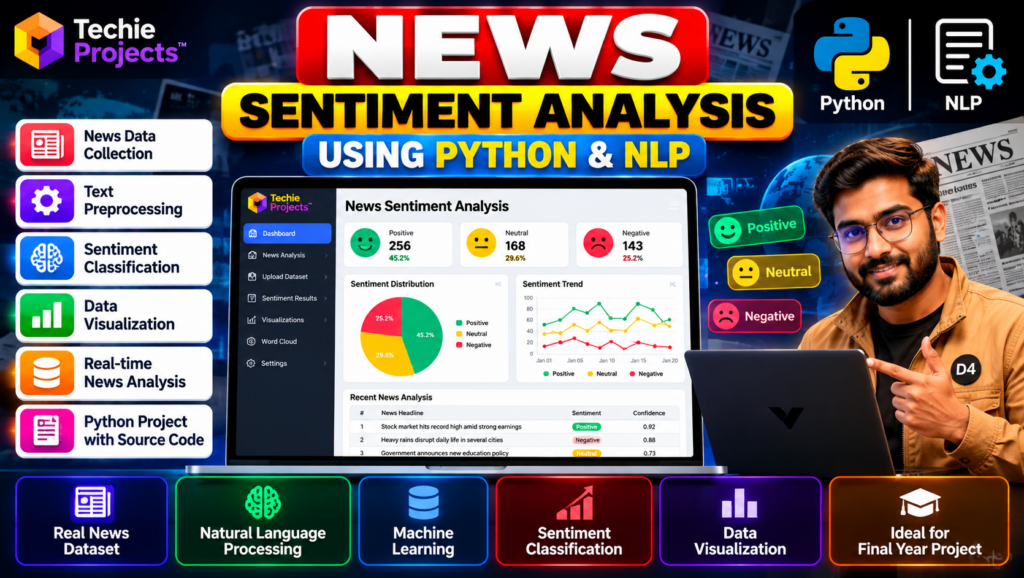
News Sentiment Analysis Using Python is a machine learning and Natural Language Processing (NLP) project that analyzes text and classifies its expressed sentiment. This project is suitable for B.Tech, B.E., BCA, MCA, and computer science students interested in Python programming, artificial intelligence, and data science.
The News Sentiment Analysis Using Python project demonstrates how news text can be cleaned, converted into numerical features, and processed by a trained machine learning model. Depending on the implementation, the model may classify text as positive, negative, or neutral.
At Techie Projects, students can enquire about source code availability, project documentation, installation instructions, implemented features, and pricing for their academic requirements.
🎬 Project Demo: News Sentiment Analysis Using Python
Watch the project demonstration to understand the application interface, news text analysis workflow, and sentiment classification output.
The demo can help you evaluate whether this Python NLP project matches your academic interests and final-year project requirements.
🎯 Objectives of the News Sentiment Analysis Project
The main objective of News Sentiment Analysis Using Python is to demonstrate how NLP and machine learning can identify sentiment patterns in textual news data. The project also helps students understand text preprocessing, feature extraction, classification, and model evaluation.
- Analyze the sentiment expressed in news text.
- Explore Natural Language Processing using Python.
- Understand text cleaning and preprocessing techniques.
- Convert text into features suitable for machine learning.
- Classify text into positive, negative, or neutral categories when supported by the trained model.
- Display sentiment classification results through an application interface.
- Understand the evaluation and limitations of text classification models.
🚀 Key Features of News Sentiment Analysis Using Python
1. News Text Input
The application can accept news text or other supported textual input for analysis, depending on the implementation.
2. Text Preprocessing
Text preprocessing may include converting text to lowercase, removing unwanted characters, tokenization, and other cleaning operations required by the selected model.
3. Natural Language Processing
NLP techniques help transform text into a representation that a machine learning algorithm can process.
4. Sentiment Classification
A trained model can classify text into sentiment categories such as positive, negative, or neutral, depending on the labels used during training.
5. Machine Learning Integration
The project can demonstrate the integration of a trained classification model into a Python application. The exact algorithm depends on the supplied implementation.
6. Result Visualization
The application may display sentiment labels, scores, or graphical summaries when those features are included.
7. Python-Based Development
Python provides a range of libraries for data processing, NLP, model development, and application integration.
Note: Confirm the actual input methods, algorithm, dataset, and output features in your project before advertising them as implemented functionality.
⚙️ How Does News Sentiment Analysis Work?
A typical News Sentiment Analysis Using Python project follows these steps.
Step 1: Collect News Text
The system receives text from a supported input source, such as manually entered news content or a prepared dataset.
Step 2: Clean the Text
The text is cleaned to remove unwanted characters and prepare it for processing.
Step 3: Tokenize and Preprocess
The text may be split into tokens and processed using techniques appropriate for the selected model.
Step 4: Extract Text Features
The cleaned text is transformed into numerical features. Depending on the implementation, this may involve TF-IDF, bag-of-words, or another text representation.
Step 5: Apply the Trained Model
The trained model processes the input features and predicts a sentiment category.
Step 6: Display the Result
The application presents the predicted sentiment through its interface or another supported output method.
This workflow describes a typical implementation. The actual algorithm and processing steps depend on your project’s source code.
⚙️ Workflow of News Sentiment Analysis Using Python
The News Sentiment Analysis Using Python workflow begins with collecting news text, cleaning the input, extracting text features, and passing those features to a trained classification model. The application then displays the predicted sentiment according to the model’s supported categories.
🛠️ Technologies Used
The project may use the following technologies, depending on its implementation:
- Python: Main programming language.
- Natural Language Processing: Techniques for preparing and analyzing text.
- Pandas: Data handling and dataset processing, if included.
- NumPy: Numerical operations, if required.
- NLTK or spaCy: Text preprocessing, if included.
- Scikit-learn: Machine learning algorithms and feature extraction, if included.
- Matplotlib or Seaborn: Visualization, if implemented.
- Streamlit, Flask, or Tkinter: Application interface, depending on the project.
Verify the actual libraries and versions before installation or purchase.
💻 Software Requirements
Typical software requirements include:
- Python with a compatible version.
- A suitable code editor or Python IDE.
- Required NLP and machine learning libraries.
- Dataset and trained model files, where applicable.
- Project source code and configuration files.
- A compatible operating system.
The exact dependencies depend on the project configuration.
🖥️ Hardware Requirements
A typical development computer may include:
- Processor: Intel Core i3 or equivalent, or better.
- RAM: 4–8 GB, depending on the dataset and libraries.
- Storage: Sufficient free space for the dataset, source code, and dependencies.
- Internet connection for installing packages when required.
Hardware requirements may vary with the selected model and dataset.
✅ Advantages of News Sentiment Analysis
- Demonstrates practical NLP concepts.
- Provides exposure to text preprocessing and classification.
- Helps students understand machine learning workflows.
- Can process textual data according to the model’s supported input.
- Provides opportunities to explore data visualization.
- Offers a practical academic project for Python and data science students.
📌 Applications of News Sentiment Analysis
News sentiment analysis can be explored in several contexts:
- Media and news text analysis.
- Public opinion research.
- Financial news sentiment research.
- Customer feedback analysis.
- Social media text analysis.
- Academic NLP experiments.
These are potential applications. A basic sentiment classifier does not automatically verify facts, identify fake news, or predict financial market movements.
⚠️ Limitations of the Project
- Sentiment predictions depend on the training dataset and model.
- Sarcasm, context, and ambiguous language can be difficult to interpret.
- Different domains may require different training data.
- Biased or unrepresentative datasets can affect results.
- Sentiment classification does not establish whether a news story is factually correct.
- Accuracy claims should be supported by appropriate testing and evaluation.
🔮 Future Scope
The project may be extended with additional features such as:
- Support for additional news categories and datasets.
- Comparison of different machine learning algorithms.
- Improved handling of negation and contextual language.
- Multilingual text processing.
- Interactive sentiment visualization.
- Evaluation using precision, recall, F1-score, and a confusion matrix.
- Integration with a news API, subject to its availability and terms.
- A web dashboard for analyzing multiple news articles.
These improvements depend on the project scope and should be tested before being presented as completed features.
🎓 Why Choose This Project for Your Final Year?
News Sentiment Analysis Using Python is a useful academic project topic for students who want practical exposure to text classification, NLP libraries, and machine learning workflows. It can also provide a foundation for experimenting with different datasets and classification algorithms.
The News Sentiment Analysis Using Python project is relevant to students studying computer science, information technology, artificial intelligence, machine learning, and data science.
It provides an opportunity to understand how raw text is converted into model inputs and how a trained classifier generates predictions. Students can also explore dataset preparation, model evaluation, and application development.
Before selecting the project, confirm that the available implementation and documentation meet your college’s requirements.
🛒 Purchase News Sentiment Analysis Using Python Project
Looking for a News Sentiment Analysis Using Python project with source code? Contact Techie Projects to confirm source-code availability, dataset inclusion, model files, documentation, installation requirements, customization options, and pricing.
📲 Call/WhatsApp: +91-9460060699
🌎 Website: www.techieprojects.com
📺 Instagram: @pythonprojects_
Techie Projects can help you enquire about project availability and the package that matches your academic requirements.
Before purchasing, ask us to confirm:
- Python source code availability.
- Dataset and trained model files included.
- Machine learning algorithm used.
- Required libraries and installation instructions.
- Project report and documentation availability.
- Implemented features and demonstration details.
- Customization options.
- Pricing and delivery details.
The available package contents and support arrangements should be confirmed before placing your order.
📲 Get Project Details and Pricing on WhatsApp
Contact Techie Projects to discuss your academic requirements, confirm project availability, and request pricing details.
👉 Enquire About the News Sentiment Analysis Project on WhatsApp
🌐 Explore More Engineering Projects
📸 Follow Techie Projects on Instagram
🎓 Recommended Projects
Explore these related project topics on Techie Projects:
- Fake News Detection Using Machine Learning – Explore text classification for identifying potentially misleading news content.
- Sentiment Analysis Using Python – Analyze sentiment in text using NLP techniques.
- Cyberbullying Detection Using Machine Learning – Explore classification of potentially harmful text.
- Text Classification Using NLP – Learn how text data can be categorized using machine learning.
- Spam Detection Using Machine Learning – Build a text classification project for identifying spam messages.
Visit the relevant project pages to explore their technologies, features, and availability.
❓ Frequently Asked Questions
1. What is News Sentiment Analysis Using Python?
It is a Python-based NLP project that classifies text according to sentiment categories defined by the dataset and trained model.
2. Which programming language is used?
Python is the primary programming language for the project.
3. Which machine learning algorithm is used?
The algorithm depends on the implementation. Common text classification approaches include Naive Bayes, Logistic Regression, and Support Vector Machines.
4. Can the project classify positive and negative news?
It can classify sentiment according to the categories supported by its trained model. The actual labels depend on the dataset and implementation.
5. Is this project suitable for final-year students?
It may be suitable for students studying computer science, AI, NLP, or data science, subject to their institution’s guidelines.
6. Can I purchase the source code?
Contact Techie Projects to confirm source-code availability, package contents, documentation, and pricing.
7. Does sentiment analysis detect fake news?
Not by itself. Sentiment analysis identifies sentiment expressed in text; verifying whether a news story is true requires different evidence and methods.
8. How can I get the project price?
Use the WhatsApp enquiry link to discuss your requirements and request current pricing.
Conclusion
The News Sentiment Analysis Using Python project is a practical way to explore NLP, text preprocessing, machine learning, and sentiment classification. It can help students develop their understanding of how machine learning models analyze textual data.
If you are interested in this project for your final-year submission, contact Techie Projects to confirm the available source code, implemented features, dataset, documentation, and pricing.
Start your project enquiry today: Contact Techie Projects on WhatsApp