
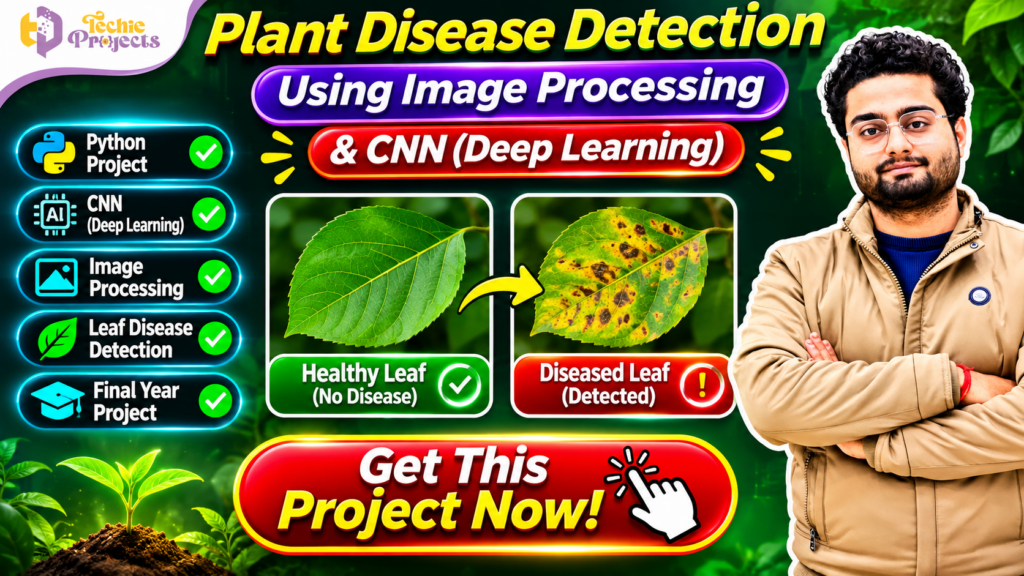
🌱 Looking for a ready-to-use Plant Disease Detection Using Image Processing project for your final-year engineering submission? Get your Python and CNN-based project from Techie Projects! If you are a B.Tech, BCA, MCA, Diploma, or Computer Science student searching for an interesting machine learning project, this application offers an excellent opportunity to explore artificial intelligence, image processing, and deep learning.
Don’t spend your entire project preparation time struggling with dataset collection, image preprocessing, CNN development, and implementation. Enquire about the Plant Disease Detection Using Image Processing project from Techie Projects and get information about the available Python source code, trained model, documentation, demonstration, and technical support options.
Plant diseases can affect crop quality, agricultural productivity, and farming operations. Identifying visible symptoms on leaves is an important part of monitoring plant health. Image processing and deep learning techniques provide an opportunity to analyze leaf images and classify them into predefined disease categories.
This project demonstrates how a Convolutional Neural Network (CNN) can be used to classify plant leaf images based on patterns learned from a dataset. It combines Python programming, image processing, computer vision, and deep learning in one practical academic application.
Whether you are preparing a Python mini project, major project, or final-year engineering submission, this project can help you understand how artificial intelligence can be applied to agricultural image analysis.
📞 Contact Techie Projects for Project Enquiries
Want to purchase the Plant Disease Detection Using Image Processing project? Contact Techie Projects to discuss the available project package and your academic requirements.
- 📱 WhatsApp: https://wa.me/919460060699
- ☎️ Contact Number: +91 94600 60699
- 🌐 Website: https://techieprojects.com/
- 📸 Instagram: https://www.instagram.com/pythonprojects_/
Enquire today about source code availability, trained model files, documentation, installation guidance, and technical support.
🎬 Watch the Plant Disease Detection Using Image Processing Project Demo
Explore the Plant Disease Detection Using Image Processing project demonstration to understand how leaf images are analyzed and classified using a CNN-based model.
The demonstration provides an overview of the application workflow, image input, prediction process, and classification output. Students can understand how the system processes a leaf image and displays the predicted category.
The project demo can also help students prepare for academic presentations by showing the relationship between image preprocessing, model prediction, and the final result.
🌿 What Is Plant Disease Detection Using Image Processing?
Plant Disease Detection Using Image Processing is a computer vision application that analyzes plant leaf images to identify visual patterns associated with selected disease categories.
Traditional plant disease identification often involves visual inspection of leaves. Image processing and machine learning provide a way to study this process computationally by analyzing image characteristics such as color, texture, shape, and visible patterns.
A CNN-based classification model learns relevant features from labeled training images. After training, it can process a new leaf image and predict one of the categories supported by its dataset.
A typical implementation involves:
- Collecting healthy and diseased plant leaf images.
- Organizing images into disease categories.
- Resizing and preprocessing image data.
- Training a CNN classification model.
- Evaluating the trained model.
- Uploading a new leaf image for prediction.
- Displaying the predicted category.
The main objective is to demonstrate how deep learning and image processing can be applied to agricultural image classification.
🎯 Why Choose This Plant Disease Detection Project?
Selecting a suitable final-year project is important for engineering students. A good project should demonstrate technical knowledge, provide practical learning opportunities, and have a clear real-world application.
Here are some reasons to consider this project.
🌱 1. Explore Agricultural Technology
The project introduces students to the use of artificial intelligence for analyzing plant leaf images and studying visible disease symptoms.
🧠 2. Learn Deep Learning Concepts
Students can understand how CNN models learn visual features from training images and use them to classify new inputs.
🖼️ 3. Understand Image Processing
The application provides practical exposure to image resizing, normalization, image loading, and preprocessing.
🐍 4. Work with Python
Python offers libraries for image processing, data preparation, neural network development, and model prediction.
🎓 5. Suitable for Academic Demonstrations
The application can be demonstrated using sample leaf images and its classification output. Students can explain the workflow during their project presentation.
🚀 6. Expandable Project Scope
Students can explore additional plant categories, improved CNN architectures, prediction history, and performance evaluation, depending on their requirements.
⚙️ Key Features of Plant Disease Detection Using Image Processing
The following are common features of a CNN-based plant leaf classification application. The exact functionality depends on the selected implementation.
📷 1. Leaf Image Upload
The application can accept a plant leaf image as input through its supported interface.
🖼️ 2. Image Preprocessing
The input image can be resized and normalized to match the requirements of the trained model.
🧠 3. CNN-Based Classification
A trained Convolutional Neural Network analyzes the image and predicts a category learned during training.
🌿 4. Healthy and Diseased Leaf Classification
Depending on the dataset, the application can classify images into healthy and selected diseased categories.
🔍 5. Disease Category Prediction
A multi-class implementation may identify specific plant disease categories included in its training dataset.
📊 6. Prediction Result Display
The application can display the predicted class. Confidence scores or probability values may also be available, depending on the implementation.
💻 7. User-Friendly Interface
A graphical interface can make it easier to upload leaf images and view classification results.
📁 8. Dataset-Based Model Training
The model can be trained using labeled leaf images to learn visual patterns associated with the supported categories.
📈 9. Model Evaluation
Performance can be studied using metrics such as accuracy, precision, recall, F1-score, and a confusion matrix.
🧰 Technologies Used in Plant Disease Detection Using Image Processing
This project combines Python programming, image processing, computer vision, and deep learning.
🐍 Python Programming Language
Python is commonly used for machine learning and computer vision applications because of its readable syntax and extensive library ecosystem.
🧠 Convolutional Neural Network (CNN)
CNN is a deep learning architecture designed to learn spatial features from images. It is widely used in image classification applications.
🔢 TensorFlow and Keras
Depending on the implementation, TensorFlow and Keras can be used to create, train, and execute the CNN model.
📷 OpenCV
OpenCV can support image reading, resizing, color conversion, and other image processing operations.
🔢 NumPy
NumPy supports numerical calculations and array operations during image preparation and model execution.
📊 Matplotlib
Matplotlib can be used to visualize sample images, training progress, accuracy, and loss graphs.
💻 Development Environment
Depending on the supplied package, the project may use:
- Python.
- Visual Studio Code or another Python IDE.
- TensorFlow/Keras.
- OpenCV.
- NumPy.
- Matplotlib.
- A labeled plant leaf image dataset.
- Windows or another supported operating system.
Confirm the exact Python version, library versions, model files, and hardware requirements before purchasing.
🔄 How Does Plant Disease Detection Using Image Processing Work?
A typical CNN-based plant disease classification system follows these steps.
Step 1: Collect Plant Leaf Images
The first step is to prepare a dataset containing images of healthy and diseased leaves. Each image should have a suitable label representing its category.
Step 2: Organize the Dataset
The images are arranged into folders or records according to their categories. The dataset is divided into training, validation, and testing subsets.
Step 3: Preprocess the Images
Images are resized to a consistent dimension and converted into the format required by the model. Normalization may also be applied to standardize pixel values.
Step 4: Build the CNN Model
A Convolutional Neural Network is designed with suitable layers for extracting image features and performing classification.
Step 5: Train the Model
The training images are provided to the model. During training, the network learns patterns associated with the different plant leaf categories.
Step 6: Validate the Model
Validation images help monitor model performance during training and support decisions about model configuration.
Step 7: Test the Model
The trained model is evaluated using separate test images to study how well it performs on images that were not used during training.
Step 8: Upload a New Leaf Image
The user selects a plant leaf image through the application interface, if image upload functionality is included.
Step 9: Generate the Prediction
The trained CNN processes the input image and predicts one of the categories supported by the model.
Step 10: Display the Result
The application displays the predicted category. The output can be used for academic demonstration and model evaluation.
🧠 Understanding CNN Architecture for Plant Disease Classification
A Convolutional Neural Network is useful for image classification because it can learn visual features directly from image data.
🔹 1. Input Layer
The input layer receives the preprocessed leaf image in the dimensions expected by the CNN.
🔹 2. Convolutional Layer
Convolutional layers apply filters to image data to learn features such as edges, textures, shapes, and patterns.
🔹 3. Activation Function
An activation function such as ReLU introduces non-linearity, allowing the network to learn more complex visual relationships.
🔹 4. Pooling Layer
Pooling reduces the spatial dimensions of feature maps and helps create a more compact representation of the image.
🔹 5. Flatten Layer
The flatten layer converts the extracted feature maps into a one-dimensional representation for classification.
🔹 6. Fully Connected Layer
Fully connected layers combine the learned features to produce classification scores.
🔹 7. Output Layer
The output layer generates predictions for the plant categories supported by the model. A suitable activation function is selected according to the classification setup.
Understanding these layers helps students explain how deep learning is used for leaf image classification.
🌍 Applications of Plant Disease Detection Systems
Image-based plant disease classification has several potential research and educational applications.
🌾 1. Agricultural Research
Researchers can study how image processing and machine learning techniques identify visual patterns in plant leaves.
🌱 2. Crop Monitoring
Image classification systems can be explored as part of experimental crop monitoring workflows.
🚜 3. Smart Agriculture
The project introduces students to the role of artificial intelligence in agricultural technology and smart farming research.
📷 4. Plant Image Analysis
Leaf images can be analyzed to study differences between selected healthy and diseased categories.
🎓 5. Academic Learning
Students can use the project to understand CNN architecture, dataset preparation, image preprocessing, and model evaluation.
🧪 6. Deep Learning Experiments
Different CNN architectures, training parameters, and image augmentation techniques can be compared to study their impact on classification performance.
Important: Image-based predictions are dependent on the training dataset and image conditions. This academic project should not be treated as a substitute for expert agricultural diagnosis or laboratory testing.
📊 How to Evaluate the CNN Model Performance
Model evaluation is an important part of machine learning development. It helps students understand the strengths and limitations of a classification model.
Accuracy
Accuracy measures the proportion of correctly classified images among all evaluated images.
Precision
Precision measures how many images predicted as belonging to a particular class were correctly classified.
Recall
Recall measures how many actual images from a particular class were correctly identified.
F1-Score
The F1-score combines precision and recall into a single metric using their harmonic mean.
Confusion Matrix
A confusion matrix summarizes correct and incorrect predictions for each class. It helps identify which plant disease categories the model may confuse.
Training and Validation Loss
Training and validation loss can help students monitor model learning and identify possible overfitting.
A model should be evaluated using separate test images. High training accuracy alone does not guarantee reliable performance on new images.
🚀 Future Scope of Plant Disease Detection Using Image Processing
Students can expand the project with additional functionality and more advanced deep learning techniques.
1. Multiple Plant Categories
The model can be extended to support additional plant types if suitable labeled image datasets are available.
2. More Disease Categories
Additional disease classes can be introduced by collecting and annotating appropriate leaf images and retraining the model.
3. Transfer Learning
Pretrained architectures such as MobileNet, VGG, or ResNet can be explored to compare their performance on plant image classification.
4. Explainable AI
Techniques such as Grad-CAM can be explored to visualize image regions that influence the model’s predictions. These visualizations should be interpreted carefully and are not proof of a biological diagnosis.
5. Mobile Application Integration
A trained model can potentially be integrated into a mobile application using a suitable deployment approach.
6. Web-Based Plant Classification
A web interface can be developed to allow users to upload leaf images and view model predictions.
7. Prediction History
The application can be extended to store previous image inputs and classification outputs using a suitable database.
8. Performance Optimization
Students can experiment with model optimization and image preprocessing techniques to study their impact on execution time and classification performance.
🎓 Benefits of This Project for Engineering Students
Working on this project can provide practical exposure to several important technical areas.
- Python programming: Learn how Python supports image processing and machine learning.
- Deep learning: Understand how CNN models learn image features.
- Computer vision: Explore how visual information is processed and classified.
- Dataset preparation: Learn image labeling, organization, and data splitting.
- Model training: Understand training, validation, and testing workflows.
- Performance evaluation: Study accuracy, precision, recall, and F1-score.
- Application development: Explore how a machine learning model can be connected to a user interface.
- Project presentation: Explain the system workflow, architecture, and output.
- Resume development: Demonstrate practical exposure to an AI-based agricultural application.
This project is particularly relevant for students interested in artificial intelligence, computer vision, machine learning, and smart agriculture.
💼 Why Purchase Your Plant Disease Detection Project from Techie Projects?
Finding a suitable final-year project can be challenging. Students often need to manage programming, dataset preparation, model training, installation, documentation, and project presentation within a limited academic schedule.
Techie Projects provides project-related solutions across multiple technical domains, helping students explore practical engineering applications.
Our project domains include:
- Artificial Intelligence Projects.
- Machine Learning Projects.
- Deep Learning Projects.
- Computer Vision Projects.
- Image Processing Projects.
- Python Projects.
- Data Science Projects.
- IoT Projects.
- Web Development Projects.
When you enquire about the Plant Disease Detection Using Image Processing project, our team can discuss the available package and your academic requirements.
📦 What Can You Enquire About?
Depending on the selected package, you can ask about:
- Python source code availability.
- CNN model files.
- Trained weights, where included.
- Dataset availability.
- Project documentation.
- Installation and execution guidance.
- Demonstration and output screenshots, where available.
- Model architecture and implementation details.
- Technical support options.
- Customization requirements.
Please confirm the exact deliverables before purchasing, especially the dataset, trained model, supported plant categories, and documentation.
🎯 Who Can Purchase This Project?
This project may be suitable for:
- B.Tech Computer Science students.
- B.Tech Information Technology students.
- BCA students.
- MCA students.
- Artificial Intelligence students.
- Machine Learning students.
- Data Science students.
- Agriculture technology learners.
- Diploma engineering students.
- Final-year engineering students.
Students should check their institution’s project guidelines and understand the implementation before submitting their academic work.
🛒 Get Plant Disease Detection Using Image Processing Project Now!
🚀 Ready to work on an interesting Python and deep learning project? Enquire about Plant Disease Detection Using Image Processing from Techie Projects today!
Get information about the available Python source code, CNN model files, dataset, project documentation, installation requirements, and technical support options.
Whether you are preparing a college mini project, major project, or final-year engineering submission, our team can discuss your requirements and help you understand the available project package.
Don’t wait until your submission deadline approaches. Start planning early, confirm the included features, and choose a package that matches your academic requirements.
📱 WhatsApp: https://wa.me/919460060699
☎️ Call: +91 94600 60699
🌐 Website: https://techieprojects.com/
📸 Instagram: https://www.instagram.com/pythonprojects_/
Contact Techie Projects today and take the next step in your plant disease classification project journey!
❓ Frequently Asked Questions (FAQs)
1. What is Plant Disease Detection Using Image Processing?
It is a computer vision project that analyzes plant leaf images and uses image processing and machine learning techniques to classify them into predefined categories.
2. Which programming language is used?
Python is commonly used because it provides libraries for image processing, machine learning, and deep learning.
3. What is CNN in plant disease detection?
CNN stands for Convolutional Neural Network. It is a deep learning architecture that learns visual features from images and uses them for classification.
4. Which libraries can be used?
Depending on the implementation, the project may use TensorFlow, Keras, OpenCV, NumPy, and Matplotlib.
5. Can the project identify multiple plant diseases?
A multi-class implementation can classify multiple disease categories if the model has been trained using suitable labeled images for those categories.
6. Can I add more plant types?
Yes. Additional plant categories can be introduced by preparing a suitable dataset and retraining or extending the model.
7. Is this project suitable for final-year engineering students?
It may be suitable for B.Tech, BCA, MCA, and other relevant students, subject to their institution’s requirements.
8. Can CNN be replaced with transfer learning?
Yes. Students can explore pretrained models such as MobileNet, VGG, or ResNet as possible extensions.
9. Does the model guarantee correct disease identification?
No. Results depend on dataset quality, image conditions, training, and testing. The application is an academic classification demonstration, not a guaranteed agricultural diagnosis.
10. Where can I purchase this project?
You can contact Techie Projects through WhatsApp at +91 94600 60699 or visit https://techieprojects.com/ to enquire about the available project package.
🔗 Explore Related Python and Machine Learning Projects
Looking for more final-year engineering projects? Explore related technical categories available at Techie Projects.
- 🤖 Artificial Intelligence Projects
- 🧠 Machine Learning Projects
- 🌱 Plant Disease Detection Projects
- 📷 Computer Vision Projects
- 🖼️ Image Processing Projects
- 🐍 Python Projects
- 📊 Data Science Projects
- 🎓 Final Year Engineering Projects
Visit https://techieprojects.com/ to explore more project ideas and find a suitable project for your academic requirements.
🏆 Conclusion
The Plant Disease Detection Using Image Processing project demonstrates how Python, CNN, and deep learning techniques can be combined to classify plant leaf images.
Students can explore image preprocessing, dataset preparation, CNN architecture, model training, prediction, and performance evaluation through this academic application. The project also provides opportunities to investigate transfer learning, explainable AI, mobile deployment, and advanced agricultural image analysis.
If you are searching for a practical Python and deep learning project for your college submission, contact Techie Projects to enquire about the available source code, documentation, demonstration, and technical support options.
📞 Contact Techie Projects today to enquire about your Plant Disease Detection Using Image Processing project!
📲 Call/WhatsApp: +91-9460060699
🌎 Website: www.techieprojects.com
📺 Instagram: @pythonprojects_