
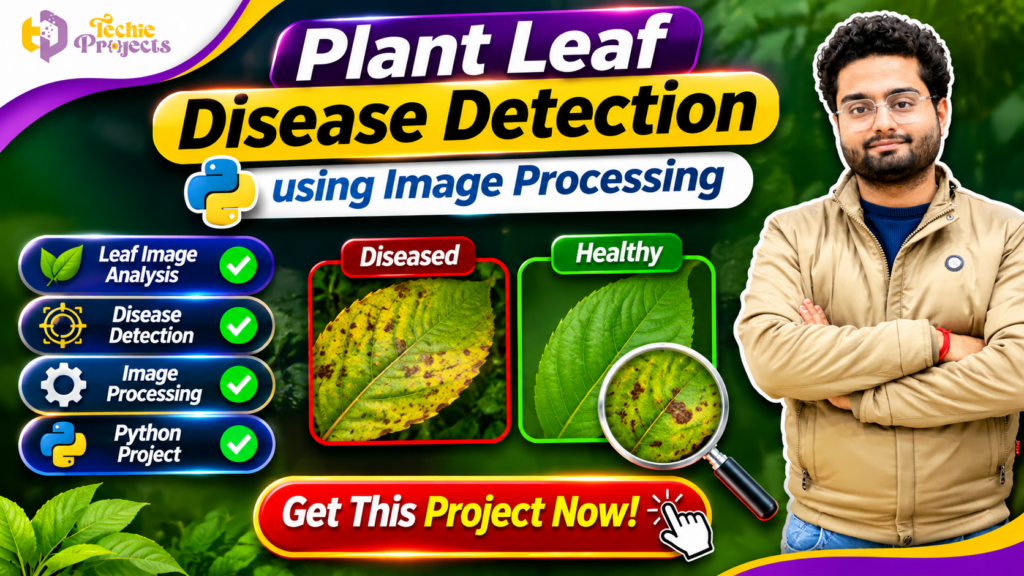
🌱 Looking for an interesting final-year project in Python, Machine Learning, or Image Processing? Get the Plant Leaf Disease Detection Using Image Processing project from Techie Projects and explore how computer vision techniques can be applied to identify visible plant leaf diseases from digital images.
Instead of spending weeks searching for a suitable project topic, struggling with implementation, or building everything from scratch, you can enquire about our ready project solution. Techie Projects helps students explore practical engineering projects with source code, project information, documentation, and implementation guidance, depending on the selected package.
The Plant Leaf Disease Detection Using Image Processing project is an excellent academic topic for students interested in Python programming, image analysis, computer vision, and agricultural technology. It demonstrates how digital leaf images can be processed to identify visual patterns associated with plant diseases.
If you want to understand the project, explore its possible features, or purchase the implementation for your academic work, contact Techie Projects today.
📞 Contact Techie Projects for Project Enquiries
Looking to purchase this project? Connect with our team for project details, available packages, pricing, and technical support.
- 📲 WhatsApp: +91-9460060699
- 🌐 Website: www.techieprojects.com
- 📸 Instagram: https://www.instagram.com/pythonprojects_/
🎬 Watch the Plant Leaf Disease Detection Project Demo
Explore the project demonstration to understand the interface, image-processing workflow, and expected output.
Project Demo: Plant Leaf Disease Detection Using Image Processing
🌿 What Is Plant Leaf Disease Detection Using Image Processing?
Plant Leaf Disease Detection Using Image Processing is a computer vision-based project that analyzes digital images of plant leaves to identify visible characteristics associated with diseases.
Plant leaves can show different visual symptoms, such as spots, discoloration, yellowing, patches, and changes in texture. Image processing techniques can help analyze these visual patterns and support the classification of leaf images.
The project generally follows a workflow in which a user provides a leaf image, the application processes the image, and the system displays an output based on the implemented detection or classification method.
Python is a suitable programming language for this project because it provides libraries for image processing, numerical operations, and machine learning. Depending on the implementation, libraries such as OpenCV, NumPy, and machine learning frameworks can be used to develop different components.
This project is especially useful for students who want to understand how computer vision can be applied to an agriculture-related problem.
🎯 Objectives of the Project
The main objective is to demonstrate how image processing can be used to analyze plant leaf images and identify visual patterns that may indicate disease.
Important project objectives include:
- 📷 Accepting digital images of plant leaves.
- 🌱 Processing images to improve their suitability for analysis.
- 🔍 Identifying visible patterns such as spots, discoloration, and affected regions.
- 🧠 Applying image analysis or classification techniques.
- 📊 Displaying the output in a user-friendly format.
- 💻 Demonstrating a practical Python-based computer vision application.
- 🎓 Helping students understand the implementation of image-processing concepts.
The project also provides an opportunity to learn how software applications can be designed around real-world agricultural challenges.
⚙️ How Does the Plant Leaf Disease Detection System Work?
The working process can be divided into several stages. The exact workflow depends on the source code, dataset, and algorithms included in the selected implementation.
1. 📷 Input Image Collection
The first stage involves collecting or uploading a digital image of a plant leaf. The quality of the image can affect the results, so clear images with visible leaf details are useful for analysis.
A dataset containing healthy and affected leaf images may also be used during development or model training.
2. 🖼️ Image Preprocessing
Image preprocessing prepares the input image for further analysis. Common operations include:
- Image resizing.
- Noise reduction.
- Image conversion.
- Contrast adjustment.
- Color-space conversion.
These operations can help standardize images and make relevant visual patterns easier to analyze.
3. 🔍 Image Segmentation and Feature Analysis
Depending on the selected approach, image segmentation can help separate the leaf or affected regions from the background.
The application may analyze visual characteristics such as:
- Color variations.
- Leaf texture.
- Spots and patches.
- Shape and affected areas.
- Differences between healthy and affected regions.
These features can be used by subsequent image-analysis or classification stages.
4. 🧠 Disease Classification
If the project includes a trained classification model, the extracted image information can be passed to that model to predict a category.
The output depends on the training dataset, model architecture, image quality, and implementation. The system should be evaluated using suitable test images rather than assuming that every prediction is correct.
5. 📊 Result Display
The final stage displays the processed image and the result generated by the application.
Depending on the interface, the output may include a predicted category, image information, or a visual indication of the analyzed region.
💻 Technologies Used in the Project
The project can be developed using Python and relevant image-processing tools. The exact software requirements should be confirmed against the selected project package.
| Technology | Purpose |
|---|---|
| Python | Main programming language |
| OpenCV | Image processing and computer vision |
| NumPy | Numerical and array operations |
| Matplotlib | Image and result visualization |
| Machine Learning | Classification, if included |
| Tkinter | Graphical interface, if included |
| Dataset | Training and testing image samples |
🐍 Python
Python provides a simple development environment and a large collection of libraries for computer vision and machine learning. It is commonly used in academic projects because students can implement and understand different processing stages.
🖼️ OpenCV
OpenCV is a popular computer vision library. It supports image reading, resizing, filtering, color conversion, and other operations that can be useful in a leaf-image analysis application.
🔢 NumPy
NumPy provides array-based mathematical operations. Since digital images are represented as numerical arrays, NumPy can be useful for processing image data.
📈 Matplotlib
Matplotlib can be used to display input images, processed images, and visual results during development.
⭐ Key Features of the Project
The following are common features that may be included in a Plant Leaf Disease Detection Using Image Processing implementation. Confirm the final feature list before purchasing.
📤 Leaf Image Upload
Users can select a leaf image from their computer for processing. This provides a simple way to test the application with different sample images.
🔬 Image Processing
The system can apply image-processing operations to prepare the leaf image for analysis.
🌱 Healthy and Diseased Leaf Analysis
A project implementation may compare healthy and affected leaf images or classify images into categories supported by its dataset.
🧠 Automated Classification
If a trained model is included, the application can generate a predicted category based on the input image.
📊 Result Visualization
The application can display the input image, processed output, and classification result in an understandable format.
🖥️ User-Friendly Interface
A graphical interface, if included, can make it easier to upload images and view the output without directly interacting with the code.
🚀 Applications of Plant Leaf Disease Detection
Image processing has several potential applications in agriculture and plant research.
🌾 Agricultural Research
Researchers and students can explore how image analysis techniques are applied to plant-health studies.
🌿 Educational Demonstrations
The project can demonstrate the use of Python, image processing, and computer vision in an agriculture-related application.
📷 Leaf Image Classification
A trained classification system can be used to categorize images according to the classes represented in its dataset.
🧪 Computer Vision Research
Students can experiment with preprocessing, segmentation, feature extraction, and classification techniques.
🎓 Final-Year Engineering Projects
The topic can be adapted for Computer Science, Information Technology, Artificial Intelligence, Data Science, and related engineering courses.
Important: This project is intended for academic and demonstration purposes. Its predictions should not be treated as professional agricultural diagnosis or as a substitute for advice from a qualified agricultural expert.
🎓 Why Choose This Project for Your Final Year?
Choosing a project that combines practical programming with a real-world application can make your academic work more engaging.
Plant Leaf Disease Detection Using Image Processing offers opportunities to explore multiple technical concepts in one application.
1. Practical Python Experience
Students can learn how to work with image files, Python libraries, and image-processing operations.
2. Understanding Computer Vision
The project introduces concepts such as image preprocessing, segmentation, feature analysis, and classification.
3. Agriculture-Based Application
It connects software development with an important application area: plant-health monitoring.
4. Scope for Further Development
Students can explore additional features, experiment with different datasets, and compare alternative image-analysis methods.
5. Project Demonstration
A working application can help students explain the relationship between input images, processing stages, and generated results during an academic presentation.
🛠️ How to Develop a Plant Leaf Disease Detection Project
Students interested in building the application themselves can follow a structured development process.
Step 1: Define the Project Scope
Decide which plant types and disease categories the system will support. Clearly define whether the project will use traditional image processing, machine learning, or a combination of approaches.
Step 2: Collect the Dataset
Gather suitable leaf images for the selected categories. Organize the images into training, validation, and testing groups if a machine learning model is being used.
Step 3: Prepare the Development Environment
Install Python and the required libraries. Create a project directory and organize the source code, datasets, and output files.
Step 4: Implement Image Preprocessing
Develop the image-loading and preprocessing functions. Test resizing, filtering, and color conversion operations using sample images.
Step 5: Develop the Analysis Method
Implement the selected feature extraction, segmentation, or classification approach. If a machine learning model is used, train and evaluate it using appropriate data.
Step 6: Create the User Interface
Develop an interface that allows users to select images and view the results. A graphical interface can make the application easier to demonstrate.
Step 7: Test the Application
Test the system using images that were not used during training. Review incorrect predictions and evaluate the model using suitable performance metrics.
This development process helps students understand the complete workflow of an image-processing project.
📦 What Should You Check Before Purchasing the Project?
Before purchasing any academic project, it is important to understand exactly what is included in the package.
At Techie Projects, students can enquire about the available project package and confirm the following details:
- Python source code availability.
- Project documentation.
- Software and hardware requirements.
- Dataset availability and usage instructions.
- Installation and execution instructions.
- Project demonstration.
- Technical support options.
- Customization possibilities, if available.
The exact deliverables, support scope, and pricing should be confirmed with the Techie Projects team before placing an order.
💡 Why Purchase from Techie Projects?
Finding a suitable final-year project is only the first step. Students also need to understand the implementation, prepare documentation, install the required libraries, and explain the workflow.
Techie Projects provides project solutions across multiple technical domains, helping students explore project topics that match their academic interests.
Benefits of Enquiring with Techie Projects
- Project Information: Understand the project concept and available implementation.
- Source Code: Enquire about the Python source code included in the selected package.
- Documentation: Check the availability of project documentation.
- Technical Guidance: Ask about available installation and implementation support.
- Multiple Domains: Explore projects in Python, Artificial Intelligence, Machine Learning, IoT, Data Science, and Image Processing.
- Project Enquiries: Connect directly with the team to discuss your requirements.
Our aim is to help students find relevant technical project solutions and understand the software development process.
🌱 Benefits of Plant Leaf Disease Detection Using Image Processing
Plant Leaf Disease Detection Using Image Processing offers an interesting way to understand how computer vision can support agricultural research. By analyzing digital leaf images, students can explore visible symptoms such as spots, discoloration, and changes in leaf texture.
Some important benefits of this project include:
- Image-Based Analysis: Understand how digital images can be processed to identify visual characteristics of plant leaves.
- Python Programming: Gain practical experience with Python libraries used in computer vision.
- Disease Classification: Explore how machine learning models can classify leaf images into supported categories.
- Agricultural Applications: Study the role of technology in plant-health monitoring.
- Academic Learning: Understand image preprocessing, segmentation, feature extraction, and classification.
Students working on Plant Leaf Disease Detection Using Image Processing can also experiment with different datasets and compare the results of alternative image-analysis techniques.
🔬 Importance of Image Processing in Plant Disease Identification
Image processing is an important part of computer vision applications because it helps convert raw digital images into useful information.
In Plant Leaf Disease Detection Using Image Processing, preprocessing operations can help improve image quality and prepare leaf images for further analysis.
For example, resizing can standardize image dimensions, filtering can reduce unwanted noise, and color conversion can help analyze specific visual characteristics.
These techniques provide students with practical knowledge of how image-processing operations work together in a real-world application.
🧠 Machine Learning Integration in Plant Leaf Disease Detection Using Image Processing
Machine learning can extend the capabilities of a basic image-processing application. A classification model can be trained using labeled images of healthy and affected leaves.
During training, the model learns patterns from the supplied dataset. After training, it can analyze new images and generate predictions for the categories it supports.
Plant Leaf Disease Detection Using Image Processing can therefore be extended with machine learning techniques to explore automated image classification.
Students can also evaluate the model using accuracy, precision, recall, F1-score, and a confusion matrix. These evaluation methods help explain the strengths and limitations of the developed system.
💰 Purchase Plant Leaf Disease Detection Using Image Processing
Ready to explore this project for your final-year submission?
Purchase enquiries for Plant Leaf Disease Detection Using Image Processing are welcome at Techie Projects. Contact our team to discuss the project implementation, available deliverables, pricing, and technical support options.
Whether you are studying Computer Science, Information Technology, Artificial Intelligence, or Data Science, this project can be a useful way to explore Python-based computer vision.
Get in touch today to discuss your project requirements.
- 📲 WhatsApp: https://wa.me/919460060699
- 📞 Call: +91 94600 60699
- 🌐 Website: https://techieprojects.com/
- 📸 Instagram: https://www.instagram.com/pythonprojects_/
🔮 Future Scope of the Project
The project can be extended in several ways depending on the available dataset, development resources, and technical requirements.
1. Deep Learning Integration
A convolutional neural network (CNN) can be explored for image classification. Students can compare its performance with traditional image-processing methods.
2. Mobile Application
A mobile application could allow users to capture or upload leaf images using a smartphone camera.
3. Multiple Plant Categories
The dataset can be expanded to include more plant types and disease categories, provided suitable labeled images are available.
4. Improved Image Segmentation
Advanced segmentation techniques can be explored to isolate affected regions more accurately.
5. Web-Based Application
A web interface can be developed to allow users to upload images and view the generated results through a browser.
6. Model Performance Evaluation
Students can evaluate the classification system using metrics such as accuracy, precision, recall, F1-score, and a confusion matrix.
These enhancements can make the project more technically comprehensive and provide opportunities for further experimentation.
❓ Frequently Asked Questions
1. What is Plant Leaf Disease Detection Using Image Processing?
It is a computer vision project that analyzes digital plant leaf images using image-processing techniques and, depending on the implementation, machine learning classification.
2. Which programming language is used?
Python is commonly used because it provides libraries such as OpenCV and NumPy for image analysis and processing.
3. Is this project suitable for final-year engineering students?
Yes. It can be suitable for Computer Science, IT, AI, and related engineering students, depending on their course requirements and project guidelines.
4. Does the project use machine learning?
Some implementations use traditional image-processing techniques, while others include machine learning or deep learning models. Confirm the selected package’s actual approach before purchasing.
5. Can I use my own leaf images?
You can test the application with your own images if they meet the input requirements and represent categories supported by the implementation.
6. Is source code available?
Contact Techie Projects to confirm source code availability and the deliverables included in the selected package.
7. Can the project be customized?
Customization may be possible depending on the requested features and project package. Discuss your requirements with the team before ordering.
8. How can I purchase this project?
Contact Techie Projects through WhatsApp at +91 94600 60699 or visit https://techieprojects.com/ to enquire about pricing and availability.
📚 Explore Related Engineering Projects
Looking for more academic project ideas? Explore other project categories available on Techie Projects.
- 🤖 Machine Learning Projects
- 🧠 Artificial Intelligence Projects
- 🖼️ Image Processing Projects
- 👁️ Computer Vision Projects
- 🐍 Python Projects
- 📊 Data Science Projects
- 🌐 Deep Learning Projects
- 📱 Android Application Projects
- 🔌 IoT Projects
Explore related project topics and find an implementation that matches your academic interests.
🎯 Get Your Plant Leaf Disease Detection Project from Techie Projects!
Turn your project idea into a practical Python-based computer vision application. Explore how image processing can be used to analyze leaf images, understand visual patterns, and demonstrate an agriculture-related software solution.
If you are ready to purchase or want more information about Plant Leaf Disease Detection Using Image Processing, contact Techie Projects today.
📲 Enquire Now on WhatsApp: https://wa.me/919460060699
🌐 Visit: https://techieprojects.com/
📞 Call: +91 94600 60699
📺 Instagram: @pythonprojects_
Techie Projects – Engineering Projects, Python Projects, AI Projects, and Final-Year Project Solutions.