
Introduction
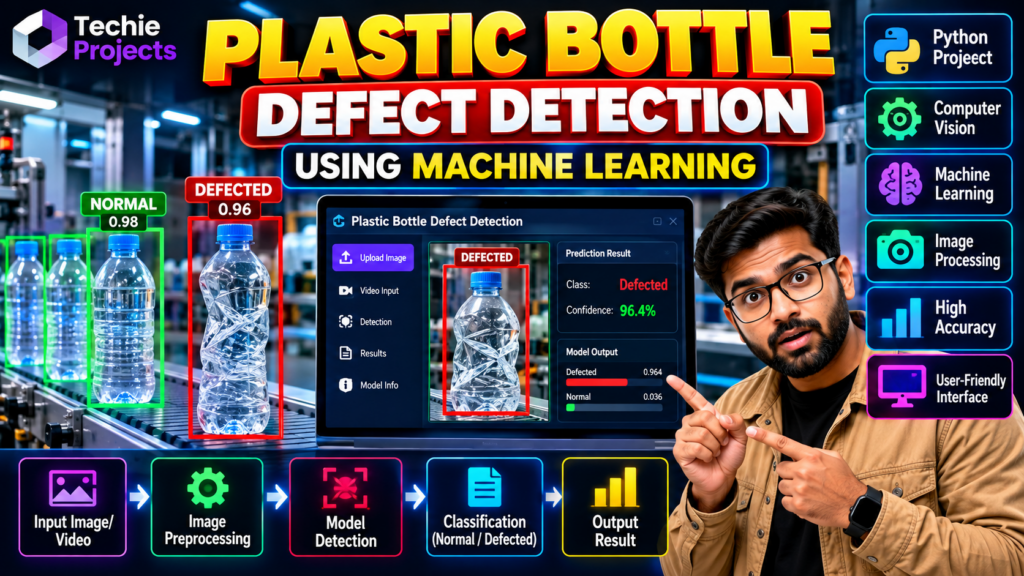
Real-time defected bottle identification using image processing is a computer vision project that demonstrates how Python-based image processing and machine learning techniques can identify and classify plastic bottles as normal or defective. Depending on the implementation, the system can analyze images or video frames, locate bottles, and display classification results through an application interface.
Bottle inspection is an important part of manufacturing quality control. Damaged, deformed, or incorrectly formed bottles can affect product quality and production efficiency. Automated visual inspection provides an opportunity to explore how computer vision can assist with identifying visible defects.
This project is suitable for B.Tech, B.E., BCA, MCA, and computer science engineering students interested in Python, OpenCV, image processing, machine learning, and industrial automation.
🎥 Watch the Real-Time Defected Bottle Identification Using Image Processing Working Demo
Watch the Real-Time Defected Bottle Identification Using Image Processing Project Demo to see how the application processes supported images or video and displays bottle classification results.
The demonstration can help you understand the user interface, image-processing workflow, and output generated by the implemented model. Depending on the available features, it may show bottle detection, classification labels, and bounding boxes.
Watch the video below to explore the project in action.
What Is Real-Time Defected Bottle Identification?
Real-time defected bottle identification is a computer vision application designed to analyze visual information and classify bottles according to the defect categories supported by the system.
Image processing techniques can prepare images for analysis, while a trained machine learning or deep learning model can classify bottles based on learned visual patterns. An object detection model may also locate bottles within an image or video frame.
The project’s capabilities depend on the dataset, trained model, image quality, and detection method. A student prototype demonstrates these concepts and should not be treated as a certified industrial inspection system without appropriate testing.
🎯 Objectives of the Project
The main objectives of this project are:
- Develop a bottle defect identification application using Python.
- Understand image processing and computer vision techniques.
- Process supported bottle images or video frames.
- Classify bottles into the categories represented by the model.
- Display results through a graphical interface.
- Explore machine learning for visual quality inspection.
- Evaluate model performance using suitable test data.
✨ Key Features of the Bottle Defect Detection System
1. Image and Video Processing
The application processes supported visual inputs according to its implementation.
2. Bottle Identification
The system identifies bottles or relevant regions within an image when bottle detection is implemented.
3. Defect Classification
A trained model can classify supported bottle conditions, such as normal or defective, according to the labels used during training.
4. Visual Result Display
The application can display predicted labels and, if supported, bounding boxes around identified bottles.
5. Python Integration
Python connects image preprocessing, model inference, and result visualization.
6. Extendable Architecture
The project can be extended with additional defect categories or alternative models if suitable data and code modifications are available.
Important: Only advertise live camera detection, real-time processing, confidence scores, or particular defect types if they are supported by the actual project.
🛠️ Technologies Used
Depending on the supplied implementation, the project may use:
- Python: Main programming language.
- OpenCV: Image and video processing.
- NumPy: Numerical operations and image-array handling.
- Machine Learning or Deep Learning: Bottle classification, if implemented.
- YOLO or another object detection model: Bottle localization, if included.
- Tkinter or another GUI framework: Application interface, if included.
- Trained Model and Dataset: Used for classification or detection.
Check the source code and requirements file to confirm the exact libraries and model architecture.
⚙️ How the Project Works
The general workflow includes the following steps:
- Input Selection: Load a supported bottle image or video stream.
- Preprocessing: Resize or prepare the input according to the model’s requirements.
- Bottle Detection: Locate bottles if the selected model supports object detection.
- Feature Analysis: Process the visual information needed for classification.
- Model Inference: Predict the relevant bottle category.
- Result Visualization: Display the output through the application interface.
- Evaluation: Compare predictions with labeled test data to assess performance.
This workflow helps students understand how computer vision can be applied to manufacturing inspection tasks.
💻 Software Requirements
Typical requirements may include:
- Operating System: Windows or another supported platform
- Programming Language: Python
- IDE: Visual Studio Code or PyCharm
- Libraries: OpenCV, NumPy, and packages required by the model
- Model File: A trained model, if supplied separately
- Dataset: Bottle images for training or evaluation, if included
- Camera: Optional, if live camera input is implemented
- Hardware: A computer capable of running the selected model
Actual requirements depend on the model, Python version, and input-processing method.
Real-Time Defected Bottle Identification Using Image Processing Workflow
The real-time defected bottle identification using image processing workflow begins with image acquisition, followed by preprocessing, bottle detection, classification, and result visualization. Python and OpenCV can handle image processing, while a trained machine learning model can classify supported bottle conditions.
Benefits for Engineering Students
The real-time defected bottle identification using image processing project helps students explore practical computer vision concepts, model inference, and visual quality inspection. It can be customized for academic demonstrations by experimenting with different datasets, preprocessing methods, and classification models.
Project Customization and Source Code
Techie Projects offers students an opportunity to enquire about the real-time defected bottle identification using image processing project, including available source code, installation guidance, documentation, and customization options. Contact us to confirm the included features, requirements, and pricing before purchasing.
🏭 Applications of Bottle Defect Identification
Potential applications and research areas include:
- Plastic bottle quality inspection
- Manufacturing automation research
- Packaging inspection demonstrations
- Computer vision education
- Image processing experiments
- Machine learning model evaluation
- Industrial quality-control prototypes
Real manufacturing environments may require controlled lighting, representative datasets, integration with production equipment, and extensive validation.
✅ Advantages of the Project
- Demonstrates practical image processing concepts.
- Helps students learn Python and computer vision.
- Introduces machine learning-based classification.
- Provides experience with model inference and result visualization.
- Can be adapted to additional defect categories.
- Offers a foundation for academic experimentation.
- Connects software development with a manufacturing use case.
🚀 Future Scope
The project can be extended with additional capabilities, depending on its architecture:
- Add more bottle defect categories.
- Evaluate alternative classification models.
- Improve performance under different lighting conditions.
- Explore live camera processing.
- Add image-based inspection reports.
- Store classification results for analysis.
- Develop a dashboard for inspection statistics.
- Investigate integration with a conveyor-belt prototype.
Any improvement in detection performance should be measured with appropriate test data rather than assumed.
🛒 Purchase the Real-Time Defected Bottle Identification Project
Are you looking for a real-time defected bottle identification using image processing project for your final-year engineering submission, computer vision assignment, or machine learning portfolio?
Techie Projects can help you enquire about project availability, Python source code, trained model files, installation instructions, documentation, and customization options.
Before purchasing, confirm which features are included in the available implementation, including supported defect categories, input formats, model files, and any live camera functionality.
📲 Call/WhatsApp: +91-9460060699
🌎 Website: www.techieprojects.com
📺 Instagram: @pythonprojects_
🔗 Explore Related Projects
- Object Detection Using Python
- Wine Quality Prediction
- Real-Time Object Detection Using YOLO
- Image Processing Projects
- Machine Learning Projects
- Deep Learning Projects
❓ Frequently Asked Questions
1. What is real-time defected bottle identification using image processing?
It is a computer vision task that analyzes bottle images or video frames to identify supported bottle conditions, such as normal or defective.
2. Which programming language is used in this project?
Python is commonly used because it supports image processing, computer vision, and machine learning libraries.
3. Does the project support live camera detection?
Live camera detection is available only if it has been implemented in the supplied version. Confirm this feature before purchasing.
4. Can I add more types of bottle defects?
Additional defect categories may be possible by preparing suitable labeled data and modifying or retraining the model, depending on the implementation.
5. Is this project suitable for final-year engineering students?
It can be suitable for students studying computer science, artificial intelligence, machine learning, or image processing, subject to their academic requirements.
6. How can I purchase this project?
Contact Techie Projects through WhatsApp to enquire about the available source code, model files, features, installation requirements, and pricing.
Conclusion
Real-time defected bottle identification using image processing is an educational computer vision project that introduces students to image preprocessing, bottle classification, and machine learning-based inspection.
By exploring its workflow, students can learn how Python-based techniques can be applied to a manufacturing quality-control problem. Contact Techie Projects to discuss the available implementation, source code, customization options, and pricing for your academic project.