
Introduction
Skin Cancer Detection Using Machine Learning is an educational computer vision project that demonstrates how Python, image processing, and machine learning or deep learning techniques can be used to analyze skin lesion images.
The basic idea of the project is to provide a skin image as input and use a trained image-classification model to generate a predicted class. This type of project can help Computer Science and Engineering students understand important concepts such as image preprocessing, dataset preparation, model training, classification, and prediction.
The project is suitable as a final-year machine learning project for students interested in Artificial Intelligence, Deep Learning, Computer Vision, Image Processing, and Python.
Important: This project is intended for educational and research purposes. A machine-learning prediction from a student project should not be considered a medical diagnosis or a substitute for evaluation by a qualified healthcare professional.
🎥 Watch the Skin Cancer Detection Project Demo
Project Overview
The Skin Cancer Detection project uses image classification techniques to analyze images of skin lesions. A machine learning or deep learning model is trained using labeled image data so that it can learn visual patterns associated with different classes.
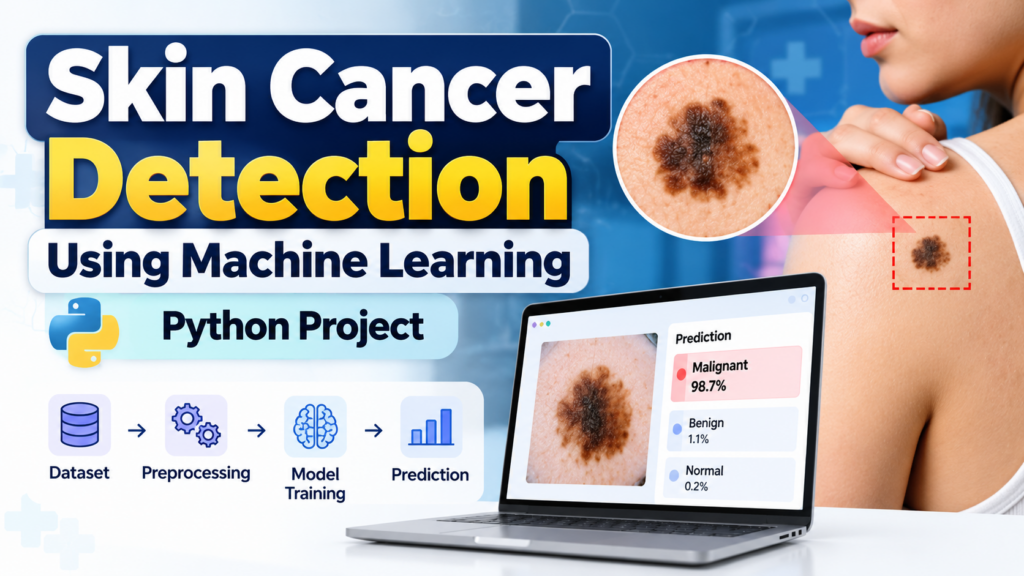
A typical implementation includes four major stages:
- Collecting and preparing the image dataset
- Preprocessing and normalizing the images
- Training a classification model
- Providing a prediction for a new input image
The system can then display the predicted class generated by the trained model.
How Skin Cancer Detection Using Machine Learning Works
The project generally follows this workflow:
Input Image → Image Preprocessing → Feature Learning → Trained Model → Classification → Prediction Result
First, the user provides an image of a skin lesion. The image is then processed into a suitable format for the trained model. Preprocessing may include resizing, normalization, noise reduction, and other image-processing operations depending on the implementation.
The processed image is passed to the trained classification model. A deep learning model such as a Convolutional Neural Network (CNN) can learn visual patterns from image data and classify an input image into the classes represented in the training dataset.
The final prediction is displayed to the user through the project’s interface.
Key Features
The major features of this educational project can include:
- Skin lesion image upload
- Image preprocessing
- Machine learning/deep learning-based image classification
- Prediction of the class supported by the trained model
- Simple user interface
- Python-based implementation
- Image-processing functionality
- Educational information about the project
- Model-based prediction results
The exact features may vary depending on the implementation and trained dataset.
Technologies Used
The project can be developed using the following technologies:
- Python – Main programming language
- Machine Learning / Deep Learning – Model development and classification
- CNN – Suitable deep learning approach for image classification
- OpenCV – Image processing and computer vision operations
- NumPy – Numerical and array operations
- TensorFlow/Keras or another ML framework – Depending on the actual model implementation
- Web or desktop interface – Depending on the project’s implementation
Only list the frameworks in your project documentation that are actually used in your implementation.
Dataset and Model Training
The quality of an image-classification system depends heavily on the dataset used for training and evaluation.
A suitable dataset should contain properly labeled skin images representing the classes that the model is expected to recognize. Before training, the images may be resized and normalized so that they can be processed consistently.
The dataset can then be divided into training, validation, and testing subsets. During training, the model learns patterns from the training images. Validation data can be used to monitor model performance, while the test dataset can provide an independent evaluation.
For a deep-learning implementation, a CNN or a suitable transfer-learning architecture can be considered depending on the dataset, available computing resources, and project requirements.
Project Requirements
Software Requirements
- Python 3.x
- Machine learning/deep learning framework used by the project
- OpenCV, if used
- NumPy
- Windows 10/11 or another supported operating system
- Required Python libraries for the implementation
Hardware Requirements
- Intel Core i3/i5 or equivalent processor
- 8 GB RAM recommended
- Sufficient storage for the dataset and project files
- GPU is optional but can be useful for model training
Actual requirements depend on the size of the dataset and the model being trained.
Advantages of Skin Cancer Detection Using Machine Learning
This project provides students with practical experience in:
- Machine learning
- Deep learning
- Computer vision
- Image classification
- Python programming
- Dataset preparation
- Model training and evaluation
- Building AI-based applications
It can also be extended into a larger academic project by adding model comparison, performance evaluation, visualization, improved preprocessing, or a web-based interface.
Limitations
Machine-learning predictions depend on the quality, size, and diversity of the training dataset. Poor-quality images, limited datasets, class imbalance, and differences between training and real-world images can affect model performance.
A prediction generated by an academic machine-learning model should not be used independently for medical diagnosis or treatment decisions. Real clinical applications require appropriate validation, medical expertise, regulatory considerations, and testing on representative clinical data.
Future Scope
The project can be further improved by experimenting with transfer-learning models, larger and more diverse datasets, improved image preprocessing, model explainability, and performance comparison between different architectures.
A future version could also include a web or mobile interface, secure image handling, model-performance dashboards, and additional research-oriented features.
Frequently Asked Questions
What is Skin Cancer Detection Using Machine Learning?
It is an educational AI project that uses image-processing and machine-learning or deep-learning techniques to classify skin images according to the classes represented in its training dataset.
Which programming language is used for this project?
Python is commonly used because it provides extensive libraries for machine learning, deep learning, computer vision, and image processing.
Is this a good final-year project?
Yes. The project covers several important areas of Computer Science, including Python, machine learning, deep learning, computer vision, image processing, and model evaluation.
Which algorithm can be used for skin image classification?
A Convolutional Neural Network (CNN) can be used for image classification. Transfer-learning architectures can also be evaluated depending on the project’s dataset and requirements.
Can this project diagnose skin cancer?
No. An academic machine-learning project should not be presented as a clinical diagnostic system. Its predictions should be treated as experimental or educational outputs and not as medical advice.
Can the project be developed using Python?
Yes. Python can be used for image preprocessing, model development, training, evaluation, and prediction.
Can this project be extended?
Yes. Students can extend the project with additional datasets, model comparison, performance visualization, transfer learning, a web interface, or other research-oriented features.
Conclusion
Skin Cancer Detection Using Machine Learning is a useful educational project for students who want to explore Artificial Intelligence, Deep Learning, Computer Vision, and Python. The project demonstrates how image data can be processed and analyzed using a trained classification model.
For a final-year project, students can further improve the system by documenting the dataset, preprocessing steps, model architecture, training process, evaluation metrics, limitations, and future scope.
Interested in This Machine Learning Project?
Looking for a final-year machine learning project with implementation guidance, documentation, and project support? Contact Techie Projects to discuss your requirements.
☎️ Contact Us For More Queries:-
📲 Call/WhatsApp: +91-9460060699
🌎 Website: www.techieprojects.com
📺 Instagram: @pythonprojects_
Frequently Asked Questions
What is Skin Cancer Detection Using Machine Learning?
It is a machine learning/deep learning project that analyzes skin lesion images and attempts to classify them based on the trained model.
Which programming language is used?
Python is used for implementing the machine learning and image-processing components.
Which deep learning model is used?
A Convolutional Neural Network (CNN) can be used for image classification. State the exact architecture if your project uses a specific model.
Is this project suitable for final-year students?
Yes. It can be used as an educational Computer Science/AI/ML final-year project, provided the implementation and documentation accurately describe the system.
Can this system diagnose skin cancer?
No. A student project should not be presented as a clinical diagnostic tool. Medical diagnosis should be performed by qualified healthcare professionals.