
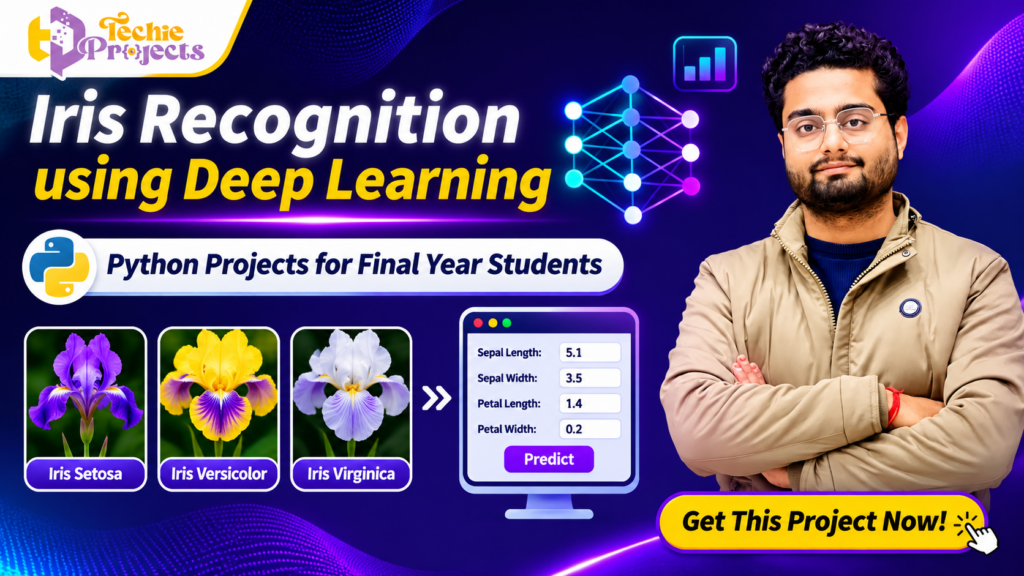
🚀 Looking to purchase an Iris Flower Classification using Python project for your final-year engineering submission? Get a complete practical machine learning project from Techie Projects, designed for B.Tech, BCA, MCA and Computer Science students.
The Iris Flower Classification using Python project demonstrates how machine learning techniques can analyze flower measurements and predict three different iris flower species: Iris Setosa, Iris Versicolor and Iris Virginica.
Instead of wasting time searching for incomplete source code, confusing tutorials and implementation resources, get your project from Techie Projects with available source code, project demonstration and implementation guidance.
🎓 Whether you need a final-year major project, college submission or practical machine learning experience, this Python project can help you understand dataset processing, classification algorithms and predictive modelling.
🔥 Get This Project Now! Contact Techie Projects for pricing, source code availability and project details.
📞 Contact Techie Projects for Project Enquiries
Interested in purchasing the Iris Flower Classification using Python project? Contact us to enquire about package availability, pricing, source code, documentation, installation guidance, and technical support options.
💬 WhatsApp Enquiry: Chat with Techie Projects
📱 Contact Number: +91 94600 60699
🌐 Official Website: www.techieprojects.com
📸 Instagram: Follow Techie Projects
🎓 Project Areas: Robotics, Machine Learning, Arduino, Deep Learning, Artificial Intelligence, and Android App.
✅ Request Project Details: Share your engineering branch, preferred features, and technical requirements to enquire about the most suitable available package.
🚀 Ready to get started? Click here to enquire on WhatsApp and mention Iris Flower Classification using Python project.
Package contents, prices, hardware availability, and support options should be confirmed before purchase.
🎬 Watch the Iris Recognition Using Deep Learning Project Demo
Explore the practical demonstration of the Iris Recognition Using Deep Learning project to understand its interface, input parameters, prediction process, and classification output.
The demonstration helps students understand how flower measurements are provided to a trained machine learning model and how the application predicts the corresponding iris flower category.
Get in touch with Techie Projects if you want the complete project package and implementation details.
🌸 What Is Iris Recognition Using Deep Learning?
Iris Recognition Using Deep Learning is a Python-based classification project that demonstrates how machine learning and artificial intelligence techniques can identify different iris flower varieties using numerical features.
The project focuses on classifying three popular iris flower categories:
- Iris Setosa
- Iris Versicolor
- Iris Virginica
The classification process uses four important flower measurements:
- Sepal Length
- Sepal Width
- Petal Length
- Petal Width
These measurements are provided to a trained predictive model, which analyzes the input values and produces a classification result.
This project is particularly useful for students who want to understand the fundamentals of supervised learning, data preprocessing, feature selection, model training, and prediction.
Important: This project focuses on iris flower classification using the Iris dataset, not biometric identification through human eye iris patterns.
🌸 Iris Flower Classification Using Python – Project Overview
The primary objective of this Iris Recognition Using Deep Learning project is to develop an intelligent classification application using Python.
The system demonstrates how numerical data can be processed and used to predict the category of a flower through a trained model.
Main Project Objectives
- Develop a Python-based flower classification application.
- Understand the fundamentals of machine learning.
- Explore classification algorithms and predictive modelling.
- Process and analyze the Iris dataset.
- Build a user-friendly graphical interface.
- Predict flower categories using input measurements.
- Understand the practical implementation of artificial intelligence.
The project offers an excellent opportunity to explore data science and machine learning concepts through a real-world educational example.
💻 Technologies Used in Iris Flower Classification Using Python
The Iris Recognition Using Deep Learning project uses Python and machine learning technologies to demonstrate an end-to-end classification workflow.
The following technologies are relevant to the project implementation:
1. Python Programming Language
Python is the primary programming language used to develop the application. Its simple syntax and extensive machine learning ecosystem make it suitable for academic AI projects.
2. Machine Learning
Machine learning techniques are used to train a classification model using flower measurements and their corresponding categories.
3. NumPy
NumPy supports numerical operations, array manipulation, and mathematical computations during data processing.
4. Pandas
Pandas can be used to load, organize, and analyze structured datasets.
5. Scikit-learn
Scikit-learn provides tools for data preprocessing, model training, classification, and performance evaluation.
6. Tkinter
Tkinter can be used to develop the graphical user interface, allowing users to enter flower measurements and view prediction results.
7. Data Visualization
Visualization techniques help students understand dataset distributions, feature relationships, and classification patterns.
⚙️ How Iris Flower Classification Using Python Works
The Iris Recognition Using Deep Learning application follows a systematic classification workflow.
Step 1: Dataset Collection
The project uses the Iris flower dataset, which contains measurements of different flower varieties.
The dataset includes four numerical features and three target categories.
Step 2: Data Preprocessing
The collected dataset is prepared for model training.
Preprocessing may include:
- Checking missing values.
- Organizing input features.
- Separating independent and dependent variables.
- Preparing training and testing datasets.
Step 3: Feature Selection
The system considers four important features:
- Sepal Length
- Sepal Width
- Petal Length
- Petal Width
These measurements help the classification model distinguish between different flower categories.
Step 4: Model Training
The training dataset is used to develop a predictive classification model.
Depending on the selected implementation, different supervised learning algorithms can be explored.
Step 5: User Input
The graphical interface allows users to enter flower measurements.
For example:
- Sepal Length: 5.1
- Sepal Width: 3.5
- Petal Length: 1.4
- Petal Width: 0.2
Step 6: Prediction
After entering the required measurements, the user clicks the Predict button.
The application processes the input values and sends them to the trained model.
Step 7: Classification Result
The model generates a prediction corresponding to one of the three iris flower categories.
This demonstrates how an intelligent classification application can transform numerical input data into meaningful predictions.
🧠 Why Is This a Good Final Year Python Project?
The Iris Recognition Using Deep Learning project is suitable for students interested in learning practical machine learning implementation.
It introduces several important concepts that are frequently used in AI and Data Science applications.
🎓 Benefits of Iris Flower Classification Using Python
1. Practical Python Development
Students understand how Python can be used to develop an interactive machine learning application.
2. Machine Learning Fundamentals
The project introduces dataset preparation, classification, model training, and prediction.
3. Graphical User Interface Development
Students can explore how Tkinter connects a Python application with a trained predictive model.
4. Dataset Analysis
The Iris dataset provides a simple environment for understanding numerical features and classification labels.
5. Academic Demonstration
The application can help students explain the complete classification workflow during project demonstrations and viva examinations.
📊 Important Features of the Iris Recognition Project
The project demonstrates several useful features that make it appropriate for academic learning.
- 🌸 Three Flower Categories: Classification of Setosa, Versicolor, and Virginica.
- 📏 Four Input Parameters: Uses sepal and petal measurements.
- 🐍 Python-Based Implementation: Developed using Python technologies.
- 🤖 Predictive Classification: Generates flower category predictions.
- 🖥️ Graphical User Interface: Provides an interface for entering measurements.
- 📚 Machine Learning Concepts: Demonstrates supervised classification.
- 🎓 Academic Application: Useful for engineering and postgraduate project demonstrations.
🌸 Understanding the Iris Flower Classification Using Python Project
The Iris Flower Classification using Python project is a practical machine learning application designed to classify different iris flower species based on their physical measurements. It uses the Iris dataset to train a classification model that predicts whether a flower belongs to the Setosa, Versicolor, or Virginica category.
With the Iris Flower Classification using Python implementation, students can understand data preprocessing, feature selection, model training, testing, and prediction. This project provides an excellent opportunity to explore real-world machine learning concepts through Python programming.
🚀 Machine Learning Implementation
The Iris Flower Classification using Python system uses numerical flower measurements, including sepal length, sepal width, petal length, and petal width. These features are processed and provided to a trained machine learning model for prediction.
Students exploring the Iris Flower Classification using Python project can learn how classification algorithms identify patterns in datasets and generate predictions. The implementation also demonstrates how Python libraries such as NumPy, Pandas, and Scikit-learn support machine learning development.
🎓 Why Choose This Python Project?
The Iris Flower Classification using Python project is suitable for B.Tech, BCA, MCA, and computer science students who want practical experience in machine learning.
By purchasing the Iris Flower Classification using Python project from Techie Projects, students can explore the available source code, understand the implementation workflow, and prepare for their academic project demonstrations.
💡 Get Your Complete Project
Looking for a ready-to-explore machine learning project? The Iris Flower Classification using Python project from Techie Projects offers a practical starting point for understanding classification techniques and Python-based application development.
Contact Techie Projects to enquire about source code availability, implementation details, project demonstrations, and pricing for the Iris Flower Classification using Python project.
🏗️ Applications of Iris Flower Classification Using Python
Although the Iris dataset is primarily an educational dataset, the classification workflow demonstrates concepts that can be applied in various machine learning applications.
1. Agricultural Data Analysis
Classification techniques can help analyze plant characteristics and identify categories based on measurable features.
2. Botanical Research
Researchers can use numerical measurements to study differences between plant varieties.
3. Educational Machine Learning
Students can understand how supervised learning models classify observations into predefined categories.
4. Data Science Training
The project provides a practical example of dataset analysis, feature selection, model development, and evaluation.
5. Artificial Intelligence Learning
Beginners can use this project to understand how predictive models are integrated into Python applications.
🎓 Who Can Purchase This Project?
Techie Projects provides engineering and academic project solutions for students interested in practical software development.
This project may be suitable for:
- B.Tech Computer Science Engineering students.
- B.Tech Information Technology students.
- BCA students.
- MCA students.
- M.Tech students.
- Artificial Intelligence and Machine Learning students.
- Data Science students.
- Students preparing final-year major projects.
- Beginners learning Python and machine learning.
Whether you are preparing a minor project or a final-year academic demonstration, this project offers a practical starting point.
⭐ Why Choose Techie Projects?
Selecting the right project resource can make your academic development process easier.
At Techie Projects, we focus on providing technology-based project solutions across multiple domains.
What Makes Techie Projects Different?
- ✅ Projects covering multiple engineering domains.
- ✅ Python, Artificial Intelligence, and Machine Learning solutions.
- ✅ Practical project demonstrations.
- ✅ Source code and implementation information according to the selected package.
- ✅ Technical guidance for understanding project functionality.
- ✅ Solutions for engineering and postgraduate students.
- ✅ Assistance with project-related enquiries.
Our objective is to help students explore practical technologies and understand how software applications are developed.
🚀 Purchase Iris Flower Classification Using Python Project from Techie Projects
Are you ready to get started with your final-year Python project?
Purchase the Iris Recognition Using Deep Learning project from Techie Projects and explore a practical machine learning classification application.
Instead of wasting time searching for different implementations, discuss your academic requirements directly with our team.
What Can You Enquire About?
- Complete Python project source code.
- Project implementation details.
- Software requirements and installation guidance.
- Project demonstration.
- Documentation availability.
- Project customization requirements.
- Pricing and delivery information.
The exact deliverables and support depend on the selected project package. Contact us to confirm the available options before purchasing.
🚀 GET THIS PROJECT NOW!
Start your final-year project journey with Techie Projects!
📞 Contact / WhatsApp: +91 94600 60699
🌐 Website: www.techieprojects.com
📸 Instagram: @pythonprojects_
💡 Recommended Projects from Techie Projects
Interested in exploring more Artificial Intelligence, Machine Learning, and Python-based projects?
Check out these related project ideas:
- Face Recognition Attendance System – Automate student attendance using facial recognition.
- Plant Leaf Disease Detection – Identify plant diseases using image processing and machine learning.
- Fake News Detection using Machine Learning – Classify news content using Natural Language Processing.
- DeepFake Detection System – Explore AI-based manipulated media detection.
- Iris Flower Classification using Machine Learning – Predict iris flower categories using numerical features.
- Human Activity Recognition – Recognize human activities using machine learning techniques.
- Real-Time Object Detection – Identify objects from live camera input using computer vision.
Explore more engineering and Python projects at Techie Projects.
❓ Frequently Asked Questions (FAQs)
1. What is Iris Recognition Using Deep Learning?
It is a Python-based educational classification project that predicts iris flower categories using numerical flower measurements and a trained predictive model.
2. Which dataset is used in this project?
The project uses the Iris flower dataset, which contains three categories: Iris Setosa, Iris Versicolor, and Iris Virginica.
3. Which programming language is used?
Python is the primary programming language used for developing the application.
4. What are the input parameters?
The application uses four measurements: sepal length, sepal width, petal length, and petal width.
5. Is this project suitable for B.Tech students?
Yes. It is suitable for students studying Computer Science, Information Technology, Artificial Intelligence, Machine Learning, and related disciplines.
6. Can beginners understand this project?
Yes. Students with basic Python knowledge can use this project to explore dataset preparation, classification, model training, and prediction.
7. Can I purchase the complete source code?
You can contact Techie Projects to enquire about source code availability, implementation details, documentation, and the available project package.
8. Does the project include a graphical user interface?
The demonstrated application includes a graphical interface for entering flower measurements and viewing prediction results.
9. What is the difference between iris flower recognition and biometric iris recognition?
Iris flower recognition classifies flower varieties using botanical measurements, whereas biometric iris recognition identifies individuals using patterns in the human eye. This project focuses on flower classification.
10. How can I purchase this project?
Contact Techie Projects through WhatsApp at +91 94600 60699 or visit www.techieprojects.com to enquire about pricing and project availability.
🎯 Conclusion
The Iris Recognition Using Deep Learning project is a practical educational application for students interested in Python programming, Artificial Intelligence, and Machine Learning.
It demonstrates how flower measurements can be processed using a trained classification model to predict different iris flower categories.
From dataset preparation and feature selection to model training and graphical interface development, the project introduces important concepts used in modern predictive applications.
If you are looking for a Python-based final-year project with implementation details and project demonstration, Techie Projects can help you explore the available project package.
🚀 Don’t delay your academic project preparation. Contact Techie Projects today and get started!
📞 Contact / WhatsApp: +91 94600 60699
🌐 Website: www.techieprojects.com
📸 Instagram: @pythonprojects_
Techie Projects – Your Partner in Engineering Projects and Innovative Technology Solutions.

