
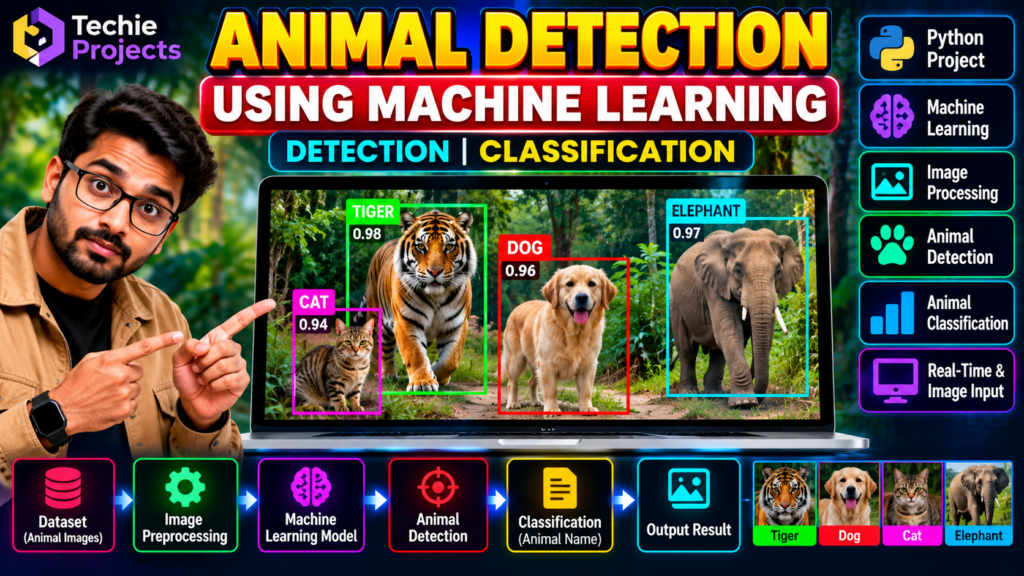
Animal Detection Using Machine Learning | Python Project
Introduction
Animal detection using machine learning is a computer vision project that identifies and classifies animals in images, videos, or live camera feeds. This project is suitable for B.Tech, BCA, MCA, and final-year engineering students who want to explore artificial intelligence, machine learning, deep learning, and image processing using Python.
The Animal Detection Using Machine Learning project demonstrates how a trained model can recognize different animal categories, such as dogs, cats, elephants, and tigers, depending on the dataset and model configuration. It helps students understand image preprocessing, dataset preparation, model training, object detection, and prediction.
🎬 Project Demo – Animal Detection Using Machine Learning
Watch the project demonstration to understand how the application detects and classifies animals from images or video input. The demo can showcase the detection interface, predicted animal labels, bounding boxes, and confidence scores supported by the implementation.
🎯 Project Objectives
The main objectives of this project are:
- Detect animals in images or video frames.
- Classify animals into supported categories.
- Display animal labels and detection results.
- Understand computer vision and machine learning workflows.
- Develop a practical Python application for academic demonstration.
- Explore the use of AI in wildlife monitoring and animal identification.
⭐ Key Features
1. Image-Based Animal Detection
Upload an image and process it to identify animals supported by the trained model.
2. Animal Classification
Classify detected animals into categories included in the dataset and model.
3. Video-Based Detection
If supported by the implementation, process video frames to identify animals across a recording.
4. Bounding Boxes and Labels
Object detection models can draw bounding boxes around detected animals and display their predicted labels and confidence scores.
5. Python-Based Implementation
The project provides an opportunity to learn how Python libraries support image processing and machine learning applications.
6. Extendable Project Architecture
Students can explore additional animal categories, improve the dataset, or experiment with different detection models.
⚙️ How the Project Works
The animal detection workflow generally includes these steps:
- Dataset Collection: Collect and organize labeled animal images for the required categories.
- Image Preprocessing: Resize, normalize, or augment images as appropriate for the selected model.
- Model Selection: Choose a suitable classification or object detection model based on the project requirements.
- Model Training: Train the model using the prepared dataset, or load a compatible pretrained model.
- Model Evaluation: Evaluate performance using suitable metrics, such as precision, recall, and accuracy where applicable.
- Animal Detection: Provide an image, video, or camera feed supported by the application.
- Result Display: Show predicted animal labels and, for object detection, bounding boxes and confidence scores.
The exact workflow depends on the model, dataset, and features included in the project version.
🛠️ Technologies Used
The following technologies may be used depending on the implementation:
- Programming Language: Python
- Image Processing: OpenCV
- Machine Learning: Scikit-learn or TensorFlow
- Deep Learning: TensorFlow or PyTorch
- Object Detection: YOLO or another compatible detection model
- User Interface: Tkinter, Streamlit, or another supported framework
- Development Tools: VS Code, PyCharm, or Jupyter Notebook
Not every library is required. The final technology list should match the actual project code.
💻 Software and Hardware Requirements
Software Requirements
- Python 3.x compatible with the project dependencies
- Required Python libraries
- VS Code, PyCharm, or another Python IDE
- Compatible trained model and dataset files, where required
- Windows or Linux operating system
Hardware Requirements
- A modern laptop or desktop computer
- At least 8 GB RAM recommended
- Sufficient storage for the dataset and model files
- A GPU may help accelerate model training but is not always necessary
- A webcam is optional for live-camera detection
🌍 Applications of Animal Detection
Animal detection using machine learning has potential applications in several areas:
- Wildlife Monitoring: Assist researchers in studying animals captured by cameras.
- Animal Identification: Recognize supported animal categories in images.
- Smart Surveillance: Explore automated animal detection near selected areas.
- Agriculture: Research animal presence around farms and agricultural land.
- Conservation Research: Support educational experiments involving wildlife image datasets.
- Academic Projects: Demonstrate object detection, image processing, and AI concepts.
These are potential applications; practical deployment requires suitable testing, reliable data, and consideration of environmental conditions.
✅ Advantages of the Project
- Provides hands-on experience with computer vision.
- Combines Python programming with machine learning concepts.
- Helps students understand object detection and classification.
- Can be extended with additional animal categories.
- Offers opportunities to experiment with different datasets and models.
- Can be used as an academic demonstration or research prototype.
🚀 Future Scope
The project can be extended by:
- Adding more animal categories and improving dataset diversity.
- Experimenting with newer object detection models.
- Developing a web-based or mobile interface.
- Exploring live-camera animal detection.
- Optimizing inference speed for edge devices.
- Evaluating model performance under different lighting and background conditions.
- Exploring alert features for specific research scenarios.
🎓 Why Choose This Project for Your Final Year?
The Animal Detection Using Machine Learning project offers students a practical way to explore Python, image processing, computer vision, and AI. It can help B.Tech, BCA, MCA, and computer science students understand the stages involved in building an image-based detection application.
Students can use the project to study its workflow, understand the implementation, prepare project documentation, and customize the application according to their academic requirements. Actual results depend on the selected model, dataset quality, and testing conditions.
🛒 Get the Animal Detection Project Details and Pricing
Looking for an Animal Detection Using Machine Learning project for your final-year submission, academic demonstration, or learning portfolio?
Contact Techie Projects to enquire about project availability, source code, supported features, documentation, installation requirements, and customization options.
📲 Call/WhatsApp: +91-9460060699
🌎 Website: www.techieprojects.com
📺 Instagram: @pythonprojects_
Contact us to confirm the available version, included files, supported animal categories, and delivery details before placing an order.
🔗 Explore Related Projects
Explore more project ideas and resources:
- Machine Learning Projects
- OpenCV Projects
- Deep Learning Projects
- Python Projects
- Image Processing Projects
❓ Frequently Asked Questions
1. What is animal detection using machine learning?
It is a computer vision application that uses a trained model to identify animals in images or video frames.
2. Which programming language is used?
Python is commonly used because it supports image processing and machine learning libraries.
3. Which algorithms can be used?
Depending on the objective, students can explore CNN-based classifiers or object detection models such as YOLO.
4. Can this project detect animals in real time?
Real-time detection may be possible if the implementation supports a live camera feed and the computer can run the selected model efficiently.
5. Is this project suitable for final-year students?
Yes. It can be a suitable academic project for students studying computer science, artificial intelligence, data science, and related fields.
6. Can the project be customized?
Customization may be possible depending on the available version, dataset, and requirements. Confirm the scope with Techie Projects before ordering.
Conclusion
Animal detection using machine learning is a practical educational project for exploring computer vision, Python programming, image processing, and AI-based object detection. By working through the dataset, model, prediction, and evaluation stages, students can gain valuable experience with a real-world machine learning workflow.
If you need the project source code, documentation, or customization details for your academic requirements, contact Techie Projects through WhatsApp to discuss availability and pricing.