
Introduction
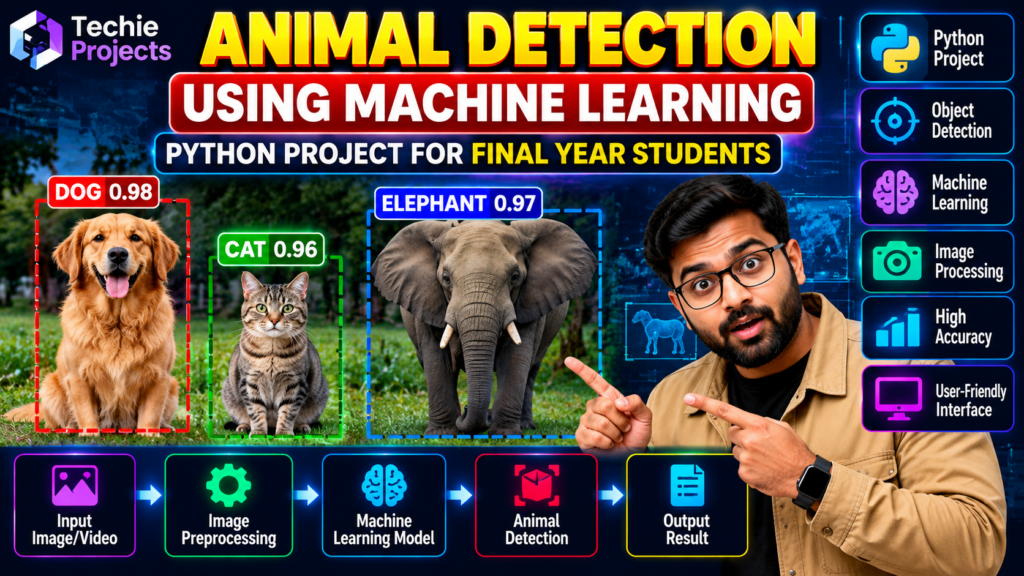
Animal detection and recognition using machine learning is a computer vision project that demonstrates how Python-based models can identify and locate animals in images or videos. Depending on the implementation, the system can recognize supported animal classes, display detection boxes, and present prediction results through an application interface.
Animal detection has applications in wildlife monitoring, animal behavior research, agriculture, and computer vision education. Machine learning models can learn visual patterns from labeled datasets and use those patterns to identify animals in new images. The results depend on the model, training data, image quality, and animal classes supported.
This animal detection and recognition using machine learning project is suitable for B.Tech, B.E., BCA, MCA, and computer science engineering students who want practical experience with Python, image processing, object detection, and machine learning.
🎥 Watch the Animal Detection Using Machine Learning Working Demo
Watch the Animal Detection Using Machine Learning Project Demo to see how the application processes supported images or videos and displays animal detection results.
Explore the working interface, animal labels, detection boxes, and output generated by the implemented model. The demonstration provides an overview of how Python and machine learning can be combined to build an animal recognition application.
Watch the video below to explore the project in action.
What Is Animal Detection and Recognition Using Machine Learning?
Animal detection and recognition using machine learning is a computer vision task that analyzes images or video frames to identify animals belonging to supported categories.
An object detection model can locate animals within an image and draw bounding boxes around them. An image classification model, by comparison, typically assigns a label to an entire image. The exact approach depends on the model used in the project.
Python libraries and trained models can support image preprocessing, prediction, and result visualization. Depending on the implementation, the application may process individual images or video frames.
🎯 Objectives of the Project
The main objectives of this project are:
- Develop an animal detection application using Python.
- Understand machine learning and computer vision concepts.
- Learn image and video preprocessing.
- Identify animal categories supported by the model.
- Display detection labels and bounding boxes when supported.
- Explore model inference and prediction results.
- Understand how image quality and training data affect detection.
✨ Key Features of the Animal Detection System
1. Image or Video Input
The application accepts supported images or video files, depending on the implemented input method.
2. Animal Detection
The model analyzes input images or video frames to locate animals represented in its supported classes.
3. Animal Recognition
The system assigns labels to detected animals according to the categories learned during training.
4. Bounding Box Visualization
If the project uses an object detection model, it can display bounding boxes around detected animals.
5. Prediction Results
The application presents the model’s output through its interface, such as animal labels and detection confidence scores when supported.
6. Python Integration
Python connects the input-processing workflow, model inference, and result display.
7. Extendable Model
The project can be extended with additional animal classes or alternative detection models, provided suitable training data and implementation changes are available.
Note: Confirm that each feature is implemented in your supplied source code before advertising it as included.
🛠️ Technologies Used
Depending on the implementation, the project may use:
- Python: Main programming language.
- OpenCV: Image and video processing.
- Machine Learning: Animal classification or detection.
- Deep Learning: Neural network-based object detection, if used.
- NumPy: Numerical operations and array processing.
- YOLO or another detection model: Animal localization and classification, if included.
- Trained Model and Dataset: Used for supported animal categories.
The exact libraries, model architecture, and dataset should be verified against the project files.
⚙️ How Animal Detection Using Machine Learning Works
The general workflow includes the following steps:
- Input Selection: Load a supported image or video.
- Preprocessing: Prepare the input according to the model’s requirements.
- Model Loading: Load the trained animal detection model.
- Inference: Process the image or video frame to identify supported animal classes.
- Detection Visualization: Display labels and bounding boxes if the model supports object detection.
- Result Display: Present the output through the application interface.
- Evaluation: If testing functionality is included, evaluate the model using labeled test images and appropriate metrics.
This workflow helps students understand how a computer vision model processes visual data and produces detection results.
💻 Software Requirements
Typical requirements may include:
- Operating System: Windows or another supported platform
- Programming Language: Python
- IDE: Visual Studio Code, PyCharm, or another compatible editor
- Libraries: OpenCV, NumPy, and the packages required by the model
- Model File: A trained model, if supplied separately
- Dataset: Animal images or videos for training or evaluation, if included
- Hardware: A compatible computer capable of running the selected model
Actual requirements depend on the model size, Python version, and whether training or inference is performed.
🎓 Applications of Animal Detection and Recognition
Potential applications include:
- Wildlife monitoring research
- Animal image classification
- Agricultural research
- Wildlife photography analysis
- Computer vision education
- Animal behavior observation
- Machine learning demonstrations
Real-world wildlife or agricultural deployments may require additional validation under different lighting, environmental, and camera conditions.
✅ Advantages of the Project
- Demonstrates practical computer vision concepts.
- Helps students learn Python-based image processing.
- Introduces object detection and classification.
- Provides experience working with trained models.
- Supports image and video analysis when implemented.
- Can be extended with new animal categories.
- Suitable for academic demonstrations and project presentations.
🚀 Future Scope
The project can be extended with additional capabilities, depending on its architecture:
- Add more animal categories.
- Improve performance on difficult lighting conditions.
- Explore real-time camera input.
- Integrate animal counting.
- Store detection results for later analysis.
- Develop a web-based interface.
- Evaluate alternative object detection models.
- Explore wildlife monitoring applications.
Any performance improvements should be measured using suitable test data.
🛒 Purchase the Animal Detection and Recognition Project
Are you looking for an animal detection and recognition using machine learning project for your final-year engineering submission, computer vision assignment, or machine learning portfolio?
Techie Projects can help you enquire about project availability, Python source code, trained model files, installation requirements, documentation, and customization options.
Before purchasing, discuss your academic requirements with us and confirm which animal classes, input formats, model files, and features are included in the available implementation.
📲 Call/WhatsApp: +91-9460060699
🌎 Website: www.techieprojects.com
📺 Instagram: @pythonprojects_
🔗 Explore Related Projects
- Object Detection Using Python
- Brain Tumor Detection using Machine Learning
- Vehicle Detection and Counting using Python
- Helmet and Number Plate Detection in Python
- Machine Learning Projects
❓ Frequently Asked Questions
1. What is animal detection and recognition using machine learning?
It is a computer vision task that uses trained models to locate or classify animals in supported images or videos.
2. Which programming language is used in this project?
Python is commonly used because it supports image processing, machine learning, and object detection libraries.
3. Can the project detect animals in videos?
It can if video input and frame-by-frame processing are implemented in the supplied application.
4. Can I add more animal categories?
Additional categories may be possible by modifying the model, preparing suitable labeled data, and retraining or fine-tuning it where supported.
5. Is this project suitable for final-year engineering students?
It can be suitable for students studying computer science, artificial intelligence, machine learning, or computer vision, depending on their academic requirements.
6. How can I purchase the project?
Contact Techie Projects through WhatsApp to enquire about source code, model files, installation requirements, available features, and pricing.
Conclusion
Animal detection and recognition using machine learning is a practical educational project that introduces students to image processing, object detection, and model inference.
By exploring the workflow, students can understand how Python and machine learning models identify supported animal categories in images or videos. If you need this project for your academic work, contact Techie Projects to discuss the available implementation, source code, customization options, and pricing.