
Introduction
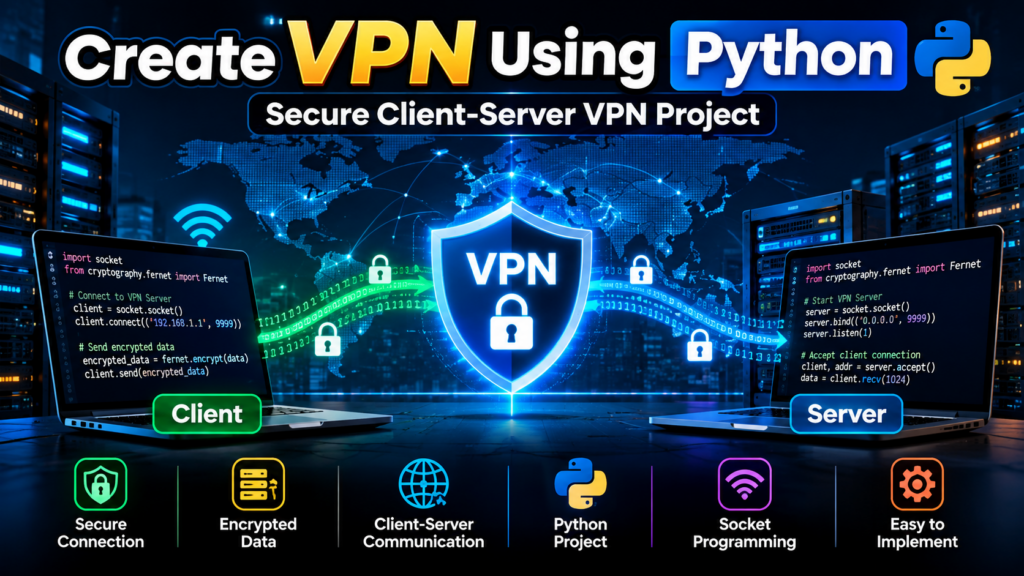
A VPN server using Python can demonstrate how secure client-server communication works over a network. In this educational Python project, we explore how a simple client-server VPN-style communication system can be developed using Python and cryptographic techniques.
The project demonstrates encrypted communication between a Python client and server running in a controlled local environment. It is useful for learning about socket programming, encryption, client-server architecture, and basic network security concepts.
Note: This project is intended for educational and authorized testing environments. Do not use it to intercept, monitor, or access network traffic without permission.
VPN Cryptography using Python
What Is a VPN?
A Virtual Private Network (VPN) is a technology used to create a protected connection over a network. It can provide privacy and security by encrypting data transmitted between endpoints.
A production VPN normally involves advanced networking, routing, authentication, encryption, and tunneling mechanisms. This Python project is a simplified educational implementation designed to demonstrate these concepts.
VPN Server Using Python – Project Overview
The VPN server using Python provides a simple way to understand client-server communication, encryption, and basic network security concepts.
The project consists primarily of two components:
- Python VPN Server
- Python VPN Client
The server starts first and waits for an incoming client connection. The client then connects to the server and exchanges messages through the established connection.
The communication layer uses cryptographic techniques to protect the exchanged data.
How the Python VPN Project Works
The basic workflow is:
- Start the Python server.
- The server listens for a client connection.
- Start the Python client.
- The client connects to the server.
- The client sends data.
- Data is processed using the project’s encryption mechanism.
- The server receives and processes the data.
- The server sends a response back to the client.
- The client receives the response.
This demonstrates the basic concept of secure client-server communication using Python.
Technologies Used
- Python
- Python Socket Programming
- Cryptography
- TCP/IP
- Tkinter
- Client-Server Architecture
- Windows 10/11
Key Features
- Python-based client-server communication
- Encrypted message exchange
- Socket-based networking
- Simple graphical interface using Tkinter
- Separate server and client modules
- Educational demonstration of cryptography
- Local network testing
- Basic secure communication workflow
VPN Server Using Python Architecture
The project can be divided into the following components.
1. VPN Server
The server listens for incoming connections and handles communication with connected clients.
2. VPN Client
The client establishes a connection with the server and exchanges information.
3. Encryption Layer
The cryptographic component protects the data exchanged between the client and server.
4. User Interface
Tkinter can be used to provide a simple graphical interface for interacting with the application.
Software Requirements
- Python 3.x
- Windows 10/11
- Tkinter
- Python Socket module
- Cryptography library
- VS Code or PyCharm
Hardware Requirements
- Intel Core i3 or equivalent processor
- 4 GB RAM or higher
- 500 GB storage or higher
- Keyboard and mouse
- Network connectivity for testing
Applications
This Python VPN project can help students understand:
- Network programming
- Socket programming
- Cryptography
- Secure communication
- Client-server architecture
- Python networking
- Cyber security fundamentals
Advantages
- Easy to understand for Python learners
- Demonstrates practical networking concepts
- Provides hands-on experience with sockets
- Introduces cryptographic communication
- Useful for academic and final-year projects
- Can be extended with additional security features
Limitations
This project is a simplified educational implementation and should not be considered a replacement for production VPN software.
A production VPN requires significantly more advanced security mechanisms, authentication, routing, key management, tunneling protocols, error handling, performance optimization, and security testing.
Future Scope
The project can be extended with:
- User authentication
- Improved key management
- Multiple client support
- Advanced encryption mechanisms
- Connection logging
- Network monitoring
- Cross-platform support
- Improved graphical interface
- Secure configuration management
- Better error handling
- User access control
Why Build a VPN Server Using Python?
A Python VPN project is a useful academic project because it combines programming, networking, cryptography, and cyber security concepts.
Students can learn how client-server communication works while gaining practical experience with Python sockets, encryption, networking, and secure data exchange.
Frequently Asked Questions
Can I create a VPN server using Python?
Yes. Python can be used to build educational client-server networking applications that demonstrate VPN-related concepts such as encrypted communication and secure data exchange.
What Python libraries are used in this project?
The project can use Python’s socket functionality for communication, cryptographic libraries for encryption, and Tkinter for creating a graphical interface.
Is this project a production VPN?
No. This is an educational project and should not be used as a replacement for professionally developed and audited VPN software.
Is this project suitable for final-year students?
Yes. The project is suitable for students interested in Python, networking, cryptography, and cyber security.
What can students learn from this project?
Students can learn about socket programming, client-server architecture, encryption, network communication, Python programming, and basic cyber security concepts.
Conclusion
The VPN Server Using Python project demonstrates how Python can be used to create a basic client-server communication system with cryptographic protection.
The project provides practical exposure to networking, sockets, encryption, client-server architecture, and cyber security concepts. It can also serve as a foundation for developing more advanced networking and security applications in an authorized educational environment.
My recommendation for your Techie Projects website:
🔗 Explore Related Projects
Vulnerability Scanning Using Python
Phishing Detection using Machine Learning
☎️ Contact Us For More Queries:-
📲 Call/WhatsApp: +91-9460060699
🌎 Website: www.techieprojects.com
📺 Instagram: @pythonprojects_