
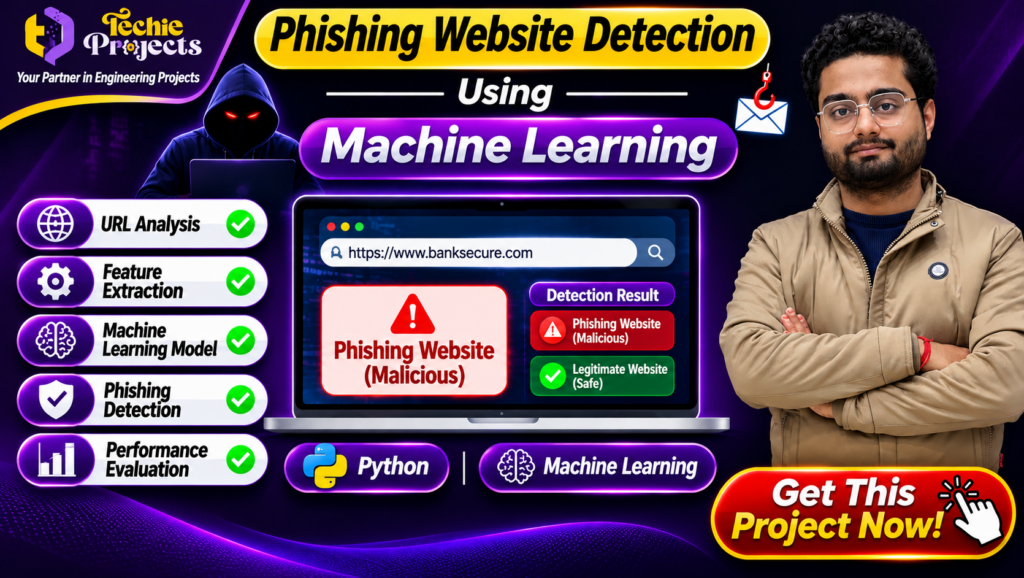
🚀 Get Your Phishing Website Detection Project with Source Code
Are you looking for a practical final-year project in Artificial Intelligence, Machine Learning, or Cyber Security? Choose Phishing Website Detection Using Machine Learning from Techie Projects and get a project that demonstrates how machine learning techniques can help identify potentially fraudulent websites.
Phishing attacks are a major cybersecurity concern. Attackers create deceptive websites that imitate legitimate platforms to trick visitors into sharing sensitive information. Detecting these suspicious websites is an important application of machine learning and intelligent security systems.
Instead of spending weeks building everything from scratch, students can purchase this ready-made academic project from Techie Projects and explore its implementation, source code, working process, and documentation options.
Whether you are a B.Tech, BCA, MCA, M.Tech, or computer science engineering student, this project can help you understand the practical relationship between Python programming, machine learning, URL analysis, and cybersecurity.
Get the project from Techie Projects and start exploring machine learning-based phishing detection.
📞 Contact Techie Projects for Project Enquiries
Looking for project source code, documentation, or implementation assistance? Contact our team to discuss the available project package.
- 📞 Call/ 📲 WhatsApp: +91-9460060699
- 🌐 Website: www.techieprojects.com
- 📸 Instagram: @pythonprojects_
🎬 Watch the Phishing Website Detection Using Machine Learning Project Demo
Explore the working demonstration to understand the website detection interface, URL analysis process, and prediction output.
🔐 What Is Phishing Website Detection Using Machine Learning?
Phishing website detection is a cybersecurity application that attempts to identify websites that may be designed to deceive users. These websites can imitate banking portals, shopping platforms, social networking services, or other trusted online destinations.
Phishing Website Detection Using Machine Learning applies machine learning techniques to website-related information and selected URL characteristics to classify a website as potentially phishing or legitimate.
Traditional security approaches may rely on predefined rules, blacklists, or manually maintained website records. Machine learning offers another approach by learning patterns from labelled examples and applying those patterns to new inputs.
A typical academic implementation may examine characteristics such as:
- URL length and structure.
- Presence of unusual symbols.
- Use of IP addresses in URLs.
- Suspicious domain patterns.
- HTTPS and security-related indicators.
- Number of special characters.
- Other selected URL-based features.
The model uses the extracted information to generate a prediction. The output can help demonstrate how intelligent classification techniques are applied to cybersecurity problems.
It is important to understand that machine learning predictions are not a guarantee of website safety. A prediction should be treated as an indication, not a replacement for professional security verification.
💡 Why Choose This Machine Learning Project?
Cybersecurity is an important area of computer science, and phishing detection provides a practical topic for understanding intelligent security applications.
Students who choose this project can explore multiple technical concepts within one application.
1. Practical Cybersecurity Application
Learn how suspicious website patterns can be analysed using programming and machine learning techniques.
2. Python Programming Experience
Understand how Python can be used to process website-related data, prepare input features, and connect a trained model with an application interface.
3. Machine Learning Implementation
Explore the classification process, training data, model selection, and prediction workflow.
4. URL Feature Analysis
Understand how different URL characteristics can be converted into numerical features for machine learning algorithms.
5. Final-Year Project Demonstration
Present a cybersecurity-based application that combines programming, data processing, and intelligent classification.
⚙️ Key Features of the Project
The following features describe the typical workflow of this academic project. The exact functions depend on the supplied implementation and package.
🌐 URL Input
Users can enter a website URL into the application for analysis. The application uses the provided input to begin the detection workflow.
🔍 URL Feature Extraction
The system can extract selected characteristics from the URL, such as its length, structure, symbols, and other relevant indicators.
🤖 Machine Learning Classification
A trained classification model analyses the extracted features and generates a prediction based on the patterns learned during training.
🚨 Phishing Website Identification
The application can display a result indicating whether the submitted URL is classified as potentially phishing or legitimate by the trained model.
📊 Prediction Results
The output can be displayed through a user interface to make the detection process easier to understand during demonstrations.
🖥️ User-Friendly Interface
Depending on the implementation, the project can include a simple interface for entering URLs and viewing classification results.
🧠 How Does the Detection System Work?
Understanding the workflow is essential for students who want to explain the project during a practical demonstration or viva examination.
The general workflow of Phishing Website Detection Using Machine Learning can be divided into the following stages.
Step 1: Dataset Collection
The first step involves collecting a labelled dataset containing examples of phishing and legitimate websites.
The dataset is used to train and evaluate the machine learning model. Data quality and correct labelling are important because inaccurate training examples can affect prediction performance.
Step 2: Data Preprocessing
The collected dataset is prepared for machine learning.
Preprocessing may include:
- Removing duplicate records.
- Handling missing values.
- Checking incorrect entries.
- Converting categorical values into numerical representations.
- Preparing the input and target variables.
Step 3: Feature Extraction
Feature extraction converts website-related information into a format that a machine learning algorithm can process.
For example, the system may calculate URL length, identify special characters, examine domain structure, or extract other selected indicators.
Step 4: Model Training
The prepared dataset is divided into training and testing subsets.
A suitable machine learning algorithm learns patterns from the training data. The trained model can then be evaluated using the testing data.
Step 5: Website Classification
When a user submits a URL, the application extracts the required features and passes them to the trained model.
The model generates a classification result based on its learned patterns.
Step 6: Result Display
The application presents the prediction through its interface. The result helps demonstrate how machine learning can support the identification of suspicious websites.
🛠️ Technologies Used in the Project
This project combines Python programming with machine learning concepts and cybersecurity-related data analysis.
| Technology | Purpose |
|---|---|
| Python | Main programming language |
| Machine Learning | Website classification |
| Pandas | Dataset processing |
| NumPy | Numerical operations |
| Scikit-learn | Model training and evaluation |
| URL Feature Extraction | Preparing input features |
| HTML/CSS or GUI tools | Interface development, depending on implementation |
The actual libraries and frameworks included should be confirmed against the supplied source code.
📈 Applications of Phishing Website Detection
Machine learning-based phishing detection is relevant to several cybersecurity applications.
🏦 Banking and Financial Services
Financial platforms are frequent targets of phishing attempts. Detection systems can help analyse suspicious website patterns associated with fake banking portals.
🛒 E-Commerce Platforms
Online shopping users may encounter fraudulent websites that imitate popular stores. Website classification can support the identification of potentially deceptive URLs.
📧 Email Security
Phishing links are frequently distributed through email messages. URL analysis can be used as one component of a broader email security workflow.
🏢 Corporate Cybersecurity
Organisations can explore website classification techniques as part of their cybersecurity research and security awareness activities.
🎓 Academic Research
Students can use this project to understand machine learning applications in cybersecurity and explore improvements to classification methods.
🎯 Benefits for Engineering and Computer Science Students
A final-year project should demonstrate more than theoretical knowledge. It should provide an opportunity to understand how different technologies work together.
This project offers several learning opportunities.
- Machine Learning Knowledge: Understand supervised learning and classification.
- Python Development: Explore practical Python programming.
- Cybersecurity Concepts: Learn about phishing threats and website-related indicators.
- Data Processing: Understand dataset preparation and feature extraction.
- Model Evaluation: Explore how classification performance can be measured.
- Project Presentation: Demonstrate a practical cybersecurity application.
Students can also use the project as a starting point for further experimentation and research.
🧪 Future Enhancements
The basic academic implementation can be extended with additional capabilities, depending on project requirements and available resources.
Real-Time URL Analysis
An enhanced version could analyse submitted URLs through a web interface and provide classification results.
Browser Integration
A browser-based extension could be explored to provide warnings when users visit websites classified as suspicious.
Advanced Machine Learning Models
Students can compare multiple classification algorithms and evaluate their performance using suitable metrics.
Deep Learning Integration
Advanced implementations may investigate deep learning approaches for analysing additional website-related information.
Improved User Interface
The interface could be upgraded with prediction history, visual reports, and a dashboard.
Additional Security Indicators
Future development could incorporate domain information, certificate-related indicators, and other security signals where reliable data sources are available.
These enhancements are possible development directions, not necessarily features included in the standard project package.
🛒 Why Purchase This Project from Techie Projects?
Building a complete final-year project requires time for planning, coding, testing, documentation, and presentation preparation. Students who need a structured starting point can consider purchasing this project from Techie Projects.
We provide academic project solutions across Python, Artificial Intelligence, Machine Learning, Data Science, Web Development, IoT, and other engineering domains.
When you enquire about this project, you can discuss the available package and confirm its contents before purchasing.
What You Can Enquire About
- Python project source code.
- Project documentation.
- Implementation details.
- Software requirements.
- Demonstration and working process.
- Customization possibilities.
- Technical assistance, subject to the selected package.
Our aim is to help students understand their chosen project and prepare for academic demonstrations.
Do not wait until your final submission deadline to select a project. Contact Techie Projects today to check availability and package details.
🎓 Who Can Purchase This Project?
This project is suitable for students interested in cybersecurity, Python programming, and machine learning.
Potential audiences include:
- B.Tech Computer Science Engineering students.
- B.Tech Information Technology students.
- BCA students.
- MCA students.
- M.Tech students.
- Diploma computer engineering students.
- Students exploring machine learning mini projects.
- Students working on cybersecurity-related academic topics.
The final suitability depends on your institution’s project guidelines and the implementation requirements.
📋 Software and Hardware Requirements
Before purchasing, students should confirm the exact software and hardware requirements of the supplied version.
Typical software environment:
- Operating System: Windows 10/11 or compatible environment.
- Programming Language: Python.
- Development Environment: VS Code, PyCharm, or Jupyter Notebook.
- Machine Learning Library: Scikit-learn, if used in the implementation.
- Data Processing: Pandas and NumPy, if included.
Typical hardware environment:
- Processor: Intel or AMD processor.
- RAM: 4 GB minimum recommended for a basic development environment.
- Storage: Sufficient space for Python, libraries, and project files.
- Internet: Required for downloading dependencies and any online resources used by the implementation.
Actual requirements may vary depending on the dataset, libraries, and interface.
❓ Frequently Asked Questions
1. What is Phishing Website Detection Using Machine Learning?
It is a cybersecurity project that uses machine learning techniques to classify website URLs as potentially phishing or legitimate based on selected features.
2. Which programming language is used?
Python is the primary programming language for the project.
3. Is this project suitable for final-year students?
Yes. It can be considered by computer science, information technology, and related students, subject to their academic requirements.
4. Can beginners understand this project?
Students with basic Python and machine learning knowledge can use it as a learning resource. Some understanding of datasets, classification, and feature extraction is helpful.
5. Does the project provide source code?
Contact Techie Projects to confirm the source code and other materials included in the available package.
6. Can the project be customized?
Customization may be possible depending on the implementation and requirements. Discuss your requirements before purchasing.
7. Does the system guarantee that a website is safe?
No. Machine learning predictions can produce false positives and false negatives. The output should not be treated as a guarantee of website safety.
8. How can I purchase the project?
Contact Techie Projects through WhatsApp at +91 94600 60699 or visit https://techieprojects.com/ to enquire about the project package.
🔍 Importance of Phishing Website Detection Using Machine Learning in Cybersecurity
Phishing Website Detection Using Machine Learning demonstrates how intelligent algorithms can support modern cybersecurity practices. As online transactions, digital banking, and e-commerce continue to grow, identifying suspicious websites has become an important security challenge.
This approach uses website-related features and trained classification models to identify patterns commonly associated with phishing URLs. Students can understand how machine learning helps analyse data and generate predictions that support cybersecurity research.
💻 Build Your Skills with a Phishing Website Detection Using Machine Learning Project
Working on a Phishing Website Detection Using Machine Learning project gives students practical exposure to Python development, dataset preparation, feature extraction, and classification algorithms.
It also provides an opportunity to understand how different components work together in a real-world-inspired cybersecurity application. Students can study the model, test sample URLs, examine prediction results, and explore possible improvements.
🚀 Get Phishing Website Detection Using Machine Learning Source Code from Techie Projects
Looking for a practical machine learning project that combines Python programming and cybersecurity?
Phishing Website Detection Using Machine Learning is an interesting academic project for students who want to explore URL analysis, feature extraction, classification, and intelligent security applications.
Get in touch with Techie Projects to discuss the available source code, documentation, project requirements, and technical support options.
📞 Call/ 📲 WhatsApp: +91-9460060699
🌐 Website: www.techieprojects.com
📸 Instagram: @pythonprojects_
Choose your project, understand the technology, and prepare your next engineering demonstration with Techie Projects!
🔗 Explore Related Python and Cybersecurity Projects
Explore more academic projects from Techie Projects:
- Machine Learning Projects
- Artificial Intelligence Projects
- Python Projects
- Cyber Security Projects
- Deep Learning Projects
- Data Science Projects
- Computer Vision Projects
Visit www.techieprojects.com to explore more final-year engineering projects and find a project that matches your academic interests.
🎯 Conclusion
Phishing Website Detection Using Machine Learning is a valuable academic project that demonstrates how Python and machine learning can be applied to cybersecurity challenges. By analysing URL characteristics, extracting relevant features, and applying classification techniques, the system helps students understand how potentially fraudulent websites can be identified through intelligent algorithms.
This project provides an opportunity to explore Python programming, dataset preprocessing, feature extraction, machine learning models, and website classification in one practical application. It is suitable for students interested in Artificial Intelligence, Machine Learning, Cyber Security, and final-year engineering projects.
If you are looking for a Phishing Website Detection Using Machine Learning project with source code and documentation, contact Techie Projects to check the available package and technical support options.
🚀 Purchase your project today and take the next step towards your final-year project demonstration!
📞 Contact: +91 94600 60699