
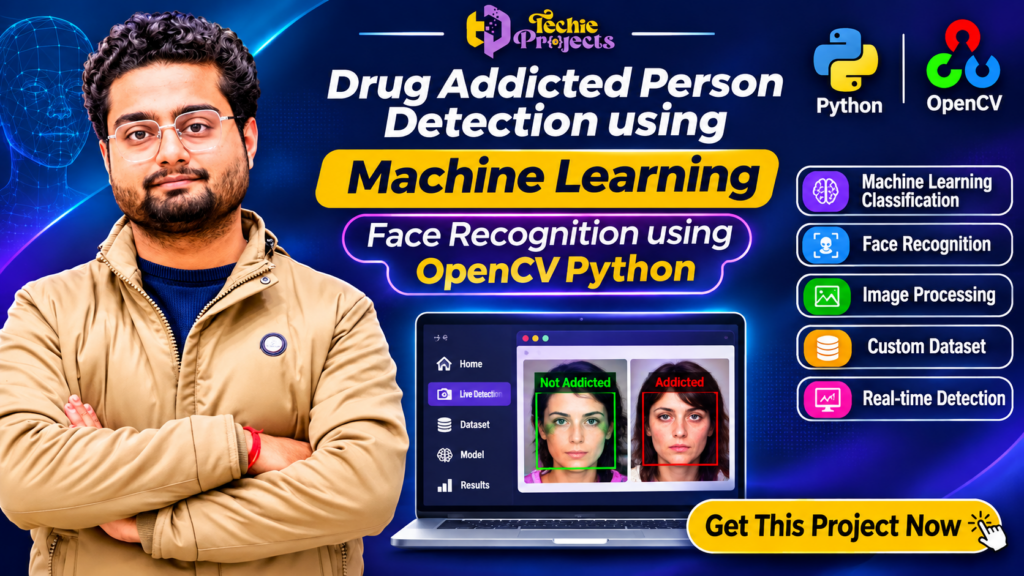
🚀 Looking for a ready-to-use Drug Addiction Detection using Machine Learning Project for your final-year engineering submission? Get your project from Techie Projects!
Are you a B.Tech, BCA, MCA, M.Tech, or computer science student searching for an interesting Artificial Intelligence and Machine Learning project? The Drug Addiction Detection using Machine Learning project is an educational computer vision prototype that demonstrates image processing, face detection, image classification, and machine learning concepts using Python and OpenCV.
Instead of spending weeks building an entire project from scratch, you can enquire about our existing project implementation, source code, demonstration, documentation, and technical assistance.
📞 Contact Techie Projects for Project Enquiries
Interested in purchasing the Drug Addiction Detection Using Machine Learning Project? Contact us to enquire about package availability, pricing, source code, documentation, installation guidance, and technical support options.
💬 WhatsApp Enquiry: Chat with Techie Projects
📱 Contact Number: +91 94600 60699
🌐 Official Website: www.techieprojects.com
📸 Instagram: Follow Techie Projects
🎓 Project Areas: Robotics, Machine Learning, Arduino, Deep Learning, Artificial Intelligence, and Android App.
✅ Request Project Details: Share your engineering branch, preferred features, and technical requirements to enquire about the most suitable available package.
🚀 Ready to get started? Click here to enquire on WhatsApp and mention Drug Addiction Detection Using Machine Learning Project.
Package contents, prices, hardware availability, and support options should be confirmed before purchase.
🎬 Watch the Drug Addiction Detection Project Demo
Explore the working demonstration of the Drug Addiction Detection using Machine Learning project to understand its interface, image processing workflow, and classification functionality.
Watch how the educational prototype processes input images, displays face-related detection results, and demonstrates a machine learning classification workflow.
Interested in developing a similar project? Contact Techie Projects to enquire about source code, implementation details, and available customization support.
📌 Introduction to Drug Addiction Detection Using Machine Learning
Machine Learning and Artificial Intelligence are transforming how computers process images, recognize patterns, and analyze visual information. Computer vision is an important branch of AI that allows computer systems to extract useful information from digital images and videos.
The Drug Addiction Detection using Machine Learning project demonstrates an experimental image classification concept using Python, OpenCV, and face recognition techniques.
The project is designed as an academic prototype to help students understand how image processing and machine learning models can be integrated into a software application.
The application demonstrates an interface where an input image or camera feed can be processed and a model-generated classification result can be displayed.
It is important to understand that facial appearance cannot reliably establish whether someone uses drugs or has an addiction. This project is an educational demonstration, not a medical diagnostic system, forensic tool, or reliable method for identifying drug use.
Students can use this project to explore Python programming, image preprocessing, machine learning workflows, and computer vision application development.
🎓 What Is the Drug Addiction Detection Using Machine Learning Project?
The Drug Addiction Detection using Machine Learning project is an academic software prototype that demonstrates an image classification workflow.
It combines different technologies to illustrate how a computer vision application can process visual input and display model predictions.
The project explores the following concepts:
- Image acquisition and preprocessing.
- Face detection and image recognition concepts.
- Machine Learning classification.
- Python-based application development.
- OpenCV image processing.
- Visual prediction results.
- User interface development.
The main objective is to provide students with practical exposure to AI and Machine Learning application development.
By studying this project, students can understand how different software components work together to create an interactive computer vision application.
⭐ Key Features of the Project
The Drug Addiction Detection using Machine Learning project demonstrates several features that make it useful for academic learning.
1. Image-Based Processing
The application demonstrates how digital images can be loaded and processed using Python libraries.
Students can learn about image reading, resizing, preprocessing, and preparing input data for a machine learning model.
2. Face Detection Concepts
OpenCV provides tools for detecting faces and processing facial regions within images.
This project demonstrates how face-related image processing can be incorporated into a computer vision workflow.
Face detection should not be confused with determining a person’s health, behaviour, or substance-use history.
3. Machine Learning Classification
Machine Learning models learn patterns from training data and generate predictions for new inputs.
The project provides an opportunity to understand classification concepts, model training, prediction generation, and output interpretation.
4. Interactive Application Interface
The application includes a user-facing interface for accessing project functionality.
Students can explore how different interface elements connect with the underlying Python implementation.
5. Prediction Display
The prototype demonstrates how classification outputs can be presented through a visual interface.
Students can understand how a model prediction is transferred to the application and displayed to the user.
6. Python and OpenCV Integration
Python and OpenCV are used to demonstrate the image processing components of the project.
This integration helps students understand the practical relationship between programming, computer vision, and machine learning.
⚙️ Technologies Used in the Project
The Drug Addiction Detection using Machine Learning project introduces students to several technologies commonly used in computer vision applications.
Python
Python is the primary programming language used for developing the application.
It offers a wide range of libraries for image processing, machine learning, data analysis, and application development.
OpenCV
OpenCV is a popular computer vision library.
It provides functionality for:
- Image reading and processing.
- Image resizing and transformation.
- Face detection.
- Video frame processing.
- Computer vision operations.
Machine Learning
Machine Learning is used to demonstrate the classification workflow.
Students can explore training datasets, model evaluation, prediction generation, and classification performance.
Face Recognition Concepts
Face-related image processing techniques help demonstrate how facial regions can be detected and analyzed within an image.
However, face detection alone cannot determine drug addiction or establish a medical condition.
Web-Based Interface
The project demonstration includes an interactive application interface through which users can explore its available functionality.
🔄 How Does the Project Work?
The Drug Addiction Detection using Machine Learning project demonstrates a general image classification workflow.
The following steps explain its educational implementation.
Step 1: Input Image Acquisition
The application receives an image or visual input through its supported input mechanism.
Students can learn how images are loaded and passed into a Python-based computer vision application.
Step 2: Image Preprocessing
The input image is prepared for further processing.
Common image preprocessing operations include:
- Image resizing.
- Color conversion.
- Noise reduction.
- Image normalization.
- Region extraction.
Preprocessing helps maintain a consistent input format for subsequent operations.
Step 3: Face Detection
OpenCV-based techniques can be used to identify facial regions within the input image.
The detected region can then be used to demonstrate further image processing operations.
Step 4: Feature Processing
The project illustrates how visual information can be represented and processed before being passed to a classification model.
Students can explore the relationship between image features and machine learning algorithms.
Step 5: Model Prediction
The trained model processes the prepared input and produces a classification output.
The output represents the model’s prediction, not a verified assessment of a person’s substance use.
Step 6: Displaying Results
The application displays the model output through its interface.
This step demonstrates how machine learning functionality can be integrated into an interactive software application.
💻 Software Requirements
The following are typical software requirements for developing and exploring a Python-based computer vision project.
| Requirement | Technology |
|---|---|
| Programming Language | Python |
| Computer Vision | OpenCV |
| Machine Learning | Scikit-learn / applicable model |
| Development Environment | VS Code / PyCharm |
| Operating System | Windows 10 / 11 |
| Interface | Project-provided application interface |
Actual library versions and installation requirements should be confirmed against the supplied project files.
🖥️ Hardware Requirements
The project can be explored on a standard computer system that supports Python development.
Recommended hardware:
- Processor: Intel Core i3 or higher.
- RAM: 4 GB minimum; 8 GB recommended.
- Storage: 500 GB HDD or SSD.
- Webcam: Optional, depending on the demonstration mode.
- Operating System: Windows 10 or Windows 11.
A dedicated GPU is not necessarily required for basic demonstrations. Hardware requirements depend on the model and implementation.
📚 Learning Outcomes for Engineering Students
The Drug Addiction Detection using Machine Learning project can help students explore several important computer science concepts.
Python Programming
Students can understand Python syntax, functions, modules, file handling, and library integration.
Computer Vision
The project introduces image processing and face detection concepts using OpenCV.
Machine Learning
Students can explore classification, training data, prediction, and model evaluation.
Application Development
The project demonstrates how a software interface can communicate with backend processing components.
Final-Year Project Preparation
Students can study the project architecture, understand the implementation, prepare technical explanations, and demonstrate the application during academic evaluation.
🚀 Why Purchase Your Project from Techie Projects?
Choosing an appropriate project implementation is an important step for engineering students.
At Techie Projects, our goal is to provide project-related solutions and technical assistance across different technology domains.
When enquiring about the Drug Addiction Detection using Machine Learning project, students can ask about the following deliverables:
1. Project Source Code
Enquire about the available Python source code and implementation files.
2. Project Demonstration
Understand the application’s workflow through the available project demo video.
3. Installation Assistance
Get guidance regarding the required environment, dependencies, and application setup.
4. Project Documentation
Enquire about project documentation and supporting materials, depending on the selected package.
5. Customization Assistance
Discuss possible modifications according to your academic requirements and project scope.
6. Technical Guidance
Understand the project workflow, technologies, modules, and implementation concepts.
7. Project Enquiry Support
Contact our team to discuss availability, pricing, deliverables, and technical requirements before purchasing.
🎯 Don’t waste your valuable project preparation time. Enquire about the Drug Addiction Detection using Machine Learning project today!
🎓 Who Can Choose This Project?
This educational project may be relevant to students pursuing:
- B.Tech Computer Science Engineering.
- B.Tech Information Technology.
- BCA.
- MCA.
- M.Tech Computer Science.
- Artificial Intelligence and Data Science.
- Machine Learning specializations.
It is particularly useful for students interested in Python, computer vision, and machine learning application development.
💡 Applications and Important Limitations
Computer vision and machine learning technologies have many potential educational and research applications.
The techniques explored in this project can help students understand:
- Image classification systems.
- Face detection applications.
- Computer vision interfaces.
- Machine learning workflows.
- AI-based image processing.
Important ethical limitation: A model trained on facial images cannot reliably determine whether an individual is addicted to drugs. Facial appearance is not a scientifically sufficient indicator of substance use. Such predictions can create discrimination, privacy violations, and false accusations.
This prototype should only be used for controlled educational demonstrations with appropriate consent and legally obtained data. It should never be used for employment screening, policing, public surveillance, medical diagnosis, or decisions about real individuals.
🔗 Explore Related Python and Machine Learning Projects
Looking for more interesting final-year engineering projects?
Explore additional project categories available through Techie Projects:
- Artificial Intelligence Projects.
- Machine Learning Projects.
- Python Projects.
- Computer Vision Projects.
- Deep Learning Projects.
- Image Processing Projects.
- Data Science Projects.
- Natural Language Processing Projects.
- IoT Projects.
- Web Development Projects.
Visit www.techieprojects.com to explore more project ideas and available implementations.
❓ Frequently Asked Questions
1. What is the Drug Addiction Detection using Machine Learning project?
It is an educational Python-based computer vision prototype that demonstrates image processing, face detection concepts, and machine learning classification.
2. Which programming language is used?
Python is used as the primary programming language.
3. Does the project use OpenCV?
Yes. OpenCV is used for image processing and computer vision functionality.
4. Is this project suitable for final-year engineering students?
It can be considered as an academic project topic for students interested in Python, Machine Learning, Artificial Intelligence, and Computer Vision.
5. Can beginners understand this project?
Students with basic Python knowledge can study the implementation with appropriate technical guidance.
6. Is the project available with source code?
Contact Techie Projects to confirm the available source code, package contents, and purchase options.
7. Can the project be customized?
Customization possibilities can be discussed with the Techie Projects team according to the implementation and academic requirements.
8. Does this project medically identify drug addiction?
No. Facial image classification cannot reliably diagnose or establish substance addiction. This is an educational prototype only.
9. How can I purchase this project?
Contact Techie Projects through WhatsApp or the official website to enquire about pricing, availability, and deliverables.
📞 Purchase Drug Addiction Detection Using Machine Learning Project Today!
Are you ready to explore an interesting Python and Computer Vision project for your engineering studies?
Get in touch with Techie Projects to enquire about the Drug Addiction Detection using Machine Learning project and its available deliverables.
We provide project-related assistance across multiple domains, including:
- Artificial Intelligence and Machine Learning.
- Python Development.
- Deep Learning.
- Computer Vision.
- Image Processing.
- Data Science and Data Analytics.
- Internet of Things.
- Web Development.
🔥 GET THIS PROJECT NOW!
📞 Contact / WhatsApp: +91 94600 60699
🌐 Website: www.techieprojects.com
📸 Instagram: @pythonprojects_
📩 Contact us today to discuss project pricing, source code availability, documentation, customization, and technical support.
Techie Projects – Building Practical Technology Solutions for Students!

