
Introduction
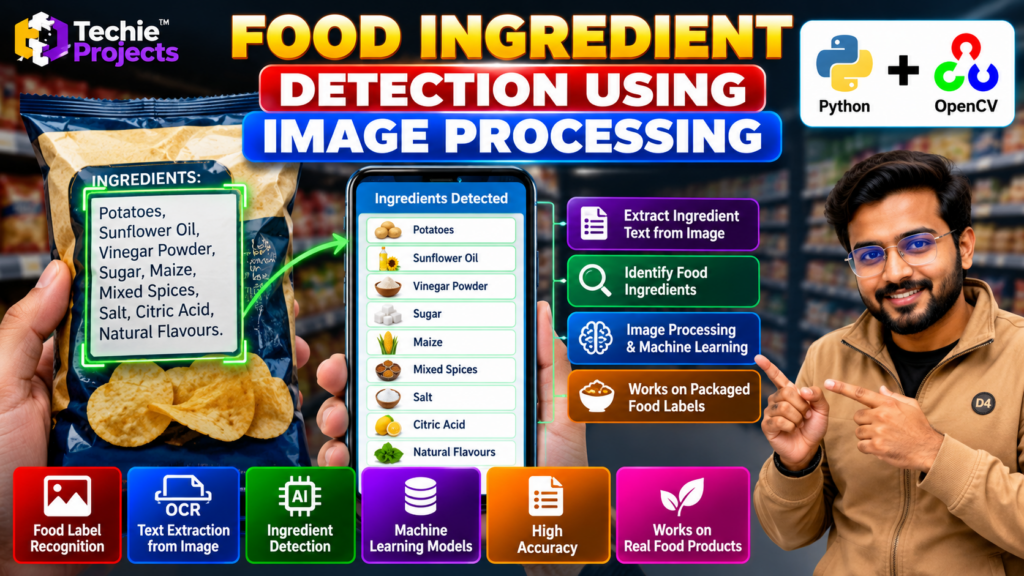
Food Ingredient Detection Using Image Processing is a Python-based project that explores how image processing and machine learning can help analyze ingredient information from packaged food labels. The project introduces students to computer vision, image analysis, text extraction, and automated ingredient identification.
For B.Tech, B.E., BCA, MCA, M.Tech, and final-year computer science students, this project offers an opportunity to explore practical applications of Python and image processing. Depending on the implementation, the system can process food label images and identify ingredient text using optical character recognition (OCR) or other suitable image analysis techniques.
If you are looking for a machine learning or image processing project for your academic submission, this project can help you understand the workflow of an automated food label analysis application.
The food ingredient detection using image processing project demonstrates how Python can analyze food packaging images and extract ingredient information. By combining image preprocessing, optical character recognition (OCR), and text analysis, the system helps students understand how automated food label recognition can work in practical applications.
🎬 Project Demo
Explore the project demonstration to see how the application interface works, how food label images are processed, and how ingredient information can be displayed. The demonstration provides an overview of the project’s workflow and its potential use in food label analysis.
🎯 Objectives of the Project
The main objectives of the Food Ingredient Detection Using Image Processing project are:
- Analyze images of packaged food labels.
- Explore image preprocessing and text extraction techniques.
- Identify ingredient names from readable label images.
- Use Python libraries for image processing and data analysis.
- Display extracted ingredient information in an understandable format.
- Explore potential applications of automated food label recognition.
🔍 Key Features of Food Ingredient Detection Using Image Processing
One important aspect of food ingredient detection using image processing is converting label images into readable text. With suitable OCR integration and text-processing techniques, the application can identify ingredient names and organize the extracted information for easier review.
1. Food Label Image Processing
The application processes food packaging images to prepare them for analysis. Depending on the implementation, preprocessing may include resizing, noise reduction, thresholding, and contrast enhancement.
2. Ingredient Text Extraction
OCR technology can extract readable text from food labels. The extracted text may then be processed to identify ingredient names and separate them from other label information.
3. Ingredient Identification
The system can identify ingredient names from extracted text using text-processing rules or a suitable classification approach. The accuracy depends on the label quality and the methods implemented.
4. Results Display
The application can present detected ingredient names through a user interface, making the output easier to read and review.
5. Python-Based Implementation
Python provides a flexible environment for combining image processing, text extraction, and data analysis libraries in one project.
⚙️ How Does the Project Work?
Step 1: Upload a Food Label Image
The user provides an image of a packaged food product containing ingredient information.
Step 2: Preprocess the Image
The image can be resized, converted to grayscale, or enhanced to improve text visibility.
Step 3: Extract Text from the Image
An OCR engine can extract readable text from the label. Results may vary depending on image resolution, lighting, fonts, and label layout.
Step 4: Identify Ingredient Names
The extracted text is processed to identify ingredient names. Additional rules or a trained model may be required to distinguish ingredients from nutritional information and other packaging text.
Step 5: Display the Results
The application presents the detected ingredient information through its interface.
Step 6: Evaluate the Output
The extracted text can be compared with the original label to evaluate the system’s performance and identify errors.
🛠️ Technologies Used
The technologies depend on the actual project implementation. Common options include:
- Python: Main programming language.
- OpenCV: Image preprocessing and computer vision.
- Pytesseract or another OCR engine: Text extraction from label images.
- NumPy: Numerical operations.
- Pandas: Text or structured-data processing, where needed.
- Tkinter or Streamlit: Optional graphical interface.
Only include the libraries that are actually used in your project.
💻 Software Requirements
Typical software requirements may include:
- Python 3.x
- Visual Studio Code, PyCharm, or another Python IDE
- OpenCV
- An OCR engine, if text extraction is implemented
- NumPy and other required dependencies
- A collection of food label images for testing
🖥️ Hardware Requirements
- Laptop or desktop computer
- At least 4 GB RAM for a basic implementation
- Sufficient storage for source code and test images
- Keyboard, mouse, and display
Hardware requirements may vary depending on the selected libraries and whether a machine learning model is included.
🌟 Applications of Food Ingredient Detection
Food Label Reading
Image-based text extraction can help users access ingredient information printed on packaged food labels.
Computer Vision Research
Students can investigate how image preprocessing affects text recognition under different conditions.
Ingredient Information Organization
Extracted ingredient text can be organized into structured lists for easier reading and analysis.
Academic Machine Learning Projects
The project can demonstrate the integration of Python, image processing, OCR, and text analysis.
Accessibility Research
With additional development, extracted label text could be integrated with text-to-speech features to help users listen to ingredient information.
Important: Extracting ingredient text does not automatically verify food safety, detect allergens reliably, or confirm that a product is suitable for a particular person. Such capabilities require additional validation and appropriate data.
✅ Advantages of the Project
- Demonstrates practical Python programming.
- Introduces image preprocessing and text extraction.
- Combines computer vision with text analysis.
- Provides opportunities for testing different image conditions.
- Can be extended with a graphical user interface.
- Offers a useful foundation for further academic development.
⚠️ Limitations
- Blurry or low-resolution images can reduce text recognition accuracy.
- Curved packaging and unusual fonts can make extraction difficult.
- Ingredient names may be confused with nutritional information or marketing text.
- Different languages and label formats may require additional processing.
- OCR output should be checked against the original packaging.
- Food safety and allergen verification require more than basic image processing.
🔮 Future Scope
The food ingredient detection using image processing system can be extended with multilingual OCR, ingredient database integration, and text-to-speech functionality. These enhancements can help students explore more advanced computer vision applications and improve the accessibility of food label information.
The project can be extended in several ways:
- Improved OCR: Explore methods to handle difficult fonts and low-quality images.
- Multilingual Labels: Investigate ingredient extraction from labels in different languages.
- Mobile Application: Develop a mobile-friendly interface for capturing food label images.
- Text-to-Speech: Read extracted ingredient information aloud.
- Ingredient Database: Match extracted names with a structured ingredient database.
- Allergen Information Support: Explore carefully validated allergen highlighting using reliable product data.
- Performance Evaluation: Compare extracted text with manually verified label text.
These enhancements may require additional development beyond the basic project.
🎓 Why Choose This as a Final-Year Project?
Food Ingredient Detection Using Image Processing is suitable for students interested in Python, computer vision, OCR, and machine learning.
The project provides an opportunity to demonstrate:
- Image preprocessing
- Text extraction
- Python application development
- Data handling and result visualization
- Testing and evaluation
- Technical documentation and project presentation
Students can also extend the application with additional features based on their academic requirements.
🛒 Get the Food Ingredient Detection Project
Looking for a Food Ingredient Detection Using Image Processing project for your B.Tech, B.E., BCA, MCA, M.Tech, or final-year engineering submission?
Techie Projects helps students explore project ideas and enquire about available project implementations.
Contact us to discuss the available package and confirm whether it includes:
- Python source code
- Required libraries and installation instructions
- Sample food label images or dataset, where applicable
- Project documentation and report
- Demonstration of the implemented features
- Customization options, if available
The exact deliverables depend on the selected package. Please confirm the features, documentation, and pricing before purchasing.
📲 Interested in Purchasing This Project?
Enquire About the Project on WhatsApp
📲 Call/WhatsApp: +91-9460060699
🌎 Website: www.techieprojects.com
📺 Instagram: @pythonprojects_
Share your course, submission deadline, and required features so we can discuss the available options.
🎓 Recommended Projects
Explore these related project topics on Techie Projects. Link each title to its corresponding published article.
- Food Classification Using Machine Learning — explore food image classification.
- Fruit and Vegetable Detection Using Python — investigate object detection in food images.
- Object Detection Using OpenCV and Python — learn about image-based object identification.
- Image Processing Projects Using Python — discover additional computer vision project ideas.
- Machine Learning Projects for Final-Year Students — explore more academic project topics.
Visit Techie Projects to explore more Python, machine learning, and image processing projects.
❓ Frequently Asked Questions
1. What is Food Ingredient Detection Using Image Processing?
It is a project that explores how images of food labels can be processed to extract and identify ingredient information.
2. Which programming language is used?
Python is a suitable choice because it supports image processing, OCR integration, and text analysis.
3. Can OpenCV detect ingredient names?
OpenCV can preprocess images and support computer vision workflows. Reading ingredient text generally requires OCR or another text-recognition method.
4. Is this project suitable for final-year engineering students?
Yes. It can be suitable for students studying computer science, information technology, artificial intelligence, or machine learning, depending on their course requirements.
5. Can the system detect allergens?
A basic ingredient extraction project does not guarantee reliable allergen detection. This feature requires validated ingredient data, careful text matching, and testing.
6. How can I purchase this project?
Contact Techie Projects through WhatsApp to enquire about source code availability, documentation, features, and pricing.
Conclusion
Food Ingredient Detection Using Image Processing demonstrates how Python can be used to analyze food label images and extract ingredient information. By combining image preprocessing, OCR, and text analysis, students can explore a practical computer vision application while developing their programming and problem-solving skills.
If you are interested in this project for your academic submission, contact Techie Projects to discuss the available implementation and deliverables.
Ready to discuss your project?
📲 Contact Techie Projects on WhatsApp