
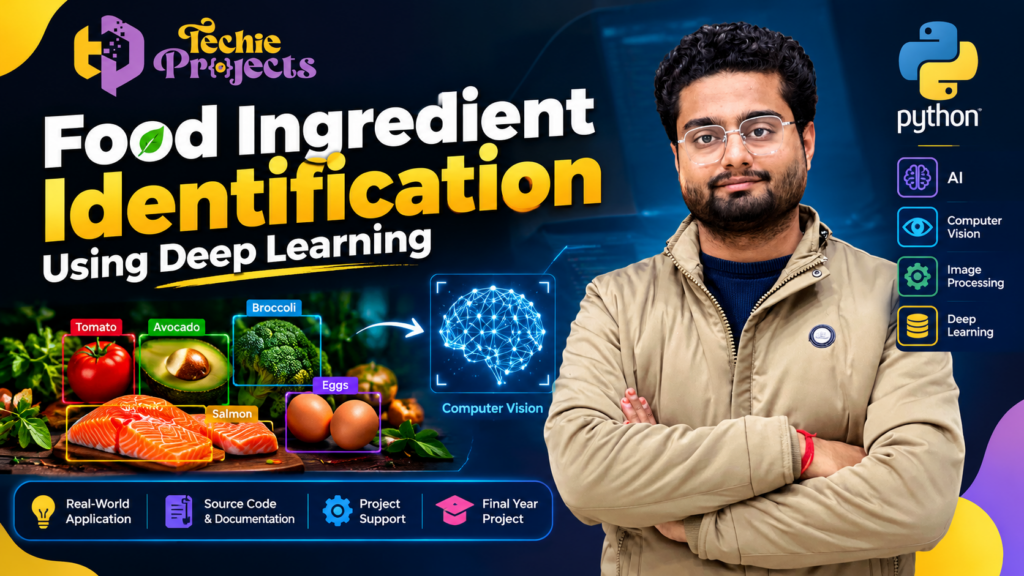
🎓 Looking for a Food Ingredient Identification Using Deep Learning project for your final-year engineering submission? Get a head start on your project journey with Techie Projects. Explore a computer vision project that demonstrates how deep learning can be applied to food images to identify ingredient categories and build practical skills in Python, image recognition, and AI.
Don’t waste valuable project time choosing an unsuitable topic or struggling with unclear implementation requirements. If you are a Computer Science Engineering (CSE) student looking for an AI-based minor project, major project, or final-year project, this topic offers an opportunity to explore deep learning through a practical application.
Ready to discuss purchasing this project? Visit Techie Projects or contact us directly on WhatsApp to confirm availability, pricing, source code, installation requirements, documentation, and the deliverables included in the package before ordering.
🎬 Watch the Food Ingredient Identification Using Deep Learning Project Demo
Explore the project demonstration to understand the concept of identifying food ingredients from images and see how a computer vision application may present its results.
A demonstration can help you evaluate whether the topic matches your academic interests and expected project scope. Before purchasing, ask Techie Projects to confirm the features implemented in the available version, the model used, and the supported input and output formats.
🍅 What Is Food Ingredient Identification Using Deep Learning?
Food Ingredient Identification Using Deep Learning is an educational computer vision project that explores how a trained model can recognize ingredient categories from digital food images.
Food images may contain different ingredients, such as tomatoes, avocados, broccoli, eggs, vegetables, fruits, and other food items. A deep learning model can learn visual patterns from labeled training examples and use those patterns to predict the category of an input image.
The exact capabilities depend on the model architecture, training dataset, image quality, and implementation. A system designed to classify a single ingredient in an image may work differently from a model designed to identify several ingredients in one photograph.
This project provides a way to study how image data, model training, prediction, and result visualization can be combined in a Python-based application.
🍅 Why Choose Food Ingredient Identification Using Deep Learning?
Food Ingredient Identification Using Deep Learning is a practical topic for students who want to explore how artificial intelligence can recognize food ingredients from images. By working with Python, image preprocessing, deep learning models, and prediction results, students can learn how computer vision is applied to visual recognition tasks.
This project can help CSE students understand image classification, model inference, and performance evaluation. It also provides opportunities to investigate how image quality, lighting, and ingredient variations affect recognition results.
At Techie Projects, you can enquire about the available project package and confirm the source code, installation instructions, documentation, and included features before purchasing.
🎯 Objectives of the Project
The main objective is to explore how deep learning techniques can be used for image-based food ingredient recognition.
Key educational objectives include:
- Understanding the fundamentals of deep learning and computer vision.
- Learning how food images can be prepared for model input.
- Exploring image preprocessing and dataset organization.
- Understanding labeled image datasets and model training.
- Investigating ingredient classification or recognition methods.
- Displaying prediction results through a suitable application interface.
- Evaluating model performance using appropriate test images and metrics.
These objectives help students connect machine learning theory with practical application development.
⚙️ How Does the Project Work?
The workflow of a food ingredient identification system typically involves several stages. The exact pipeline depends on the implementation supplied with the project.
1. Image Input
The process begins when a user provides a food image. Depending on the application’s design, the image may be uploaded from a computer or captured using a camera.
Image quality, lighting, background, camera angle, and ingredient visibility can influence recognition performance.
2. Image Preprocessing
The image is prepared for the deep learning model. Common preprocessing operations include resizing the image, converting its format, and normalizing pixel values.
Consistent preprocessing helps ensure that the image follows the input requirements expected by the model.
3. Deep Learning Model
A trained deep learning model analyzes visual patterns in the image. Convolutional Neural Networks (CNNs) are commonly used for image classification because they can learn useful visual features from training data.
Some implementations may use transfer learning, in which a model trained on a larger dataset is adapted to a particular classification task.
The selected architecture and training approach depend on the available dataset and project requirements.
4. Ingredient Prediction
After processing the image, the model produces a prediction based on the ingredient classes it has learned.
For example, a model trained to recognize tomatoes, avocados, and broccoli may predict one of those categories when presented with a suitable image. Recognition of multiple ingredients in one image requires an appropriate multi-label classification or object detection approach.
Predictions depend on the model’s training data and should not be treated as guaranteed identification.
5. Result Display
The application presents the prediction to the user. Depending on the implemented interface, the result may include a predicted ingredient label, confidence score, or annotated image.
A clear output makes it easier for students to understand and demonstrate the system’s workflow.
🧠 Applications of Food Ingredient Identification Using Deep Learning
Food Ingredient Identification Using Deep Learning demonstrates how image recognition techniques can be explored in food-related applications. Depending on the model and dataset, an ingredient recognition system may help categorize food images, organize ingredient photographs, or support educational experiments in computer vision.
Students can also investigate how different deep learning architectures perform on ingredient images and evaluate their predictions using suitable test data. These experiments provide a practical way to study classification performance, dataset limitations, and model reliability.
The system’s actual capabilities depend on its implementation and should be confirmed before presenting specific application claims.
🛠️ Technologies Used
The following technologies are commonly relevant to deep learning-based image recognition projects. Confirm the exact libraries and versions included in the package before purchasing.
- Python: programming language for application development and model integration.
- TensorFlow or PyTorch: frameworks that can be used to build or run deep learning models.
- Keras: a high-level API commonly used to create and train neural networks.
- OpenCV: a library for image loading and preprocessing.
- NumPy: supports numerical operations and image-array manipulation.
- Matplotlib: useful for displaying images, training curves, and evaluation results.
- Streamlit, Flask, or another GUI framework: may be used to provide an interface, depending on the implementation.
Not every project uses all these tools. The actual technology stack should be confirmed before installation.
🌟 Key Features to Explore
The following are potential features of a food ingredient recognition application. Ask Techie Projects which features are included in the current version.
Food Image Upload
An image upload feature allows users to select an image for analysis, if supported by the application.
Deep Learning-Based Recognition
The system may use a trained model to predict ingredient categories from images included within its supported class set.
Prediction Results
The application can display predicted labels and, where implemented, confidence values or visual annotations.
User-Friendly Interface
A graphical interface can make image selection and result presentation easier to demonstrate during academic evaluation.
Model Evaluation
Where training and test data are available, students can explore metrics such as accuracy, precision, recall, and a confusion matrix.
Opportunities for Customization
Students may investigate additional ingredient classes, improved preprocessing, alternative model architectures, or more diverse datasets, depending on the project’s structure.
These features describe possible capabilities, not a guarantee that every feature is included in the available package.
🎓 Why Choose This Project for Your Final Year?
Food Ingredient Identification Using Deep Learning can be a relevant academic topic for students interested in Artificial Intelligence, Machine Learning, and Computer Vision.
Practical Python learning: Explore how image data can be processed and passed to a trained model.
Deep learning concepts: Understand image classification, model inference, training data, and evaluation methods.
Real-world application: Study how visual recognition methods can be applied to food-related image analysis.
Project presentation: Explain the objectives, methodology, workflow, results, and limitations of the system.
Portfolio development: A project you have installed, tested, and understood can help demonstrate your technical learning.
The strongest academic result comes from understanding the implementation rather than relying only on the final prediction screen.
📦 What Should You Confirm Before Purchasing?
Before ordering a project, clarify exactly what is included in the package.
Ask Techie Projects about:
- Source code: Is the complete project code included?
- Model and dataset: Is a trained model, training code, or dataset provided?
- Installation guide: Are setup instructions and dependency versions available?
- Documentation: Is a project report or technical document included?
- Demonstration: Can you review a demo or screenshots of the implemented features?
- Code explanation: Is code explanation or technical guidance included in the selected package?
- Compatibility: Which operating system, Python version, and hardware requirements are supported?
- Pricing and delivery: What is the total cost, delivery method, and applicable support policy?
Package contents vary, so confirm these details before making payment. Also check whether the project satisfies your institution’s rules and make sure you can explain the work you submit.
🚀 Possible Future Enhancements
After understanding the basic implementation, students may investigate these improvements:
- More ingredient categories: Extend the supported classes using suitable labeled images.
- Multi-ingredient recognition: Explore object detection or multi-label classification for images containing several ingredients.
- Transfer learning: Compare suitable pretrained models for the task.
- Model evaluation: Measure performance on separate test images and investigate common classification errors.
- Improved interface: Add clearer image previews and result displays.
- Dataset diversity: Test how lighting, background, and ingredient presentation affect predictions.
- Deployment: Explore making the application available through a suitable local or web interface.
These extensions depend on the available source code, computing resources, dataset, and academic scope.
🛒 Purchase the Food Ingredient Identification Using Deep Learning Project
Looking for a Food Ingredient Identification Using Deep Learning project in Python for your minor or final-year engineering submission? Techie Projects can help you enquire about the available package and its technical requirements.
Before purchasing, confirm whether the package includes source code, a trained model, dataset, installation instructions, documentation, and technical support. Also check compatibility with your system and your college’s project guidelines.
- 📲 Call/WhatsApp: +91-9460060699
- 🌎 Website: www.techieprojects.com
- 📺 Instagram: @pythonprojects_
Before purchasing, confirm the source code, installation requirements, dataset or trained model availability, documentation, and support terms. Choose a project that matches your academic guidelines and gives you an opportunity to learn and explain the implementation.
🔗 Explore Related Projects
Looking for more ideas in Artificial Intelligence and Computer Vision? Explore the relevant project categories on Techie Projects.
- Python Projects: Applications for programming practice and automation.
- Machine Learning Projects: Data-driven prediction and classification systems.
- Deep Learning Projects: Neural network applications involving images and other data.
- Image Processing Projects: Techniques for analyzing and transforming digital images.
- Computer Vision Projects: Applications that interpret visual information.
- Data Science Projects: Projects involving data analysis, visualization, and evaluation.
Compare the available topics to find a project that suits your interests and academic requirements.
❓ Frequently Asked Questions
1. What is Food Ingredient Identification Using Deep Learning?
It is an educational project that explores the use of a trained deep learning model to recognize ingredient categories from food images.
2. Which programming language is used?
Python is commonly used for this type of project. Confirm the programming language and dependency requirements of the specific package before purchasing.
3. Is this project suitable for final-year CSE students?
It may be suitable for students interested in AI, deep learning, and computer vision. Confirm the required project complexity and topic approval with your college supervisor.
4. Can the system identify multiple ingredients in one image?
That depends on the model and implementation. Identifying multiple ingredients generally requires a suitable multi-label classification or object detection approach.
5. Does the project include a trained model and dataset?
The included files depend on the selected package. Contact Techie Projects to confirm whether the trained model, training code, dataset, and documentation are provided.
6. Can I customize the project?
Possible extensions include adding ingredient classes, comparing models, and improving the interface. Customization depends on the source code and may involve additional work or charges.
7. How can I purchase the project?
Visit Techie Projects or contact us on WhatsApp to discuss availability, price, and package details before ordering.
✅ Conclusion
Food Ingredient Identification Using Deep Learning is a useful topic for exploring Python, neural networks, image recognition, and computer vision through an educational application.
By understanding image preprocessing, model inference, ingredient classification, and performance evaluation, students can build a stronger foundation in deep learning and practical software development.
If you are interested in purchasing this project, contact Techie Projects to confirm the available implementation, deliverables, compatibility, and pricing before ordering.
🚀 Start your project enquiry today: Visit Techie Projects | Chat on WhatsApp