
Introduction
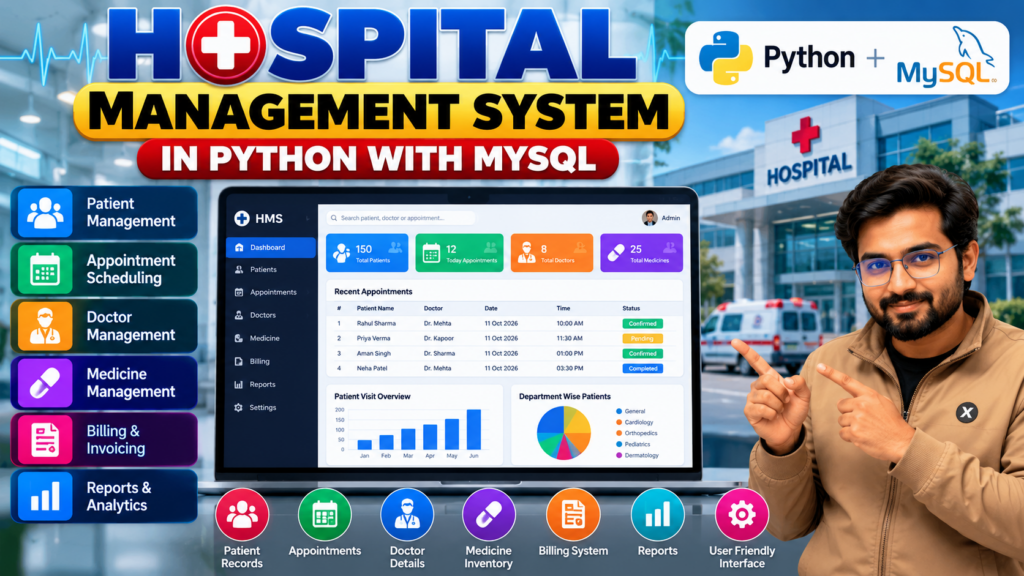
The Hospital Management System Project in Python with MySQL is a database-driven application designed to simplify hospital operations, including patient registration, doctor information, appointment scheduling, billing, and medical record management. This project demonstrates how Python programming and MySQL database connectivity can be used to develop a practical healthcare management application.
For B.Tech Computer Science students, MCA students, and final-year engineering students, a hospital management system is a useful project for understanding database management, application development, CRUD operations, and software design.
If you are looking for a Hospital Management System project with source code, Techie Projects can help you explore the available project package, implementation details, documentation, and support options.
🎬 Project Demo
Watch the Hospital Management System Project in Python with MySQL demo to explore the application interface, patient management workflow, database connectivity, and available features.
This demonstration helps students understand how the project works and evaluate whether it meets their final-year engineering project requirements.
What Is a Hospital Management System?
A Hospital Management System (HMS) is software that helps organize hospital-related information in one application. Depending on its implementation, it can allow authorized users to register patients, maintain doctor records, schedule appointments, manage billing, and retrieve stored information.
Using Python with MySQL provides a practical way to demonstrate application logic and relational database operations. The user interface may be developed with Tkinter or another framework, depending on the project version.
Objectives of the Hospital Management System Project
The hospital management system project in Python helps students understand patient record management, appointment scheduling, billing operations, and MySQL database connectivity. It provides practical experience in developing a database-driven application for healthcare management.
The main objectives of this project are:
- To simplify patient registration and record management.
- To organize doctor and department information.
- To manage appointment details efficiently.
- To demonstrate Python and MySQL connectivity.
- To reduce repetitive manual data entry.
- To provide a structured way to retrieve and update hospital records.
- To demonstrate database operations in a real-world-inspired application.
Key Features of the Hospital Management System
1. Patient Registration
The application can store patient information such as patient ID, name, age, contact details, and other relevant fields.
2. Doctor Management
Doctor records can be maintained with information such as names, specialties, and availability, depending on the implemented features.
3. Appointment Management
The system can record appointment dates, times, patient details, and assigned doctors.
4. Patient Record Management
Authorized users can retrieve and update stored patient information through the application.
5. Billing Management
A billing module can record charges and calculate totals for supported services. The exact billing functionality depends on the project implementation.
6. MySQL Database Connectivity
MySQL stores structured application data, while Python handles application logic and database operations.
7. User-Friendly Interface
A graphical interface can make it easier to navigate between patient records, doctor information, appointments, and other modules.
Technologies Used
The project may use the following technologies:
- Programming language: Python
- Database: MySQL
- Database connectivity: A compatible Python MySQL connector
- User interface: Tkinter or the framework used in the selected implementation
- Development environment: Visual Studio Code, PyCharm, or another Python IDE
- Operating system: Windows or another supported environment
Confirm the exact libraries and framework against the project package you select.
Software Requirements
Typical software requirements include:
- Python installed on the computer
- MySQL Server
- A compatible MySQL connector for Python
- A Python development environment
- Required project dependencies
The setup process may differ according to the Python version, database configuration, and user interface framework.
Hardware Requirements
A typical development setup includes:
- A laptop or desktop computer
- A compatible processor
- Sufficient RAM to run Python and MySQL
- Available disk space for the application and database
- Keyboard, mouse, and monitor
Actual hardware requirements depend on the selected implementation and the software running alongside it.
Database Design
A relational database helps organize hospital information into related tables. A possible database design may include the following tables:
Patient Table
Stores patient IDs, names, ages, contact information, and other required details.
Doctor Table
Stores doctor IDs, names, specialties, and other relevant information.
Appointment Table
Stores appointment IDs, patient references, doctor references, dates, times, and appointment status.
Billing Table
Stores billing references, applicable charges, totals, and payment status if billing is implemented.
Primary keys can uniquely identify records, while foreign keys can connect related tables. Appropriate validation and database constraints help maintain data consistency.
How Does the Hospital Management System Work?
The general workflow is as follows:
- Application launch: The user opens the hospital management application.
- Database connection: Python connects to the configured MySQL database.
- Data entry: The user enters information through the application interface.
- Validation: The application checks the submitted information.
- Database operations: The system inserts, retrieves, updates, or deletes records according to the user’s permissions.
- Results display: The application displays the relevant records or operation status.
- Record maintenance: Authorized users update information when required.
This workflow helps students understand how a database-driven desktop application works.
Advantages of a Hospital Management System
- Organizes patient and doctor information.
- Makes record retrieval more convenient.
- Demonstrates practical database operations.
- Helps students understand application development.
- Supports modular development and future enhancements.
- Provides a useful demonstration of Python and MySQL integration.
Limitations of the Project
A basic academic implementation may have limitations such as:
- Limited user roles and access controls.
- Basic reporting and billing features.
- Limited integration with other hospital systems.
- No advanced appointment notifications.
- Limited backup and recovery capabilities.
A real healthcare deployment would require much stronger security, privacy protections, audit logging, backup procedures, and appropriate clinical and operational validation.
Future Scope
The project can be extended with additional features, depending on the development scope:
- Role-based login for administrators, doctors, and staff.
- Improved appointment scheduling.
- Electronic medical record integration.
- Report generation and dashboard analytics.
- Automated appointment reminders.
- Secure backup and recovery.
- A web-based interface for remote access.
- Improved access control and activity logging.
These enhancements can help students explore more advanced software engineering and database concepts.
🎓 Recommended Projects
If you are exploring more database and Python-based final-year projects, consider these related ideas:
- Hotel Management System Project in Python — Manage guest records, room allocation, and bookings.
- Employee Management System in Python — Maintain employee details and organizational records.
- College Management System Project — Organize student information, courses, and academic records.
- Patient Appointment Booking System — Manage patient appointments and scheduling.
- Pharmacy Management System — Maintain medicine inventory, sales, and stock records.
- Library Management System in Python — Track books, members, and issue-return transactions.
Explore the available projects on Techie Projects to find an option suited to your interests and academic requirements.
Why Choose This Hospital Management System Project?
The Hospital Management System project in Python with MySQL offers students an opportunity to explore database design, application logic, record management, and interface development in a single application.
It can be useful for academic demonstrations, project presentations, and learning how software manages structured information. Before selecting a package, review its implemented modules, source code, documentation, compatibility, and support arrangements.
Get the Hospital Management System Project from Techie Projects
🎓 Looking for a Hospital Management System project with source code?
Techie Projects helps students explore engineering projects involving Python, databases, artificial intelligence, machine learning, and software development.
Contact us to enquire about the availability of the Hospital Management System project and confirm the included deliverables, such as:
- Project source code
- Implemented features and modules
- Software setup instructions
- Project documentation, if included
- Technical guidance and support options
📲 Call/WhatsApp: +91-9460060699
🌎 Website: www.techieprojects.com
📺 Instagram: @pythonprojects_
Contact us with your requirements to discuss availability, pricing, and the most suitable project package before purchasing.
Frequently Asked Questions
1. Which programming language is used in this project?
Python is used for application logic, while MySQL can be used to store and manage structured hospital data.
2. Is the Hospital Management System project suitable for final-year students?
It can be suitable for B.Tech, BCA, MCA, and related students, subject to their institution’s requirements and the scope of the implementation.
3. What are the main modules of a Hospital Management System?
Common modules include patient registration, doctor management, appointments, patient records, and billing. The available modules depend on the selected project version.
4. Does the project use MySQL?
The project described in this article uses MySQL as its intended database. Confirm the database configuration and connector requirements for the specific package.
5. Can the project be customized?
Customization may be possible depending on the source code, architecture, and support package. Discuss your required features before purchasing.
6. How can I enquire about the source code and price?
Contact Techie Projects on WhatsApp to ask about availability, pricing, documentation, and included support.
Conclusion
The Hospital Management System Project in Python with MySQL is a practical way to explore database management, application development, patient record organization, and software workflows. Its modular structure can help students understand how Python applications interact with relational databases.
If you are planning a final-year engineering project, contact Techie Projects to review the available package and choose a solution that meets your academic requirements.