
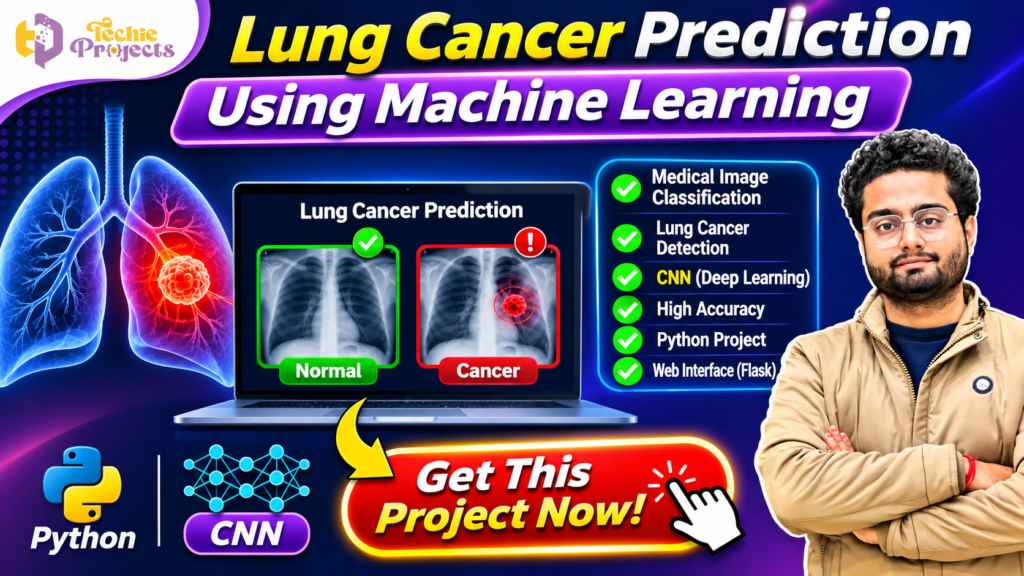
Are you looking for an impressive Lung Cancer Prediction Using Machine Learning project for your final-year engineering submission? Get a practical Python-based machine learning project from Techie Projects and explore how artificial intelligence can be applied to medical image classification and healthcare research.
Instead of spending weeks starting your project from scratch, you can enquire about our ready-to-study project package, including source code, project documentation, implementation guidance, and technical support options. This project demonstrates how machine learning and deep learning concepts can be used to analyse lung-related medical images and classify them into different categories.
The Lung Cancer Prediction Using Machine Learning project is suitable for students pursuing B.Tech, BCA, MCA, M.Tech, computer science, information technology, artificial intelligence, and data science courses. It provides an opportunity to understand Python programming, image preprocessing, model training, classification, and web-based application development.
If you want to purchase this project for academic learning, demonstration, or further development, contact Techie Projects today to check the available package and project details.
📞 Contact Techie Projects for Project Enquiries
Want to purchase the Lung Cancer Prediction Using Machine Learning project? Contact our team for pricing, source code availability, project documentation, and implementation support.
- 📲 WhatsApp: Get Project Details
- ☎️ Contact Number: +91 94600 60699
- 🌐 Website: https://techieprojects.com/
- 📸 Instagram: @pythonprojects_
🎬 Lung Cancer Prediction Using Machine Learning – Project Demo
Explore the project demonstration to understand its interface, workflow, and classification process. The demo can help you see how the application accepts an image, processes the input, and displays the model’s predicted category.
If you are interested in the complete implementation, contact Techie Projects to enquire about the available project package.
🫁 What Is Lung Cancer Prediction Using Machine Learning?
Lung Cancer Prediction Using Machine Learning is an academic AI project that demonstrates how computational models can analyse medical image data and identify patterns associated with different image categories.
Machine learning algorithms learn from examples in a dataset. During training, the model identifies patterns that help it distinguish between the classes represented in the training data. After training, the model can process an unseen input image and return a predicted class.
In this project, Python is used for image processing, model development, and application integration. A convolutional neural network (CNN) can be used to learn visual features from chest images and perform image classification.
The project demonstrates an important application area of artificial intelligence: medical image analysis. It is intended for academic learning and experimentation, not for diagnosing patients or replacing professional medical evaluation.
🎯 Main Objectives of the Project
The main objective of the Lung Cancer Prediction Using Machine Learning project is to demonstrate the practical implementation of machine learning techniques in medical image classification.
Key objectives include:
- Understand how machine learning can be applied to medical image datasets.
- Learn image preprocessing techniques using Python.
- Develop an image classification model using deep learning.
- Understand the working process of a convolutional neural network.
- Train and evaluate a model using an appropriate dataset.
- Build an interface for uploading and analysing images.
- Display the predicted class and relevant output.
- Understand the limitations of machine learning in healthcare applications.
These objectives make the project useful for students who want practical exposure to Python, artificial intelligence, and deep learning.
⚙️ How Does the Project Work?
The Lung Cancer Prediction Using Machine Learning project follows a structured workflow, starting from dataset preparation and ending with prediction output.
1. 📂 Dataset Collection
The first step is collecting a suitable dataset containing labelled medical images. The dataset should have clearly defined categories and appropriate usage permissions.
Dataset quality is important because the model learns patterns from the examples provided during training. Incorrect labels, duplicate images, poor-quality samples, or an unbalanced dataset can affect model performance.
2. 🖼️ Image Preprocessing
Before training, images are prepared in a consistent format. Image preprocessing may include:
- Resizing images to a fixed dimension.
- Converting images into a suitable colour format.
- Normalising pixel values.
- Organising images into training and testing folders.
- Applying suitable data augmentation techniques.
These operations help prepare the dataset for model training.
3. 🧠 Model Development
A convolutional neural network is a common deep learning architecture for image classification. It can learn visual patterns through convolutional layers, pooling operations, and fully connected layers.
The model is trained using labelled images. During training, it adjusts its parameters to reduce prediction errors on the training data.
The exact architecture and configuration depend on the dataset and implementation.
4. 📊 Model Training and Evaluation
After preparing the dataset, the model is trained using the selected training samples. The testing dataset is used to evaluate performance on images that were not used for training.
Common evaluation measures include:
- Accuracy
- Precision
- Recall
- F1-score
- Confusion matrix
A reliable evaluation should consider more than accuracy alone, particularly when the dataset has an unequal number of samples in different classes.
5. 💻 User Interface Development
A graphical interface can make the application easier to demonstrate. A user can upload an image, initiate the analysis process, and view the model’s output.
Depending on the implementation, the interface may be developed using Flask or another Python web framework.
6. 📌 Prediction Output
Once an image is processed, the trained model returns a predicted category. The application displays the output to the user.
The output represents the model’s classification result. It should not be interpreted as a confirmed medical diagnosis.
✨ Key Features of Lung Cancer Prediction Using Machine Learning
The project can demonstrate several important features of an AI-based image classification application.
🧠 1. Deep Learning-Based Classification
The project uses a deep learning model to learn visual patterns from labelled images. This helps students understand how neural networks can be applied to image classification problems.
🖼️ 2. Medical Image Processing
Image preprocessing prepares input images for analysis. Students can explore resizing, normalisation, image loading, and dataset organisation.
📤 3. Image Upload Interface
A user-friendly interface allows users to upload an image for demonstration and classification.
📊 4. Prediction Results
The application displays the predicted category returned by the trained model.
🐍 5. Python Implementation
Python provides the programming environment for dataset handling, preprocessing, model development, and application integration.
🔬 6. Model Evaluation
The project provides an opportunity to study model evaluation using metrics such as precision, recall, F1-score, and confusion matrices.
🌐 7. Web Application Integration
A web interface can make the project easier to present during academic demonstrations and practical evaluations.
🛠️ Technologies Used in the Project
The Lung Cancer Prediction Using Machine Learning project can combine several technologies from the Python and deep learning ecosystem.
| Technology | Purpose |
|---|---|
| Python | Main programming language |
| TensorFlow / Keras | Deep learning model development |
| CNN | Image classification architecture |
| NumPy | Numerical operations |
| Pandas | Dataset and tabular data handling |
| OpenCV | Image processing |
| Matplotlib | Visualisation |
| Flask | Web application development |
| HTML and CSS | User interface design |
The exact libraries and versions depend on the supplied implementation and system configuration.
📚 Modules of the Project
The application can be organised into the following modules.
1. Dataset Management Module
This module manages the image dataset and its class labels. It helps organise images for training, validation, and testing.
2. Image Preprocessing Module
This module prepares images for the model. It performs operations such as resizing, normalisation, and format conversion.
3. Model Training Module
This module trains the deep learning model using the prepared training dataset.
4. Model Testing Module
This module evaluates the trained model using separate test images and generates performance measurements.
5. Prediction Module
This module accepts a new image and passes it to the trained model to obtain a predicted category.
6. User Interface Module
This module provides the interface for uploading images and viewing the prediction output.
🎓 Benefits of Lung Cancer Prediction Using Machine Learning for Students
Choosing a practical AI project can help students connect classroom concepts with real-world computing applications.
1. Learn Practical Python Programming
Students can understand how Python is used in dataset processing, model development, image analysis, and application integration.
2. Understand Artificial Intelligence
The project introduces the practical use of artificial intelligence in medical image analysis and demonstrates how computational models learn from data.
3. Gain Deep Learning Experience
Students can explore CNN architecture, training processes, model evaluation, and prediction workflows.
4. Improve Final-Year Project Knowledge
The project can support academic demonstrations and help students explain the complete development process, from dataset preparation to prediction.
5. Understand Image Processing
Students gain practical experience with image resizing, normalisation, loading, and preprocessing.
6. Build a Portfolio Project
After understanding and extending the implementation, students can document their work as part of an academic or personal technical portfolio.
7. Explore Research Opportunities
The project provides a starting point for exploring dataset quality, model performance, image classification, and responsible AI applications in healthcare.
💼 Why Purchase the Project from Techie Projects?
Developing an AI project from the beginning can involve several steps, including dataset preparation, environment configuration, model training, testing, and interface development.
Techie Projects helps students explore practical engineering project packages and enquire about resources that can support their learning and development.
When you contact us about the Lung Cancer Prediction Using Machine Learning project, you can enquire about:
- Python project source code availability.
- Project documentation.
- Installation and execution guidance.
- Model and implementation details.
- Demonstration and explanation support.
- Technical assistance options.
- Package pricing and delivery details.
The available inclusions and support depend on the selected package. Contact our team to confirm the exact deliverables before purchasing.
🚀 Get This Project Now!
Looking for a practical machine learning project for your academic work? Enquire about the Lung Cancer Prediction Using Machine Learning project from Techie Projects.
👉 GET THIS PROJECT NOW – Contact on WhatsApp
Our team can help you check availability, pricing, project contents, and the next steps for purchasing.
📦 What Can Be Included in the Project Package?
Students should confirm the package contents before placing an order. Depending on availability, the project package may include:
- Python source code.
- Dataset details or permitted dataset resources.
- Project documentation.
- Installation instructions.
- Required library information.
- Model training and testing details.
- Application demonstration.
- Technical guidance options.
Please contact Techie Projects to verify which items are included in the current package.
💻 Software and Hardware Requirements
The following are general requirements for developing and running a Python-based deep learning project. Actual requirements depend on the model, dataset size, and selected libraries.
Software Requirements
- Operating System: Windows 10/11 or compatible Linux distribution.
- Programming Language: Python.
- IDE: Visual Studio Code, PyCharm, or Jupyter Notebook.
- Deep Learning Framework: TensorFlow or Keras.
- Image Processing: OpenCV.
- Data Processing: NumPy and Pandas.
- Web Framework: Flask, if included in the implementation.
- Browser: Google Chrome or another modern browser.
Hardware Requirements
- Processor: Modern Intel or AMD processor.
- RAM: 8 GB recommended for basic experimentation.
- Storage: Sufficient free disk space for the dataset and libraries.
- GPU: Optional for smaller experiments; a compatible GPU can accelerate training.
🔍 Applications of Machine Learning in Medical Image Analysis
Machine learning has several research and educational applications in medical image analysis.
Examples include:
- Medical image classification.
- Image segmentation research.
- Pattern recognition.
- Image quality analysis.
- Dataset exploration.
- Computer-aided research tools.
- Deep learning model evaluation.
The Lung Cancer Prediction Using Machine Learning project demonstrates one educational example of this broader field.
It is important to understand that an academic classification model is not automatically suitable for clinical use. Real-world medical applications require appropriate clinical validation, regulatory review, representative datasets, and evaluation by qualified healthcare professionals.
📈 Future Scope of the Project
Students can explore several improvements after understanding the basic implementation.
1. Improve Dataset Quality
A larger, diverse, and carefully labelled dataset can help researchers study how data quality affects model performance.
2. Experiment with Different CNN Architectures
Students can compare different neural network architectures and analyse their results using consistent evaluation methods.
3. Apply Transfer Learning
Pre-trained models can be explored to understand transfer learning and its possible benefits for image classification tasks.
4. Add Model Explainability
Visualisation methods such as Grad-CAM can help students investigate which image regions influence a model’s classification output. Such visualisations do not establish medical correctness.
5. Improve the User Interface
The application can be extended with image previews, result history, model information, and improved navigation.
6. Compare Evaluation Metrics
Students can compare precision, recall, F1-score, and confusion matrices to understand the strengths and weaknesses of different models.
❓ Frequently Asked Questions (FAQs)
1. What is Lung Cancer Prediction Using Machine Learning?
It is an academic machine learning project that demonstrates how a trained model can classify medical images into predefined categories using Python and deep learning techniques.
2. Which programming language is used?
Python is commonly used for dataset preparation, image processing, model training, and application development.
3. Which algorithm is used in this project?
A convolutional neural network (CNN) can be used for image classification. The exact architecture depends on the implementation.
4. Is this project suitable for final-year students?
Yes. It can be a useful academic project for students studying computer science, information technology, artificial intelligence, and data science.
5. Can I get the source code?
You can contact Techie Projects to check the availability of the Python source code and the current project package.
6. Does the project include documentation?
Documentation availability depends on the selected package. Confirm the included deliverables with Techie Projects before purchasing.
7. Can I run the project on a laptop?
A compatible laptop can run many basic Python deep learning projects. The required resources depend on the dataset, model architecture, and software configuration.
8. Can the project be improved?
Yes. Students can explore transfer learning, different CNN architectures, data augmentation, model explainability, and improved evaluation methods.
9. Is the prediction a medical diagnosis?
No. This is an educational machine learning project. Its output must not be used to diagnose, screen, or make treatment decisions for any person. Medical concerns should be discussed with a qualified healthcare professional.
10. How can I purchase this project?
Contact Techie Projects through WhatsApp at +91 94600 60699 to enquire about pricing, availability, source code, documentation, and package details.
🔗 Explore Related Python and AI Projects
Explore more practical project ideas and resources from Techie Projects:
- Artificial Intelligence Projects
- Machine Learning Projects
- Deep Learning Projects
- Python Projects
- Image Processing Projects
- Data Science Projects
- Computer Vision Projects
- Healthcare Machine Learning Projects
Visit Techie Projects to explore more engineering projects and available project packages.
📞 Purchase Lung Cancer Prediction Using Machine Learning from Techie Projects
Ready to explore this project for your final-year academic work?
The Lung Cancer Prediction Using Machine Learning project offers a practical way to study Python programming, CNN architecture, image preprocessing, model training, and image classification.
Instead of guessing what is included, contact Techie Projects and confirm the current package details, source code availability, documentation, pricing, and technical support options.
🚀 Get This Project Now!
👉 CLICK HERE TO GET THIS PROJECT
📲 WhatsApp: +91 94600 60699
🌐 Website: www.techieprojects.com
📸 Instagram: @pythonprojects_
Techie Projects – Practical Engineering Projects for Students.
Educational disclaimer: This project is intended for academic learning and software demonstration only. It is not a clinically validated diagnostic system and must not be used for medical diagnosis or treatment decisions.