
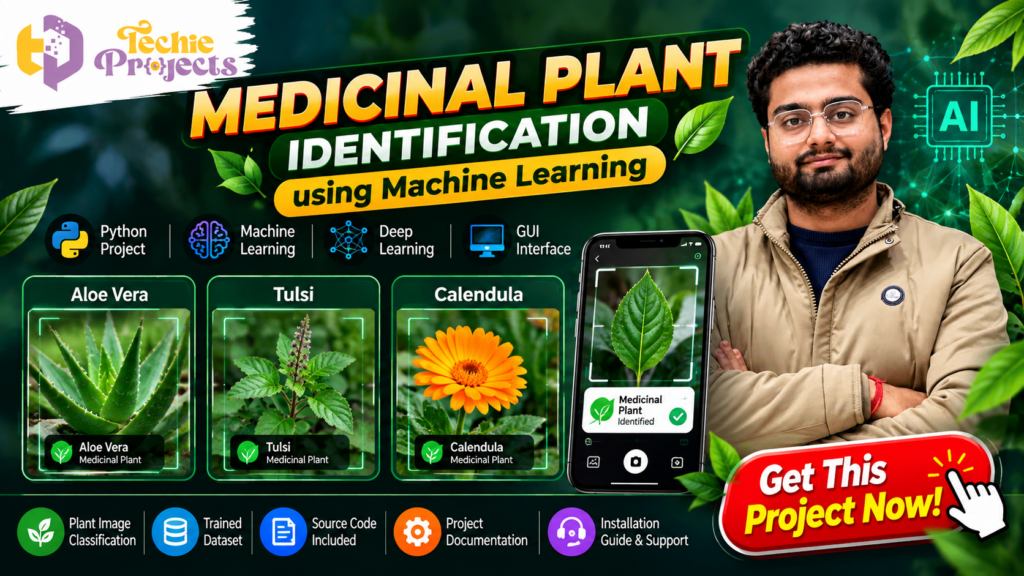
Are you looking for an innovative final-year engineering project based on Artificial Intelligence, Machine Learning, and Image Processing? The Medicinal Plant Identification Using Machine Learning project is an excellent choice for B.Tech, M.Tech, BCA, MCA, and Computer Science students who want to develop a practical AI-based application.
Instead of spending months building an entire project from scratch, you can get a ready-to-study project package from Techie Projects. Get access to the project source code, implementation guidance, technical explanation, and supporting documentation to help you understand how machine learning can identify medicinal plants from images.
This project demonstrates how artificial intelligence can recognize different medicinal plants, such as Aloe Vera, Tulsi, Calendula, and other plant categories, using image classification techniques. It is a valuable academic project for students interested in Python, deep learning, computer vision, and smart agriculture applications.
If you want a practical final-year project that combines programming with real-world applications, contact Techie Projects today and enquire about the complete project package.
📞 Contact Techie Projects for Project Enquiries
Looking for the complete Medicinal Plant Identification Using Machine Learning project with source code and documentation? Contact our team for project details, availability, and technical support.
- 📲 Call/WhatsApp: +91-9460060699
- 🌎 Website: www.techieprojects.com
- 📺 Instagram: @pythonprojects_
🎬 Watch the Medicinal Plant Identification Using Machine Learning Project Demo
Explore the project demonstration to understand how the application processes plant images and predicts their corresponding categories.
The demonstration can help you understand the application interface, image-upload process, plant classification workflow, and prediction output before purchasing the project.
🌱 What Is Medicinal Plant Identification Using Machine Learning?
Medicinal Plant Identification Using Machine Learning is an artificial intelligence-based application designed to recognize medicinal plants from digital images.
Medicinal plants are widely studied for their traditional uses, botanical characteristics, and importance in agriculture and research. Identifying plants manually may require botanical knowledge and experience. Machine learning provides an opportunity to develop image-based systems that can assist with plant classification.
The application accepts an image of a plant or its leaf as input. The image is processed and passed to a trained machine learning or deep learning model. Based on the patterns learned during training, the system predicts the most likely plant category.
For example, when a user uploads an image of an Aloe Vera leaf, the application processes the image and may classify it as Aloe Vera if that category is included in the trained dataset.
The main purpose of this project is to demonstrate how Python and artificial intelligence can be used to build an automated plant recognition application.
Important: The prediction is an educational classification result, not a verified botanical identification or medical recommendation. Users should consult qualified experts before relying on plant identification for medicinal purposes.
🎯 Objectives of the Project
The main objectives of the Medicinal Plant Identification Using Machine Learning project include:
- Develop an AI-based application for medicinal plant image classification.
- Apply image preprocessing techniques to prepare plant images.
- Train a machine learning or deep learning model using labeled images.
- Predict plant categories from uploaded images.
- Develop an easy-to-use graphical user interface.
- Demonstrate the practical use of artificial intelligence in botanical research.
- Help students understand computer vision and image classification.
⚙️ How Does the Project Work?
The application follows a structured workflow involving image input, preprocessing, model prediction, and output generation.
1. 📸 Upload Plant Image
The user selects an image of a medicinal plant or leaf from the computer. The uploaded image becomes the input for the classification system.
2. 🖼️ Image Preprocessing
The system prepares the image before passing it to the trained model. Depending on the implementation, preprocessing may include:
- Image resizing
- Image normalization
- Noise reduction
- Color conversion
- Image augmentation during training
These operations help maintain a consistent input format.
3. 🧠 Feature Extraction
The model learns visual patterns from the training images. These patterns may include leaf shape, texture, edges, color distribution, and other image characteristics.
In a deep learning implementation, convolutional neural networks (CNNs) can automatically learn useful visual features.
4. 🤖 Machine Learning Classification
The processed image is passed to the trained model. The model evaluates the image patterns and generates prediction scores for the available plant categories.
5. 📊 Display Prediction Result
The application displays the predicted plant category. Depending on the implementation, it may also show a confidence score or related information.
6. 💻 User Interface
A graphical interface allows users to upload images and view classification results without directly interacting with the Python code.
🌿 Medicinal Plants Included in the Project
The dataset determines which plant categories the application can recognize. Some possible examples include:
🌵 Aloe Vera
Aloe Vera is a widely recognized plant known for its distinctive thick, fleshy leaves. It is commonly studied in botanical and plant classification projects.
🌿 Tulsi
Tulsi, also known as Holy Basil, is an important plant in traditional Indian practices. Its leaf structure makes it an interesting category for image classification.
🌼 Calendula
Calendula is a flowering plant that can be included in medicinal plant image datasets. Its characteristic flowers provide useful visual features for classification.
🌱 Other Medicinal Plants
Additional categories can be included depending on the available dataset and model training. Examples may include Neem, Mint, Ashwagandha, and other selected plant varieties.
The actual supported categories depend on the dataset and trained model supplied with the project.
🧠 Technologies Used in Medicinal Plant Identification Using Machine Learning
This project combines several technologies used in artificial intelligence and computer vision.
🐍 Python Programming
Python is used to develop the application, process images, load the trained model, and generate classification results.
📷 Image Processing
Image processing techniques prepare plant images for model training and prediction. These techniques help standardize image dimensions and improve input consistency.
🤖 Machine Learning
Machine learning enables the application to learn patterns from labeled plant images and classify new images.
🧠 Deep Learning
Convolutional Neural Networks (CNNs) can be used to learn complex visual features from plant images. Depending on the implementation, transfer learning may also be used.
📊 NumPy
NumPy supports numerical calculations and array operations required for image processing and model input preparation.
🖼️ OpenCV
OpenCV can be used for image reading, resizing, color conversion, and other computer vision operations.
📚 TensorFlow or Keras
TensorFlow and Keras can be used to build, train, load, and evaluate deep learning models when the project uses a CNN-based approach.
💻 Graphical User Interface
A graphical user interface allows users to interact with the system by uploading plant images and viewing the prediction results. The exact interface technology depends on the project implementation.
⭐ Key Features of the Project
The Medicinal Plant Identification Using Machine Learning project can include the following features, depending on the delivered implementation:
- Image Upload: Select plant images from a local system.
- Automatic Classification: Predict plant categories using a trained model.
- Image Preprocessing: Prepare images before prediction.
- AI-Based Recognition: Apply machine learning or deep learning techniques.
- User-Friendly Interface: Provide a simple interface for project demonstration.
- Prediction Output: Display the predicted plant category.
- Dataset-Based Training: Use labeled plant images to train the classification model.
- Modular Implementation: Separate image processing, model prediction, and interface components for easier understanding.
🔬 Dataset Used for Medicinal Plant Classification
A labeled image dataset is an important part of any image classification project.
The dataset contains images belonging to different plant categories. Each image is associated with a corresponding label so that the model can learn the relationship between visual features and plant classes.
A typical dataset preparation process includes:
- Collecting plant images.
- Organizing images into category-wise folders.
- Checking image quality and labels.
- Removing unsuitable or duplicate images.
- Dividing the dataset into training and testing sets.
- Applying preprocessing and augmentation where appropriate.
The quality and diversity of the dataset have a significant impact on classification performance.
For a reliable academic demonstration, the model should be evaluated using images that were not used during training. This helps students understand the difference between training accuracy and real-world performance.
📈 Model Training and Evaluation
Model training is one of the most important stages of the project.
During training, the model receives labeled plant images and learns visual patterns associated with each category.
A CNN-based implementation may contain:
- Convolutional layers
- Activation functions
- Pooling layers
- Flattening layers
- Fully connected layers
- Output classification layer
The trained model can then be evaluated using a separate test dataset.
Common evaluation metrics include:
Accuracy: Measures the proportion of correctly classified test images.
Precision: Measures how many images predicted as a particular category actually belong to that category.
Recall: Measures how many images belonging to a category are correctly identified.
F1-Score: Combines precision and recall into a single evaluation metric.
A confusion matrix can also help identify which plant categories are frequently confused by the model.
Actual performance depends on the dataset, image quality, training process, and model architecture. Do not assume a particular accuracy unless it has been measured and verified.
🎓 Why Choose This Project for Your Final Year?
The Medicinal Plant Identification Using Machine Learning project is suitable for students who want to explore the practical implementation of AI and computer vision.
1. Practical AI Implementation
Students can understand how artificial intelligence processes images and generates predictions.
2. Useful for Computer Science Students
The project combines Python programming, machine learning, image processing, and software development.
3. Good Demonstration Potential
The image-upload and prediction workflow makes the application suitable for a live academic demonstration.
4. Learning Opportunity
Students can study dataset preparation, model training, testing, and application development.
5. Extendable Project Architecture
Students can explore additional plant categories, improved datasets, or alternative classification models as future enhancements.
🏫 Who Can Purchase This Project?
This project may be suitable for students pursuing:
- B.Tech Computer Science Engineering
- B.Tech Artificial Intelligence and Machine Learning
- B.Tech Information Technology
- M.Tech Computer Science
- BCA
- MCA
- Diploma in Computer Engineering
It can also be considered for academic mini-projects, major projects, and machine learning demonstrations, subject to institutional requirements.
📦 What Do You Get from Techie Projects?
When you enquire about the Medicinal Plant Identification Using Machine Learning project, ask our team about the available project package and its inclusions.
Depending on the selected package, the deliverables may include:
- Python Source Code: Files required to study and run the application.
- Project Installation Guidance: Instructions for setting up the required environment.
- Dataset: Available labeled plant images used by the implementation.
- Trained Model: Model file, if included in the selected package.
- Project Documentation: Technical explanation of the project.
- Project Report: Academic documentation, if included.
- PPT Presentation: Presentation material, if included.
- Code Explanation: Guidance for understanding the main implementation.
- Technical Support: Assistance according to the selected package.
Please confirm the exact deliverables, supported Python version, dataset, and support availability before placing your order.
💼 Why Purchase from Techie Projects?
Choosing a suitable final-year project is an important decision. Students need more than just a project title; they need an implementation they can understand, execute, and explain.
Techie Projects focuses on providing engineering project solutions across artificial intelligence, machine learning, Python, computer vision, data analytics, and other technical domains.
By enquiring about this project, you can discuss:
- Project source code availability
- Installation requirements
- Software and library dependencies
- Dataset and trained model details
- Project documentation
- Code explanation
- Technical support options
Our aim is to help students understand their selected project and prepare for academic demonstrations.
🚀 Future Scope of Medicinal Plant Identification Using Machine Learning
The project can be extended with additional features and improved machine learning techniques.
📱 1. Android Application
The classification system could be integrated into an Android application so users can capture plant images directly using a mobile camera.
☁️ 2. Cloud-Based Deployment
The trained model could be deployed through a cloud platform, allowing users to access the application through a web interface.
🌿 3. More Plant Categories
Additional labeled images can be collected to expand the number of supported plant categories.
🧠 4. Advanced Deep Learning Models
Students can experiment with architectures such as MobileNet, ResNet, and EfficientNet, depending on dataset size and computational requirements.
📍 5. Plant Information Database
A database could be integrated to display verified botanical information associated with predicted plant categories.
📷 6. Real-Time Plant Recognition
The system could be extended to process live camera images and provide real-time classification predictions.
These enhancements provide opportunities for further research and development.
💻 Software and Hardware Requirements
Software Requirements
- Programming Language: Python
- Operating System: Windows or another supported operating system
- Image Processing: OpenCV, if used
- Machine Learning: Scikit-learn, if used
- Deep Learning: TensorFlow/Keras or the framework used by the implementation
- Numerical Computing: NumPy
- Development Environment: VS Code, PyCharm, or Jupyter Notebook
Hardware Requirements
- Processor: Modern Intel or AMD processor
- RAM: 4 GB minimum; 8 GB or more recommended
- Storage: Sufficient space for the dataset, source code, and dependencies
- Input Device: Keyboard and mouse
- GPU: Optional for many smaller models; useful for larger training workloads
Exact requirements depend on the dataset size and model architecture.
🛒 Get Medicinal Plant Identification Using Machine Learning Project Now!
Are you ready to develop your final-year project using Python, Artificial Intelligence, and Machine Learning?
Get in touch with Techie Projects to enquire about the Medicinal Plant Identification Using Machine Learning project package.
Instead of beginning with an empty folder, explore an available project implementation that can help you understand image preprocessing, model training, plant classification, and application development.
What are you waiting for? Contact Techie Projects today!
👉 Get This Project Now
- 📲 Call/WhatsApp: +91-9460060699
- 🌎 Website: www.techieprojects.com
- 📺 Instagram: @pythonprojects_
Contact our team for pricing, source code availability, documentation, installation instructions, and technical support details.
❓ Frequently Asked Questions (FAQs)
1. What is Medicinal Plant Identification Using Machine Learning?
It is an AI-based image classification project that uses a trained machine learning or deep learning model to predict medicinal plant categories from uploaded images.
2. Which programming language is used in this project?
Python is the primary programming language used for image processing, model implementation, and application development.
3. Which machine learning algorithm is used?
A CNN-based deep learning model can be used for image classification. The exact algorithm depends on the supplied implementation.
4. Can this project identify Aloe Vera and Tulsi?
Yes, if Aloe Vera and Tulsi are included as labeled categories in the dataset used to train the model.
5. Is this project suitable for B.Tech final-year students?
Yes. It can be suitable for students studying Computer Science, Artificial Intelligence, Machine Learning, and related engineering branches.
6. Does the project include source code?
Source code availability can be confirmed with Techie Projects when enquiring about the selected package.
7. Can I add more medicinal plants?
Additional plant categories can be added by collecting and labeling suitable images and retraining or fine-tuning the model.
8. Does the application provide medical advice?
No. The project demonstrates educational image classification. Its output should not be used as medical advice or as confirmation that a plant is safe for consumption or treatment.
9. Can the project be converted into an Android application?
Yes. A future version could integrate the trained model into an Android application, subject to additional development.
10. How can I purchase this project?
Contact Techie Projects through WhatsApp at +91 94600 60699 or visit https://techieprojects.com/ to enquire about availability, pricing, and package details.
🔗 Explore Related Python and AI Projects
If you are interested in more machine learning and artificial intelligence projects, explore related categories on Techie Projects:
- Python Projects
- Machine Learning Projects
- Deep Learning Projects
- Computer Vision Projects
- Image Processing Projects
- Artificial Intelligence Projects
- Data Science Projects
- Android Application Projects
Visit www.techieprojects.com to explore more engineering project ideas and available project packages.
🎯 Conclusion
The Medicinal Plant Identification Using Machine Learning project demonstrates how Python, image processing, and artificial intelligence can be combined to develop an image-based plant classification application.
From collecting and preparing plant images to training a model and generating predictions, the project provides students with an opportunity to explore the complete machine learning workflow.
Whether you are pursuing B.Tech, M.Tech, BCA, or MCA, this project can help you study practical AI implementation and understand how computer vision can be applied to botanical classification.
If you are interested in purchasing the project with source code and supporting materials, contact Techie Projects today.
📲 Call/WhatsApp: +91-9460060699
🌎 Website: www.techieprojects.com
📺 Instagram: @pythonprojects_
Techie Projects – Engineering Projects, Python Projects, AI & Machine Learning Solutions.