
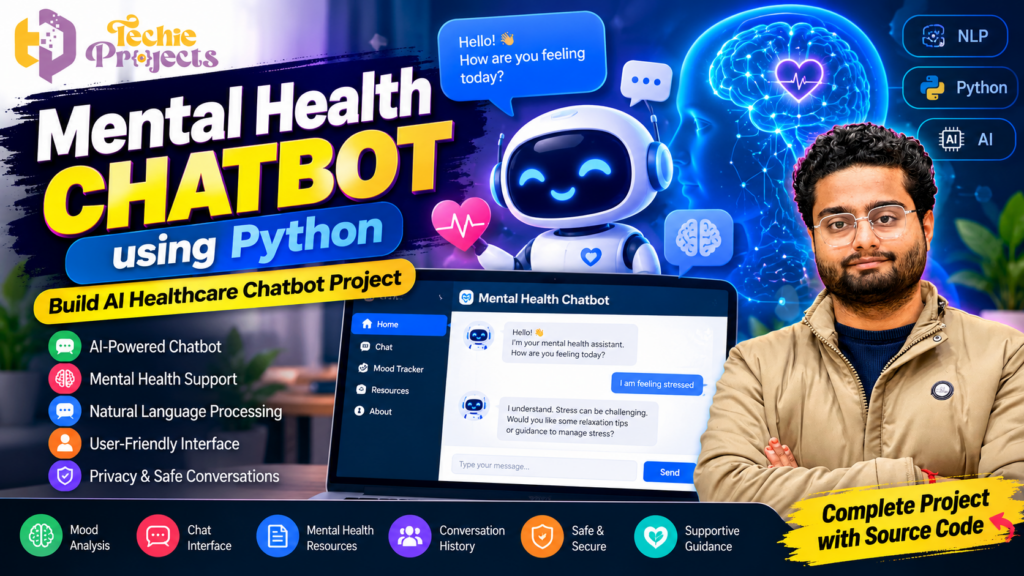
Looking for an innovative AI project that combines Python, Natural Language Processing (NLP), and healthcare technology? The Mental Health Chatbot Project Using Python is an excellent choice for engineering students who want to explore conversational AI and build a practical software application for their final-year or academic project.
At Techie Projects, you can enquire about this project to get a better understanding of its implementation, source code availability, documentation, installation requirements, and technical features. Instead of starting from scratch, choose a project package that helps you study how an AI-powered chatbot processes user messages and generates relevant responses. Contact us to discuss the available package, pricing, and support options.
📩 Get the Mental Health Chatbot Project
Want to explore this Python AI project for your academic work? Contact Techie Projects for details about source code, project documentation, installation, and technical guidance.
- WhatsApp: +91 94600 60699
- Website: Techie Projects
- Instagram: Follow Techie Projects
🎬 Mental Health Chatbot Using Python – Project Demo
Explore the project demonstration to understand the chatbot interface, message interaction, and overall application workflow. The demo can help you evaluate whether this project matches your academic requirements and technical interests.
🧠 What Is a Mental Health Chatbot Project Using Python?
A mental health chatbot is a software application designed to interact with users through text-based conversations. It can demonstrate how conversational interfaces, predefined responses, Natural Language Processing, and AI techniques may be combined to provide general wellbeing information and supportive interactions.
The Mental Health Chatbot Project Using Python can be developed as an educational prototype that accepts a user’s message, processes the text, identifies a relevant intent or pattern, and returns an appropriate response. Depending on the implementation, it may include a graphical interface, conversation history, predefined wellbeing resources, and basic mood-related interactions.
Python is suitable for this type of project because it provides libraries for text processing, machine learning, application development, and data handling.
Important: This project is an educational software application, not a replacement for a qualified mental health professional. It should not be presented as a diagnostic tool, emergency service, or clinically validated treatment system.
🎯 Objectives of the Project
The main objective is to demonstrate how conversational software can be developed using Python and related technologies.
Key objectives include:
- Developing a user-friendly chatbot interface.
- Accepting and processing text-based user messages.
- Exploring NLP techniques for understanding user input.
- Generating relevant responses using rules, intent classification, or a suitable language model.
- Demonstrating responsible digital wellbeing information delivery.
- Learning how to integrate the interface, processing logic, and response system.
- Understanding privacy and safety considerations when designing healthcare-related software.
⚙️ Key Features of the Mental Health Chatbot Project
The final feature set depends on the source code and project version. Common features that can be explored or implemented include the following.
💬 1. Interactive Chat Interface
The chatbot provides a conversation area where users can enter messages and view responses. A simple interface helps demonstrate how a user communicates with a software-based conversational assistant.
🤖 2. AI-Based Response Generation
The response engine can use predefined rules, intent matching, machine learning, or an integrated language model. The selected approach determines how the application interprets messages and produces responses.
📝 3. Natural Language Processing
NLP techniques can help process text, identify keywords, classify intents, and prepare user messages for response generation. This component is useful for understanding how language-processing methods work in a practical Python application.
🌿 4. General Wellbeing Information
The chatbot may provide general information about healthy routines, relaxation techniques, stress-management resources, and the importance of seeking professional support. Information should be carefully reviewed and should not be represented as personalised medical advice.
📊 5. Mood-Related Interaction
An optional mood check-in feature can allow users to select or describe how they feel. The application may display general wellbeing resources based on the selected response. Such interactions should not be presented as a validated psychological assessment.
🖥️ 6. User-Friendly Application Interface
A graphical interface can make the application easier to demonstrate. Depending on the implementation, Python GUI frameworks such as Tkinter or a web framework may be used.
🔒 7. Privacy-Aware Design
Mental health conversations can contain sensitive information. A responsible implementation should minimise data collection, avoid unnecessary storage, protect any stored records, and explain how user information is handled.
🌟 Benefits of the Mental Health Chatbot Project Using Python
The Mental Health Chatbot Project Using Python offers students an opportunity to explore conversational AI, Python programming, and Natural Language Processing in a practical application. It demonstrates how software can process text input and provide relevant responses through an interactive interface.
Key benefits include:
- Practical Python learning: Understand application logic, functions, input handling, and interface development.
- NLP implementation: Explore text preprocessing, intent recognition, and response selection.
- AI project experience: Learn how conversational systems can be structured and tested.
- Customisation opportunities: Modify the interface, response patterns, and general wellbeing resources according to project requirements.
- Academic demonstration: Use the application as a learning reference for explaining chatbot architecture and software development concepts.
Students interested in purchasing this project can contact Techie Projects to confirm source code availability, documentation, installation requirements, and technical support options.
🛠️ Technologies Used in the Project
The exact technology stack depends on the version supplied. A typical implementation may use the following tools.
| Technology | Purpose |
|---|---|
| Python | Core application development |
| NLP libraries | Text processing and intent analysis |
| Machine learning | Optional intent classification |
| Tkinter or a web framework | User interface |
| JSON or a database | Optional response or conversation storage |
| HTML and CSS | Optional web-based interface |
Libraries such as NLTK or spaCy can support text-processing tasks. Scikit-learn may be used for a basic intent-classification model. These are possible implementation choices, not a guarantee that every package includes all of them.
🔄 How Does the Chatbot Work?
The project can be understood through a simple processing pipeline.
Step 1: User Enters a Message
The user types a message into the chatbot interface.
Step 2: Text Preprocessing
The application may clean the input, normalise text, remove unnecessary elements, or perform tokenisation.
Step 3: Intent or Pattern Identification
The system identifies a relevant intent or pattern using rules, keyword matching, a trained classifier, or another configured method.
Step 4: Response Selection
The response engine selects or generates an appropriate reply based on the detected intent and the system’s available information.
Step 5: Response Display
The chatbot displays its response in the conversation window.
Step 6: Safety and Escalation
A responsibly designed prototype should provide clear limitations and direct users to qualified professionals or appropriate emergency resources when needed. It must not claim to diagnose conditions or reliably assess suicide risk unless it has been appropriately designed, evaluated, and validated for that purpose.
🛠️ How to Develop a Mental Health Chatbot Project Using Python
Developing a Mental Health Chatbot Project Using Python involves several stages, from designing the conversation flow to testing the final application.
First, define the chatbot’s purpose and decide which general wellbeing topics it will cover. Next, prepare suitable responses and organise them into intents or categories. Implement the message-processing logic using Python and the selected NLP approach.
After developing the response engine, connect it to a graphical or web-based interface. Test different inputs, check how the chatbot handles unknown messages, and verify that its limitations are clearly communicated.
For an academic project, document the architecture, libraries, workflow, test cases, and limitations. If you prefer a ready-made learning reference, contact Techie Projects to enquire about the Mental Health Chatbot Project Using Python, including its available source code and documentation.
🎓 Why Choose This Project for Your Academic Work?
The Mental Health Chatbot Project Using Python brings together several topics that are relevant to computer science and software engineering.
📚 Practical Learning
Students can explore Python programming, user-interface design, text processing, application logic, and software testing in one project.
🧩 Understanding AI Concepts
The project provides an opportunity to study how a chatbot processes language and how different response-generation methods affect the conversation.
💻 Software Development Experience
Building or studying the application can help students understand modules, functions, input validation, exception handling, and interface integration.
🎤 Project Demonstration
A working prototype can be demonstrated during a presentation or viva, subject to the institution’s rules and the actual functionality of the selected version.
🔍 Scope for Future Improvements
Students can investigate additional capabilities such as multilingual interfaces, improved intent classification, accessibility improvements, or links to verified wellbeing resources.
📦 What Should You Check Before Purchasing?
Before ordering the Mental Health Chatbot Project Using Python from Techie Projects, confirm the package contents and suitability for your requirements.
Depending on the selected package, ask whether it includes:
- Python source code.
- Installation instructions.
- Project documentation or a report.
- Explanation of the code and major modules.
- Software and hardware requirements.
- Sample input and output.
- Demonstration video or screenshots, if available.
- Troubleshooting or technical support, if included in the package.
Package contents, delivery arrangements, and support terms should be confirmed before payment. Do not assume every item is included automatically.
💼 Who Can Benefit From This Project?
This project may be relevant to:
- B.Tech Computer Science and Engineering students.
- Information Technology students.
- MCA and related postgraduate students.
- Students learning Python application development.
- Beginners exploring NLP and conversational AI.
- Learners interested in digital wellbeing software.
Students should follow their institution’s academic-integrity rules. Use any purchased source code as a learning reference, understand how it works, and disclose external assistance where required. Do not submit work as entirely your own if your institution prohibits that practice.
💻 Software and Hardware Requirements
A typical Python chatbot prototype can run on a standard computer, although requirements depend on the libraries and models used.
Possible software requirements:
- Windows, Linux, or another supported operating system.
- A compatible Python version.
- Required project dependencies.
- A code editor or IDE.
- Internet access if the implementation uses an online API or remote service.
Possible hardware requirements:
- A laptop or desktop computer.
- Sufficient RAM for the chosen dependencies.
- Storage space for the code, packages, and optional datasets.
A lightweight rule-based chatbot may require fewer resources than a chatbot using a large language model. Confirm the exact requirements for your chosen version before installation.
🧪 Testing and Evaluation
Testing helps establish whether the application behaves as expected. For an academic prototype, consider evaluating the following:
- Input validation: Does the system handle empty messages and unexpected characters?
- Response relevance: Does the chatbot return an appropriate response for supported intents?
- Unknown inputs: Does it handle messages that it cannot interpret?
- Interface behaviour: Are messages displayed correctly?
- Error handling: Does the application respond safely when a dependency or service fails?
- Privacy: Does the application avoid storing sensitive information unnecessarily?
- Safety messaging: Are the chatbot’s limitations clearly communicated?
If a machine-learning model is included, evaluation can also cover appropriate metrics for its task, such as precision, recall, and F1-score. Do not claim high accuracy without measuring it on a suitable test dataset.
🚀 Future Scope of the Mental Health Chatbot Project
The project can provide a starting point for exploring additional software-development ideas. Potential extensions include:
- Multilingual conversation support.
- Improved intent recognition.
- Accessibility features.
- A curated library of trusted wellbeing resources.
- Secure user preferences, where necessary.
- Optional conversation export with explicit user consent.
- Better handling of unsupported or ambiguous questions.
- Evaluation of response quality and potential bias.
Any feature involving personal health information requires careful attention to privacy, security, consent, and appropriate professional review.
💰 Purchase the Mental Health Chatbot Project Using Python
Looking for a project package to support your Python and AI learning? Techie Projects can discuss available options for the Mental Health Chatbot Project Using Python according to your academic requirements.
Before purchasing, confirm the included source code, documentation, installation instructions, demonstration materials, delivery terms, and support arrangements.
Enquire today:
Ask about source code availability, documentation, installation guidance, pricing, delivery, and the support included with your package before confirming your order.
❓ Frequently Asked Questions
1. What is a Mental Health Chatbot Project Using Python?
It is a software project that demonstrates how Python and conversational techniques can be used to create a chatbot for general wellbeing information and supportive interactions.
2. Which programming language is used?
Python is the primary language in a typical implementation. Additional technologies depend on the interface and response-generation approach.
3. Does this project use Natural Language Processing?
It can use NLP for text preprocessing and intent analysis. Confirm the exact libraries and methods included in the selected version.
4. Can beginners learn from this project?
Yes. It can be a useful learning reference for students who understand basic Python and want to explore chatbot development. Beginners should review the code and installation requirements before starting.
5. Is the source code available from Techie Projects?
Contact Techie Projects to confirm source code availability, the package contents, pricing, and delivery terms for the version you need.
6. Can I customise the project?
Customisation depends on the source code, framework, and project requirements. Possible changes include the interface, supported intents, response content, and language options.
7. Can this chatbot diagnose mental health conditions?
No. An educational chatbot should not be used to diagnose conditions, recommend treatment, or replace a qualified mental health professional.
8. What information should I provide before ordering?
Share your degree or course, project title, required features, preferred technology, submission deadline, and any documentation requirements.
🎓 Explore Related Python Projects
If you are exploring AI and software development, browse related project categories on Techie Projects:
- Artificial Intelligence Projects
- Machine Learning Projects
- Python Projects
- Natural Language Processing Projects
Visit the website to explore the available catalogue and contact the team for relevant project options.
✅ Conclusion
The Mental Health Chatbot Project Using Python is a practical way to explore conversational interfaces, NLP, Python programming, and responsible digital wellbeing applications. It can help students understand how user input is processed, how responses are selected, and how a chatbot interface is integrated with application logic.
If you want to study this project for your academic work, contact Techie Projects to confirm the available source code, documentation, technical requirements, and support options. Choose a package that fits your learning goals and institutional requirements, and make sure you understand the implementation before presenting it.
Contact Techie Projects today to discuss your Mental Health Chatbot Project Using Python.
- 📲 Call/WhatsApp: +91-9460060699
- 🌎 Website: www.techieprojects.com
- 📺 Instagram: @pythonprojects_