
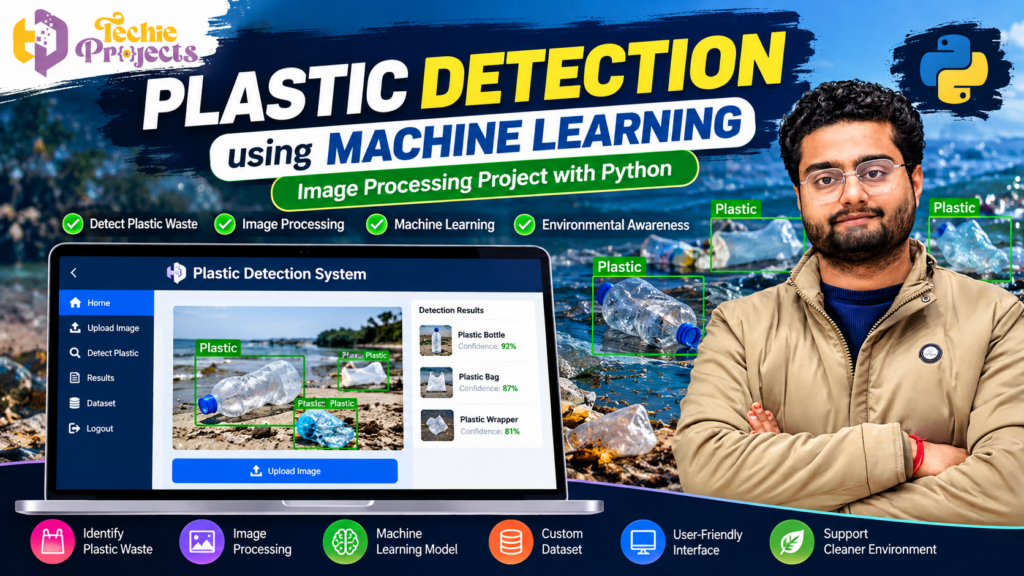
Are you looking for a practical machine learning project that combines Python, image processing, and environmental technology? Plastic Detection Using Machine Learning is an excellent project option for computer science students who want to explore how artificial intelligence can help identify plastic waste in digital images. Get a project package from Techie Projects to help you understand the implementation, run the software, explore the source code, and prepare for your academic demonstration.
Instead of spending weeks building every component from scratch, you can enquire about our Plastic Detection Using Machine Learning project source code, installation guidance, and technical explanation. This project is designed to demonstrate how an image-processing application can analyse uploaded images, identify plastic-related objects, and display detection results through a user-friendly interface. It can be a valuable learning resource for B.Tech, M.Tech, BCA, MCA, and other students studying machine learning or image processing.
🎓 Looking for the complete project package?
- WhatsApp: Enquire about the Plastic Detection Project
- Website: Techie Projects
- Instagram: Follow Techie Projects
- Contact number: +91 94600 60699
🎬 Plastic Detection Using Machine Learning – Project Demo
The project demonstration introduces the software interface, image upload workflow, plastic detection process, and output presentation. It helps students understand how the application operates and how machine learning can be applied to image-based waste identification.
The demonstration can also help you assess whether the project’s workflow matches your academic requirements before enquiring about the complete package.
🌍 What Is Plastic Detection Using Machine Learning?
Plastic Detection Using Machine Learning is a software project that applies image-processing techniques and a trained machine learning model to identify plastic waste in images. Depending on the model and dataset used, the application can identify plastic bottles, bags, wrappers, and other plastic-related objects.
Plastic waste is a major environmental concern because discarded plastic can accumulate in streets, water bodies, landfills, and other public areas. Identifying plastic waste is one part of the wider waste-management process. Computer vision offers a way to analyse images and assist with the identification of objects that may require further inspection or collection.
In this project, Python is used to connect the image-processing workflow with the trained model and the application’s interface. A user can upload an image, initiate detection, and view the output generated by the system.
The purpose of the project is educational: it demonstrates the relationship between image data, model predictions, software development, and a practical environmental use case. Detection performance depends on the quality of the training data, model architecture, image conditions, and implementation.
💡 Why Choose This Plastic Detection Project?
Students often need a project that demonstrates more than basic programming. A machine learning application provides an opportunity to study data preparation, model inference, image processing, and application development within a single workflow.
The Plastic Detection Using Machine Learning project brings these concepts together in an environmental application. It can help students explore how a trained model produces predictions from image inputs and how those predictions can be presented in an accessible interface.
Key learning opportunities include:
- Understanding the fundamentals of machine learning and computer vision.
- Exploring image upload and preprocessing techniques.
- Learning how a trained model identifies objects in an image.
- Displaying detection results through a graphical user interface.
- Studying model predictions and confidence scores, where supported.
- Understanding the limitations of automated image-based identification.
- Practising installation, testing, debugging, and project presentation.
If you want to study these concepts through a working software example, contact Techie Projects to confirm the available source code, documentation, and support options.
⚙️ Main Features of the Plastic Detection System
The features available in the final application depend on the selected implementation and model. The following are common features for this type of project.
📤 1. Image Upload
The image upload feature allows users to select an image from their computer. The uploaded image becomes the input for the detection process.
Students can learn how to handle image files, validate supported formats, and prepare an image for model inference.
🔍 2. Plastic Object Identification
The detection component analyses the image using a trained model. If the model has been trained to recognise plastic-related classes, it can return predictions for objects that match those classes.
Depending on the implementation, results may include labels and bounding boxes around detected objects. Correct identification depends on the classes represented in the training dataset.
🟩 3. Detection Results
The system can display the processed image with visual indicators identifying the predicted objects. Bounding boxes and class labels make the output easier to understand.
Where confidence scores are available, they represent the model’s estimated confidence in a prediction rather than a guarantee that the detection is correct.
🖥️ 4. User-Friendly Interface
A graphical interface can make the project easier to operate. Users can select an image, start the detection process, and review the output without manually running every model operation.
The interface also provides an opportunity to learn how the application connects the frontend workflow to Python-based image processing.
🧠 5. Machine Learning Integration
The machine learning model is the central component of the application. It processes the image and produces predictions based on patterns learned from its training data.
Students can examine how the model is loaded, how input images are prepared, and how its output is converted into information that users can understand.
🌱 6. Environmental Application
The project demonstrates one possible application of computer vision in environmental technology. Similar approaches may be explored in waste sorting, recycling research, and image-based waste monitoring.
However, an image detection program alone does not collect waste or manage disposal. Those functions would require additional hardware, operational processes, or system integrations.
🛠️ Technologies Used in the Project
The exact technology stack should be confirmed against the project package you select. A typical Python implementation may use the following technologies.
🐍 Python
Python is the main programming language for developing the application, connecting libraries, processing inputs, and running the detection workflow. Its extensive machine learning ecosystem makes it suitable for educational computer vision projects.
🖼️ OpenCV
OpenCV is a computer vision library that can be used to read, resize, convert, and display images. It is useful when preparing uploaded images for a model or drawing detection boxes on the output.
🤖 Machine Learning or Deep Learning Model
The selected model learns visual patterns from training data and predicts the objects present in an image. Depending on the implementation, the project may use an object detection model or another image classification approach.
An object detection model can locate individual objects, while an image classification model generally assigns labels to an entire image. The distinction matters when choosing a project for a specific academic requirement.
📊 Dataset
A dataset contains the images and labels used to train or evaluate the model. The quality and variety of the data influence how well the model performs on new images.
A dataset intended for plastic detection should represent the classes the application is expected to recognise. Images captured under different lighting conditions, backgrounds, and angles can help evaluate the model’s practical limitations.
🖥️ Graphical User Interface
Depending on the package, the interface may be developed using a Python GUI framework or a web-based interface. It provides the controls needed to upload an image, run detection, and view results.
🔍 Benefits of Plastic Detection Using Machine Learning
Plastic Detection Using Machine Learning helps students explore how artificial intelligence can be applied to environmental challenges. By analysing images, a trained model can identify plastic-related objects and display predictions for further inspection.
Key benefits of this project include:
- Automated identification: Helps identify plastic objects in digital images.
- Image processing practice: Demonstrates how images are prepared and analysed using Python.
- Computer vision learning: Introduces object detection, model predictions, and visual output.
- Environmental applications: Provides an educational example related to waste monitoring and recycling.
- Practical development experience: Combines a machine learning model with a user-friendly software interface.
The accuracy of Plastic Detection Using Machine Learning depends on the training dataset, model quality, and image conditions. The system should be tested before its predictions are used for practical decisions.
⚙️ Steps to Implement Plastic Detection Using Machine Learning
Developing a Plastic Detection Using Machine Learning application involves several stages. First, collect or select a suitable dataset containing plastic-related objects and accurate labels. Next, prepare the images and select a model appropriate for the required detection task.
After training or configuring the model, integrate it with a Python application. Add an image upload feature, process the input, and display the model’s predictions. Finally, test the software using different images and evaluate incorrect detections as well as successful results.
Students purchasing the project from Techie Projects can enquire about the available implementation, source code, installation guidance, and technical explanation before ordering.
🧪 Applications of Plastic Detection Using Machine Learning
Plastic Detection Using Machine Learning can be studied in several environmental and educational contexts. Potential applications include identifying plastic waste in photographs, supporting recycling research, analysing waste images, and exploring automated waste-sorting concepts.
A basic image-based application does not independently collect, sort, or dispose of plastic. Those capabilities require additional equipment or software integrations. Nevertheless, this project provides a useful starting point for understanding how computer vision can contribute to environmental technology.
🔄 How Does Plastic Detection Using Machine Learning Work?
Understanding the workflow helps students explain the project during a presentation or viva.
Step 1: Prepare the Image
The user selects an image containing objects that may include plastic waste. The application loads the image and checks whether it can be processed.
Step 2: Preprocess the Input
The application performs the preprocessing required by the selected model. This may include resizing the image, converting its format, and scaling pixel values.
The preprocessing method must match the model’s requirements; otherwise, the prediction may be unreliable or the application may produce an error.
Step 3: Run the Model
The prepared image is passed to the trained model. The model analyses the image and generates predictions according to the classes and object patterns it has learned.
Step 4: Interpret the Output
The application processes the model output. In an object detection implementation, this may involve class labels, bounding-box coordinates, and confidence values.
The application may also filter predictions using a confidence threshold to control which detections are displayed.
Step 5: Display the Results
The application presents the results to the user. Depending on the implementation, the output may show the original image, detected objects, labels, and bounding boxes.
Step 6: Test the Application
The system should be tested with different images to examine its behaviour. Students can compare correct detections, missed objects, and false detections to understand the model’s strengths and weaknesses.
🎓 Who Can Purchase This Project?
The Plastic Detection Using Machine Learning project may be suitable for students who want to study a practical application of machine learning and image processing.
B.Tech Computer Science Students
Computer science students can use the project to explore Python programming, model integration, image processing, and software development.
M.Tech Students
Postgraduate students can use the implementation as a learning reference for studying computer vision workflows, evaluating model behaviour, or exploring possible improvements.
BCA and MCA Students
Students learning Python and application development can explore how a graphical interface interacts with image-processing components and a trained model.
Students Working on Minor or Major Projects
The project may be considered for a minor project, final-year project, or academic demonstration, subject to the student’s syllabus and institution’s requirements.
Before purchasing, confirm the project scope, implementation details, documentation, and suitability for your assigned topic.
📦 What Should You Confirm Before Buying?
Techie Projects can help you enquire about the available project package and its contents. Ask for confirmation of the following items before placing an order:
- Python source code: Confirm which files and modules are included.
- Installation instructions: Check the supported Python version, required libraries, and setup procedure.
- Project execution: Confirm how the application is launched and tested.
- Technical explanation: Ask whether the project workflow and important code components are explained.
- Documentation: Confirm whether a project report, synopsis, or other academic documents are available.
- Demonstration: Ask whether a working demo or preview is available for the selected implementation.
- Technical support: Confirm the scope and availability of installation or troubleshooting assistance.
Package contents and support arrangements can vary. Confirm these details directly before purchasing rather than assuming every item is included.
💻 Software and Hardware Requirements
A typical Python-based image detection project may require:
- A Windows, Linux, or other supported operating system.
- A compatible Python installation.
- The required image-processing and machine learning libraries.
- The trained model and any necessary configuration files.
- Sufficient RAM and storage for the software and model files.
- A laptop or desktop computer capable of running the selected model.
A dedicated GPU may improve performance for some deep learning workloads, but it is not necessarily required for every implementation. Actual hardware requirements depend on the model, input resolution, and inference method.
Always check the package’s specific requirements before installing libraries or changing your Python environment.
🧪 Testing and Evaluation
Testing helps determine whether the application behaves as expected and provides an opportunity to understand model limitations.
Useful test cases include:
- An image containing a clearly visible plastic bottle.
- An image containing a plastic bag or wrapper.
- An image with multiple objects.
- An image with poor lighting or a cluttered background.
- An image without the target plastic classes.
- An image containing objects that may be confused with plastic.
Record the results and examine whether the model identifies the correct classes. If the project reports confidence scores, compare those values across test cases while remembering that confidence does not establish correctness.
For a more formal evaluation, students can study metrics such as precision, recall, and mean average precision when supported by the selected object detection model and labelled evaluation data.
🚀 Possible Future Enhancements
The project can provide a foundation for further learning. Depending on the current implementation and available resources, possible extensions include:
- Adding more plastic categories to the dataset.
- Improving the diversity and quality of training images.
- Comparing different object detection models.
- Creating a dashboard to summarise detection results.
- Testing inference speed on different hardware.
- Exploring video-based detection.
- Investigating integration with a camera or a waste-sorting prototype.
These are potential enhancements, not guaranteed features of the existing package. Each extension may require additional data, development, testing, and hardware.
💰 Purchase the Plastic Detection Using Machine Learning Project
If you need a Python project that demonstrates machine learning, image processing, and an environmental use case, the Plastic Detection Using Machine Learning project is worth exploring.
Purchasing a suitable project package can help you access an existing implementation to study, run, and customise according to your academic needs. Before ordering, discuss the required project level, preferred interface, installation environment, and documentation requirements with Techie Projects.
Get in touch today to enquire about the source code and available project package.
- 📱 WhatsApp: https://wa.me/919460060699
- 🌐 Website: https://techieprojects.com/
- 📸 Instagram: https://www.instagram.com/pythonprojects_/
- ☎️ Contact: +91 94600 60699
Share your academic requirements and ask for the package details, price, installation procedure, and support options before confirming your purchase.
🎓 Recommended Related Projects
- E-Waste Detection Using Machine Learning
- Garbage Detection Using YOLO
- Object Detection Using YOLO with Python
- Image Classification Using Deep Learning
- Smart Waste Management System Using IoT
❓ Frequently Asked Questions
1. What is Plastic Detection Using Machine Learning?
It is a software application that uses a trained machine learning model to identify plastic-related objects in images. Depending on the model, it may also locate objects and display bounding boxes.
2. Which programming language is used?
Python is commonly used because it supports image processing, machine learning, and application development through a wide range of libraries.
3. Can this project be used for a final-year submission?
It may be suitable for a final-year project if its scope meets your institution’s requirements. Students should understand the implementation, verify the results, and follow their institution’s rules for external code and project assistance.
4. Does the project detect every type of plastic?
No. The model can identify only the classes it has been trained and configured to recognise, and predictions may be incorrect. Performance depends on the dataset, model, and image conditions.
5. Do I need a GPU to run the project?
Not always. Some models can run on a CPU, while larger models may perform better on a compatible GPU. Confirm the requirements of the selected implementation.
6. What is included in the purchase?
The available package may include source code, installation guidance, documentation, or technical support. Contact Techie Projects to confirm the exact inclusions, price, and delivery details.
7. How can I enquire about the project?
You can contact Techie Projects through WhatsApp or visit techieprojects.com to ask about the available package.
🎯 Conclusion
Plastic Detection Using Machine Learning demonstrates how Python, computer vision, and trained models can be combined to identify plastic-related objects in images. It gives students an opportunity to explore image preprocessing, model inference, detection results, software interfaces, and evaluation methods through a practical environmental application.
If you are planning a machine learning or image-processing project, contact Techie Projects to review the available implementation and confirm the source code, documentation, installation requirements, and support options. Choose a package that matches your academic requirements and use it as a learning resource to understand the technology behind the system.