
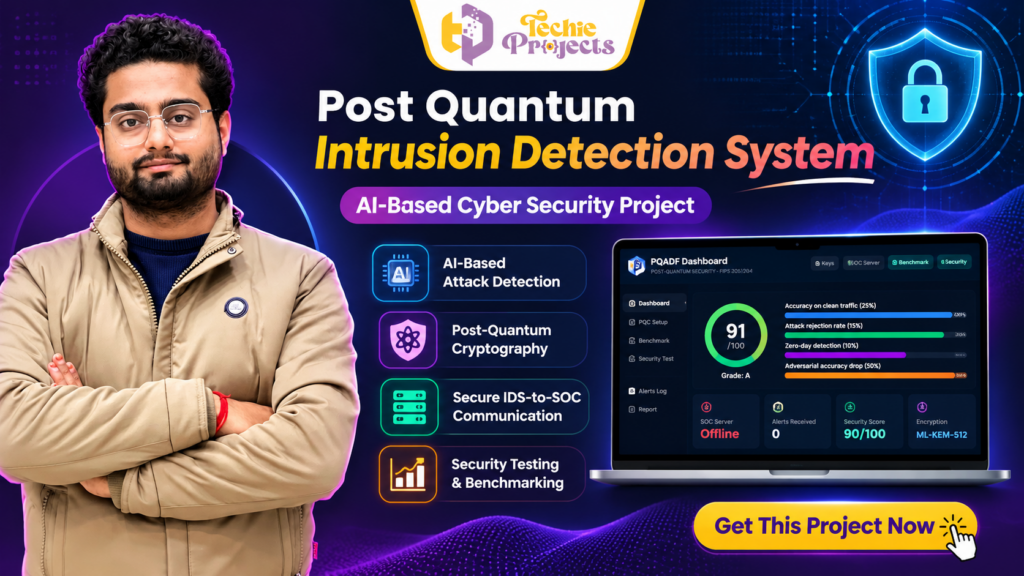
🚀 Looking for an advanced Cyber Security final-year project that combines Artificial Intelligence, Machine Learning and Post-Quantum Cryptography? Build your academic project around next-generation network security with our Post Quantum Intrusion Detection System Project, available from Techie Projects.
Computer Science Project Ideas play an important role in helping students develop practical programming skills and understand real-world software development. Whether you are pursuing B.Tech, BCA, MCA, or another computer-related degree, selecting the right project can strengthen your technical knowledge and improve your academic portfolio.
Traditional intrusion detection systems focus on identifying suspicious network activities, but modern cybersecurity also needs secure communication between detection systems and security monitoring centres. This project takes that concept further by integrating an AI-based Intrusion Detection System (IDS) with quantum-resistant cryptographic mechanisms.
🎓 Whether you are a B.Tech Computer Science student, M.Tech researcher, Artificial Intelligence student or Cyber Security enthusiast, this project provides an opportunity to explore network attack classification, secure alert transmission, cryptographic algorithms and interactive security monitoring through a practical Python implementation.
Get this advanced project from Techie Projects and explore AI-powered network security with post-quantum cryptography.
📞 Contact Techie Projects for Project Enquiries
Want to purchase this project or need assistance with the source code and implementation?
- 🌐 Website: www.techieprojects.com
- 📱 WhatsApp: Chat with Techie Projects
- 📸 Instagram: @pythonprojects_
Our team can help you with project availability, implementation information and academic project enquiries.
🎬 Post Quantum Intrusion Detection System Project Demo
Explore the working demonstration of the Post Quantum Intrusion Detection System and understand how AI-based network traffic classification works together with quantum-safe communication.
The demonstration covers:
- AI-based network intrusion detection.
- Classification of normal and malicious network traffic.
- Post-quantum cryptographic key generation.
- Secure IDS-to-SOC alert transmission.
- Digital signature verification.
- Security testing and benchmarking.
- Interactive cybersecurity dashboard.
📌 What Is a Post Quantum Intrusion Detection System?
A Post Quantum Intrusion Detection System is an advanced cybersecurity solution designed to identify suspicious network activities and protect the communication of security alerts using post-quantum cryptographic mechanisms.
An Intrusion Detection System (IDS) monitors network traffic and identifies activities that may indicate cyberattacks. When suspicious traffic is detected, the system generates an alert that can be sent to a Security Operations Centre (SOC).
In this project, an AI-based neural network analyses network traffic and classifies it into different categories. The generated security alerts are then protected using post-quantum cryptographic algorithms before being transmitted to the SOC server.
The project integrates two important cybersecurity concepts:
- Artificial Intelligence: Detects and classifies suspicious network traffic.
- Post-Quantum Cryptography: Protects security alerts during communication.
The combination provides an interesting practical implementation of modern AI-based cybersecurity and quantum-resistant security concepts.
🎯 Objectives of the Project
The main objective of the Post Quantum Intrusion Detection System Project is to develop an AI-powered intrusion detection solution with secure communication between IDS and SOC components.
Major objectives include:
- Detect normal and malicious network traffic.
- Apply machine learning techniques for intrusion detection.
- Classify network activities into nine traffic categories.
- Generate cryptographic keys for secure communication.
- Encrypt security alerts using ML-KEM-512.
- Apply digital signatures using ML-DSA-44.
- Verify incoming alerts at the SOC server.
- Maintain an alert log for security monitoring.
- Evaluate system performance through benchmarking.
- Provide an interactive dashboard for project monitoring.
🧠 Key Features of the Post Quantum Intrusion Detection System
1. AI-Based Intrusion Detection
The project uses an AI-based neural network model to analyse network traffic and identify suspicious activities.
The model is trained using the CICIDS 2017 and CICIDS 2018 datasets. The implementation uses 77 features per sample and classifies traffic into nine categories.
This functionality helps demonstrate how machine learning can be applied to network security monitoring.
2. Detection of Nine Network Traffic Categories
The system identifies the following nine traffic categories:
| Traffic Category | Description |
|---|---|
| BENIGN | Normal network traffic |
| DDoS | Distributed Denial of Service |
| DoS | Denial of Service |
| PortScan | Network port scanning |
| FTP-Patator | FTP brute-force activity |
| SSH-Patator | SSH brute-force activity |
| Botnet | Botnet-related traffic |
| Web Attack | Web-based attacks |
| Infiltration | Suspicious network infiltration |
The classification functionality makes the project useful for demonstrating different types of network security threats.
3. Post-Quantum Cryptography Integration
One of the major highlights of this project is the integration of Post-Quantum Cryptography (PQC).
Traditional cryptographic mechanisms such as RSA and ECC may face future security challenges from sufficiently capable quantum computers.
To explore quantum-resistant security, this project implements two post-quantum algorithms:
ML-KEM-512 (FIPS 203)
ML-KEM-512 is used for quantum-resistant key encapsulation. It helps establish shared secret material that can be used to protect security alert data.
ML-DSA-44 (FIPS 204)
ML-DSA-44 is used for digital signatures. It helps verify the authenticity and integrity of security alerts received by the SOC server.
These algorithms demonstrate how post-quantum cryptographic mechanisms can be integrated into a practical cybersecurity workflow.
4. Secure IDS-to-SOC Communication
The project implements communication between two important cybersecurity components:
- Intrusion Detection System (IDS)
- Security Operations Centre (SOC)
The IDS generates security alerts after analysing network traffic. These alerts are encrypted and digitally signed before transmission.
The SOC server receives the incoming alerts and performs verification and decryption operations.
After successful verification, the received security incidents are recorded in the alert log.
5. Interactive Cybersecurity Dashboard
The project includes a modern web-based PQADF Dashboard that provides a centralized interface for monitoring the security pipeline.
The dashboard includes:
- Main security dashboard.
- PQC setup section.
- Benchmark monitoring.
- Security testing.
- Alerts log.
- Report section.
- Encryption status.
- SOC server status.
- Security score monitoring.
The interface provides a convenient way to demonstrate the project’s different modules during academic presentations and project evaluations.
6. Security Testing and Benchmarking
The system includes security testing and performance benchmarking features.
The dashboard displays testing categories such as:
- Accuracy on clean traffic.
- Adversarial accuracy drop.
- Attack rejection rate.
- Zero-day detection evaluation.
- Encryption performance comparison.
- Simulated attack verification.
The displayed security score provides a summarized view of the configured test results. Actual performance should be evaluated using the project’s test configuration and dataset.
⚙️ Technologies Used in the Project
The Post Quantum Intrusion Detection System combines several technologies from Artificial Intelligence, Cyber Security and Web Development.
| Technology | Application |
|---|---|
| Python | Main programming language |
| Machine Learning | Network traffic classification |
| Neural Networks | AI-based intrusion detection |
| CICIDS 2017/2018 | Network traffic datasets |
| ML-KEM-512 | Post-quantum key encapsulation |
| ML-DSA-44 | Digital signatures |
| Flask | SOC server implementation |
| HTML, CSS and JavaScript | Dashboard interface |
| FIPS 203/204 | Post-quantum algorithm standards |
These technologies make the project relevant to students interested in modern cybersecurity applications.
🏗️ System Architecture
The project follows an integrated architecture involving network traffic analysis, cryptographic protection and security monitoring.
Step 1: Network Traffic Input
The system receives network traffic samples from the prepared dataset.
The input samples contain network-related features that are processed by the trained AI model.
Step 2: AI-Based Traffic Classification
The trained neural network analyses the input samples and predicts their traffic categories.
The prediction determines whether the traffic is classified as normal or belongs to a suspicious activity category.
Step 3: Generate Security Alerts
When the classification identifies an attack category, the IDS generates a corresponding security alert.
The alert contains information required for security monitoring and further processing.
Step 4: Cryptographic Protection
The system uses ML-KEM-512 for key encapsulation and ML-DSA-44 for digital signature operations.
These mechanisms help protect the alert communication process.
Step 5: Send Alerts to the SOC Server
The IDS sends the protected alerts to the SOC server through the configured communication pipeline.
Step 6: Verification and Decryption
The SOC server verifies the digital signature and processes the encrypted alert using the appropriate cryptographic keys.
Step 7: Store Security Incidents
Successfully processed alerts are recorded for monitoring and analysis through the dashboard.
📂 Project Modules and Python Files
The implementation is organized into different Python modules, with each module performing a specific function.
1. setup_keys.py
This module generates the required cryptographic keys for the communication pipeline.
It creates the keys associated with ML-KEM-512 and ML-DSA-44 and stores the generated key material in the configured keys directory.
2. pqc_core.py
This module contains the core post-quantum cryptographic operations.
It supports the encryption-related and digital-signature functionality used by the project.
3. ids_alert_sender.py
This module loads the trained AI model, processes network traffic samples and sends protected security alerts to the SOC server.
4. soc_server.py
This module implements the Flask-based SOC server.
It receives incoming alerts, performs verification and decryption operations and records security incidents.
5. config.py
This file contains the central configuration settings used by different project modules.
It includes algorithm names, file paths, communication settings and other configuration parameters.
6. Keys Directory
The keys directory stores generated cryptographic key material required by the communication workflow.
It includes files such as:
- soc_keys.json
- ids_keys.json
Private keys must be handled securely and should never be published in a public repository.
📊 PQADF Dashboard – Project Demonstration
The project provides a dark-themed cybersecurity dashboard with multiple monitoring sections.
Main Dashboard
The dashboard displays the system setup status, resilience score, encryption information, SOC server status and monitoring cards.
The demonstration screenshots show a security score of 90/100 in one dashboard view and 91/100 in a security testing view.
These values are example results displayed by the project interface rather than guaranteed performance measurements.
PQC Setup Dashboard
This section demonstrates the post-quantum cryptography workflow.
It includes:
- Generate encryption keys.
- Start SOC server.
- Send IDS alerts.
- Display pipeline output.
- Monitor communication status.
IDS Alert Monitoring
The IDS alert module processes selected test samples and displays classification results.
Users can select the number of samples to process and initiate the alert-sending workflow.
Security Score
The security testing interface presents an overall score and visual indicators for different evaluation categories.
Attack Simulation
The attack simulation section provides test cases for evaluating the system’s security checks, including signature verification and replay detection.
🔐 Advantages of the Project
The Post Quantum Intrusion Detection System offers several academic and technical advantages.
- AI and Cybersecurity Integration: Demonstrates how neural networks can be used for network intrusion detection.
- Advanced Cryptography: Introduces students to ML-KEM-512 and ML-DSA-44.
- Practical Implementation: Connects AI-based detection with secure alert communication.
- Interactive Dashboard: Provides a visual interface for demonstrating different system modules.
- Multiple Attack Categories: Supports classification of nine network traffic categories.
- Modular Python Architecture: Separates key generation, cryptographic operations, alert transmission and SOC processing.
- Performance Evaluation: Includes benchmarking and security testing functionality.
- Research Opportunities: Provides a foundation for exploring AI-based network security and post-quantum communication.
🎓 Applications of the Project
This project can be explored in several cybersecurity and academic application areas.
- Network intrusion detection research.
- AI-based cybersecurity systems.
- Security Operations Centre demonstrations.
- Post-quantum cryptography research.
- Secure communication systems.
- Machine learning-based threat classification.
- Cybersecurity laboratory experiments.
- Academic research and final-year project demonstrations.
It is particularly suitable as a learning and demonstration project for students interested in the intersection of AI and modern cybersecurity.
💻 Why Choose This Post Quantum Intrusion Detection System Project?
Choosing the right final-year project is important for engineering students. A good project should demonstrate technical knowledge, practical implementation and an understanding of real-world applications.
The Post Quantum Intrusion Detection System brings together multiple important areas of computer science in a single implementation.
Instead of focusing only on conventional intrusion detection, this project also explores the protection of security alerts through post-quantum cryptographic mechanisms.
Students can study the AI model, understand the network traffic dataset, explore cryptographic operations and demonstrate the SOC communication workflow.
Techie Projects provides project-related assistance for students looking to explore advanced Python, Artificial Intelligence, Machine Learning and Cyber Security implementations.
If you are looking for an advanced final-year project, this implementation is worth exploring.
If you are searching for industry-relevant Computer Science Project Ideas with practical implementation, Techie Projects can help you find suitable project solutions. Explore available projects, understand their functionality, and choose a project that matches your academic requirements.
🛒 Get This Project Now – Techie Projects
Are you searching for an advanced Python Cyber Security Project for your B.Tech or M.Tech final-year submission?
Get in touch with Techie Projects to enquire about the Post Quantum Intrusion Detection System Project.
Why enquire with Techie Projects?
- Project source code availability.
- Project implementation guidance.
- Demonstration and explanation assistance.
- AI and Machine Learning project solutions.
- Python-based academic projects.
- Assistance with project-related queries.
📲 Purchase / Enquiry: Contact Us on WhatsApp
🌐 Explore More Projects: www.techieprojects.com
📸 Follow Us: Instagram – Techie Projects
Looking for innovative Computer Science Project Ideas for your final-year submission? Techie Projects provides practical project solutions covering Python, Artificial Intelligence, Machine Learning, Deep Learning, Web Development, Data Science, and emerging technologies.
Explore more Computer Science Project Ideas from Techie Projects to discover innovative solutions in AI, Python, IoT, Machine Learning, and Data Analytics. Choose a project that helps you gain practical experience while completing your academic requirements.
💡 Recommended Projects
Looking for more advanced engineering projects? Explore these related project topics from Techie Projects:
- AI-Based Intrusion Detection System Using Machine Learning
- Fake News Detection Using Machine Learning
- DeepFake Detection Using Artificial Intelligence
- Face Recognition Attendance System
- Crime Data Analysis Using Machine Learning
- Android Malware Detection Using Machine Learning
- Phishing Website Detection Using Python
- Keylogger Detection Using Python
- Real-Time Cybersecurity Monitoring Dashboard
Explore more Python, AI, Machine Learning and Cyber Security projects at www.techieprojects.com.
❓ Frequently Asked Questions (FAQs)
1. What is the Post Quantum Intrusion Detection System Project?
It is an AI-based cybersecurity project that combines network intrusion detection with post-quantum cryptographic protection for secure IDS-to-SOC communication.
2. Which programming language is used?
Python is the primary programming language used for the AI model, cryptographic modules and SOC server implementation.
3. Which dataset is used in this project?
The project uses CICIDS 2017 and CICIDS 2018 network traffic datasets.
4. Which machine learning model is used?
The implementation uses a Feature Squeezing Feedforward Neural Network (FNN) for network traffic classification.
5. Which post-quantum algorithms are integrated?
The project uses ML-KEM-512 (FIPS 203) for key encapsulation and ML-DSA-44 (FIPS 204) for digital signatures.
6. What is the role of the SOC server?
The SOC server receives encrypted alerts, verifies digital signatures, processes incoming security information and records incidents.
7. How many network traffic categories can the system classify?
The project demonstrates nine traffic categories, including BENIGN, DDoS, DoS, PortScan, Botnet, Web Attack, FTP-Patator, SSH-Patator and Infiltration.
8. Is this project suitable for final-year engineering students?
Yes. It is a suitable advanced academic project topic for B.Tech and M.Tech students interested in Computer Science, Artificial Intelligence, Machine Learning and Cyber Security.
9. Can I purchase the project source code?
You can contact Techie Projects to enquire about source code availability, project deliverables and implementation assistance.
10. How can I contact Techie Projects?
Visit www.techieprojects.com or contact us directly through WhatsApp.
🚀 Conclusion
The Post Quantum Intrusion Detection System Project demonstrates an advanced approach to modern cybersecurity by integrating Artificial Intelligence, Machine Learning and Post-Quantum Cryptography.
By combining AI-based network traffic classification with ML-KEM-512 and ML-DSA-44, the project explores how security alerts can be protected during communication between an Intrusion Detection System and a Security Operations Centre.
Its interactive PQADF dashboard, modular Python implementation, security testing features and benchmarking interface make it an interesting academic project for engineering students.
Whether you are interested in AI, Machine Learning, Python programming or advanced cybersecurity research, this project offers an opportunity to explore important technologies through a practical implementation.
🎓 Ready to start your advanced cybersecurity project?
Contact Techie Projects today to enquire about the Post Quantum Intrusion Detection System source code and project assistance.
🌐 Website: www.techieprojects.com
📱 WhatsApp: +91-9460060699
Techie Projects – Your Destination for Innovative Engineering Projects!

