
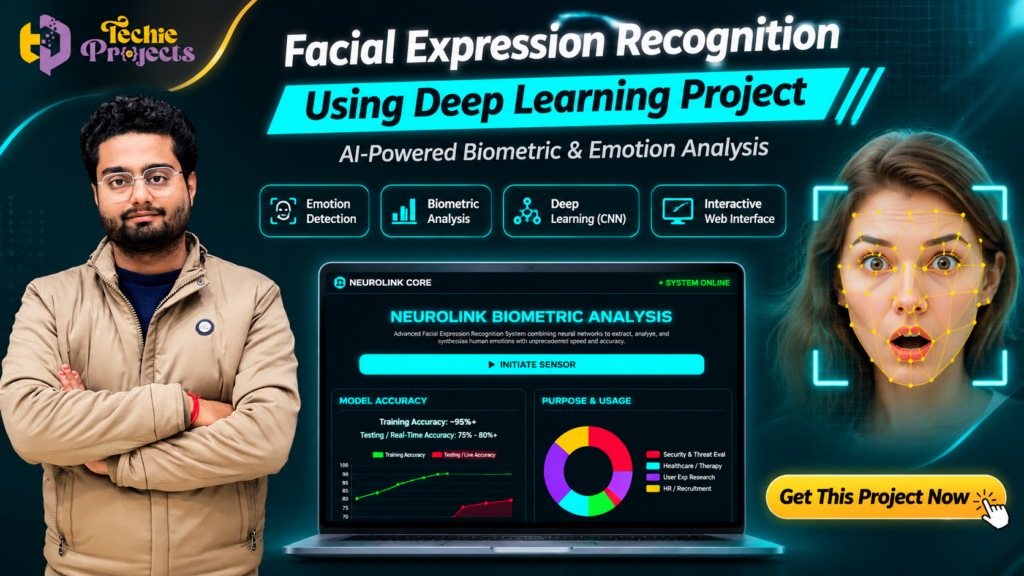
Are you looking for an advanced Facial Expression Recognition Using Deep Learning Project for your final-year engineering submission, computer science project, AI/ML demonstration, or academic portfolio? 🚀 Take your project experience to the next level with the NeuroLink Biometric Analysis System, an intelligent facial emotion recognition application developed using deep learning and computer vision technologies.
This project demonstrates how artificial intelligence can analyze facial images, identify facial expressions, and display predicted emotional states through an interactive biometric analysis dashboard. Instead of building a basic image classification application, this project provides a modern interface with visual sensor input, facial landmark visualization, emotion prediction, model accuracy information, and biometric telemetry.
🎓 Whether you are a B.Tech, M.Tech, MCA, BCA, or computer science student, this project can help you understand practical applications of deep learning, facial expression analysis, and AI-powered image processing.
Want to purchase this project? Get in touch with Techie Projects to explore the project demonstration, implementation details, and available project packages.
📞 Contact Techie Projects for Project Enquiries
Looking for a ready-to-explore AI and deep learning project for your academic requirements? Contact our team for project information, pricing, and availability.
- 🌐 Website: www.techieprojects.com
- 📱 WhatsApp: +91-9460060699
- 📸 Instagram: Techie Projects
🎬 Watch the Facial Expression Recognition Using Deep Learning Project Demo
Explore the NeuroLink Biometric Analysis System through its working demonstration.
The demonstration showcases the project interface, facial image selection, image scanning, facial analysis visualization, and predicted emotional state.
Key demonstration highlights:
- NeuroLink Core dashboard.
- Interactive Initiate Sensor option.
- Facial image upload functionality.
- Initiate Scan functionality.
- Original subject image visualization.
- Biometric facial mask visualization.
- Predicted emotion display.
- Combined accuracy matrix.
- System activity logs and biometric telemetry.
🚀 Introduction to Facial Expression Recognition Using Deep Learning Project
Human facial expressions provide important visual information about emotions and reactions. Artificial intelligence and deep learning make it possible to develop computer vision applications that analyze facial images and classify visible expressions into predefined emotional categories.
The Facial Expression Recognition Using Deep Learning Project is designed to demonstrate this concept through an interactive biometric analysis application called NeuroLink Core.
The system accepts a facial image as input and processes it through an emotion recognition workflow. After analysis, the application displays the predicted emotional category along with a visual representation of the detected facial region.
The project focuses on combining deep learning concepts, image processing, facial expression classification, and an interactive web-based interface.
The NeuroLink dashboard provides a futuristic interface that makes the project suitable for academic demonstrations, technical presentations, and AI project exhibitions.
🎯 Objectives of the Project
The main objective of this project is to develop an intelligent facial expression recognition application using deep learning techniques.
The important objectives include:
- To develop a facial expression classification system using deep learning.
- To analyze facial images and identify visible expression patterns.
- To implement image upload and scanning functionality.
- To visualize facial regions using a biometric mask or facial landmark representation.
- To display predicted emotional categories through an interactive dashboard.
- To understand the practical implementation of computer vision and neural networks.
- To demonstrate model performance using accuracy-related visualizations.
- To develop a modern web interface for AI-based facial analysis.
🧠 How Does the Facial Expression Recognition System Work?
The project follows an image-based processing workflow. A facial image is provided to the application, processed by the recognition pipeline, and analyzed to generate an emotion prediction.
1. Facial Image Input
The first step is selecting a facial image from the local computer. The application provides an interactive image selection option through its Visual Sensor interface.
The selected image becomes the input for the facial expression analysis process.
2. Image Processing
After image selection, the system prepares the input for the recognition model. Image processing is an important stage because facial images can differ in size, lighting conditions, orientation, and quality.
The preprocessing requirements depend on the model architecture and training configuration.
3. Facial Feature Analysis
The application analyzes facial regions and visual patterns that may help distinguish different expressions.
Facial regions such as the eyes, eyebrows, nose, and mouth can provide useful visual features for expression classification.
The demonstration also includes a biometric mask visualization to represent facial analysis.
4. Emotion Classification
The trained recognition model processes the facial input and predicts an emotion category.
The application demonstration displays an example prediction of SURPRISE.
Other emotion categories depend on the classes supported by the trained model.
5. Result Visualization
The final prediction is presented through the NeuroLink Biometric Telemetry dashboard.
The interface displays the detected state, confidence-related visualization where implemented, and system activity information.
⚙️ Technologies Used in the Project
The project demonstrates the integration of artificial intelligence, deep learning, computer vision, and web application development.
The technologies and concepts relevant to this implementation include:
Python
Python is widely used in artificial intelligence and machine learning development. It provides an extensive ecosystem for image processing, model training, and data analysis.
Deep Learning
Deep learning enables computer systems to learn complex patterns from image data. Neural networks can be trained to recognize visual characteristics associated with facial expressions.
Computer Vision
Computer vision techniques help computers process and interpret image information. They are useful for facial image analysis, image preprocessing, and visual feature extraction.
YOLO-Format Facial Image Dataset
The project demonstration shows a facial expression image dataset organized in YOLO format on Kaggle. Dataset preparation and annotation formats are important considerations when developing image-based recognition applications.
Web-Based Dashboard
The NeuroLink Core interface provides a visual environment for uploading images, initiating scans, and displaying analysis results.
Note: The exact model architecture, framework versions, dataset composition, and implementation dependencies should be confirmed against the supplied project files.
💻 Major Modules of the Project
The Facial Expression Recognition Using Deep Learning Project can be understood through the following major modules.
1. NeuroLink Core Dashboard
The dashboard is the main interface of the application. It displays the project name, system status, and sensor initiation functionality.
Its futuristic design provides an interactive environment for demonstrating the facial expression recognition workflow.
2. Visual Sensor Module
The Visual Sensor module allows users to select a facial image from their computer.
It acts as the input interface between the user and the image analysis pipeline.
3. Facial Image Processing Module
This module prepares the selected image for analysis. Depending on the implementation, it can include resizing, normalization, image conversion, and other preprocessing operations.
4. Biometric Mask Visualization Module
This module presents a visual representation of the facial region being analyzed.
In the demonstration, the original facial image is displayed alongside a biometric mask containing facial feature markings.
5. Emotion Detection Module
The emotion detection module generates the predicted expression category using the trained recognition model.
The example interface displays SURPRISE as the detected state.
6. Biometric Telemetry Module
The telemetry section displays the predicted state, accuracy-related information, and system activity logs.
This makes it easier to demonstrate the analysis workflow during project presentations.
7. Model Performance Module
The dashboard includes a model accuracy section with training and testing or real-time accuracy visualizations.
The demonstration shows approximately 95%+ training accuracy and 75%–80%+ testing/real-time accuracy figures. These are displayed project figures, not independently verified performance guarantees. Actual results depend on the dataset, model, test methodology, and input conditions.
📊 Features of NeuroLink Biometric Analysis System
The major features of this project include:
- AI-based facial expression recognition.
- Deep learning-based image analysis.
- Facial image upload functionality.
- Interactive image scanning.
- Facial analysis visualization.
- Emotion prediction display.
- Biometric telemetry dashboard.
- Model performance visualization.
- System activity logging.
- Modern futuristic user interface.
- Practical demonstration of computer vision concepts.
💡 Benefits of Facial Expression Recognition Using Deep Learning Project
Choosing a Facial Expression Recognition Using Deep Learning Project offers several academic and technical benefits for students interested in artificial intelligence and computer vision.
1. Practical Understanding of Deep Learning
Students can understand how deep learning models process facial images and identify patterns associated with different expressions.
2. Real-World AI Application
This project demonstrates a practical application of artificial intelligence rather than limiting learning to theoretical concepts.
3. Improves Computer Vision Knowledge
Working with facial images helps students understand image preprocessing, feature extraction, classification, and visual analysis.
4. Useful for Final-Year Engineering Projects
The project combines multiple technical concepts, making it suitable for academic demonstrations and final-year project discussions, subject to institutional requirements.
5. Interactive Project Demonstration
The NeuroLink Core dashboard provides a modern interface for presenting image inputs, scan results, and predicted emotional states.
6. Better Technical Presentation
Students can explain the complete workflow, from image selection to prediction and result visualization, during project demonstrations and viva examinations.
7. Supports Portfolio Development
An AI-based facial expression recognition application can be a useful addition to a student portfolio when accompanied by a clear explanation of the implementation and limitations.
8. Encourages Further Research
Students can explore different deep learning architectures, datasets, preprocessing strategies, and evaluation methods to understand how model performance can be improved.
🌍 Applications of Facial Expression Recognition Technology
Facial expression recognition is an active area of computer vision research. Some potential application areas include:
Healthcare Research
Researchers can investigate facial expression patterns as one possible source of information in carefully designed studies. Such systems should not be treated as diagnostic tools.
Human-Computer Interaction
Facial expression classification can be explored as an additional input modality for interactive applications.
Academic Research
Students and researchers can experiment with neural networks, image datasets, and classification methods.
Customer Experience Research
With informed consent and appropriate privacy protections, researchers may study visual expression patterns in controlled environments.
Interactive AI Applications
Facial expression recognition can be incorporated into experimental AI interfaces and computer vision demonstrations.
Educational Demonstrations
The technology can help students understand how computer vision models classify images and visualize predictions.
Important: Facial expression predictions do not reliably establish a person’s actual emotional state, intentions, honesty, or suitability for employment. The project should be used for educational and research demonstrations, not high-stakes decisions or surveillance.
📚 Dataset Used for Facial Expression Recognition
Dataset quality is an important factor in developing any deep learning-based image classification application.
The project demonstration shows a Kaggle dataset titled Facial Expression Image Data AFFECTNET YOLO Format.
The dataset interface displays facial image files organized into training and testing directories.
A properly prepared dataset helps the model learn visual patterns from different facial expressions.
Important dataset preparation steps include:
- Collecting suitable facial images.
- Organizing images into appropriate categories.
- Checking image quality.
- Preparing training and testing data.
- Applying suitable preprocessing techniques.
- Ensuring consistent annotations and labels.
- Evaluating model performance on unseen data.
Students should also review the dataset’s licensing and usage conditions before redistributing or using it in commercial applications.
🔬 Future Scope of the Project
The Facial Expression Recognition Using Deep Learning Project can be extended with additional features and research experiments.
Some possible future enhancements include:
- Real-time facial expression recognition using a webcam.
- Video-based facial expression analysis.
- Support for additional expression categories.
- Improved model evaluation and testing.
- Comparison of multiple deep learning architectures.
- Improved image preprocessing techniques.
- Enhanced visualization of facial landmarks.
- Integration with additional computer vision applications.
- Development of a mobile-friendly dashboard.
- Performance evaluation under different lighting and image conditions.
These enhancements can help students explore advanced concepts in artificial intelligence and machine learning.
🚀 Why Choose Facial Expression Recognition Using Deep Learning Project?
The Facial Expression Recognition Using Deep Learning Project is an excellent option for students interested in developing practical artificial intelligence applications. It combines facial image processing, emotion classification, deep learning concepts, and an interactive dashboard.
Students choosing this project can explore how neural networks identify visual patterns and generate facial expression predictions.
Key reasons to choose this project include:
- Practical implementation of deep learning.
- AI-based facial expression classification.
- Interactive biometric analysis dashboard.
- Facial image processing and visualization.
- Useful for B.Tech, M.Tech, BCA, and MCA students.
- Opportunities for further AI and computer vision research.
📊 Real-Time Emotion Detection and Facial Analysis
An important part of the Facial Expression Recognition Using Deep Learning Project is its facial analysis workflow.
The NeuroLink Biometric Analysis System allows users to upload a facial image, initiate scanning, and view the predicted expression through its dashboard.
The system demonstrates:
- Facial image selection.
- Image preprocessing.
- Facial feature analysis.
- Deep learning-based emotion prediction.
- Biometric visualization.
- Result monitoring through the dashboard.
This workflow helps students understand how a Facial Expression Recognition Using Deep Learning Project can be developed as an interactive computer vision application.
🎓 Who Can Develop This Facial Expression Recognition Using Deep Learning Project?
This project is suitable for students pursuing:
- B.Tech Computer Science Engineering.
- B.Tech Artificial Intelligence and Machine Learning.
- M.Tech Computer Science.
- BCA and MCA.
- Data Science and AI-related courses.
The Facial Expression Recognition Using Deep Learning Project is particularly useful for students who want to explore Python programming, deep learning, neural networks, and computer vision.
🎓 Why Choose Techie Projects for Your Final-Year Project?
Selecting an appropriate engineering project is an important step in your academic journey.
At Techie Projects, our goal is to help students explore practical technology projects in areas such as Python, artificial intelligence, machine learning, deep learning, computer vision, IoT, and data science.
The NeuroLink Biometric Analysis System is an interesting option for students who want to explore facial expression recognition through an interactive AI-based application.
When enquiring about this project, you can ask our team about:
- Project availability and pricing.
- Demonstration and working workflow.
- Technologies and implementation details.
- Source code and documentation availability.
- Installation and execution requirements.
- Customization options, if available.
Our team can help you understand the available project package before making a purchase decision.
🛒 Get Facial Expression Recognition Using Deep Learning Project from Techie Projects
Looking for an advanced AI-based final-year engineering project? Techie Projects offers students opportunities to explore practical implementations in artificial intelligence, machine learning, Python, and computer vision.
Get in touch to enquire about the Facial Expression Recognition Using Deep Learning Project, including source code availability, project documentation, demonstration, installation requirements, and pricing.
📲 WhatsApp: Contact Techie Projects
🌐 Website: www.techieprojects.com
📸 Instagram: @pythonprojects_
💡 Recommended Projects
Explore more interesting engineering and artificial intelligence projects from Techie Projects:
- AI-Based Fake News Detection Using Machine Learning
- DeepFake Detection Using Deep Learning
- Face Recognition Attendance System
- Human Emotion Detection Using Machine Learning
- AI-Based Exam Proctoring System
- Real-Time Object Detection Using YOLO
- Human Activity Recognition Using Deep Learning
- Helmet and Number Plate Detection Using AI
Visit www.techieprojects.com to explore more Python, AI, ML, and final-year engineering projects.
🏁 Conclusion – Facial Expression Recognition Using Deep Learning Project
The Facial Expression Recognition Using Deep Learning Project demonstrates the practical application of artificial intelligence in facial image analysis and emotion classification.
With its NeuroLink Biometric Analysis dashboard, image uploading functionality, facial visualization, and prediction interface, this project provides an interesting learning experience for engineering students.
If you are searching for a Facial Expression Recognition Using Deep Learning Project for your final-year submission or academic demonstration, contact Techie Projects today.
🚀 Learn advanced AI technologies and build innovative engineering projects with Techie Projects!

