
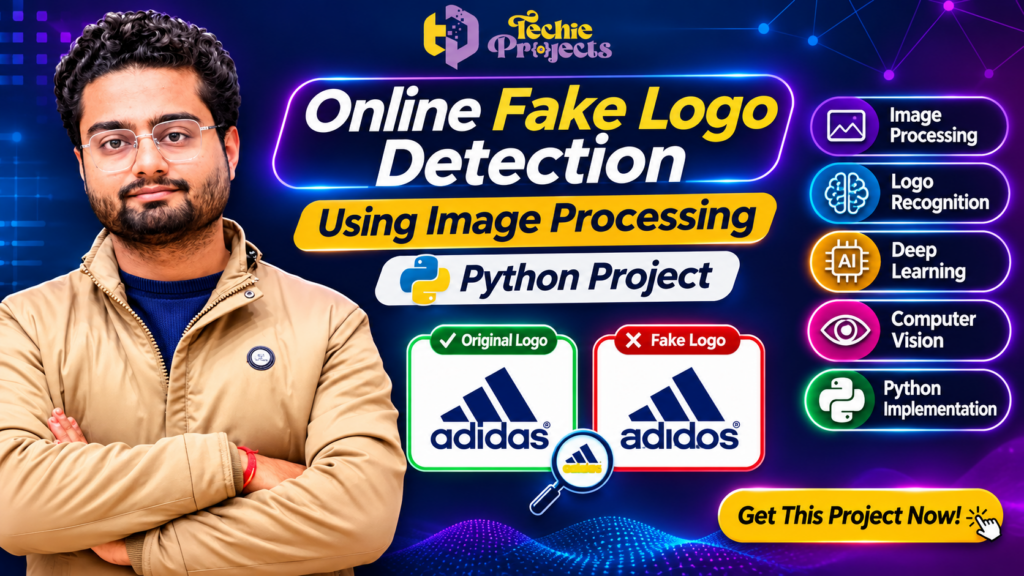
🚀 Get a Complete Fake Logo Recognition Project Using Python – Source Code & Project Demo
Fake Logo Recognition using Python is an advanced image processing and computer vision project designed for final-year engineering students. This project demonstrates how Python, OpenCV, and machine learning techniques can identify and classify brand logos from digital images. If you are looking for a practical Fake Logo Recognition using Python project with source code and demonstration, Techie Projects provides project solutions to help you understand and implement this technology.
Looking for an advanced Fake Logo Recognition using Python project for your final-year engineering submission, college major project, or computer science portfolio? Get a practical Python-based logo detection and recognition solution from Techie Projects, designed to help students understand image processing, computer vision, and artificial intelligence through a real-world application.
Don’t waste your valuable project-development time struggling with incomplete code, confusing tutorials, or complicated implementation steps. Purchase the Fake Logo Recognition using Python project from Techie Projects and get access to a project implementation that you can study, run, understand, and demonstrate during your academic presentation.
This project focuses on identifying and recognizing brand logos from images using image processing and machine learning concepts. It demonstrates how a computer can analyze visual patterns, extract important image features, and compare them with trained logo information to identify potential logo matches.
Whether you are a B.Tech CSE student, IT student, MCA student, or final-year engineering student, this Logo Detection using Image Processing project can help you explore an interesting application of artificial intelligence and computer vision.
📞 Contact Techie Projects for Project Enquiries
Interested in purchasing the Fake Logo Recognition using Python? Contact us to enquire about package availability, pricing, source code, documentation, installation guidance, and technical support options.
💬 WhatsApp Enquiry: Chat with Techie Projects
📱 Contact Number: +91 94600 60699
🌐 Official Website: www.techieprojects.com
📸 Instagram: Follow Techie Projects
🎓 Project Areas: Robotics, Machine Learning, Arduino, Deep Learning, Artificial Intelligence, and Android App.
✅ Request Project Details: Share your engineering branch, preferred features, and technical requirements to enquire about the most suitable available package.
🚀 Ready to get started? Click here to enquire on WhatsApp and mention Fake Logo Recognition using Python Project.
Package contents, prices, hardware availability, and support options should be confirmed before purchase.
🎬 Watch the Fake Logo Recognition Using Python Project Demo
Explore the practical demonstration of the Fake Logo Recognition using Python project to understand how logo images are processed and recognized through a Python-based application.
The project demonstration helps students understand the overall interface, image input process, logo identification workflow, and expected application output.
Students can watch the demonstration before purchasing to understand the project concept and its practical implementation.
📌 What Is Fake Logo Recognition Using Python?
Fake Logo Recognition using Python is an image-processing and computer vision project that aims to identify and classify brand logos from digital images.
Brand logos are important visual identities for companies. However, unauthorized copying, imitation, and visually similar designs can create challenges when identifying genuine brand representations.
A Logo Recognition System uses computer vision techniques to analyze an uploaded image and identify whether it matches a logo available in its reference dataset.
The Fake Logo Recognition using Python project demonstrates how Python libraries can process images, extract visual information, and perform logo matching or classification.
The system can be designed to analyze:
- Logo shapes and structures.
- Color combinations.
- Visual patterns.
- Image features.
- Logo similarity.
- Known brand logo references.
The main objective of this project is to demonstrate an intelligent approach to logo identification using Python and image processing techniques.
Note: This academic prototype demonstrates image-based logo recognition. It does not independently establish whether a physical product is authentic or legally determine trademark infringement.
🎯 Objectives of the Fake Logo Recognition Project
The primary objective of Fake Logo Recognition using Python is to develop an intelligent application capable of identifying brand logos through image analysis.
The major objectives include:
- Automated Logo Identification: Develop a system that can identify logos from uploaded images.
- Image Processing: Apply image preprocessing techniques to improve image quality and consistency.
- Feature Extraction: Extract useful visual characteristics from logo images.
- Logo Classification: Classify images according to the available reference logo categories.
- Python Implementation: Use Python libraries to develop the recognition application.
- Computer Vision Integration: Understand how computer vision can solve practical image recognition problems.
- User-Friendly Interface: Provide an interface where users can upload images and view recognition results.
⚙️ Working Methodology of Logo Detection Using Image Processing
The working methodology of Logo Detection using Image Processing involves several stages, starting from image collection and preprocessing to feature extraction, classification, and result generation.
The system processes the uploaded image and compares its visual information with the reference logo dataset. Depending on the selected recognition approach, the system can use traditional image processing, feature matching, or a trained deep learning model.
1. Image Dataset Collection
The first step involves collecting images of different brand logos.
The dataset contains reference logo images belonging to different categories. These images are used for training, testing, or comparison depending on the implementation.
2. Image Upload
The user uploads a logo image through the application interface.
The uploaded image becomes the input for the Logo Recognition System.
3. Image Preprocessing
Image preprocessing is performed to prepare the input image for further analysis.
Common preprocessing operations include:
- Image resizing.
- Noise reduction.
- Color conversion.
- Image normalization.
- Background handling.
- Image enhancement.
These operations help maintain consistent image dimensions and improve the quality of subsequent processing.
4. Feature Extraction
The system extracts important visual information from the uploaded image.
Features may include edges, shapes, textures, color distributions, and other visual patterns.
Feature extraction plays an important role in Logo Detection using Image Processing because it helps the application understand the characteristics of different logo designs.
5. Logo Feature Matching
The extracted features are compared with available reference logo information.
Depending on the implementation, the system may use image similarity measurements, feature matching algorithms, or trained classification models.
6. Logo Classification
After analyzing the input image, the application identifies the closest matching logo category from the available dataset.
This stage demonstrates the concept of a Brand Logo Identification System.
7. Result Generation
Finally, the application displays the recognition result through its interface.
The result may include the predicted logo category, matching information, or similarity score, depending on the implemented model.
💻 Technologies Used in the Fake Logo Recognition Project
The Fake Logo Recognition using Python project combines multiple technologies related to image processing, artificial intelligence, and computer vision.
| Technology | Purpose |
|---|---|
| Python | Main programming language |
| OpenCV | Image processing and computer vision |
| NumPy | Numerical and array operations |
| TensorFlow/Keras | Deep learning model implementation, if included |
| Scikit-learn | Machine learning and classification, if included |
| HTML/CSS | Frontend interface, if included |
| Django/Flask | Web application development, depending on implementation |
The exact libraries and framework requirements depend on the delivered project version.
🔥 Key Features of Fake Logo Recognition Using Python
The Fake Logo Recognition using Python application demonstrates several useful functionalities.
1. Image Upload Functionality
Users can upload logo images for analysis through the application interface.
2. Automated Logo Recognition
The system analyzes the uploaded image and identifies a matching logo category from its available reference data.
3. Image Processing Integration
The application uses Image Processing using Python techniques to prepare and analyze images.
4. Logo Classification
The system demonstrates how different logo categories can be classified using image features or trained models.
5. Visual Result Display
The recognition output is displayed through the application interface.
6. Computer Vision Implementation
The project demonstrates the practical application of Computer Vision Based Logo Detection.
7. Academic Project Demonstration
Students can study the implementation and explain its workflow during project presentations and viva examinations.
🧠 Deep Learning for Logo Detection
Deep Learning for Logo Detection is an important area of computer vision that focuses on identifying logos through neural network architectures.
Traditional image processing techniques rely on manually designed features, whereas deep learning models can learn useful visual representations from training images.
Convolutional Neural Networks (CNNs) are commonly used for image classification tasks because they can learn spatial patterns, edges, shapes, and other visual characteristics.
In an advanced version of Fake Logo Recognition using Python, a CNN-based model can be trained using labeled logo images to recognize different logo categories.
The model learns patterns from the training dataset and uses the learned information to classify new input images.
Deep learning can be useful when the dataset contains variations in:
- Logo size.
- Image resolution.
- Rotation.
- Lighting conditions.
- Background appearance.
- Image quality.
The effectiveness of the model depends on dataset quality, training configuration, and testing conditions.
🎓 Benefits of Fake Logo Recognition Using Python for Final-Year Students
Choosing Fake Logo Recognition using Python as a final-year project provides students with an opportunity to understand how artificial intelligence and computer vision techniques are applied to real-world image recognition problems.
The project combines multiple technical concepts in one implementation, making it useful for students who want practical exposure beyond theoretical programming knowledge.
1. Practical Python Development Experience
Students learn how Python can be used to develop an image recognition application and integrate different programming libraries.
2. Understanding Image Processing
The project provides practical knowledge of image preprocessing, resizing, feature extraction, and visual analysis.
3. Computer Vision Knowledge
Students gain an understanding of how computer systems analyze images and identify visual patterns.
4. Machine Learning Exposure
Students can understand classification techniques and how models learn from labeled image datasets.
5. Deep Learning Concepts
An advanced implementation introduces CNN architecture and neural network-based image classification.
6. Academic Presentation Support
The project provides a practical application that students can explain during their final-year project presentation, demonstration, and viva.
7. Resume and Portfolio Development
A Python Image Recognition Project can demonstrate practical interest in Python development, artificial intelligence, and computer vision.
🌐 Real-World Applications of Fake Logo Recognition Using Python
A Brand Logo Identification System has several potential applications in different industries.
Some examples include:
1. E-Commerce Platforms
Logo recognition can help analyze product images and identify visible brand logos in product listings.
2. Brand Monitoring
Companies can explore image recognition techniques to monitor the appearance of their logos across digital platforms.
3. Digital Marketing
Logo identification can support visual analysis of brand appearances in marketing images and promotional content.
4. Social Media Image Analysis
Computer vision systems can analyze uploaded images to identify known brand logos.
5. Image-Based Search Applications
Logo recognition can be integrated into applications that search for visually similar brand images.
6. Research and Academic Development
Students and researchers can use logo recognition techniques to explore computer vision, deep learning, and image classification.
📂 What Will You Learn From This Python Image Recognition Project?
By studying the Fake Logo Recognition using Python implementation, students can explore the following technical concepts:
- Python programming.
- Image preprocessing.
- OpenCV operations.
- Image feature extraction.
- Logo image classification.
- Computer vision fundamentals.
- Machine learning concepts.
- Deep learning fundamentals.
- Dataset preparation.
- Model testing and evaluation.
- Application development.
These concepts can provide a foundation for exploring more advanced Computer Vision Projects.
💡 Recommended Projects From Techie Projects
Interested in developing more advanced artificial intelligence and computer vision applications? Explore these related project ideas:
- Brain Tumor Detection Using Deep Learning
- AI-Based Apple Detection & Robotic Harvesting
- Helmet and Number Plate Detection Using AI
- Vehicle Detection and Counting Using Python
- AI Exam Proctoring System Using Python
- Accident Detection and Alert System Using AI
- Intrusion Detection System Using Machine Learning
- AI-Based Smart Waste Segregation System
- IoT-Based Smart Irrigation System
- AI-Based Smart Surveillance
- IoT-Based Smart Home Automation System
- AI-Based Water Surface Cleaning Boat
Explore more project ideas at www.techieprojects.com.
🛒 Why Purchase the Fake Logo Recognition Project From Techie Projects?
Developing an advanced computer vision project from scratch can take considerable time, particularly when you are unfamiliar with image preprocessing, model implementation, and application integration.
Techie Projects provides project solutions across Python, Artificial Intelligence, Machine Learning, Deep Learning, Data Science, IoT, and Web Development.
When you enquire about the Fake Logo Recognition using Python project, you can discuss the available deliverables and support options before purchasing.
Depending on the selected project package, you can enquire about:
- Python project source code.
- Project implementation.
- Installation guidance.
- Project demonstration.
- Technical explanation.
- Documentation availability.
- Customization requirements.
- Project-related assistance.
The exact deliverables should be confirmed with our team before purchase.
🚀 Get This Project Now!
Are you searching for a ready-to-study Fake Logo Recognition using Python project for your final-year engineering submission?
Take the next step with Techie Projects.
Get in touch with our team to check the project availability, source code, demonstration, pricing, and delivery details.
📞 Contact / WhatsApp: +91 94600 60699
🌐 Website: www.techieprojects.com
📸 Instagram: @pythonprojects_
🎓 Build your technical knowledge with practical Python and AI projects from Techie Projects!
❓ Frequently Asked Questions (FAQs)
1. What is Fake Logo Recognition using Python?
Fake Logo Recognition using Python is an image-processing and computer vision project that analyzes logo images and attempts to identify or classify them using reference data and recognition techniques.
2. Which programming language is used in this project?
Python is the primary programming language used for image processing, feature extraction, and logo recognition.
3. What is Logo Detection using Image Processing?
Logo Detection using Image Processing involves analyzing digital images to locate, identify, and recognize logo patterns through image-processing and computer vision techniques.
4. Is this project suitable for final-year CSE students?
Yes. This project is suitable as an academic project topic for B.Tech CSE, IT, MCA, and related engineering students, depending on their academic requirements.
5. Does the project use deep learning?
An advanced implementation can use CNN-based image classification or other deep learning techniques. The exact architecture depends on the delivered version.
6. What is the role of OpenCV?
OpenCV is used for image loading, resizing, preprocessing, feature analysis, and other computer vision operations.
7. Can I get the source code?
Contact Techie Projects to confirm the availability of the source code and the deliverables included in your selected package.
8. Can I watch the project demonstration before purchasing?
Yes. You can explore the available project demonstration on the Techie Projects YouTube channel or request the relevant demo from our team.
9. Can this system identify every fake brand logo?
No. Recognition depends on the dataset, trained model, image quality, and matching method. A predicted match should not be treated as definitive proof of counterfeit products.
10. How can I purchase this project?
You can contact Techie Projects through WhatsApp at +91 94600 60699 or visit www.techieprojects.com to enquire about pricing, source code, and project availability.
🚀 Ready to Purchase Your Fake Logo Recognition Project?
Get your complete Fake Logo Recognition using Python project from Techie Projects!
- ✅ Python-based implementation
- ✅ Image processing and computer vision concepts
- ✅ Project demonstration
- ✅ Source code availability
- ✅ Installation and technical assistance options
🎯 Get This Project Now!
📞 Contact / WhatsApp: +91 94600 60699
🎯 Conclusion
Fake Logo Recognition using Python is an interesting computer vision project that demonstrates how image processing, machine learning, and deep learning techniques can be applied to brand logo identification.
From image preprocessing and feature extraction to logo classification and result generation, the project introduces students to important concepts used in modern artificial intelligence applications.
For students looking for a practical Logo Detection using Image Processing project, this implementation offers an opportunity to explore Python development and computer vision in an academic environment.
If you are ready to work on an advanced Python Image Recognition Project, contact Techie Projects today.
🚀 Get Your Fake Logo Recognition Project Now and Start Your AI Project Journey!
📞 Contact / WhatsApp: +91 94600 60699
🌐 Website: www.techieprojects.com
📸 Instagram: @pythonprojects_

