
Introduction
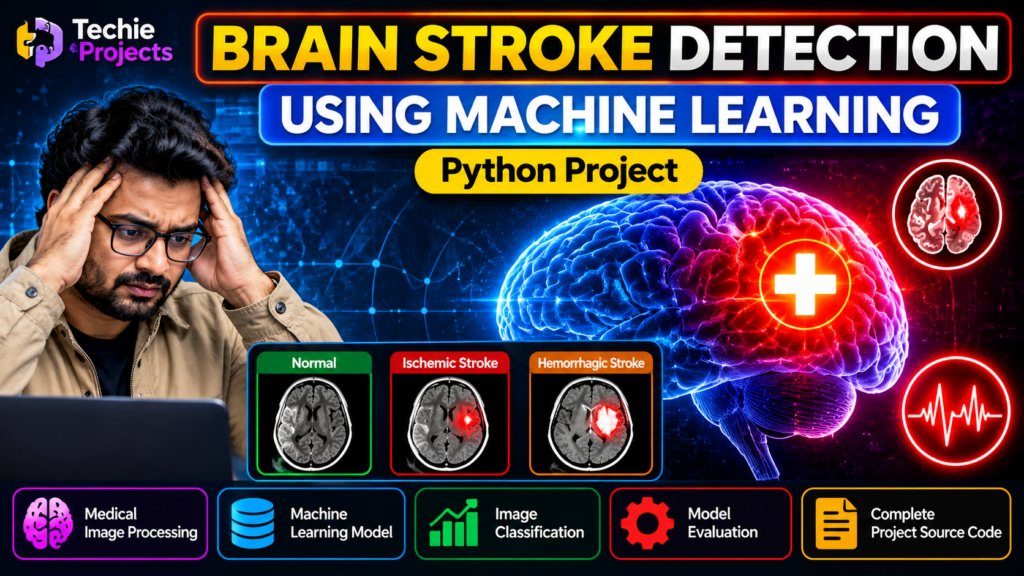
Brain Stroke Detection Using Machine Learning is a healthcare-focused Python project that demonstrates how machine learning and deep learning techniques can be explored for brain image analysis. This project is suitable for computer science engineering students who want to understand medical image processing, model training, image classification, and artificial intelligence applications.
If you are looking for a Brain Stroke Detection Using Machine Learning project for your final-year submission, Techie Projects can help you explore the project workflow, implementation approach, software requirements, and project availability. Contact us to enquire about the project package, source code, and customization options.
🎬 Brain Stroke Detection Using Machine Learning – Project Demo Video
Watch the project demonstration to understand the interface, image-processing workflow, and how the machine learning model is used in the project.
What Is Brain Stroke Detection Using Machine Learning?
Brain Stroke Detection Using Machine Learning is an educational project that explores the use of computational techniques to analyze brain-related medical images. Depending on the dataset and implementation, a model may be trained to classify images into predefined categories.
The project introduces students to the relationship between Python programming, image processing, data preparation, and machine learning. It can also help demonstrate how a trained model receives an image and produces a predicted class.
Important: This is an educational prototype, not a clinically validated diagnostic system. Its output must not be used to diagnose or treat a real patient.
🎯 Project Objectives
The main objectives of the project are:
- Understand the fundamentals of machine learning for medical image analysis.
- Learn how to prepare and process image datasets.
- Explore model training and image classification.
- Develop a Python application for demonstrating model predictions.
- Understand model evaluation using suitable metrics.
- Create a practical final-year engineering project for academic demonstration.
Key Features of the Project
The features available depend on the supplied implementation and trained model.
1. Medical Image Input
The application can accept supported image files for processing when image upload is included in the implementation.
2. Image Preprocessing
Image preprocessing may include resizing, normalization, and other transformations required by the selected model.
3. Machine Learning Classification
A trained model can analyze the input image and return a predicted category supported by its training labels.
4. User Interface
A Python interface can make it easier to load images, run the model, and view the result.
5. Model Evaluation
Students can evaluate a model using appropriate measures such as accuracy, precision, recall, F1-score, and a confusion matrix, depending on the dataset and implementation.
Technologies Used
The exact technologies depend on the project package. A typical implementation may use:
- Programming language: Python
- Image processing: OpenCV or Pillow
- Machine learning: Scikit-learn or a compatible deep learning framework
- Data analysis: NumPy and Pandas
- Visualization: Matplotlib
- Interface: Tkinter, Streamlit, or another supported framework
- Dataset: A suitable, properly licensed medical image dataset
Only list a library or framework as part of your final submission if it is actually used in your project.
How the Project Works
The general workflow of a Brain Stroke Detection Using Machine Learning project consists of these steps:
- Dataset collection: Obtain a suitable dataset with appropriate labels and usage permissions.
- Data preprocessing: Prepare the images in the format required by the model.
- Model training: Train or load a compatible machine learning or deep learning model.
- Model evaluation: Assess its performance on suitable validation or test data.
- Image input: Provide a supported image to the application.
- Prediction: Run the model and display its predicted category.
- Result presentation: Show the output through the user interface.
Actual performance depends on the dataset, model design, data quality, and evaluation method.
Software and Hardware Requirements
Software Requirements
- Python 3.x, compatible with the selected libraries
- A code editor such as Visual Studio Code or PyCharm
- Required Python packages
- A compatible trained model and dataset
- Windows, Linux, or another supported operating system
Hardware Requirements
- A computer or laptop
- Recommended 8 GB RAM or more for a comfortable development experience
- Sufficient storage for the dataset and model files
- A GPU is optional for many inference tasks but may help with deep learning training
These are general recommendations. Confirm the requirements against the actual project files before installation.
Advantages of the Project
- Provides practical experience with Python and machine learning.
- Introduces medical image processing concepts.
- Helps students understand model training and evaluation.
- Can be extended with a graphical interface or reporting features.
- Offers opportunities to learn about responsible AI in healthcare.
Applications and Limitations
Potential Educational Applications
- Medical image classification demonstrations
- Machine learning and deep learning laboratory work
- Final-year computer science project presentations
- Research and experimentation with image datasets
Limitations
- Predictions depend on the quality and suitability of the training data.
- Performance on one dataset does not guarantee performance on other populations or imaging systems.
- A model may produce incorrect predictions.
- Clinical use requires rigorous validation, appropriate regulatory review, and qualified medical oversight.
Future Scope
Students can explore the following extensions, subject to dataset availability and technical feasibility:
- Compare different classification models.
- Add performance charts and evaluation reports.
- Develop a web-based demonstration interface.
- Improve dataset documentation and preprocessing.
- Explore explainability techniques to better understand model predictions.
- Test generalization using suitable independent datasets.
Why Choose Techie Projects?
Techie Projects provides engineering project resources for students who want to explore practical software development and machine learning concepts.
Before purchasing, you can contact us to confirm the available deliverables, including:
- Project source code availability
- Installation and execution instructions
- Documentation and report availability
- Demonstration video availability
- Customization options and pricing
- Compatibility with your system and academic requirements
Deliverables vary by project package, so please confirm the exact inclusions before placing an order.
💬 Purchase or Enquire About the Project
Looking for a Brain Stroke Detection Using Machine Learning project for your final-year engineering submission?
Contact Techie Projects to request the current price, available source code package, documentation details, and customization options.
📲 Call/WhatsApp: +91-9460060699
🌎 Website: www.techieprojects.com
📺 Instagram: @pythonprojects_
🎓 Explore Related Projects
Students interested in related technologies can also explore:
- Brain Stroke Classification Using CNN
- Brain Tumor Detection Using Deep Learning
- Skin Cancer Detection Using Machine Learning
- Dental Caries Detection Using Deep Learning
- Medical Image Processing Projects
- Deep Learning Projects for Final-Year Students
These project collections can help you compare ideas and choose a topic aligned with your skills and academic requirements.
Frequently Asked Questions
1. What is a Brain Stroke Detection Using Machine Learning project?
It is an educational software project that explores machine learning techniques for analyzing brain-related medical images and classifying images according to the model’s supported categories.
2. Which programming language is used?
Python is commonly used because it supports image processing, machine learning, data analysis, and application development.
3. Can I customize this project for my final-year submission?
Customization may be possible depending on the available implementation. Contact Techie Projects to discuss your requirements and confirm what can be modified.
4. Is the project suitable for beginners?
It can be a useful learning project for students with basic Python knowledge. Students may need additional guidance to understand datasets, model training, and evaluation.
5. Does the project provide medically reliable stroke diagnoses?
Not necessarily. An educational prototype is not a substitute for a clinically validated medical system or professional medical assessment.
6. How can I get the project price and details?
Use the WhatsApp link above to request the current pricing, source code availability, documentation, and other package details.
Conclusion
Brain Stroke Detection Using Machine Learning is a useful academic topic for students interested in Python, image processing, and artificial intelligence in healthcare. By studying the workflow, preprocessing techniques, classification methods, and model evaluation, students can develop practical skills while learning about the limitations of medical AI.
If you want to explore this project for your final-year submission, contact Techie Projects for current pricing, deliverables, and customization options. Review the package details before purchasing and make sure you understand the implementation well enough to present your work confidently.