
Introduction
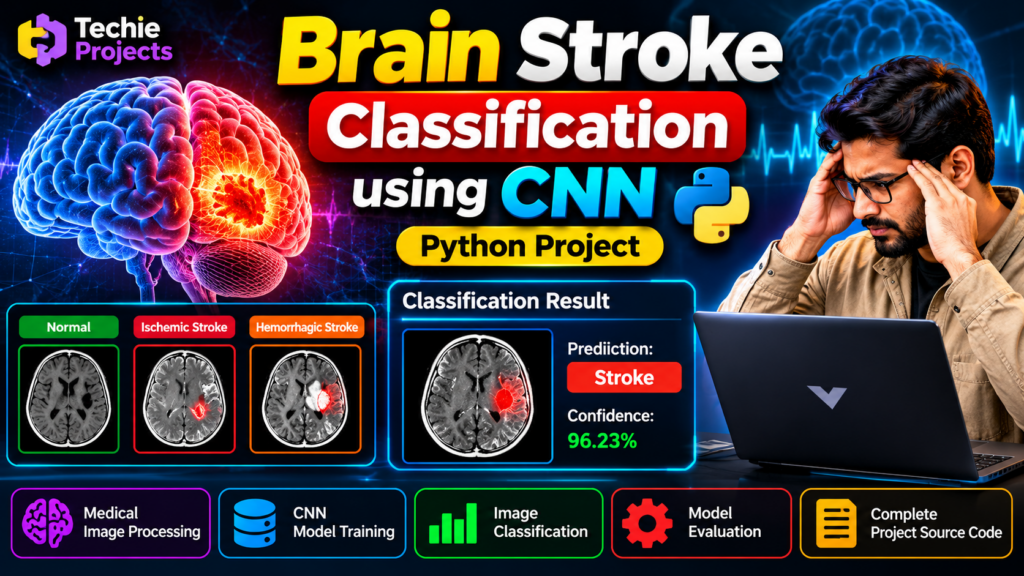
Brain stroke classification using CNN is a deep learning project that demonstrates how Convolutional Neural Networks (CNNs) can be used to classify brain images into predefined categories. Developed as an educational Python project, it helps engineering students understand medical image processing, image classification, model training, and the practical implementation of deep learning techniques.
If you are looking for a final-year B.Tech CSE, IT, AI, or Data Science project, this project offers an opportunity to explore an important application of artificial intelligence. Techie Projects can help you get started with the project implementation, understand its workflow, and prepare for your academic demonstration.
🎬 Brain Stroke Classification Using CNN – Project Demo Video
Watch the project demonstration to understand the interface, image classification workflow, and how a CNN-based model can be integrated into a Python application.
What Is Brain Stroke Classification Using CNN?
Brain stroke classification using CNN is a machine learning approach that uses image data and a trained neural network to identify patterns associated with predefined image classes. CNNs are widely used in image analysis because they can learn visual features from training images.
In this project, Python provides the programming environment, while a CNN model performs the image classification task. The final output depends on the dataset, model architecture, training process, and classes implemented in the application.
This project is intended for educational and research purposes. It is not a clinically validated medical diagnostic system and must not be used to make healthcare decisions.
The brain stroke classification using CNN project demonstrates how deep learning can be applied to image classification using Python.
Students working on a brain stroke classification using CNN project can explore image preprocessing, CNN model training, and performance evaluation.
If you are interested in a brain stroke classification using CNN Python project for your final-year submission, contact Techie Projects to enquire about source code availability and pricing.
🎯 Project Objectives
The main objectives of this project are:
- Understand how CNNs work for image classification.
- Learn image preprocessing techniques using Python.
- Prepare and organize an image dataset for model training.
- Train and evaluate a deep learning classification model.
- Display classification results through a Python application.
- Understand the limitations of machine learning in medical image analysis.
Key Features of the Project
The following features can be included depending on the supplied implementation:
1. Image Upload
Allow users to select an image through the application interface for processing.
2. Image Preprocessing
Prepare images for model input by applying suitable resizing, normalization, and other preprocessing steps.
3. CNN-Based Classification
Use a trained Convolutional Neural Network to predict a class from the categories supported by the dataset.
4. Classification Results
Display the model’s predicted class in a clear and understandable format.
5. Model Evaluation
Evaluate the trained model using appropriate metrics, such as accuracy, precision, recall, and a confusion matrix, where supported by the implementation.
6. Python Application Interface
Provide an interface for interacting with the model and viewing its output.
⚙️ Technologies Used
The project may use the following technologies, depending on the implementation:
- Programming language: Python
- Deep learning: TensorFlow/Keras or PyTorch
- Image processing: OpenCV and Pillow
- Numerical computing: NumPy
- Data analysis: Pandas
- Visualization: Matplotlib
- Interface: Tkinter, Flask, or Streamlit
Confirm the actual libraries used in your project package before including them in your final documentation.
How the Project Works
The typical workflow of a brain stroke classification project involves these stages:
- Dataset preparation: Collect and organize a suitable, properly licensed image dataset.
- Image preprocessing: Resize and normalize images according to the model’s requirements.
- Dataset splitting: Separate the data into training, validation, and testing sets.
- CNN model training: Train the neural network to learn relevant image features.
- Model evaluation: Evaluate performance on data not used for training.
- Prediction: Submit an input image to the trained model.
- Result display: Show the predicted category in the application.
The quality of the results depends on the dataset, class balance, preprocessing, model design, and evaluation methodology. A model’s prediction should not be interpreted as a medical diagnosis.
💻 Software Requirements
Typical software requirements include:
- Python 3
- A compatible code editor, such as Visual Studio Code or PyCharm
- Required Python libraries
- A compatible deep learning framework
- A suitable dataset for the implemented classification task
- Windows, Linux, or another supported operating system
A GPU may help accelerate training for larger datasets, but it is not always necessary for a small educational implementation.
🎓 Applications of CNN-Based Image Classification
CNN-based image classification projects can help students explore:
- Medical image analysis research
- Deep learning and computer vision
- Image preprocessing and feature learning
- Neural network training and evaluation
- Academic demonstrations of AI applications
These are educational and research applications, not evidence that a student project is suitable for real-world clinical use.
Advantages of the Project
- Provides practical experience with Python and deep learning.
- Demonstrates the end-to-end image classification workflow.
- Helps students understand CNN architecture and model evaluation.
- Can support academic presentations and project demonstrations.
- Offers opportunities to experiment with preprocessing and model improvements.
Limitations and Future Scope
The model may perform poorly on images that differ from its training data. Dataset quality, class imbalance, overfitting, and insufficient testing can affect the results.
Possible future improvements include:
- Experimenting with transfer learning.
- Comparing different CNN architectures.
- Improving dataset diversity and quality.
- Adding visual performance reports.
- Developing a web-based interface.
- Evaluating robustness on an independent test dataset.
Any medical application would require appropriate clinical validation, privacy safeguards, expert oversight, and regulatory review before real-world use.
Why Choose This Project for Your Final Year?
If you need a practical deep learning project for your final-year engineering work, this topic combines Python programming, computer vision, dataset preparation, neural network training, and model evaluation.
Techie Projects provides engineering project resources for students who want to explore implementation and understand the concepts behind their projects. Before purchasing, confirm the available source code, dataset, documentation, setup instructions, and features included in the package.
🛒 Get the Brain Stroke Classification Project
Looking for the Brain Stroke Classification Using CNN Python project for your academic work?
Contact Techie Projects to ask about project availability, source code, implementation details, setup support, and pricing.
- 📲 Call/WhatsApp: +91-9460060699
- 🌎 Website: www.techieprojects.com
- 📺 Instagram: @pythonprojects_
Please confirm the package contents and support terms before placing your order.
🔗 Explore Related Projects
Explore these related project categories to discover more ideas for your academic work:
- Brain Tumor Detection Using Deep Learning
- Brain MRI Image Classification Using CNN
- Alzheimer’s Disease Detection Using Deep Learning
- Pneumonia Detection Using CNN
- Skin Cancer Detection Using Machine Learning
- Bone Fracture Detection Using Image Processing
- Dental Caries Detection Using Deep Learning
- Diabetic Retinopathy Detection Using Deep Learning
- Lung Cancer Detection Using Machine Learning
Frequently Asked Questions
1. What is brain stroke classification using CNN?
It is an educational image classification project that uses a Convolutional Neural Network to classify images into predefined categories based on the dataset and trained model.
2. Which programming language is used?
Python is the primary programming language for the project. The exact libraries depend on the implementation.
3. Is this project suitable for final-year engineering students?
It can be suitable for B.Tech CSE, IT, AI, and Data Science students interested in deep learning and image classification.
4. Can I customize the project?
Customization depends on the available source code and project structure. Ask about modifications, additional features, and their costs before ordering.
5. Does this project provide a medical diagnosis?
No. It is an educational prototype and is not a substitute for assessment by a qualified healthcare professional.
6. How can I get the project source code?
Contact Techie Projects through WhatsApp to confirm source code availability, pricing, and package details.
Conclusion
Brain stroke classification using CNN is a useful educational topic for students exploring deep learning, Python, and image classification. By working through dataset preparation, model training, evaluation, and application development, students can gain practical experience with an AI-based project workflow.
If you want to explore this project for your final-year submission, contact Techie Projects to discuss the available implementation, source code, and pricing. Choose a project package that matches your requirements and make sure you understand the code before presenting or submitting your work.