
Introduction
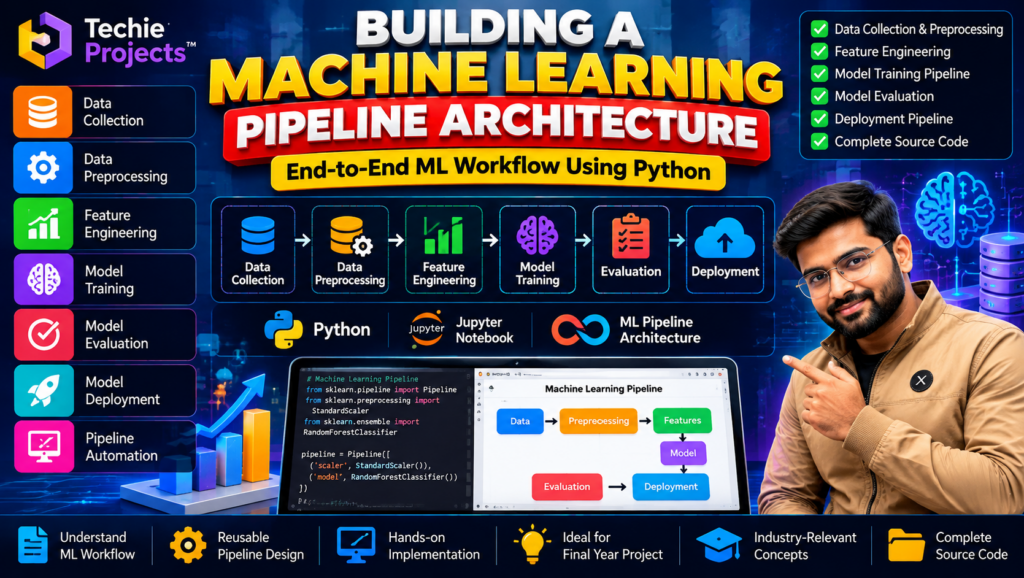
Machine learning pipeline architecture using Python is a practical project that demonstrates how data processing, feature engineering, model training, evaluation, and deployment can be organized into a structured machine learning workflow. It helps students understand how different stages of an ML project work together to create a reusable and maintainable solution.
If you are a B.Tech, B.E., BCA, MCA, Computer Science, Artificial Intelligence, or Data Science student looking for a machine learning project, this topic provides an opportunity to explore Python-based data science workflows and model development.
Techie Projects offers software project options for students who want practical implementation experience. Contact us to confirm the available source code, documentation, dependencies, implementation details, and pricing.
🎬 Project Demo: Machine Learning Pipeline Architecture Using Python
Watch the project demonstration to understand the pipeline architecture and its implementation workflow. Review the demonstrated components and available functionality before purchasing.
The exact stages, models, and automation features depend on the supplied project version.
🎯 What Is Machine Learning Pipeline Architecture?
Machine learning pipeline architecture describes how data moves through the different stages of an ML workflow, from preparing input data to training and evaluating a model.
Instead of implementing every step separately, developers can organize related operations into a repeatable sequence. This makes it easier to understand the workflow, reuse preprocessing steps, and maintain a consistent approach to model development.
A typical machine learning pipeline may include:
- Data collection and loading
- Data cleaning and preprocessing
- Feature engineering
- Model training
- Model evaluation
- Model saving and deployment preparation
The exact pipeline depends on the dataset, problem type, selected algorithms, and project requirements.
✨ Key Features of the Machine Learning Pipeline Project
The following features are relevant to this project type. Confirm which features are implemented in the version available from Techie Projects.
- Data preprocessing: Prepare input data for machine learning.
- Feature engineering: Select, transform, or create features for model training.
- Model training: Train a selected machine learning algorithm.
- Pipeline organization: Combine compatible processing steps into a structured workflow.
- Model evaluation: Assess model performance using appropriate evaluation metrics.
- Reusable components: Reuse preprocessing and training steps where supported.
- Python integration: Implement the workflow using Python libraries.
- Deployment preparation: Organize a trained model for later integration into an application, if included.
Do not assume automated scheduling, cloud deployment, model monitoring, or production integration is included unless the supplied implementation supports it.
🎓 Objectives of Building a Machine Learning Pipeline Architecture
The main objectives of this project are:
- To understand the stages of a machine learning workflow.
- To organize data preprocessing and model training.
- To explore feature engineering techniques.
- To train and evaluate a machine learning model.
- To improve the reusability of processing steps.
- To understand how a trained model can be prepared for future deployment.
⚙️ How Does a Machine Learning Pipeline Work?
1. Data Collection
The process begins by loading a dataset from a supported file or data source. The dataset should match the problem being solved.
2. Data Preprocessing
The data is checked and prepared for training. Depending on the dataset, this may include handling missing values, encoding categorical variables, scaling numerical values, and removing invalid records.
3. Feature Engineering
Relevant input features are selected or transformed to make them suitable for the chosen model. Any transformation that learns from data should be fitted using training data only to avoid data leakage.
4. Model Training
The prepared training data is passed to a selected machine learning algorithm. The algorithm learns patterns that can be used to make predictions.
5. Model Evaluation
The trained model is evaluated using suitable metrics. Classification problems may use precision, recall, F1-score, and accuracy, while regression problems may use MAE, RMSE, or other appropriate measures.
6. Model Saving
A trained model and its associated preprocessing steps can be saved for reuse if the project implements model persistence.
7. Deployment Preparation
The final pipeline may be prepared for integration into a web application, desktop application, or other prediction service. Actual deployment requires additional implementation if it is not part of the supplied project.
Benefits of Machine Learning Pipeline Architecture
Machine learning pipeline architecture helps organize data preparation, feature engineering, model training, and evaluation into a repeatable workflow. Using Python libraries such as Scikit-learn, developers can combine compatible preprocessing steps and estimators to make model development easier to maintain and reproduce.
For students, this project provides practical experience with data processing, model evaluation, and reusable machine learning workflows. The final implementation should be tested with appropriate data to verify its results.
🧰 Technologies Used
Python
Python is commonly used to implement machine learning workflows, prepare datasets, train models, and connect pipeline components.
Scikit-learn
Scikit-learn provides tools for preprocessing, model training, evaluation, and pipeline construction. Its Pipeline and ColumnTransformer utilities can help combine compatible transformations and estimators.
Pandas
Pandas can be used to load, inspect, clean, and manipulate tabular datasets.
NumPy
NumPy provides numerical operations and array-processing capabilities useful in data analysis and machine learning.
Jupyter Notebook or VS Code
Jupyter Notebook is useful for experimenting with datasets and models. VS Code or another compatible editor can be used to organize the project code.
The exact packages and versions depend on the supplied implementation.
💻 Software and Hardware Requirements
Software Requirements
- Operating System: Windows, Linux, or another compatible operating system
- Programming Language: Python
- Scikit-learn, if used
- Pandas and NumPy, if required
- Jupyter Notebook or a compatible code editor
- Required dataset and Python dependencies
Hardware Requirements
- Laptop or desktop computer
- Compatible processor
- Sufficient RAM for the dataset and selected model
- Storage for datasets, trained models, and project files
A GPU is not necessarily required for conventional scikit-learn pipelines. Hardware requirements depend on dataset size and the algorithms used.
🌟 Advantages of Machine Learning Pipeline Architecture
- Organizes the ML workflow into clear stages.
- Helps make preprocessing steps reusable.
- Supports consistent training and evaluation procedures.
- Makes individual pipeline components easier to inspect.
- Can reduce repeated manual operations.
- Provides a useful foundation for more advanced ML workflows.
- Helps students understand practical machine learning development.
🏢 Applications of Machine Learning Pipelines
Machine learning pipelines are useful in many data-driven applications, including:
- Customer churn prediction
- Sales forecasting
- Fraud detection
- Sentiment analysis
- Classification and regression tasks
- Predictive maintenance
- Recommendation systems
- Data analytics and business intelligence
These are potential application areas. The project itself performs only the tasks implemented in its code and supported by its dataset and model.
⚠️ Limitations and Important Considerations
A machine learning pipeline does not automatically guarantee a good model. Its quality depends on the dataset, preprocessing decisions, feature selection, model choice, and evaluation process.
Important considerations include:
- Poor-quality data can produce unreliable predictions.
- Data leakage can make evaluation results misleading.
- Different datasets may require different preprocessing steps.
- Models can perform differently on unseen data.
- Deployment requires suitable integration and testing.
- Saved model files should be handled securely and loaded only from trusted sources.
Students should evaluate their models on suitable held-out data and explain the limitations of their results in the project report.
🚀 Future Scope
Possible improvements to a machine learning pipeline project include:
- Adding automated hyperparameter tuning.
- Comparing multiple machine learning algorithms.
- Introducing experiment tracking.
- Adding data validation checks.
- Automating model evaluation reports.
- Integrating a prediction interface.
- Exploring model versioning and monitoring.
- Connecting the pipeline to a deployment platform.
These are potential extensions rather than guaranteed features of the current implementation.
🎓 Why Choose This Machine Learning Pipeline Project for Your Final Year?
The machine learning pipeline architecture project may be suitable for students interested in machine learning, data science, Python programming, and model development.
It offers an opportunity to explore:
- Data preprocessing and feature engineering
- Model training and evaluation
- Scikit-learn pipeline construction
- Reusable machine learning workflows
- Python library integration
- Model testing and documentation
Before purchasing, confirm the project’s complexity, dataset, model, and deliverables against your institution’s requirements.
📦 What Is Included When You Purchase the Project?
The package contents depend on the available version. Contact Techie Projects to confirm whether the project includes:
- Python source code
- Dataset or dataset instructions
- Required dependencies and installation steps
- Model training and evaluation scripts
- Saved model files, if applicable
- Project documentation or report
- Instructions for running the project
- Available setup or technical support options
Confirm the exact deliverables and price before placing an order.
📲 Purchase the Machine Learning Pipeline Project from Techie Projects
Looking for a machine learning pipeline architecture using Python project for your college assignment or final-year submission? Contact Techie Projects to enquire about the current implementation, source code availability, documentation, and pricing.
We can help you confirm the included features and technical requirements before you purchase.
Get Project Details and Pricing on WhatsApp
📲 Call/WhatsApp: +91-9460060699
🌎 Website: www.techieprojects.com
📺 Instagram: @pythonprojects_
Contact us to confirm current pricing, source code availability, dataset requirements, documentation, and setup options before purchasing.
🔗 Explore Related Machine Learning Projects
Explore these related project topics on Techie Projects:
- Intrusion Detection System Using Machine Learning
- Fake News Detection Using Machine Learning
- Malware Detection Using Machine Learning
- Sentiment Analysis Using Python
- Sales Prediction Using Machine Learning
Link each project title to its relevant article on your website when available.
❓ Frequently Asked Questions
1. What is machine learning pipeline architecture?
It is a structured workflow that connects data preprocessing, feature engineering, model training, evaluation, and potentially deployment preparation.
2. Which programming language is used in this project?
Python is the main programming language. The specific libraries depend on the supplied implementation.
3. What is the role of Scikit-learn in a machine learning pipeline?
Scikit-learn provides tools to combine preprocessing operations and machine learning estimators into reusable workflows.
4. Is a GPU required for this project?
Not necessarily. Many conventional machine learning pipelines can run on a CPU. Requirements depend on the dataset and algorithms used.
5. Is the project suitable for final-year engineering students?
It may be suitable for Computer Science, Artificial Intelligence, Information Technology, and Data Science students, subject to their academic requirements.
6. Does the project include source code and documentation?
Contact Techie Projects to confirm the current package contents, including source code, datasets, documentation, and installation instructions.
7. How can I purchase the project?
You can contact Techie Projects on WhatsApp to enquire about pricing and availability.
📝 Conclusion
Machine learning pipeline architecture using Python is a useful project topic for learning how data processing, feature engineering, model training, and evaluation can be combined into a structured workflow.
It provides a practical foundation for students interested in Python, data science, and machine learning development.
If you want to purchase this project for learning or academic purposes, contact Techie Projects to confirm the current implementation, included deliverables, and price.