
Introduction
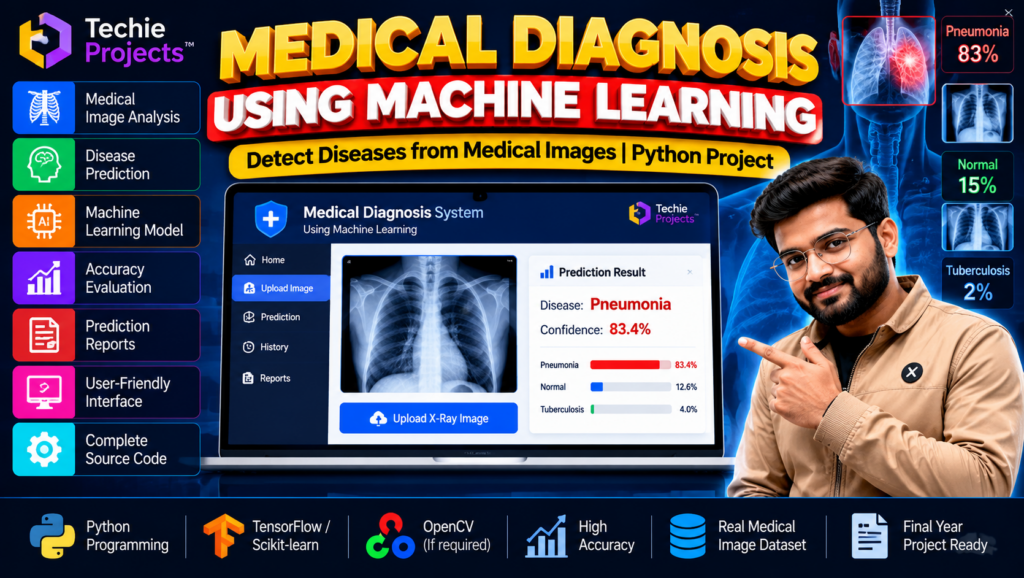
Medical diagnosis using machine learning is an educational project that demonstrates how machine learning techniques can analyze medical datasets and generate predictions based on patterns learned from data. This project introduces students to Python programming, data preprocessing, model training, prediction, and evaluation in a healthcare-related application.
If you are a B.Tech, B.E., BCA, MCA, Computer Science, Artificial Intelligence, or Data Science student looking for a final-year project, this topic offers an opportunity to explore machine learning concepts through a practical software implementation.
Techie Projects provides engineering project options for students interested in practical development. Contact us to confirm the available source code, dataset, documentation, implementation details, and pricing.
🎬 Project Demo: Medical Diagnosis Using Machine Learning
Watch the project demonstration to understand the application’s interface and prediction workflow. Review the available functionality and implementation before purchasing.
The prediction categories, input options, supported datasets, and model features depend on the supplied version of the project.
🎯 What Is Medical Diagnosis Using Machine Learning?
Medical diagnosis using machine learning involves applying algorithms to medical data to identify patterns and generate predictions. Depending on the dataset and model, an educational project may demonstrate classification of selected conditions or distinguish between predefined categories.
A typical project may accept structured medical data or medical images, process the input, and display a model-generated prediction. The type of input and output depends on the specific implementation.
This project is intended for academic learning and software demonstration. Its predictions should not be used to diagnose a real person, make treatment decisions, or replace qualified medical professionals.
✨ Key Features of the Medical Diagnosis Project
The following features may be included, depending on the supplied implementation.
- Data input: Accept supported information or files for analysis.
- Data preprocessing: Prepare input data for the trained machine learning model.
- Machine learning model: Apply a trained model to generate predictions.
- Prediction interface: Display the output through the application’s interface.
- Result visualization: Show prediction categories or model outputs where implemented.
- Python integration: Connect the processing logic and interface using Python.
- Model evaluation: Explore model performance using suitable evaluation metrics if included.
- User-friendly interface: Provide a way to interact with the implemented functionality.
Confirm the actual features before purchasing, particularly whether the project uses structured data, medical images, or both.
🎓 Objectives of Medical Diagnosis Using Machine Learning
The main objectives of this project are:
- To understand machine learning concepts in a healthcare-related use case.
- To prepare a dataset for model training and testing.
- To train or use a machine learning model for prediction.
- To understand classification and prediction workflows.
- To explore a Python-based application interface.
- To evaluate model results using suitable metrics.
- To understand the limitations of machine learning in medical applications.
⚙️ How Does the Project Work?
1. Dataset Collection
The project begins with a dataset appropriate to the selected prediction task. The dataset may contain structured records, medical images, or other supported input types.
2. Data Preprocessing
The input data is prepared for analysis. Depending on the dataset, this may involve handling missing values, scaling numerical features, encoding categorical values, or preparing images.
3. Model Training
A suitable machine learning algorithm is trained on the training data, or an already trained model is loaded if training is not performed within the application.
4. Model Testing and Evaluation
The model can be evaluated on appropriate held-out data using metrics suited to the task. For classification problems, these may include precision, recall, F1-score, and a confusion matrix.
5. Input Processing
When a user submits supported input, the application applies the same required preprocessing steps used during model development.
6. Prediction Generation
The model generates an output based on the submitted input. The output reflects the model’s learned patterns and may contain errors.
7. Result Display
The application displays the prediction in its interface. Any displayed confidence score must be interpreted carefully and should not be treated automatically as the probability that a person has a disease.
🧰 Technologies Used
Python
Python is used to implement the application, process input data, and connect the model with the user interface.
Scikit-learn
Scikit-learn may be used for conventional machine learning algorithms, preprocessing, classification, and evaluation.
TensorFlow or Keras
TensorFlow or Keras may be used if the implementation relies on a neural network or deep learning model.
Pandas and NumPy
These libraries may be used to load, transform, and process structured datasets.
OpenCV
OpenCV may be used if the project processes medical images or other image inputs.
The exact technologies and versions depend on the supplied implementation. Not every listed library is necessarily required.
💻 Software and Hardware Requirements
Software Requirements
- Operating System: Windows or another compatible operating system
- Programming Language: Python
- Required machine learning libraries
- Dataset and model files
- Compatible code editor, such as VS Code or PyCharm
- Additional dependencies specified in the installation instructions
Hardware Requirements
- Laptop or desktop computer
- Compatible processor
- Sufficient RAM for the dataset and model
- Storage space for project files and datasets
- GPU only if required by the selected model or desired processing performance
Check the supplied setup instructions to confirm the exact Python version and dependencies.
🌟 Advantages of the Project
- Demonstrates practical machine learning concepts.
- Combines Python programming with data analysis.
- Introduces data preprocessing and prediction workflows.
- Helps students understand model evaluation.
- Can be extended with additional datasets or models.
- Provides an academic example of applying machine learning to a healthcare-related problem.
🏥 Applications and Research Areas
Machine learning methods are studied in a variety of healthcare-related research areas, including:
- Medical image classification
- Analysis of selected clinical datasets
- Disease-risk prediction research
- Pattern recognition in healthcare data
- Medical data visualization
- Educational demonstrations of classification algorithms
These are general application areas, not a claim that the supplied project supports every use case.
⚠️ Limitations and Medical Safety
Medical diagnosis using machine learning requires careful evaluation. A model trained on a limited or unrepresentative dataset may generate inaccurate predictions when used with different data.
Important considerations include:
- Dataset quality affects model performance.
- Training and testing data must be separated appropriately.
- Class imbalance can make accuracy misleading.
- Performance should be evaluated using suitable metrics.
- Results may not generalize to different populations or clinical settings.
- Medical information must be handled with appropriate privacy safeguards.
- Clinical use requires rigorous validation and appropriate regulatory and professional oversight.
Important: This project is an educational prototype, not a certified medical device. Do not use its predictions to diagnose, treat, or make healthcare decisions about real people.
🚀 Future Scope
Possible improvements to the project include:
- Comparing multiple machine learning algorithms.
- Improving data validation and preprocessing.
- Adding more comprehensive evaluation metrics.
- Developing a clearer visualization dashboard.
- Supporting additional datasets where appropriate.
- Improving application usability and error handling.
- Exploring explainability methods to understand model predictions.
- Conducting further validation before any proposed real-world application.
These are potential enhancements and are not guaranteed features of the current project.
🎓 Why Choose This Project for Your Final Year?
The medical diagnosis using machine learning project may be suitable for students interested in Artificial Intelligence, Data Science, Machine Learning, and Python development.
It provides an opportunity to study:
- Dataset preparation and preprocessing
- Machine learning model development
- Classification and prediction
- Model evaluation
- Python application development
- Technical documentation and project presentation
Before selecting the project, confirm that the actual implementation and its complexity meet your college’s academic requirements.
📦 What Is Included When You Purchase the Project?
Package contents depend on the available version. Contact Techie Projects to confirm whether it includes:
- Python source code
- Dataset or dataset instructions
- Trained model files, if applicable
- Required libraries and installation instructions
- Project documentation or report
- Instructions for running the application
- Setup guidance or technical support options
Confirm the included deliverables, model type, dataset, and price before placing an order.
📲 Purchase Medical Diagnosis Using Machine Learning from Techie Projects
Looking for a medical diagnosis using machine learning project for your college assignment or final-year submission? Contact Techie Projects to enquire about the available implementation, source code, documentation, and pricing.
We can help you confirm the project features and technical requirements before you purchase.
Get Project Details and Pricing on WhatsApp
📲 Call/WhatsApp: +91-9460060699
🌎 Website: www.techieprojects.com
📺 Instagram: @pythonprojects_
Contact us to confirm current pricing, source code availability, dataset requirements, documentation, and setup options before purchasing.
🔗 Explore Related Machine Learning Projects
Explore these related project topics on Techie Projects:
- Disease Prediction Using Machine Learning
- Pneumonia Detection Using Deep Learning
- Skin Cancer Detection Using Machine Learning
- Diabetes Prediction Using Machine Learning
- Medical Image Classification Using Deep Learning
Link each title to its relevant article on your website when available.
❓ Frequently Asked Questions
1. What is medical diagnosis using machine learning?
It is the use of machine learning methods to analyze medical-related data and generate predictions for a defined task. Educational implementations demonstrate the workflow but do not establish clinical reliability.
2. Which programming language is used?
Python is commonly used for data processing, model development, and application integration.
3. Which algorithms are used in the project?
The algorithms depend on the supplied implementation and may include conventional machine learning models or neural networks. Contact Techie Projects to confirm the specific model.
4. Can this project diagnose real patients?
No. The project should be treated as an educational prototype and must not be used for medical diagnosis or treatment decisions.
5. Is this project suitable for final-year students?
It may be suitable for students studying Computer Science, Artificial Intelligence, Data Science, or related disciplines, subject to their college requirements.
6. Does the project include source code and documentation?
Contact Techie Projects to confirm whether the current package includes source code, datasets, model files, documentation, and installation instructions.
7. How can I purchase this project?
You can contact Techie Projects on WhatsApp to enquire about pricing and availability.
📝 Conclusion
Medical diagnosis using machine learning is a useful academic project topic for exploring Python, data preprocessing, model training, prediction, and evaluation in a healthcare-related context.
It offers students a practical way to study machine learning workflows while understanding the importance of dataset quality, model limitations, and responsible use.
If you want to purchase this project for learning or academic purposes, contact Techie Projects to confirm the current implementation, included deliverables, and price.
👉 Contact Techie Projects on WhatsApp to get started.