
Introduction
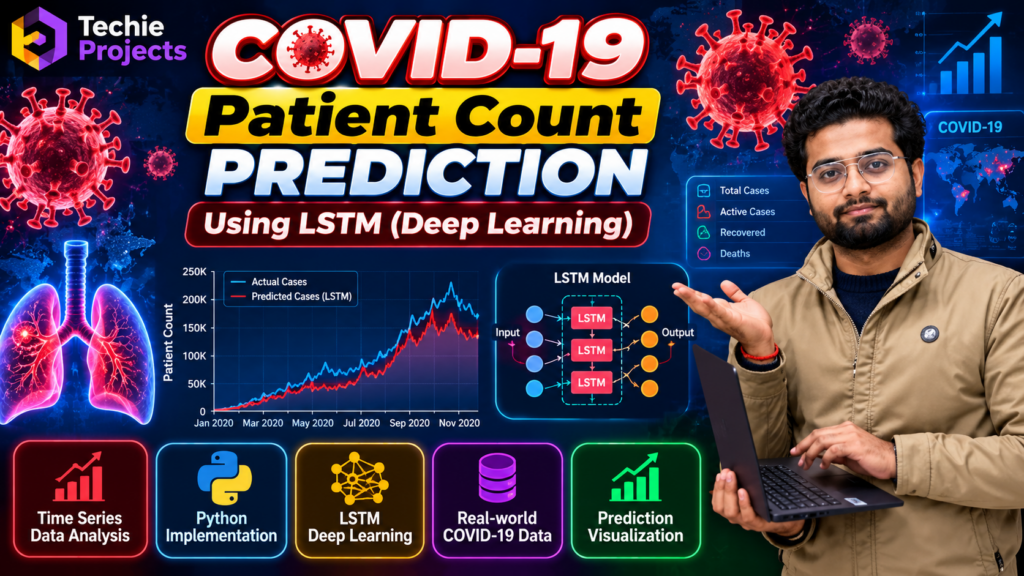
The COVID-19 patient count prediction using LSTM project is a machine learning and deep learning project designed to analyze historical COVID-19 data and forecast patient counts using Long Short-Term Memory (LSTM) neural networks. Developed using Python, this project demonstrates how time-series analysis and deep learning can be applied to understand trends in pandemic-related data.
🎓 If you are a B.Tech, B.E., BCA, MCA, M.Tech, or computer science student looking for an interesting final-year project, this topic offers practical experience with Python programming, data preprocessing, recurrent neural networks, model training, and data visualization.
The COVID-19 patient count prediction using LSTM project is suitable for students interested in machine learning, deep learning, artificial intelligence, and data science. It can also serve as an educational demonstration of how historical data can be used to build forecasting models.
🎬 COVID-19 Patient Count Prediction Using LSTM – Project Demo
Explore the project demonstration to understand how the application processes historical COVID-19 data, trains an LSTM model, and displays predicted trends through visualizations.
The demo introduces the project workflow and shows how Python-based deep learning can be used for time-series forecasting. Watch the demonstration to understand the implementation before deciding whether this project matches your academic requirements.
🦠 What Is COVID-19 Patient Count Prediction Using LSTM?
COVID-19 patient count prediction using LSTM is a forecasting application that uses historical patient-count data to estimate future values. LSTM is a type of recurrent neural network designed to learn patterns from sequential data.
Unlike a basic model that treats every observation independently, an LSTM can learn relationships between observations across time. This makes it a useful technique to explore for time-series forecasting tasks.
In this project, historical records are prepared for training, the LSTM model learns patterns from the training data, and the application generates predictions that can be compared with actual values.
Important: This is an educational machine learning prototype. Its predictions depend on the quality, coverage, and characteristics of the dataset and should not be used for public-health decisions, clinical guidance, or official pandemic forecasting.
🎯 Project Objectives
The main objectives of the COVID-19 patient count prediction using LSTM project include:
- 📊 Analyze historical COVID-19 patient-count data.
- 🧹 Clean and preprocess time-series records.
- 🐍 Implement the forecasting workflow using Python.
- 🧠 Train an LSTM neural network on sequential data.
- 📈 Visualize historical and predicted patient counts.
- 🔍 Evaluate model performance using suitable forecasting metrics.
- 🎓 Demonstrate a practical application of deep learning for academic learning.
These objectives help students understand the complete machine learning pipeline, from preparing a dataset to evaluating a trained model.
⚙️ How Does the Project Work?
The COVID-19 patient count prediction using LSTM project follows a series of data-processing and model-development steps.
1. 📥 Data Collection
The project begins with historical COVID-19 patient-count records. Depending on the implementation, the dataset may contain daily case counts or other time-based observations.
Students should document the dataset source, reporting period, geographical coverage, and relevant limitations.
2. 🧹 Data Preprocessing
Raw data may contain missing values, inconsistent formats, duplicate entries, or reporting variations. Preprocessing prepares the records for model training.
Typical tasks include:
- Handling missing or invalid observations.
- Converting dates into a consistent format.
- Ordering records chronologically.
- Scaling numerical values when required by the model.
- Creating sequences of observations for LSTM input.
3. 🧠 LSTM Model Development
The LSTM network learns patterns from the training sequences. The model uses earlier observations to estimate a future value or a sequence of future values, depending on the implementation.
The model architecture, sequence length, training settings, and forecasting horizon should be selected according to the dataset and project objectives.
4. 🏋️ Model Training
The prepared training data is passed to the LSTM model. During training, the model adjusts its parameters to reduce the selected prediction error.
For a more reliable evaluation, the dataset should be split chronologically into training and testing periods rather than randomly mixing past and future observations.
5. 📈 Prediction and Visualization
Once trained, the model generates forecasts for the selected period. Graphs can display historical values alongside predicted values to make trends easier to interpret.
The visualizations help students compare the model’s output with observed data and identify where predictions perform well or poorly.
6. ✅ Model Evaluation
Forecasts should be evaluated using appropriate metrics, such as Mean Absolute Error (MAE) or Root Mean Squared Error (RMSE). Results should be reported honestly and should not imply that the model is reliable for real-world public-health decisions without appropriate independent validation.
✨ Key Features of the Project
The COVID-19 patient count prediction using LSTM project can demonstrate the following features, depending on the supplied implementation:
- 🐍 Python-based development: Practice a widely used language for machine learning.
- 🧠 Deep learning implementation: Explore LSTM networks for sequential data.
- 📊 Time-series analysis: Study how observations change over time.
- 📈 Prediction visualization: Compare observed values with model outputs.
- 🧹 Data preprocessing: Learn how to prepare datasets for training.
- 📉 Model evaluation: Assess forecasts with appropriate error metrics.
- 🎓 Academic demonstration: Use the workflow to explain a practical machine learning application.
Before purchasing, ask for a demonstration of the actual features included in the project package.
🛠️ Technologies Used
The exact technologies depend on the delivered version, but a typical implementation may use:
- Programming language: Python
- Deep learning framework: TensorFlow/Keras
- Data processing: Pandas and NumPy
- Visualization: Matplotlib
- Model type: Long Short-Term Memory (LSTM)
- Development environment: Jupyter Notebook, Python IDE, or another compatible environment
Check the project’s actual software requirements before installation, especially the Python and library versions.
💻 Hardware and Software Requirements
Software Requirements
- Python installed on a compatible operating system
- Required machine learning and data-processing libraries
- Dataset used by the project
- A suitable IDE or notebook environment
Hardware Requirements
- Laptop or desktop computer
- Sufficient RAM for the selected dataset and libraries
- Storage space for the source code, dataset, and trained model
A dedicated GPU is not necessarily required for a small educational dataset. Actual requirements depend on the model size and training workload.
🎓 Why Choose This Project for Your Final Year?
The COVID-19 patient count prediction using LSTM project brings together several concepts that computer science students commonly study.
For B.Tech and B.E. students: It provides a practical topic for exploring neural networks, data preparation, and prediction.
For MCA and M.Tech students: It offers opportunities to investigate model evaluation, sequence length, forecasting strategies, and comparisons with baseline models.
For machine learning beginners: It can help explain how sequential data is transformed into model inputs and how forecasts are evaluated.
For project demonstrations: Visual comparisons between historical data and predictions can help communicate the workflow clearly.
Students should follow their institution’s rules for external project assistance and ensure they understand, test, document, and present their own work.
📦 What to Check Before Purchasing
Looking for a ready-to-study implementation? Contact Techie Projects to confirm the deliverables available for this specific project.
Depending on the package, you can ask whether it includes:
- Source code and project files
- Dataset and data-preprocessing scripts
- Trained model or model-training script
- Installation and execution instructions
- Requirements file and compatible library versions
- Sample outputs and visualization screenshots
- Project report or documentation, if offered
- Customization or troubleshooting support, if available
These items should be confirmed before payment. Availability, pricing, delivery time, and customization options may vary.
💼 Get the COVID-19 Patient Count Prediction Using LSTM Project
Want to explore this deep learning project for your academic work? Techie Projects can help you enquire about the implementation, available deliverables, and customization options.
📲 Call/WhatsApp: +91-9460060699
🌎 Website: www.techieprojects.com
📺 Instagram: @pythonprojects_
When enquiring, mention that you are interested in the COVID-19 patient count prediction using LSTM project. Share your course, project requirements, preferred framework, and submission deadline so the available package can be checked against your needs.
💡 Tip: Ask for the latest demo, software requirements, and a clear list of deliverables before purchasing.
🔮 Future Scope
The educational project can be extended in several ways:
- Compare LSTM with simpler forecasting baselines.
- Evaluate different sequence lengths and model configurations.
- Add more detailed time-series visualizations.
- Test performance on a separate chronological period.
- Investigate the effects of missing data and changes in reporting.
- Create a simple dashboard to display historical data and model predictions.
- Document limitations and uncertainty alongside forecast results.
Any extension should be evaluated on suitable data. Historical trends alone cannot account for every factor that influences the spread or reporting of an infectious disease.
❓ Frequently Asked Questions
1. What is the COVID-19 patient count prediction using LSTM project?
It is an educational deep learning application that uses historical COVID-19 patient-count data to explore time-series forecasting with an LSTM neural network.
2. Which programming language is used?
Python is commonly used for this type of project, alongside suitable data-processing and deep learning libraries. Confirm the exact dependencies in the available package.
3. Is this project suitable for final-year engineering students?
It can be suitable for students studying computer science, information technology, artificial intelligence, machine learning, or data science, subject to their institution’s project requirements.
4. Can I customize the project?
Customization depends on the supplied source code and available support. Contact Techie Projects to discuss changes such as visualizations, model evaluation, dataset preparation, or interface improvements.
5. Does the model provide accurate real-world COVID-19 forecasts?
Accuracy is not guaranteed. Results depend on the dataset, training process, evaluation method, and changes in real-world conditions. The project is intended for educational use, not official forecasting or medical decisions.
6. What should I confirm before purchasing?
Confirm the source code, dataset, dependencies, execution instructions, documentation, pricing, delivery timeline, and any customization support included in the package.
🎓 Explore Related Projects
If you are interested in machine learning and deep learning, explore these related project topics:
- COVID-19 Detection Using Machine Learning
- Disease Prediction Using Machine Learning
- Brain Tumor Detection Using Deep Learning
- Pneumonia Detection Using Chest X-Ray Images
- Autism Prediction System Using Machine Learning
- Stock Price Prediction Using Machine Learning
Explore the relevant project categories on Techie Projects to find additional topics and enquire about available implementations.
✅ Conclusion
The COVID-19 patient count prediction using LSTM project demonstrates how Python and deep learning can be applied to sequential data and forecasting experiments. It covers important concepts such as data preprocessing, LSTM model training, prediction visualization, and performance evaluation.
For students searching for a machine learning project, it can be a useful learning opportunity when supported by clear documentation, reproducible results, and an honest discussion of limitations.
📲 Interested in purchasing this project? Contact Techie Projects on WhatsApp to confirm the available package, requirements, pricing, and customization options before placing your order.