
Introduction
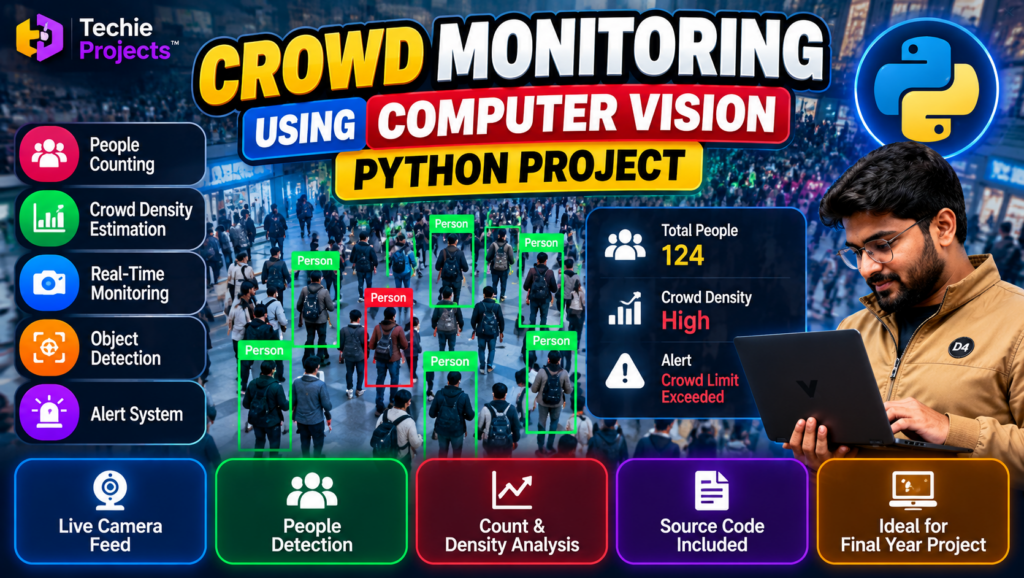
Crowd Monitoring Using Computer Vision is a Python-based project that explores how computer vision and machine learning can be used to analyze crowded scenes, detect people, and estimate crowd counts. This project is suitable for B.Tech, B.E., BCA, MCA, and computer science students interested in artificial intelligence, image processing, and machine learning.
The Crowd Monitoring Using Computer Vision with Python project demonstrates how visual data from images or video can be processed to identify people and analyze crowd patterns, depending on the implemented model. It introduces important concepts such as object detection, image processing, people counting, and crowd density estimation.
At Techie Projects, students can enquire about project availability, Python source code, documentation, installation instructions, and customization options for their academic requirements.
If you are searching for a crowd monitoring project for your final-year submission, this guide explains the typical workflow, technologies, features, requirements, and potential applications.
🎬 Project Demo: Crowd Monitoring Using Computer Vision
Watch the project demonstration to understand how the application processes visual input and displays crowd monitoring results.
The demo provides an overview of the implemented interface, people detection, and crowd analysis workflow. Actual outputs depend on the model, input video, and features included in the project.
🎯 Objectives of the Crowd Monitoring Project
The main objectives of this crowd monitoring project are:
- Explore computer vision techniques for crowd analysis.
- Detect people in images or video frames, if supported.
- Estimate the number of people in a scene.
- Understand object detection and image processing.
- Explore crowd density estimation techniques.
- Display detection or counting results through an application.
- Learn how Python and machine learning can be integrated into a computer vision project.
🎯 Benefits of Crowd Monitoring Using Computer Vision
Crowd monitoring using computer vision helps students explore how images and video can be analyzed to identify people and estimate crowd sizes. This project demonstrates practical applications of Python, image processing, and machine learning in crowd analysis.
🚀 Key Features of Crowd Monitoring Using Computer Vision
1. People Detection
The system can identify people in supported images or video frames using a computer vision model. Detection performance depends on the model, image quality, camera angle, and crowd conditions.
2. Crowd Counting
Crowd counting estimates the number of people visible in an image or video frame. The counting method depends on the model and implementation.
3. Video Frame Processing
A video-based implementation can process frames to analyze people in a scene. Real-time processing should be claimed only if the application has been implemented and tested for it.
4. Crowd Density Estimation
Crowd density estimation explores how closely people are distributed within a scene. The actual method may use detected people, density maps, or another supported approach.
5. Detection Visualization
The application may display detection boxes, labels, counts, or other visual outputs, depending on the implementation.
6. Python-Based Development
Python provides tools for image processing, model inference, video handling, and application development.
7. Results Display
The system can present its output through a graphical interface, video window, or other supported display method.
Note: Confirm which of these features are included in your actual source code before advertising them as available functionality.
⚙️ How Does Crowd Monitoring Using Computer Vision Work?
A typical crowd monitoring project follows these steps.
Step 1: Capture or Load Visual Input
The application receives an image, recorded video, or camera feed, depending on the supported input method.
Step 2: Process the Input
The system prepares the image or video frame for analysis. This may involve resizing, color conversion, or other preprocessing steps.
Step 3: Detect People
A trained computer vision model identifies people in the input when person detection is part of the implementation.
Step 4: Count Detected People
The application may calculate a count from the detected people or use a dedicated crowd-counting model.
Step 5: Analyze Crowd Density
If density estimation is implemented, the system analyzes the distribution of people using its configured method.
Step 6: Display Results
The application presents the available results, such as bounding boxes, estimated counts, or density visualizations.
This workflow describes a typical approach. The exact algorithm, model, and output depend on the supplied project.
🛠️ Technologies Used
The project may use the following technologies, depending on the implementation:
- Python: Main programming language.
- OpenCV: Image and video processing.
- YOLO or another object detection model: People detection, if included.
- NumPy: Numerical operations and array processing.
- PyTorch or TensorFlow: Model execution or development, if included.
- Computer Vision: Analysis of images and video.
- Machine Learning: Training or using models for detection or counting.
Verify the actual libraries, model files, and versions before installation.
💻 Software Requirements
Typical software requirements include:
- Python with a compatible version.
- Visual Studio Code, PyCharm, or another Python IDE.
- Required computer vision and machine learning libraries.
- Model weights and configuration files, where applicable.
- Sample images or video files for testing.
- A compatible operating system.
A webcam or video source is needed if the project supports live camera input.
🖥️ Hardware Requirements
A typical development setup may include:
- Processor: Intel Core i3 or equivalent, or better.
- RAM: 8 GB recommended for many computer vision workflows.
- Storage: Sufficient space for model files, libraries, and test videos.
- Webcam or compatible video source, if required.
- A compatible GPU may improve performance for some models but is not always necessary.
Actual requirements depend on the selected model and whether inference runs on a CPU or GPU.
✅ Advantages of Crowd Monitoring Using Computer Vision
- Provides practical experience with Python and computer vision.
- Demonstrates people detection and counting concepts.
- Helps students understand image and video processing.
- Introduces machine learning model inference.
- Provides opportunities to explore crowd analysis.
- Can be extended with additional visualization and reporting features.
- Offers a practical academic project for AI and machine learning students.
📊 Crowd Monitoring Using Computer Vision in Real-World Applications
A crowd monitoring using computer vision system can be studied for applications such as event analysis, public venue occupancy estimation, and transportation hub monitoring. Actual results depend on the detection method, camera quality, and testing conditions.
Computer vision-based crowd monitoring can be explored in:
- Public event crowd analysis.
- Stadium and venue monitoring.
- Shopping centre occupancy estimation.
- Transportation hub analysis.
- Queue management research.
- Campus and building occupancy studies.
- Academic computer vision experiments.
Real-world deployment requires appropriate camera placement, testing, privacy safeguards, and evaluation under actual operating conditions.
⚠️ Limitations of the Project
- Detection accuracy may decrease in crowded or heavily occluded scenes.
- Lighting, camera angle, image resolution, and motion blur can affect results.
- Counting methods may produce errors when people overlap.
- Real-time performance depends on hardware and model complexity.
- Density estimates depend on the selected method and training data.
- Camera-based monitoring should follow applicable privacy and data protection requirements.
🔮 Future Scope
The crowd monitoring project may be extended with features such as:
- Live camera-based monitoring.
- Improved person detection and counting.
- Crowd density heatmaps.
- Video-based crowd count summaries.
- Detection performance evaluation.
- Alerts when configured occupancy thresholds are exceeded.
- A dashboard for viewing analysis results.
- Integration with additional camera sources.
- Better performance on crowded scenes.
- Privacy-aware data handling and storage.
These are potential enhancements and should not be presented as existing features unless implemented and tested.
🎓 Why Choose the Crowd Monitoring Project for Your Final Year?
Crowd Monitoring Using Computer Vision with Python is a useful academic project topic for students interested in artificial intelligence, computer vision, image processing, and machine learning.
The project provides opportunities to study visual data processing, object detection, counting methods, and model evaluation. Students can also explain the system workflow, discuss limitations, and demonstrate the results during their project presentation.
Before selecting the project, confirm that the actual implementation and documentation meet your college’s requirements.
🛒 Get the Crowd Monitoring Using Computer Vision Project
Looking for a crowd monitoring using computer vision project with Python source code? Contact Techie Projects to confirm project availability, implemented features, model files, documentation, and pricing.
📲 Call/WhatsApp: +91-9460060699
🌎 Website: www.techieprojects.com
📺 Instagram: @pythonprojects_
Techie Projects can help you enquire about project availability and the package that matches your academic requirements.
Before purchasing, ask us to confirm:
- Python source code availability.
- Model files and configuration files included.
- People detection and counting features implemented.
- Video or camera input support.
- Installation instructions and required libraries.
- Project report and documentation availability.
- Customization options.
- Pricing and delivery details.
The exact package contents, functionality, and support arrangements should be confirmed before ordering.
📲 Get Project Details and Pricing on WhatsApp
Contact Techie Projects to discuss your requirements, check project availability, and request current pricing.
👉 Enquire About the Crowd Monitoring Project on WhatsApp
🌐 Explore More Engineering Projects
📸 Follow Techie Projects on Instagram
🎓 Recommended Projects
Explore these related project topics on Techie Projects:
- Crowd Counting Using YOLO – Explore object detection for estimating the number of people.
- People Counting System Using Computer Vision – Analyze people moving through a camera view.
- Vehicle Detection and Counting Using Python – Detect and count vehicles in images or videos.
- Object Detection Using YOLO and Python – Explore object detection with a trained model.
- Smart Traffic Management System Using AI – Study computer vision applications in traffic analysis.
Visit the relevant project pages to check their technologies, features, and availability.
❓ Frequently Asked Questions
1. What is crowd monitoring using computer vision?
Crowd monitoring using computer vision is an approach to analyzing images or video to detect people, estimate counts, or study crowd distribution.
2. Which programming language is used?
Python is the primary language in this project.
3. Which algorithm is used for crowd monitoring?
The algorithm depends on the implementation. It may use an object detection model, a dedicated crowd-counting model, or another computer vision technique.
4. Can this project count people in videos?
Video-based counting is possible when video processing and counting functionality are implemented in the supplied version.
5. Does the project support real-time monitoring?
Real-time support depends on whether live camera input and continuous processing are included and tested.
6. Is the project suitable for final-year students?
It may be suitable for students studying computer science, artificial intelligence, data science, or machine learning, subject to their institution’s guidelines.
7. Can I purchase the source code?
Contact Techie Projects to confirm source code availability, included model files, documentation, and pricing.
8. How can I get the project price?
Use the WhatsApp enquiry link to discuss your requirements and request current pricing.
Conclusion
Crowd Monitoring Using Computer Vision with Python is a practical project for exploring people detection, crowd counting, image processing, and machine learning. It helps students understand how visual data can be analyzed through a computer vision workflow.
If you want this project for your final-year submission, contact Techie Projects to confirm source code availability, implemented features, model files, documentation, and pricing.
Start your project enquiry today: Contact Techie Projects on WhatsApp