
Introduction
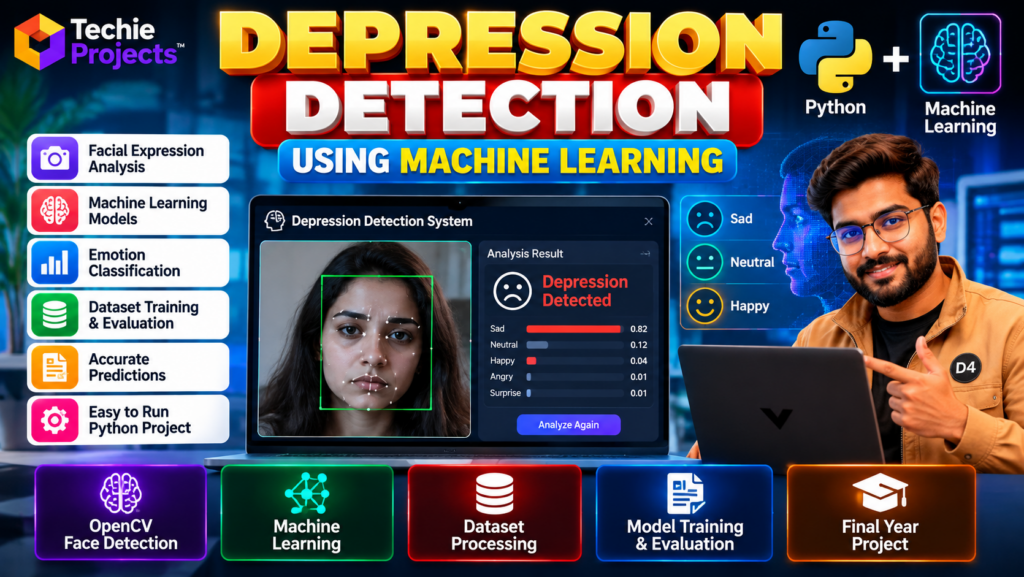
Depression Detection Using Machine Learning is an educational Python project that explores facial expression analysis, computer vision, and AI-based classification. Designed for students working on B.Tech, B.E., BCA, MCA, and computer science projects, it demonstrates how image processing and trained machine learning models can be integrated into an application.
This project helps students understand facial image preprocessing, feature extraction, model prediction, and result visualization. It is intended for academic learning and research, not for diagnosing depression or replacing professional mental health assessment.
The Depression Detection System Using Python demonstrates concepts from artificial intelligence, image processing, computer vision, and machine learning. Depending on the implementation, the system may process facial images or video frames, extract relevant features, and classify visible facial expressions using a trained model.
This project is suitable for students interested in Python programming, AI-based applications, and computer vision research. At Techie Projects, students can enquire about project availability, source code, documentation, installation instructions, and customization options.
Important: Facial expressions alone cannot reliably diagnose depression. This project should be treated as an educational prototype, not a clinical diagnostic tool or a replacement for assessment by a qualified mental health professional.
🎬 Project Demo: Depression Detection Using Machine Learning
Watch the project demonstration to understand the interface, facial expression analysis workflow, and the type of output displayed by the application.
The demo provides an overview of the project for students who want to explore machine learning and facial expression recognition as part of their academic work.
🎯 Objectives of the Depression Detection System
The main objectives of this Python machine learning project are:
- Develop an educational application using Python.
- Explore facial expression analysis using image processing techniques.
- Understand how machine learning models classify visual features.
- Demonstrate a basic computer vision workflow.
- Learn about dataset preparation and model evaluation.
- Explore the integration of a trained model into a Python application.
- Understand the limitations of using facial expressions to infer emotional states.
🚀 Key Features of Depression Detection Using Python
1. Facial Image Processing
The system can process facial images or video frames, depending on the implemented version. Image preprocessing helps prepare input data for subsequent analysis.
2. Facial Expression Analysis
Facial expression analysis explores visible facial patterns that may be used in emotion-recognition research. The output depends on the dataset, model, and implementation.
3. Machine Learning Model
A trained machine learning model can classify input features into predefined categories. The algorithm and supported categories depend on the actual project configuration.
4. Real-Time Camera Input
If webcam functionality is implemented, the application can capture video frames for facial analysis. Real-time processing should be described only if it is supported by the supplied project.
5. Python-Based Development
Python provides tools for image processing, data preparation, model development, and application integration.
6. Result Display
The application may display the model’s classification output through a user interface. Such output represents the model’s prediction and must not be interpreted as a medical diagnosis.
⚙️ How Does the Depression Detection Project Work?
A typical facial expression analysis project follows these steps:
Step 1: Input Collection
The system receives an image or camera frame, depending on the implemented input method.
Step 2: Face Detection
A computer vision technique identifies the face region in the input image when face detection is included.
Step 3: Image Preprocessing
The detected region may be resized, normalized, or converted into the format required by the model.
Step 4: Feature Extraction
The system extracts or learns relevant visual features from the prepared input.
Step 5: Model Prediction
A trained model processes the features and produces a classification based on its training data and configuration.
Step 6: Result Display
The application presents the model output for educational demonstration and analysis.
This workflow describes a general implementation. The exact algorithm, dataset, and processing pipeline should be verified against the actual project source code.
🛠️ Technologies Used
The project may use the following technologies, depending on its implementation:
- Python: Main programming language.
- OpenCV: Image processing and computer vision.
- Machine Learning: Training or using a classification model.
- NumPy: Numerical operations and array processing.
- Scikit-learn or TensorFlow: Model development, if included.
- Webcam or image input: Visual data collection, where supported.
- Tkinter or another interface framework: Application interface, if implemented.
Confirm the actual libraries and versions before installing or purchasing the project.
💻 Software Requirements
Typical requirements for a Python-based computer vision project include:
- Python and a compatible version of its dependencies.
- Visual Studio Code, PyCharm, or another Python IDE.
- Required image processing and machine learning libraries.
- Model files and dataset files, where applicable.
- Compatible operating system.
- Webcam, if the project uses live camera input.
The exact Python version and package requirements depend on the implementation.
🖥️ Hardware Requirements
A typical development setup may include:
- Intel Core i3 or equivalent processor, or better.
- At least 4–8 GB RAM, depending on model requirements.
- Sufficient disk space for Python libraries and model files.
- Webcam for real-time input, if required.
- GPU acceleration only if supported and needed by the selected model.
📌 Applications of Facial Expression Analysis
Facial expression analysis has potential educational and research applications in:
- Human-computer interaction.
- Emotion recognition research.
- Computer vision experiments.
- Human behaviour research.
- AI-based interface development.
- Academic projects involving image classification.
These applications do not establish that a facial expression model can detect or diagnose depression accurately.
✅ Advantages of the Project
- Provides practical exposure to Python programming.
- Demonstrates image processing and machine learning concepts.
- Introduces facial feature analysis.
- Helps students understand model inference and classification.
- Can be extended for further computer vision experiments.
- Offers a practical topic for project demonstrations and technical discussions.
⚠️ Limitations and Ethical Considerations
- Facial expressions alone cannot establish whether a person has depression.
- Model predictions can be affected by lighting, image quality, pose, dataset bias, and other factors.
- A model may perform differently on people or conditions not represented in its training data.
- Sensitive facial data should be handled with appropriate consent and privacy protections.
- Predictions should not be used to make clinical decisions or label individuals with a mental health condition.
The project is intended for educational and research purposes, not for medical diagnosis or treatment.
🔮 Future Scope
Possible future improvements, depending on the project scope, include:
- Improving dataset diversity and model evaluation.
- Comparing different facial expression classification algorithms.
- Adding a more user-friendly graphical interface.
- Improving image preprocessing and face detection.
- Evaluating performance under different lighting conditions.
- Adding model evaluation reports and confusion matrices.
- Documenting ethical limitations and privacy safeguards.
Any proposed extension should be tested and evaluated before making performance claims.
🎓 Why Choose This Project for Your Final Year?
The Depression Detection System Using Python offers students an opportunity to explore computer vision, image processing, and machine learning in one academic project.
It may be suitable for students studying computer science, information technology, artificial intelligence, and data science, subject to their college guidelines.
This depression detection using machine learning project offers practical exposure to Python, computer vision, and model evaluation
The project can support learning about data preprocessing, model integration, application development, and responsible AI. Students should be prepared to explain the algorithm, dataset, limitations, and evaluation method used in their actual implementation.
🛒 Purchase Depression Detection Project Source Code
Are you looking for a Depression Detection Using Machine Learning project with Python source code for your final-year submission?
📲 Call/WhatsApp: +91-9460060699
🌎 Website: www.techieprojects.com
📺 Instagram: @pythonprojects_
Techie Projects can help you enquire about project availability and the package that matches your academic requirements.
Before purchasing, ask us to confirm the following:
- Python source code availability.
- Machine learning algorithm and model files included.
- Dataset availability and usage requirements.
- Required libraries and installation instructions.
- Project report and documentation availability.
- Implemented features and demonstration details.
- Customization options and pricing.
- Available technical support.
Package contents, delivery details, and support arrangements should be confirmed before ordering.
📲 Get Project Details and Pricing on WhatsApp
Contact Techie Projects to discuss your requirements and check the available project package.
👉 Enquire About the Depression Detection Project on WhatsApp
🌐 Explore More Engineering Projects
📸 Follow Techie Projects on Instagram
🎓 Recommended Projects
Explore these related project topics on Techie Projects:
- Facial Emotion Recognition Using Python – Explore facial expression classification using computer vision.
- Face Recognition Attendance System – Demonstrate face detection and attendance record management.
- Fake News Detection Using Machine Learning – Explore text preprocessing and classification.
- Mental Health Chatbot Using Python – Build an educational conversational application.
- Age and Gender Prediction Using Machine Learning – Explore facial image analysis and model prediction.
Visit the relevant project pages to check their implementation details and availability.
❓ Frequently Asked Questions
1. What is a Depression Detection System Using Python?
It is an educational project that explores machine learning and facial expression analysis. Its predictions should not be considered a clinical depression diagnosis.
2. Which programming language is used?
Python is the primary language for the project described here. The specific libraries depend on the implementation.
3. Does the project use machine learning?
The project focuses on machine learning concepts. Confirm the actual model and algorithm in the supplied implementation.
4. Can this project be used for a final-year submission?
It may be suitable for a computer science, AI, or machine learning academic project, depending on your institution’s requirements.
5. Can I purchase the source code?
Contact Techie Projects to confirm current source-code availability, package contents, and pricing.
6. Does facial expression analysis accurately diagnose depression?
No. Facial expression analysis alone cannot reliably diagnose depression. A qualified mental health professional is needed for clinical assessment.
7. How can I get project pricing?
Use the WhatsApp enquiry link to discuss the project requirements and request the current price.
Conclusion
The Depression Detection System Using Python is an educational project for exploring machine learning, facial expression analysis, and computer vision. It provides opportunities to study image preprocessing, model classification, and Python application development while understanding the limitations of emotion-related predictions.
“Depression detection using machine learning is an educational topic for exploring facial expression analysis and responsible AI.”
If you are interested in this project for your final-year submission, contact Techie Projects to confirm the available source code, implemented features, documentation, installation requirements, and pricing.
Start your project enquiry today: Contact Techie Projects on WhatsApp