
Introduction
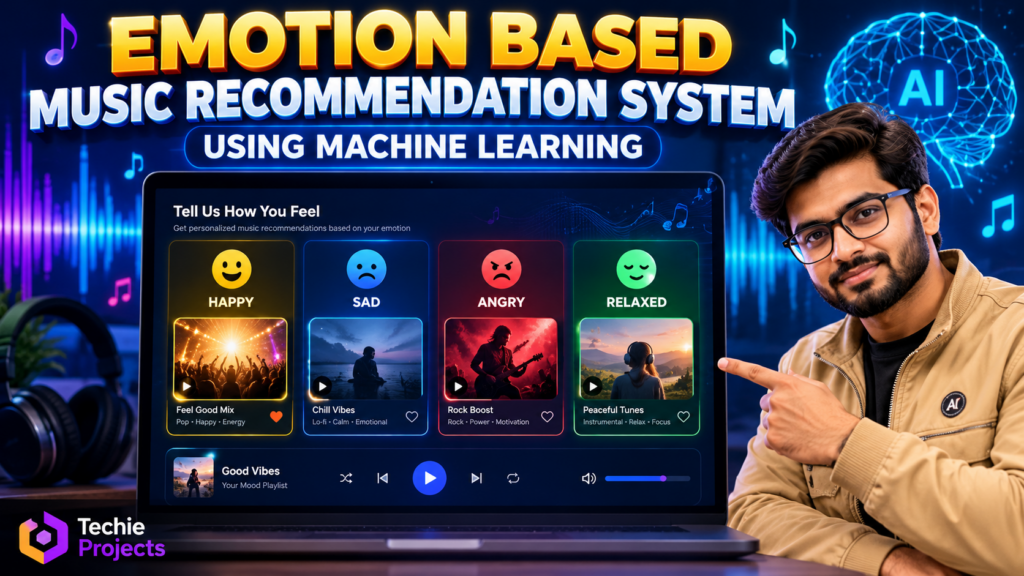
An emotion based music recommendation system using machine learning is an academic project that explores how music suggestions can be personalized according to a user’s selected mood or an emotion detected by the implemented system. By combining Python programming, machine learning concepts, and music recommendation techniques, this project demonstrates how software can organize music according to emotional preferences.
This project is suitable for B.Tech, B.E., Computer Science, Information Technology, Artificial Intelligence, and Machine Learning students who want to explore an interactive application for their final-year project. The exact capabilities depend on the model and features included in the implementation.
🎬 Project Demo
Watch the project demonstration to understand the interface, workflow, and music recommendation features.
The demo can help you explore how the application presents different mood categories and recommends suitable music. Whether the system uses manually selected moods or automatic emotion recognition depends on the supplied project version.
🎯 Objectives of the Project
The main objective of the emotion based music recommendation system using machine learning is to demonstrate personalized music suggestions through an interactive software application.
Key objectives include:
- Organizing music according to different emotional categories.
- Exploring machine learning and recommendation concepts.
- Developing an interface for selecting moods and viewing music suggestions.
- Connecting mood categories with suitable music collections.
- Demonstrating how personalized digital entertainment applications can work.
⚙️ Features of the Emotion Based Music Recommendation System Using Machine Learning
The following features describe common possibilities for this type of project. Confirm which ones are included in the actual implementation before purchasing.
1. Mood-Based Music Recommendations
The application can organize music into categories such as happy, sad, angry, and relaxed. Depending on the implementation, users may select a mood and receive recommendations from the corresponding music collection.
2. Interactive User Interface
A graphical interface can make it easier to navigate mood categories, view recommended tracks, and interact with the application.
3. Machine Learning Integration
Machine learning techniques can be used to classify emotional information or support a recommendation workflow when the required model is implemented.
4. Music Collection Management
The project may organize song information into categories based on mood, genre, or other supported attributes.
5. Personalized Listening Experience
Mood-based recommendations provide a way to explore music that aligns with a user’s current preferences. The quality of recommendations depends on the available music data and the implemented recommendation logic.
🔄 How the Project Works
The general workflow of an emotion based music recommendation system using machine learning can include these steps:
- User input: The user selects a mood or provides supported input for emotion analysis.
- Input processing: The application prepares the selected information for the recommendation process.
- Mood classification: If automatic emotion detection is implemented, the model analyzes the input and predicts an emotion category.
- Recommendation mapping: The application matches the selected or predicted category with available music.
- Results display: Recommended songs or playlists are presented through the interface.
- Music interaction: Users can explore the available recommendations and use playback features if included.
The actual workflow may vary according to the supplied code and its supported functionality.
🧰 Technologies Used
The technologies depend on the project’s implementation. A typical version may use:
- Python: Main programming language.
- Machine learning libraries: For supported model training or prediction.
- Pandas and NumPy: For handling and processing structured data, if required.
- GUI framework: Such as Tkinter or another interface library.
- Audio playback library: If music playback is implemented.
- Dataset or music collection: For organizing moods, songs, and related information.
Check the included requirements file before installing dependencies.
💻 Software and Hardware Requirements
Software Requirements
- A compatible operating system.
- Python version supported by the project.
- Required Python libraries.
- A compatible code editor, such as Visual Studio Code or PyCharm.
- The music dataset or audio files required by the application.
Hardware Requirements
- A desktop or laptop computer.
- Sufficient RAM and storage for the software and dataset.
- Speakers or headphones for audio playback, if supported.
The final requirements depend on the included libraries, model, and audio features.
🎓 Applications
An emotion based music recommendation system using machine learning can demonstrate concepts relevant to:
- Personalized music applications.
- Music classification and organization.
- Recommendation system development.
- Human-computer interaction.
- Machine learning education.
- Research into mood-aware digital entertainment.
The project is an educational prototype and should not be presented as a clinically validated emotion assessment tool.
✅ Advantages
- Combines Python programming with practical machine learning concepts.
- Demonstrates a personalized recommendation workflow.
- Provides an interactive application for academic presentation.
- Offers opportunities to study datasets, classification, and recommendation logic.
- Can be extended as a learning exercise with additional features.
⚠️ Limitations
Music preferences vary between individuals, and the same song may suit different moods for different people. Recommendations may also be limited by the size and quality of the available music collection.
If the application includes automatic emotion recognition, its results may be affected by input quality, model limitations, and the diversity of its training data. Emotion predictions should not be treated as definitive judgments about a person’s feelings.
🚀 Future Scope
Students can explore possible extensions such as:
- Adding more mood and music categories.
- Improving recommendation logic using user preferences.
- Building a larger, properly organized music dataset.
- Comparing different recommendation approaches.
- Developing a web or mobile interface.
- Adding playlist management or playback controls.
- Evaluating recommendation relevance through user testing.
These are potential improvements and should only be described as implemented after they have been developed and tested.
🎓 Why Choose This Project for Your Final Year?
The emotion based music recommendation system using machine learning is a useful option for students interested in Python, recommendation systems, and AI-based applications. It offers an opportunity to explain the connection between user input, data processing, recommendation logic, and interface design.
Students can study the workflow, demonstrate the available features, and investigate improvements based on their academic requirements.
📲 Get the Project Source Code and Pricing
Looking for an emotion based music recommendation system using machine learning for your final-year project?
Techie Projects can help you check project availability and the exact deliverables before you purchase. Contact us to discuss:
- Source code and model files, if included.
- Installation and software requirements.
- Project documentation and explanation materials, if available.
- Demonstration and implemented features.
- Pricing and customization options.
📲 Call/WhatsApp: +91-9460060699
🌎 Website: www.techieprojects.com
📺 Instagram: @pythonprojects_
🔗 Explore Related Projects
Add links to the relevant published pages on your website:
- Speech Emotion Recognition Using Deep Learning
- News Sentiment Analysis Using Python
- Language Translator Using Python
- Recommendation System Projects
- Machine Learning Projects
❓ Frequently Asked Questions
What is an emotion based music recommendation system using machine learning?
It is a software project that explores how mood categories or supported emotion predictions can be used to suggest music.
Which programming language is used?
Python is commonly used for this type of project. Additional libraries depend on the supplied implementation.
Does the project detect emotions automatically?
Automatic detection is available only if an emotion recognition model and the required input-processing functionality are included. Confirm this before purchasing.
Can I use this project for my final-year submission?
It may be suitable for a final-year academic project, subject to your institution’s guidelines and the project’s actual scope. Students should understand the implementation and follow their institution’s rules for project submissions.
How can I purchase the project?
Contact Techie Projects through WhatsApp to confirm availability, included files, documentation, features, and pricing.
📝 Conclusion
An emotion based music recommendation system using machine learning demonstrates how Python, data processing, and recommendation techniques can be combined to create a mood-oriented music application. It provides a practical learning opportunity for students interested in machine learning and personalized software experiences.
For project availability, source code details, and pricing, contact Techie Projects through the WhatsApp link above.