
Introduction
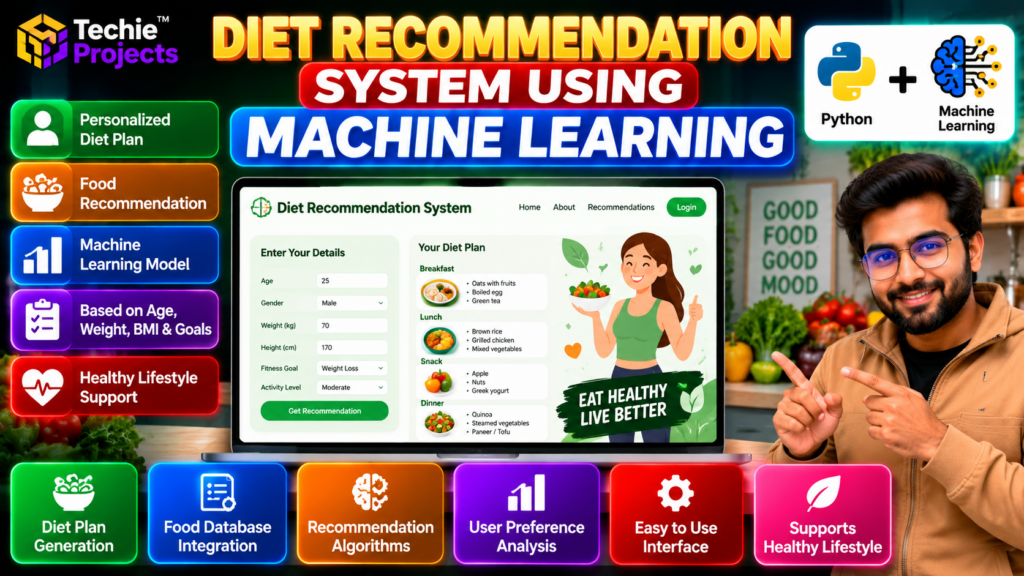
The Diet Recommendation System Using Machine Learning is a Python-based project that explores how machine learning and recommendation techniques can help suggest food options based on user preferences and dietary information. The project demonstrates how data processing, recommendation logic, and a user-friendly interface can be combined to create a personalized food recommendation application.
For B.Tech, B.E., BCA, MCA, M.Tech, and final-year computer science students, this project provides an opportunity to explore practical applications of Python, machine learning, and data analysis.
A diet recommendation application may use inputs such as age, height, weight, activity level, food preferences, and fitness goals, depending on its implementation. The system processes these inputs and generates recommendations according to its programmed rules, dataset, or trained model.
🎬 Project Demo
Explore the project demonstration to see how users enter their details, interact with the application, and view the recommended food options. The demonstration introduces the system interface and its recommendation workflow.
🎯 Objectives of the Project
The main objectives of the Diet Recommendation System Using Machine Learning are:
- Explore personalized food recommendation techniques.
- Process user information and dietary preferences.
- Apply Python to recommendation logic and data analysis.
- Generate food suggestions based on supported inputs.
- Develop an interface for entering information and viewing recommendations.
- Understand the role of machine learning in recommendation systems.
🥗 Key Features of the Diet Recommendation System
1. Personalized Food Recommendations
The application can suggest food options based on supported user inputs and the recommendation logic implemented in the project.
2. User Information Input
Depending on the implementation, users may enter details such as age, weight, height, activity level, food preferences, or fitness goals.
3. Food Recommendation Database
A food dataset or predefined food database can provide the information required to generate recommendations.
4. Machine Learning Integration
If a trained model is included, it can process the supported input features and generate predictions or recommendations based on its training data.
5. User-Friendly Interface
A graphical or web-based interface can make it easier to enter information and review the results.
6. Scope for Future Improvements
The project can be extended with food nutrient information, dietary preference filters, improved recommendation logic, and additional interface features.
⚙️ How Does the Project Work?
Step 1: Enter User Details
The user provides the information requested by the application, such as body measurements, activity level, or food preferences.
Step 2: Process the Input Data
Python processes the supplied information and prepares it for the recommendation logic or trained model.
Step 3: Apply Recommendation Logic
The system uses its implemented rules, dataset, or machine learning model to determine suitable food suggestions.
Step 4: Generate Recommendations
The application produces food recommendations based on the available information and supported functionality.
Step 5: Display Results
The interface presents the recommended food options in an understandable format.
Step 6: Evaluate the Recommendations
Students can test the system with different inputs and examine whether the outputs match the intended recommendation criteria.
🛠️ Technologies Used
The technologies depend on the actual implementation. Common options include:
- Python: Main programming language.
- Pandas: Data processing and manipulation.
- NumPy: Numerical calculations.
- Scikit-learn: Machine learning algorithms, if used.
- Matplotlib: Data visualization, if required.
- Tkinter or Streamlit: Optional user interface.
- Food dataset: Information used by the recommendation logic.
Only list the libraries and algorithms included in your implementation.
💻 Software Requirements
Typical requirements may include:
- Python 3.x
- Visual Studio Code, PyCharm, or another Python IDE
- Pandas and NumPy, if required
- Scikit-learn, if machine learning is implemented
- Required dataset and supporting libraries
🖥️ Hardware Requirements
- Laptop or desktop computer
- At least 4 GB RAM for a basic implementation
- Sufficient storage for source code and datasets
- Keyboard, mouse, and display
Hardware requirements may vary depending on the size of the dataset and the selected model.
📊 Applications of a Diet Recommendation System
Food Recommendation Research
The project can demonstrate how recommendation systems process user preferences to suggest food options.
Dietary Preference Management
The application can be extended to filter suggestions based on preferences such as vegetarian or non-vegetarian food, where supported.
Fitness-Oriented Applications
A recommendation system can explore how user-defined fitness goals influence food suggestions, provided the implemented logic supports those inputs.
Machine Learning Education
Students can study data preprocessing, model training, recommendation logic, and output evaluation.
Personalized Application Development
The project can be extended with additional filters, food information, and improved user-interface functionality.
Important: This project is an educational demonstration, not a clinically validated diet planner. Its recommendations should not replace advice from a qualified healthcare professional or registered dietitian. Health conditions, allergies, and nutritional requirements need appropriate professional consideration.
✅ Advantages of the Project
- Demonstrates Python-based application development.
- Introduces recommendation-system concepts.
- Provides experience with data processing.
- Can combine machine learning with a user interface.
- Supports experimentation with different inputs.
- Can be expanded with additional food data and features.
- Offers a practical topic for academic demonstration.
⚠️ Limitations
- Recommendation quality depends on the data and logic used.
- Limited datasets may produce repetitive or unsuitable suggestions.
- A basic model may not account for allergies or medical conditions.
- Machine learning does not guarantee nutritionally balanced recommendations.
- Additional validation is necessary before using recommendations for real dietary decisions.
🔮 Future Scope
The Diet Recommendation System Using Machine Learning can be extended with the following features:
- Nutritional Information: Include validated food information such as calories, protein, carbohydrates, and fats.
- Dietary Preference Filters: Support user-selected food preferences.
- Improved Recommendation Algorithms: Compare different approaches to recommendation generation.
- Food Database Integration: Store and retrieve structured food information.
- Web or Mobile Interface: Make the application accessible through a suitable interface.
- Recommendation Evaluation: Test the quality and relevance of generated suggestions.
- Allergy Information Support: Add carefully validated allergy-related filters with appropriate warnings.
These features may require additional development beyond the existing implementation.
🎓 Why Choose This as a Final-Year Project?
The Diet Recommendation System Using Machine Learning is a useful topic for students interested in Python, data science, machine learning, and recommendation systems.
Through this project, students can demonstrate:
- Python programming skills
- Data preprocessing
- Recommendation logic
- Machine learning concepts, if implemented
- Interface development
- Testing and documentation
It can also provide a foundation for further experimentation with personalized recommendation applications.
🛒 Get the Diet Recommendation System Project
Looking for a Diet Recommendation System Using Machine Learning project for your B.Tech, B.E., BCA, MCA, M.Tech, or final-year engineering submission?
Techie Projects helps students explore engineering project options and enquire about available implementations.
Contact us to discuss the available package and confirm whether it includes:
- Python source code
- Dataset and preprocessing workflow
- Machine learning model, if applicable
- Installation and execution instructions
- Project documentation and report
- Demonstration of implemented features
- Customization options, if available
The exact deliverables depend on the selected package. Please confirm availability, features, and pricing before purchasing.
📲 Interested in Purchasing This Project?
Enquire About the Diet Recommendation System on WhatsApp
📲 Call/WhatsApp: +91-9460060699
🌎 Website: www.techieprojects.com
📺 Instagram: @pythonprojects_
Share your course, submission deadline, and required features so we can discuss the available options.
🎓 Recommended Projects
Explore these related project topics on Techie Projects. Link each title to its relevant published article.
- Emotion Based Music Recommendation System Using Python — explore personalized recommendations using user-related data.
- Food Ingredient Detection Using Image Processing — investigate image-based food label analysis.
- Food Classification Using Machine Learning — explore machine learning for food image classification.
- Machine Learning Projects Using Python — discover additional academic project ideas.
- Data Science Projects for Final-Year Students — explore projects involving data analysis and predictive techniques.
Visit Techie Projects to explore more Python, AI, and machine learning projects.
❓ Frequently Asked Questions
1. What is a Diet Recommendation System Using Machine Learning?
It is an application that uses data, recommendation logic, or a trained model to suggest food options based on supported user inputs and preferences.
2. Which programming language is used?
Python is commonly used because it supports data processing, machine learning, and application development.
3. Is machine learning necessary for a diet recommendation system?
Not every recommendation system requires machine learning. Some use predefined rules, while others use trained models. The method depends on the project implementation.
4. Can the project be customized?
Additional features may be possible depending on the available source code and project package. Confirm the scope before purchasing.
5. Is the system suitable for medical diet planning?
A student project should not be treated as a validated medical nutrition tool. Medical dietary decisions should be discussed with a qualified healthcare professional or registered dietitian.
6. How can I purchase this project?
Contact Techie Projects on WhatsApp to enquire about source code availability, documentation, included features, and pricing.
Conclusion
The Diet Recommendation System Using Machine Learning demonstrates how Python can be used to develop a personalized food recommendation application. By combining user inputs, food data, and recommendation logic, students can explore practical concepts in machine learning and application development.
If you are interested in this project for your mini-project or final-year submission, contact Techie Projects to discuss the available implementation and deliverables.
Ready to discuss your project?
📲 Contact Techie Projects on WhatsApp