
Introduction
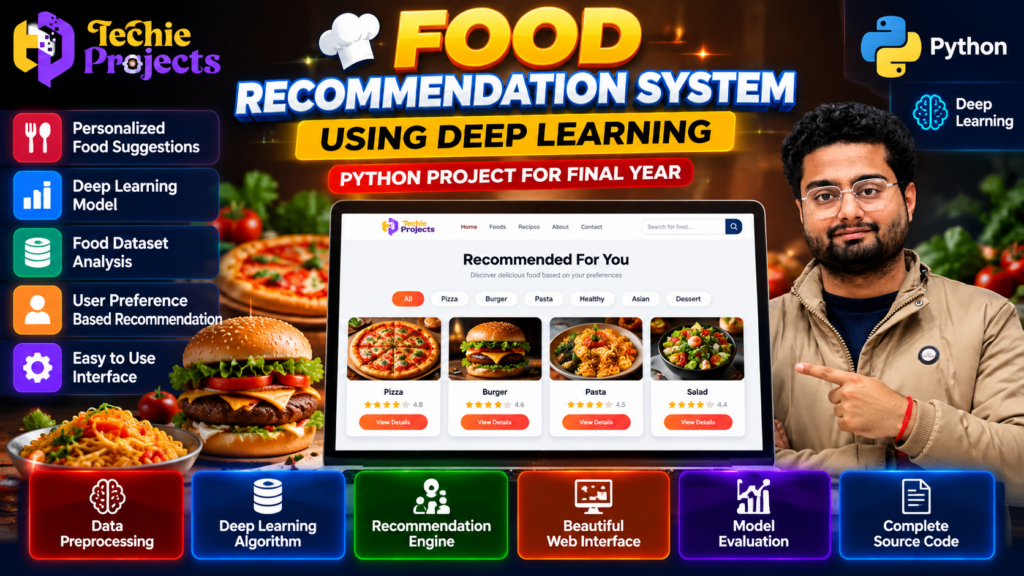
A food recommendation system using deep learning is an AI-based project that helps users discover food items according to their preferences, food categories, and available recommendation data. Developed using Python and machine learning technologies, this project demonstrates how intelligent recommendation systems can make food discovery easier and more personalized.
For B.Tech, B.E., computer science, information technology, and AI/ML students, this project offers an opportunity to explore recommendation algorithms, data preprocessing, model development, and web application design. It can be developed as a final-year engineering project with a practical interface and a clear demonstration of how AI can support food discovery.
At Techie Projects, students can enquire about project source code, implementation guidance, customization options, and support for their academic requirements.
🎬 Food Recommendation System Using Deep Learning – Project Demo
Watch the project demonstration to understand how the food recommendation interface works, how food items are presented, and how users can explore recommendations. The demo helps students understand the project workflow and visualize how a Python-based recommendation application can be presented during a project review or viva.
🎯 Objectives of the Food Recommendation System using Deep Learning
The main objective of the food recommendation system using deep learning is to demonstrate an intelligent approach to presenting relevant food suggestions through a software application.
Key objectives include:
- Develop a Python-based food recommendation application.
- Organize food information into useful categories.
- Explore how recommendation algorithms can support personalized suggestions.
- Build a user-friendly interface for browsing recommended food items.
- Understand data preprocessing and recommendation workflows.
- Demonstrate the use of AI concepts in a practical application.
- Provide a project that can be studied, tested, and customized for academic purposes.
🤖 What Is a Food Recommendation System?
A food recommendation system is a software application that suggests food items based on information such as user preferences, food categories, ingredient details, ratings, or previous interactions, depending on the implementation.
For example, a user interested in vegetarian meals may prefer recommendations from vegetarian food categories. Similarly, someone browsing pizza, burgers, pasta, or salads may benefit from a system that organizes food choices and displays relevant options.
A food recommendation system using deep learning can incorporate neural-network-based techniques when suitable training data and a trained model are available. The exact recommendation method depends on the project’s implementation and dataset.
⚙️ How the Food Recommendation System using Deep Learning Project Works
The project can follow a workflow consisting of the following stages.
1. Food Dataset Collection
The system uses food-related data containing relevant details about food items. Depending on the implementation, the dataset may include names, categories, ingredients, descriptions, ratings, or other useful attributes.
2. Data Preprocessing
The collected data is prepared for use by the recommendation application. This may involve handling missing values, removing duplicate records, standardizing categories, and converting relevant information into a suitable format.
3. Feature Selection
Useful attributes are selected to help the recommendation process distinguish between food items. The chosen features depend on the dataset and the recommendation technique.
4. Recommendation Model Development
The project can use an appropriate recommendation approach. If a deep learning model is implemented, the model must be trained or loaded using suitable data and evaluated before it is used to generate recommendations.
5. User Interface Development
A web interface allows users to explore food items and view the suggestions produced by the system. The interface may contain food categories, recommendation cards, search functionality, and item details.
6. Recommendation Display
The application displays food suggestions according to the implemented logic. The quality and relevance of the recommendations depend on the available data, algorithm, and evaluation results.
✨ Key Features of food recommendation system using deep learning
The food recommendation system using deep learning can include the following features, depending on the final implementation.
🍕 Food Category Browsing
Organize food items into categories such as pizza, burgers, pasta, salads, desserts, or other supported groups.
🧠 Intelligent Recommendation Logic
Explore recommendation algorithms that identify relevant food options using available food information and user preferences.
👤 Preference-Based Suggestions
The system can be extended to use user preferences to make recommendations more relevant to individual users.
💻 User-Friendly Interface
Display food items through a clean interface that makes it easier to explore available options.
📊 Dataset Processing
Demonstrate how structured food data can be cleaned, organized, and prepared for a recommendation application.
🔧 Customization Potential
Students can explore additional features such as filters, ratings, ingredient-based search, user profiles, and recommendation history where supported by the architecture.
🛠️ Technologies Used
The exact technology stack depends on the supplied implementation. A typical Python-based version may use:
- Programming language: Python
- Data processing: Pandas and NumPy, if required
- Machine learning: Scikit-learn, where applicable
- Deep learning: TensorFlow/Keras or PyTorch, if used by the model
- Frontend: HTML, CSS, and JavaScript, if the application uses a web interface
- Backend: Flask or Django, depending on the project architecture
- Dataset: A suitable food dataset
- Development tools: Visual Studio Code, Jupyter Notebook, or another compatible Python environment
Only list frameworks as implemented dependencies when documenting the actual project.
💻 Software and Hardware Requirements
Software Requirements
- Python-compatible development environment
- Required Python libraries for the implementation
- Compatible operating system
- Dataset and model files, if applicable
- Web browser for testing the interface
- Database software, if required by the application
Hardware Requirements
- Laptop or desktop computer
- Recommended 8 GB RAM or more for a comfortable development experience
- Adequate storage for the source code, dataset, and dependencies
- GPU only if required by the chosen model or training workload
Actual requirements depend on the model size, dataset, and implementation.
🎓 Applications of a Food Recommendation System
Food recommendation technology has potential applications in several areas:
- Food delivery platforms: Helping users discover relevant menu items.
- Restaurant websites: Presenting popular or preference-based dishes.
- Recipe applications: Suggesting recipes based on selected ingredients or food preferences.
- Food discovery platforms: Organizing food options by categories and attributes.
- Academic research: Studying recommendation algorithms and user-personalization techniques.
- AI and machine learning education: Demonstrating data processing, model development, and application integration.
These are potential applications; they are not a claim that every feature is already implemented in this project.
📈 Advantages of the Project
- Demonstrates a practical application of AI and recommendation concepts.
- Helps students understand Python-based application development.
- Combines data preparation, recommendation logic, and interface design.
- Can be extended with additional features depending on project scope.
- Provides opportunities to study model evaluation and software testing.
- Can support a final-year project presentation, demonstration, and technical discussion.
⚠️ Limitations and Future Scope
Recommendation quality depends on the dataset, the implemented algorithm, and the accuracy of user preference information. A basic system may produce generic suggestions if it does not learn from user interactions or use sufficient data.
Future improvements may include:
- User registration and preference profiles
- Ingredient-based recommendations
- Vegetarian and dietary preference filters
- Ratings and feedback collection
- Improved recommendation algorithms
- Mobile-friendly interface design
- Recommendation evaluation using suitable metrics
- Integration with a larger food catalogue
Dietary suggestions should not be treated as medical advice. Any allergy-related feature would require careful design and validation.
🧑🎓 Why Choose This Project for Your Final Year?
The food recommendation system using deep learning is a useful project topic for students interested in artificial intelligence, machine learning, Python programming, and recommendation systems.
It offers a practical way to explain a software workflow, discuss the selected algorithm, demonstrate an interface, and identify possible future improvements. Students can also use the project to explore how data-driven applications are developed and evaluated.
If you need a project for your academic submission, review the implementation details, supported features, dependencies, and documentation before selecting the final scope.
💼 Get the Food Recommendation System Project from Techie Projects
Looking for a food recommendation system using deep learning project in Python for your final-year engineering project?
Techie Projects helps students explore Python, AI, machine learning, deep learning, and computer science project options. Contact us to discuss the available implementation and the support you require.
Depending on the project package, you can enquire about:
- Project source code availability
- Setup and execution guidance
- Project workflow and implementation explanation
- Documentation availability
- Customization based on academic requirements
- Demonstration and viva preparation guidance
Availability of source code, documentation, and other deliverables should be confirmed before purchase.
📲 Contact Us for Project Enquiries
- 📲 Call/WhatsApp: +91-9460060699
- 🌎 Website: www.techieprojects.com
- 📺 Instagram: @pythonprojects_
Ready to discuss your project? Send us a WhatsApp message with your course, preferred technology, and project requirements to enquire about pricing and available customization options.
🎓 Explore Related Projects
Students interested in AI and Python may also explore these related project topics:
- Food Recommendation System
- Diet Recommendation System Using Machine Learning
- Movie Recommendation System Using Python
- Fashion Trend Analysis and Forecasting using AI
- Sentiment Analysis Using Deep Learning
- Image Classification Using Deep Learning
Visit the relevant project categories on Techie Projects to explore more project ideas. Confirm individual project availability before placing an order.
❓ Frequently Asked Questions
1. What is a food recommendation system using deep learning?
It is a software project that explores how recommendation techniques can present relevant food choices using food data and, where implemented, a trained deep learning model.
2. Which programming language is used?
Python is a common choice for this project. Additional libraries and frameworks depend on the implementation.
3. Is this project suitable for B.Tech students?
Yes. It can be suitable for computer science, information technology, AI, and machine learning students when the project scope matches their academic requirements.
4. Can the project be customized?
Potential customizations include interface changes, additional food categories, preference filters, and other features, depending on the source code and architecture.
5. Can I purchase this project from Techie Projects?
You can contact Techie Projects to enquire about availability, pricing, source code, documentation, setup support, and customization options.
6. Does the project require a GPU?
Not necessarily. Many smaller recommendation applications can run on a CPU. GPU requirements depend on the deep learning model and whether model training is needed.
7. Does the system provide medically reliable diet advice?
No such claim should be made without appropriate validation. This is an educational software project, not a substitute for professional nutrition or medical advice.
🏁 Conclusion
A food recommendation system using deep learning is a practical project topic for exploring Python development, food data processing, recommendation algorithms, and user-interface design. With an appropriate dataset and a clearly defined implementation, students can demonstrate how recommendation technology may help users discover food options.
If you are planning a final-year engineering project, contact Techie Projects to discuss the available source code, implementation details, documentation, and customization options.
Explore your project options today: https://techieprojects.com/
Ask about availability on WhatsApp: +91-9460060699