
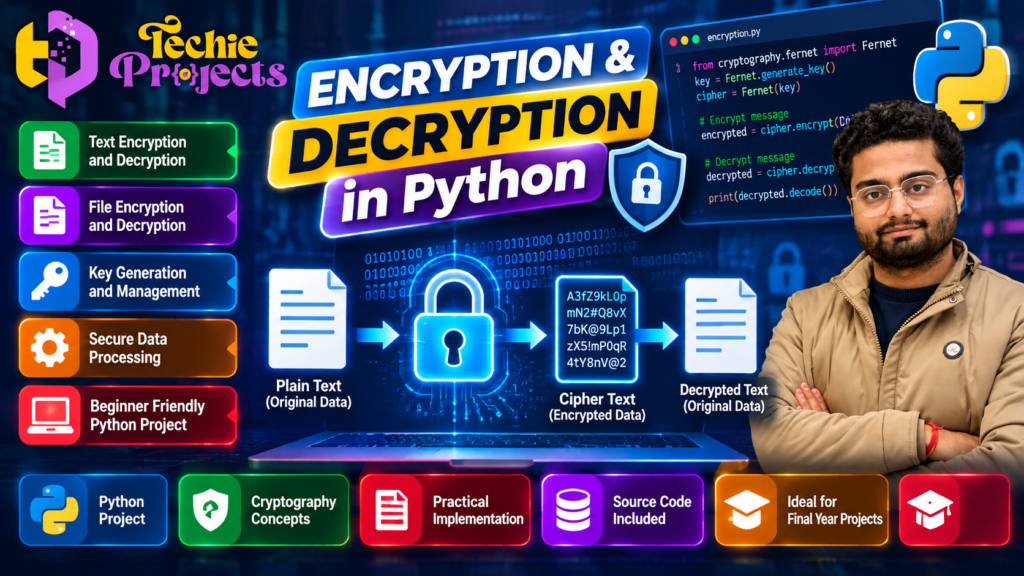
Encryption and Decryption in Python is a practical cybersecurity project that demonstrates how sensitive information can be converted into a protected format and restored when authorized access is available. This project helps engineering students understand cryptography concepts, Python programming, secure data handling, and the fundamentals of information security through a hands-on implementation.
If you are searching for an Encryption and Decryption in Python project for your college assignment, mini project, final-year project, or technical portfolio, Techie Projects can help you explore a practical project approach. You can review the project demonstration and contact us to confirm the available source code, documentation, installation instructions, and other deliverables before purchasing.
🎬 Project Demo: Encryption and Decryption in Python
Watch the project demonstration to understand the interface, encryption workflow, and decryption process. The demo can help you evaluate whether the project matches your academic requirements and the features you want to learn.
🔐 What Is Encryption and Decryption in Python?
Encryption is the process of transforming readable information, known as plaintext, into an encoded format called ciphertext. Decryption reverses this process to recover the original information using the appropriate key and algorithm.
An Encryption and Decryption in Python application uses Python libraries and cryptographic methods to demonstrate these operations. Depending on its implementation, the application may support text encryption, file encryption, key generation, and the recovery of encrypted data.
For example, a user may enter a message such as “Welcome to Python.” The application encrypts the message into ciphertext that is not directly readable. When the authorized user provides the correct key and encrypted data, the application can decrypt the message.
This project introduces students to an important area of computer science: protecting information from unauthorized access.
🎓 Objectives of the Encryption and Decryption Project
The main objective is to develop a Python application that demonstrates how cryptographic techniques protect information.
Key learning objectives include:
- Understanding plaintext, ciphertext, encryption, and decryption.
- Learning the role of encryption keys in data protection.
- Implementing cryptographic operations with Python.
- Exploring secure handling of messages and files.
- Developing a simple interface for user interaction.
- Understanding input validation and error handling.
- Learning the importance of key management and secure storage.
- Documenting the software development process.
An Encryption and Decryption in Python project can also help students practise debugging, modular programming, testing, and technical presentation skills.
🛠️ Technologies Used in the Project
The technology stack depends on the particular implementation and the requirements of your college.
1. Python Programming Language
Python is used to implement the core encryption and decryption logic. Its readable syntax makes it suitable for students who want to understand cryptographic operations without starting with a complex programming language.
2. Cryptography Library
Python’s cryptography library provides tools for implementing established cryptographic methods. For example, the Fernet interface supports authenticated symmetric encryption, where the same secret key is used to encrypt and decrypt data.
The selected library and algorithm should match the project’s actual implementation.
3. User Interface
A graphical interface can make the project easier to demonstrate. Depending on the implementation, developers may use Tkinter, Flask, Streamlit, or another suitable framework.
4. Development Environment
Students can develop and test the application using an editor such as Visual Studio Code or PyCharm. Python and the required dependencies must be installed in a compatible environment.
⚙️ How the Encryption and Decryption System Works
The workflow can be divided into several stages.
Step 1: Accept the Input
The user enters a message or selects a supported file. The application validates the input before processing it.
Step 2: Generate or Load the Key
The encryption process requires an appropriate cryptographic key. The application may generate a key or load one securely, depending on its design.
Step 3: Encrypt the Information
The plaintext is processed using the selected cryptographic algorithm and key. The result is ciphertext, which can be stored or transmitted according to the application’s functionality.
Step 4: Store or Display the Encrypted Output
The application displays the encrypted result or saves it to a supported location. The exact behaviour depends on whether the project focuses on text, files, or both.
Step 5: Decrypt the Information
The authorized user provides the encrypted data and the required key. The application attempts to recover the original information.
Step 6: Validate the Result
The output should be checked to ensure that decryption works correctly. Incorrect keys, damaged files, or invalid inputs should produce appropriate error messages.
This workflow makes the Encryption and Decryption in Python project useful for understanding the relationship between algorithms, keys, data processing, and application design.
✨ Key Features to Explore
The features below are possible capabilities for a cryptography application. Confirm which ones are included in the specific project package before purchasing.
Text Encryption and Decryption
The application may allow users to enter a message, encrypt it, and decrypt the resulting ciphertext.
File Encryption and Decryption
A file-based implementation can demonstrate how data is read, encrypted, written to storage, and recovered. Supported file types and size limits depend on the implementation.
Key Generation
Cryptographic applications need suitable keys. A key-generation module can demonstrate how keys are created and used during encryption and decryption.
User-Friendly Interface
A simple interface can provide fields, buttons, status messages, and output areas for the main operations.
Error Handling
The application should handle common problems, including missing input, invalid data, incorrect keys, and unsupported files.
Modular Code Structure
Separating input handling, encryption, decryption, and interface logic into different functions can make the code easier to understand and maintain.
📚 Modules of the Encryption and Decryption in Python Project
A project can be organised into the following modules:
| Module | Purpose |
|---|---|
| Input Module | Accepts text or supported files |
| Key Management Module | Generates or loads cryptographic keys |
| Encryption Module | Converts plaintext into ciphertext |
| Decryption Module | Recovers data using the appropriate key |
| Output Module | Displays or saves processed information |
| Validation Module | Checks inputs and handles errors |
| Interface Module | Connects the user with the application’s functionality |
These modules provide a useful structure for explaining the system during a project presentation or viva. The final module list should match the source code supplied with the selected project.
🎯 Applications of Encryption and Decryption
Encryption and decryption are used across many areas of information technology.
Data Protection
Cryptographic techniques help protect stored information from unauthorised access when implemented with suitable security controls.
Secure File Handling
Applications may encrypt confidential documents before storage or transfer, provided the key-management process is secure.
Communication Security
Encryption is an important component of many secure communication systems. Real-world deployments also require correct authentication, protocols, and implementation practices.
Cybersecurity Education
Students can use this project to explore cryptography concepts and understand why sensitive information should not be stored or transmitted in plain text.
Software Development
The project demonstrates how a Python application can integrate a library, process input, manage errors, and present results through a user interface.
💼 Why Choose This Python Project for Your College?
An Encryption and Decryption in Python project offers a practical way to study programming and cybersecurity together.
For mini projects: Students can focus on the core encryption and decryption workflow, input validation, and a simple interface.
For final-year projects: The scope may be extended with additional modules, improved interface design, file handling, testing, and detailed documentation, subject to the project’s requirements.
For Python learners: The project provides an opportunity to practise functions, modules, library integration, file operations, and exception handling.
For technical portfolios: A properly documented implementation can demonstrate familiarity with Python and introductory cryptography concepts.
Remember that the project should be understood, tested, and adapted according to your institution’s rules. Students should be able to explain the code and the security limitations of their implementation.
🛒 Get the Encryption and Decryption in Python Project from Techie Projects
Looking for an Encryption and Decryption in Python project for your engineering coursework? Techie Projects provides project-related resources for students exploring Python programming, cybersecurity, and software development.
Before placing an order, contact us to confirm the exact package and deliverables available for this project.
Depending on the agreed package, you can enquire about:
- Python project source code.
- Installation and execution instructions.
- Project workflow and technical explanation.
- Documentation and report availability.
- Demonstration and troubleshooting support options.
- Customisation possibilities for your academic requirements.
Contact Techie Projects to check availability, pricing, and package details.
- 📲 Call/WhatsApp: +91-9460060699
- 🌎 Website: www.techieprojects.com
- 📺 Instagram: @pythonprojects_
Share your course, project deadline, required features, and college guidelines so that the available options can be discussed before you purchase.
🚀 Recommended Projects for Students
If you are interested in related topics, explore these project ideas on Techie Projects:
- Password Manager Using Python – Explore password storage and secure application design.
- File Integrity Checker – Learn how hashing can help detect unexpected file changes.
- Secure File Transfer System – Study protected file transmission and validation.
- Network Intrusion Detection System – Explore network traffic analysis and security monitoring.
- Phishing Website Detection – Investigate techniques for identifying suspicious websites.
- Secure Login System Using Python – Learn about authentication and password-handling practices.
- Data Hiding Using Steganography – Explore techniques for concealing information within digital media.
Visit https://techieprojects.com/ to explore relevant Python, cybersecurity, and final-year engineering project resources.
❓ Frequently Asked Questions
1. What is an Encryption and Decryption in Python project?
It is a software project that demonstrates how Python can transform readable data into ciphertext and recover it using an appropriate cryptographic key.
2. Which programming language is used?
Python is the primary programming language. Additional libraries and interface frameworks depend on the implementation.
3. Is this project suitable for engineering students?
It can be suitable for computer science, information technology, and cybersecurity students, depending on their course requirements and the project’s scope.
4. Can the project support file encryption?
File encryption can be implemented, but you should confirm whether it is included in the package you intend to purchase.
5. Does the project include source code and documentation?
The availability of source code, reports, installation instructions, and other materials depends on the selected package. Confirm the deliverables with Techie Projects before ordering.
6. Can I customise the project?
Possible customisations depend on the existing implementation, your requirements, and the agreed scope of work.
7. Is this project suitable for learning cybersecurity?
Yes. It can introduce students to cryptographic concepts, key handling, input validation, and secure software design. A basic educational implementation should not automatically be treated as production-ready security software.
📝 Conclusion
The Encryption and Decryption in Python project is a practical way to explore cryptography, data protection, Python programming, and application development. By studying the encryption workflow, key management, decryption process, and error handling, students can strengthen their understanding of fundamental cybersecurity concepts.
Whether you need a Python mini project, a final-year engineering project, or a learning resource for your portfolio, review the demonstration and confirm the available deliverables before purchasing.
Explore more engineering projects at Techie Projects: www.techieprojects.com
Contact us on WhatsApp at +91-9460060699 to discuss the Encryption and Decryption in Python project, available package options, and your academic requirements.
Educational note: This project is intended for learning and demonstration. Real-world security requires appropriate algorithms, secure key management, safe implementation, and independent security testing.