
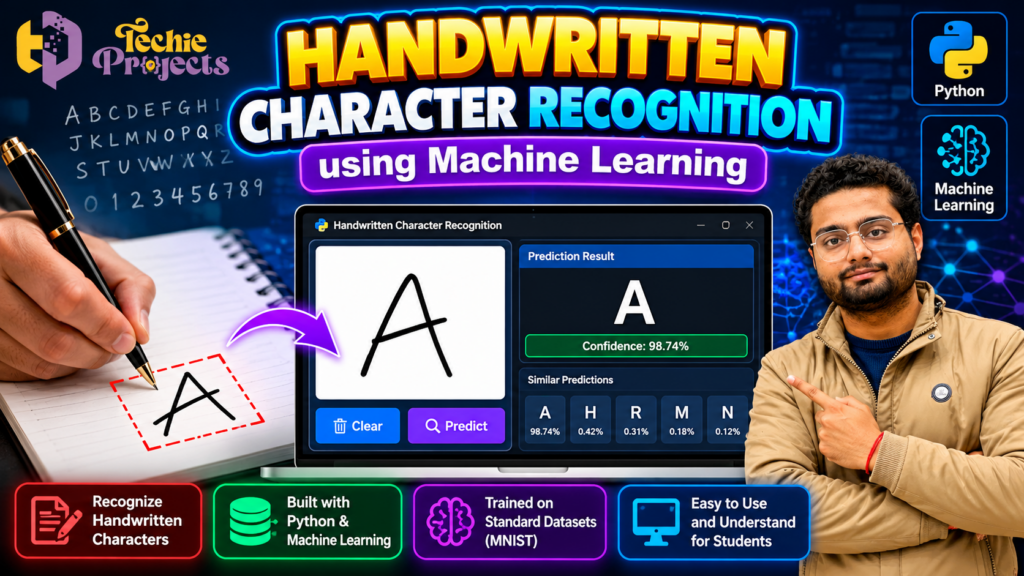
Looking for a practical machine learning project that can help you demonstrate your Python, image processing, and artificial intelligence skills? Handwritten Character Recognition using Machine Learning is an excellent project idea for computer science students, final-year engineering students, and learners who want to explore how computers recognize handwritten letters and digits.
Instead of spending hours searching for a suitable project topic, explore this project from Techie Projects and understand its working process, technologies, and potential applications before making your purchase decision. It can be a useful addition to your academic project portfolio and a starting point for learning about intelligent character recognition systems.
Whether you need a machine learning project for your final-year submission, a practical demonstration, or an academic presentation, this project provides an opportunity to study how handwritten input can be processed and converted into a recognizable character. Contact Techie Projects to confirm the current project package, available deliverables, pricing, and installation requirements before ordering.
🎬 Watch the Handwritten Character Recognition Project Demo
Explore the project demonstration to understand how handwritten characters can be submitted to a recognition system and how the application displays a prediction.
Watching the demonstration before purchasing can help you understand the interface and expected workflow. Actual features and prediction performance depend on the implementation, trained model, input quality, and dataset used.
📌 What Is Handwritten Character Recognition Using Machine Learning?
Handwritten Character Recognition using Machine Learning is a computer vision application that attempts to identify letters or digits from handwritten images. Unlike printed text, handwriting varies from person to person in shape, size, spacing, thickness, and writing style.
Machine learning techniques can learn patterns from labeled examples and use those patterns to predict the character represented in a new image.
For example, a user may draw or upload a handwritten letter such as A, B, or C. The application processes the input and passes it to a trained model, which produces a predicted class. Depending on the implementation, the system may recognize digits, uppercase letters, lowercase letters, or a selected subset of characters.
This makes the project relevant to students studying Python programming, machine learning, image processing, and introductory artificial intelligence.
🎯 Objectives of the Project
The main objective is to understand how a computer can recognize handwritten characters using image data and a trained classification model.
Key learning objectives include:
- Understanding the fundamentals of character recognition.
- Learning how images are prepared for machine learning.
- Exploring labeled datasets for training and testing.
- Understanding the relationship between input features and predicted classes.
- Building or studying a Python-based recognition workflow.
- Evaluating prediction results and identifying possible errors.
- Learning how a machine learning model can be connected to a user interface.
These objectives can help students connect theoretical concepts with a practical software application.
⚙️ How Does the Project Work?
A typical handwritten character recognition system follows several stages. The exact workflow may vary according to the model and interface used in the selected project package.
1. Input Collection
The system receives a handwritten character through a drawing area, uploaded image, or another supported input method. The input must be suitable for the recognition model.
2. Image Preprocessing
The input image may be converted to grayscale, resized to a standard dimension, normalized, or transformed into a format accepted by the model. Preprocessing helps maintain consistency between training and prediction data.
3. Feature Learning
The model learns patterns that distinguish different characters. Depending on the implementation, this may involve traditional machine learning features or a neural network that learns visual patterns directly from images.
4. Model Training
A labeled dataset can be used to train the model. Each training example is associated with a target character or digit. The model adjusts its parameters to reduce prediction errors during training.
A dataset such as MNIST is commonly used for handwritten digit recognition. It contains digit images rather than the complete alphabet, so alphabet recognition requires a suitable additional dataset or a different model.
5. Character Prediction
When a new handwritten image is submitted, the trained model processes it and predicts a class. Some implementations also display class probabilities or confidence scores. These scores should not automatically be interpreted as a guarantee that the prediction is correct.
6. Result Display
The predicted character is displayed in the application interface. The result can be compared with the original input to evaluate whether the recognition was successful.
✨ Important Features to Explore
The available features depend on the implementation supplied with the project. When reviewing the package, ask which of the following capabilities are included.
- Handwritten input: Support for drawing or uploading character images.
- Character prediction: Classification of supported letters or digits.
- Image preprocessing: Preparation of input images for model inference.
- Machine learning model: A trained model or training workflow for character classification.
- Prediction interface: A way to submit input and view the predicted result.
- Result visualization: Display of the predicted class and, where implemented, probability scores.
- Educational workflow: An opportunity to study the relationship between image processing, model training, and prediction.
Confirm the exact supported character set, interface features, and model details before purchase rather than assuming every feature is included.
🛠️ Technologies Used
A Python-based handwritten recognition project may use several tools and libraries.
Python
Python is commonly used to develop machine learning applications because of its readable syntax and extensive ecosystem of data and image processing libraries.
NumPy
NumPy supports numerical operations and array manipulation. Image data and model inputs are often represented as arrays.
OpenCV or Pillow
OpenCV and Pillow can be used for image loading, resizing, conversion, and other preprocessing tasks. The selected implementation may use one, both, or a different image library.
Machine Learning or Deep Learning Libraries
Depending on the model, a project may use scikit-learn, TensorFlow, Keras, or PyTorch. A neural network can be particularly useful when learning visual patterns from handwritten images.
Dataset
The dataset must match the recognition task. MNIST is commonly used for digit recognition, while alphabet recognition requires an appropriate letter dataset or a dataset containing both letters and digits.
Important: The exact libraries, model architecture, dataset, and versions should be verified against the project package before installation.
💻 Software and Hardware Requirements
A typical Python implementation may require:
Software requirements
- Python installed in a compatible version.
- Required Python packages and dependencies.
- A code editor or IDE, such as VS Code or PyCharm.
- A compatible operating system.
- Dataset files and model weights, if required by the implementation.
Hardware requirements
- A computer or laptop.
- Sufficient memory and storage for Python, libraries, and project files.
- A standard processor suitable for running the selected model.
A GPU is generally not necessary for a small, already-trained character classification model, although requirements depend on the model and training workload.
Before ordering, confirm the supported Python version, installation procedure, dependency list, and whether pretrained model files or training data are included.
🎓 Why Choose This Project for Final-Year Engineering?
Handwritten Character Recognition using Machine Learning combines several important computer science concepts in one practical topic. It can be suitable for students who want to demonstrate their understanding of programming, image preprocessing, supervised learning, and model evaluation.
Useful for Academic Demonstrations
The input-and-prediction workflow can make the basic idea of machine learning easier to explain during a project presentation.
Relevant to Machine Learning Coursework
Students can explore datasets, training and testing, classification, prediction errors, and model evaluation.
Scope for Further Development
Depending on the project structure and your academic requirements, you could explore additional datasets, improve preprocessing, compare models, or evaluate recognition performance on different handwriting styles.
Portfolio Development
The project can provide a practical discussion topic for a student portfolio, particularly when you can explain the code, model choices, limitations, and test results yourself.
Remember to follow your institution’s rules on external project resources and make sure you understand the implementation you submit.
🌍 Applications of Handwritten Character Recognition
Character recognition is relevant to several real-world applications. A student project demonstrates the underlying concepts, but it should not be assumed to provide a production-ready system for every use case.
Potential applications include:
- Digit recognition: Identifying handwritten numbers in suitable images.
- Form digitization: Supporting the conversion of handwritten information into digital records.
- Document processing: Contributing to document recognition workflows when integrated with appropriate systems.
- Educational tools: Creating interactive activities for exploring handwriting and machine learning.
- Postal processing research: Studying the recognition of handwritten address components.
- Historical document research: Exploring methods for analyzing handwritten archival material.
- Computer vision learning: Demonstrating image preprocessing and classification techniques.
Real-world deployments generally require more extensive testing, error handling, data privacy measures, and evaluation across varied handwriting styles.
📊 Advantages and Limitations
Advantages
- Demonstrates an understandable machine learning workflow.
- Connects Python programming with image processing.
- Provides opportunities to study supervised classification.
- Can be extended through suitable datasets and model comparisons.
- Offers practical examples for academic demonstrations.
Limitations
- Similar-looking characters may be confused by the model.
- Poor image quality, unusual handwriting, and inconsistent input dimensions can reduce accuracy.
- A model trained only on digits will not automatically recognize letters.
- Performance depends on the dataset, training process, and evaluation method.
- A successful classroom demonstration does not guarantee production-level reliability.
Understanding these limitations is important when explaining the project in a report or viva.
🛒 Get the Handwritten Character Recognition Project from Techie Projects
Want to explore this Python machine learning project for your academic work? Contact Techie Projects to enquire about purchasing the Handwritten Character Recognition project.
Before confirming your order, ask for the current price and verify the exact package contents. Depending on the available offering, you may wish to confirm whether it includes source code, installation instructions, a project report, a demonstration, or technical explanation. Do not assume these deliverables are included unless confirmed by the provider.
Contact Techie Projects:
- 📲 Call/WhatsApp: +91-9460060699
- 🌎 Website: www.techieprojects.com
- 📺 Instagram: @pythonprojects_
When enquiring, mention your course, project deadline, preferred programming environment, and any college-specific requirements. This will help you check whether the available version is suitable for your needs.
🔗 Explore Related Python Projects
If you are comparing project ideas, explore other categories on Techie Projects:
- Machine Learning Projects
- Image Processing Projects
- Artificial Intelligence Projects
- Python Projects
- Final Year Engineering Projects
These links lead to the website’s main page. Replace them with specific category or project URLs if dedicated pages are available.
❓ Frequently Asked Questions
1. What is Handwritten Character Recognition using Machine Learning?
It is a system that uses a trained model to classify handwritten character images into supported categories, such as letters or digits.
2. Which programming language is used in this project?
Python is a common choice because it supports image processing, data preparation, and machine learning libraries. Verify the programming language used in the specific package you intend to purchase.
3. Can this project recognize both letters and numbers?
That depends on the training dataset and model. A model trained only on handwritten digits, such as a standard MNIST digit classifier, does not automatically recognize the full alphabet.
4. Is the project suitable for final-year students?
It can be suitable for computer science and related engineering students, subject to their syllabus, project requirements, and institution’s rules.
5. Do I need a GPU to run the project?
Usually, a small pretrained model can run on a standard CPU. Training larger models may require more resources. Check the specific project’s requirements.
6. Can I purchase this project from Techie Projects?
You can enquire through the Techie Projects website or WhatsApp to confirm availability, pricing, package contents, and delivery details.
7. What should I confirm before purchasing?
Confirm the supported character classes, model and dataset details, Python version, installation requirements, included deliverables, and compatibility with your academic requirements.
🚀 Conclusion
Handwritten Character Recognition using Machine Learning is a useful educational topic for exploring how computers interpret handwritten images. It brings together Python programming, image preprocessing, supervised learning, and prediction in a project that can be demonstrated and extended.
If you are looking for a project for your academic learning or final-year work, contact Techie Projects to review the available version and confirm the deliverables before purchasing. Choose a project that fits your requirements, understand how it works, and prepare to explain its design, testing, and limitations confidently.