
🎓 Introduction
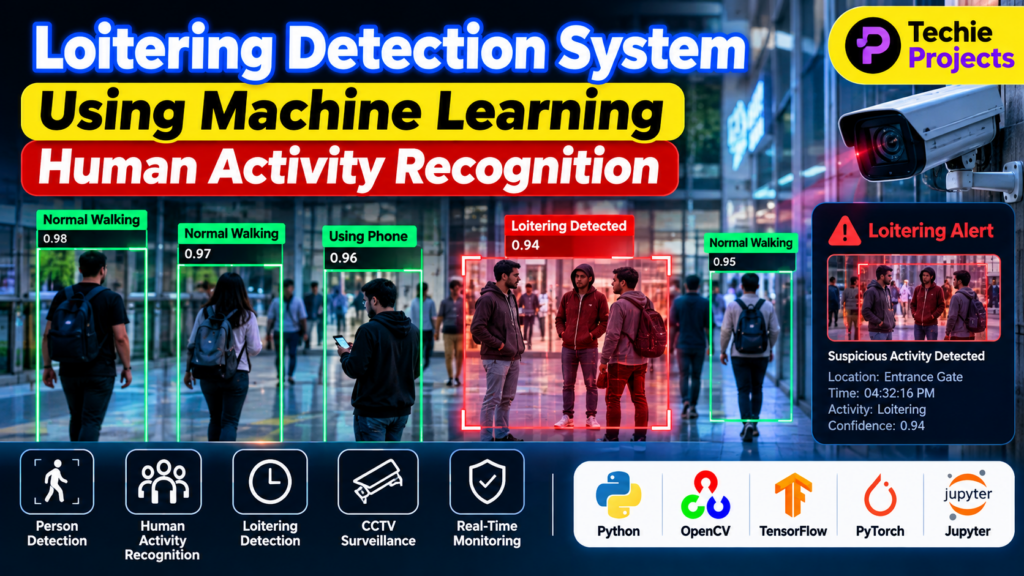
A Loitering Detection System using Machine Learning is a computer vision project designed to analyze human activity in video footage and identify prolonged presence or unusual waiting behavior in a defined area. The project combines Python, OpenCV, machine learning, deep learning, and human activity recognition to demonstrate how intelligent video analytics can be developed.
In conventional surveillance, security personnel may need to continuously monitor CCTV footage. A computer vision-based system can assist by automatically analyzing video frames and generating an alert when predefined loitering conditions are detected.
This project is suitable for B.Tech, BCA, MCA, Computer Science, Information Technology, and final-year engineering students who want to develop a practical machine learning and computer vision project.
Educational Note: Loitering detection should be treated as an assistive analytics system. A detected event should be reviewed by an authorized person before any real-world action is taken.
🎥 Project Working Demo
Before selecting or purchasing the project, students can watch the Loitering Detection System working demonstration to understand the interface, detection workflow, human activity recognition, tracking process, and overall project functionality.
A working demo provides a practical understanding of how the project operates beyond the theoretical explanation.
🔍 What Is Loitering Detection?
Loitering detection refers to identifying when a person remains within a specified area for longer than a predefined period.
For example, a system may monitor an entrance, corridor, restricted area, campus location, or other authorized monitoring zone. When a detected person remains inside the defined region beyond the configured time threshold, the system can mark the event for review.
A machine learning-based loitering detection system can combine:
- Person detection
- Object tracking
- Human activity recognition
- Region-of-interest detection
- Time-based analysis
- Video processing
- Event logging
- Alert generation
The exact implementation depends on the project requirements and selected detection or tracking model.
🎯 Objectives of the Project
The main objectives of this Loitering Detection System using Machine Learning are:
- Detect people from images or video streams.
- Track detected individuals across consecutive frames.
- Define a monitoring region for analysis.
- Calculate how long a detected person remains within the region.
- Identify prolonged presence based on configurable rules.
- Display detection and tracking information in real time.
- Generate an event or alert when the configured condition is met.
- Demonstrate the practical application of computer vision and machine learning.
⚙️ How the Loitering Detection System Works
The project can be divided into several stages.
Step 1: Video Input
The system receives video from an authorized source such as:
- CCTV footage
- Webcam
- Recorded video
- Test dataset
- IP camera stream
The video is processed frame by frame using Python and computer vision libraries.
Step 2: Person Detection
The system identifies people appearing in each video frame.
A suitable object detection model can be used to detect human objects and return information such as:
- Bounding box
- Detection confidence
- Object class
- Frame coordinates
The detection model depends on the implementation and available hardware.
Step 3: Object Tracking
Detection alone does not provide continuous information about the same person across multiple frames.
A tracking mechanism can assign an identifier to detected individuals and maintain their movement information across frames.
For example:
Person ID 01 → Frame 1 → Frame 2 → Frame 3 → Frame 4
This allows the system to estimate how long a tracked person remains in a particular region.
Step 4: Region of Interest
A specific monitoring area can be defined inside the video frame.
For example:
- Entrance area
- Building gate
- Corridor
- Parking area
- Restricted zone
- Campus area
The system checks whether the tracked person’s position overlaps with or enters the configured region.
Step 5: Time-Based Analysis
The system records when a tracked person enters the monitoring region.
If the person remains inside the region beyond the configured threshold, the system can classify the event as potential loitering.
For example:
Entry Time → Tracking → Duration Calculation → Threshold Check → Event Detection
The threshold should be configurable according to the application instead of using a fixed value for every environment.
Step 6: Alert Generation
When the configured condition is satisfied, the system can display an alert such as:
Potential Loitering Detected
The event can also be logged with information such as:
- Person ID
- Detection time
- Duration
- Region
- Confidence
- Event status
Alerts should be treated as events requiring human review rather than automatic proof of suspicious behavior.
🧠 Machine Learning and Deep Learning
Machine learning and deep learning can be used at different stages of the project.
A deep learning object detection model can identify people from video frames, while a tracking algorithm can maintain identity information across frames.
Human activity recognition can also be integrated to analyze activities such as:
- Walking
- Standing
- Sitting
- Running
- Remaining stationary
- Other project-defined activities
The combination of object detection, tracking, and temporal analysis makes the project more useful than simple image classification.
🖥️ Technologies Used
A typical implementation may use the following technologies:
- Python
- OpenCV
- Machine Learning
- Deep Learning
- Computer Vision
- Object Detection
- Object Tracking
- NumPy
- TensorFlow or PyTorch
- Jupyter Notebook or Python IDE
The exact libraries depend on the selected model and implementation approach.
💻 Software Requirements
Programming Language
- Python 3.x
Libraries and Frameworks
- OpenCV
- NumPy
- TensorFlow or PyTorch
- Matplotlib
- Pandas, if required
- Object detection/tracking framework, if required
Operating System
- Windows 10/11
- Linux
- macOS
Development Environment
The project can be developed using:
- VS Code
- PyCharm
- Jupyter Notebook
- Anaconda
🖥️ Hardware Requirements
A basic version of the project can run on a modern computer.
Recommended configuration:
- Intel Core i5 or equivalent processor
- 8 GB RAM or more
- SSD storage
- Webcam or video source
- Dedicated GPU for faster deep learning inference, if required
GPU requirements depend on the selected model and whether real-time processing is required.
📊 Key Features
A complete Loitering Detection System using Machine Learning can include the following features:
👤 Person Detection
Detect people appearing in the video stream using an object detection model.
🎯 Person Tracking
Track detected individuals across consecutive frames.
⏱️ Duration Monitoring
Calculate how long a tracked individual remains inside a defined region.
🚨 Loitering Event Detection
Identify prolonged presence according to configurable project rules.
📍 Region-Based Monitoring
Allow the administrator to define specific areas for monitoring.
📹 Real-Time Video Processing
Process video frames and display detection results in real time.
📋 Event Logging
Store important event information for later review.
📊 Monitoring Dashboard
A dashboard can display:
- Active detections
- Person count
- Tracking IDs
- Event status
- Detection duration
- Recent alerts
🔄 Project Workflow
The overall workflow can be represented as:
Video Input
↓
Frame Extraction
↓
Person Detection
↓
Object Tracking
↓
Region-of-Interest Analysis
↓
Time/Duration Calculation
↓
Loitering Condition Check
↓
Event/Alert Generation
↓
Logging and Visualization
This workflow makes the project a useful example of combining multiple computer vision components into one application.
📈 Applications
A loitering detection project can be studied for applications such as:
- Authorized security monitoring
- Campus surveillance research
- Building entrance monitoring
- Restricted-area monitoring
- Smart facility management
- Public-space video analytics research
- Industrial safety monitoring
- Computer vision research projects
Real-world deployment should consider privacy, consent, local laws, data protection requirements, and appropriate human oversight.
⚠️ Limitations
Although machine learning can assist with video analysis, the system has several limitations.
Environmental Conditions
Poor lighting, shadows, rain, camera movement, or low-quality video can affect detection accuracy.
Occlusion
A person may be partially hidden by another person or object, making detection and tracking difficult.
False Positives
The system may classify legitimate activities as potential loitering.
For example, a person waiting for transportation or meeting someone may remain in one location for an extended period.
False Negatives
The system may also fail to detect an event because of poor camera angles, occlusion, or tracking failures.
Privacy Considerations
Video surveillance involves sensitive considerations. Systems should be deployed only for legitimate and authorized purposes with appropriate privacy safeguards.
🚀 Future Scope
The project can be improved in several ways.
Advanced Object Tracking
More robust tracking techniques can improve identity continuity when multiple people are present.
Human Activity Recognition
Activity recognition models can provide additional contextual information about movement patterns.
Multi-Camera Monitoring
Multiple authorized camera feeds could be processed through a centralized monitoring application.
Cloud-Based Dashboard
A secure dashboard could allow authorized administrators to review events remotely.
Database Integration
Detection events can be stored in a database for reporting and historical analysis.
Notification System
A controlled notification mechanism can notify authorized personnel when a configured event occurs.
Edge AI
The system could be optimized to perform inference directly on edge devices, reducing the need to transmit continuous video to a server.
🧪 Why This Is a Good Final-Year Project
The Loitering Detection System using Machine Learning combines several important computer science concepts in one project.
Students can learn about:
- Python programming
- Computer vision
- Machine learning
- Deep learning
- Object detection
- Object tracking
- Image and video processing
- Time-series analysis
- Database integration
- Real-time application development
It can therefore be presented as a practical AI and computer vision final-year project.
🎓 Who Can Develop This Project?
This project can be suitable for:
- B.Tech Computer Science students
- B.Tech IT students
- BCA students
- MCA students
- Diploma students
- Engineering final-year students
- AI and Machine Learning students
- Computer Vision students
The project scope can be customized according to the academic requirements, implementation level, dataset, and available hardware.
❓ Frequently Asked Questions
What is a Loitering Detection System?
A loitering detection system analyzes video and identifies prolonged presence within a predefined monitoring area according to configured rules.
Which programming language is used?
Python is commonly used because it provides libraries and frameworks for computer vision, machine learning, deep learning, and video processing.
Can OpenCV be used for this project?
Yes. OpenCV can be used for video capture, image processing, visualization, and other computer vision operations.
Is this a machine learning project?
Yes. The project can incorporate machine learning or deep learning models for person detection and human activity recognition.
Can this project work with CCTV footage?
It can be designed to process authorized CCTV footage or camera streams, depending on the implementation and hardware.
Can the project be customized?
Yes. Features such as region monitoring, tracking, activity recognition, event logging, dashboards, and notifications can be customized according to project requirements.
🔗 Explore Related Computer Vision Projects
- Human Activity Recognition Using Deep Learning
- Crowd Counting Using Python
- Face Recognition Attendance System Using Python
- Object Detection and Recognition Using Python
- Image Processing Projects Using Python
🎓 Need Help With Your Final-Year Project?
Looking for a Python, AI, Machine Learning, Computer Vision, or final-year engineering project?
Techie Projects can help you discuss your project idea, required features, source-code requirements, documentation, and project scope before development.
📲 Call/WhatsApp: +91-9460060699
🌎 Website: www.techieprojects.com
📺 Instagram: @pythonprojects_
🏁 Conclusion
The Loitering Detection System using Machine Learning is a practical computer vision project that demonstrates how person detection, object tracking, human activity recognition, and time-based analysis can be combined to identify prolonged presence in a defined area.
For students, the project provides hands-on experience with Python, OpenCV, machine learning, deep learning, and real-time video processing. With additional modules such as event logging, dashboards, database integration, and configurable monitoring regions, it can be expanded into a comprehensive academic project.
The system should be used responsibly, with appropriate authorization, privacy protections, and human review of detected events.